2022 Honda Ridgeline Reviews, Pricing & Specs

Pros & cons
What we like
Great ride quality
Comfortable
Quiet cabin
What to consider
Irritating transmission
Outdated technology
Expert review
The Honda Ridgeline might be the Japanese car-maker's lone pickup truck, but it remains a sensible choice.
Honda isn’t known for pickup trucks, but that means it brings a different perspective to the genre. The 2022 Honda Ridgeline is like no other pickup on the market.
The Ridgeline isn’t just being different for the sake of being different, either. It uses the same unibody construction that gives crossover SUVs greater refinement than traditional models to offer increased comfort and better on-road handling than most pickups.
Since the Ridgeline’s debut, the Hyundai Santa Cruz and Ford Maverick have applied the unibody concept to smaller compact pickups, creating a new niche, but the Honda is a larger vehicle that competes with existing midsize pickups like the Ford Ranger, Jeep Gladiator, Nissan Frontier, Toyota Tacoma, and Chevrolet Colorado/GMC Canyon twins.
The Ridgeline debuted for the 2006 model year and the current second-generation version dates back to the 2017 model year. It got a facelift for 2021, so it carries over to 2022 essentially unchanged. In Canada, trim levels include the base Ridgeline Sport, midlevel EX-L and Touring, and the range-topping Black Edition, which is what we sampled for this review.
out of 10 expert review
Look & feel
In contrast to the body-on-frame construction used by most other pickup trucks, the Ridgeline is built on a unibody platform similar to crossovers like the Honda Pilot and Passport. This more car-like construction has been largely avoided by truck makers, but it provides increased rigidity that’s difficult to match with a separate body and frame.
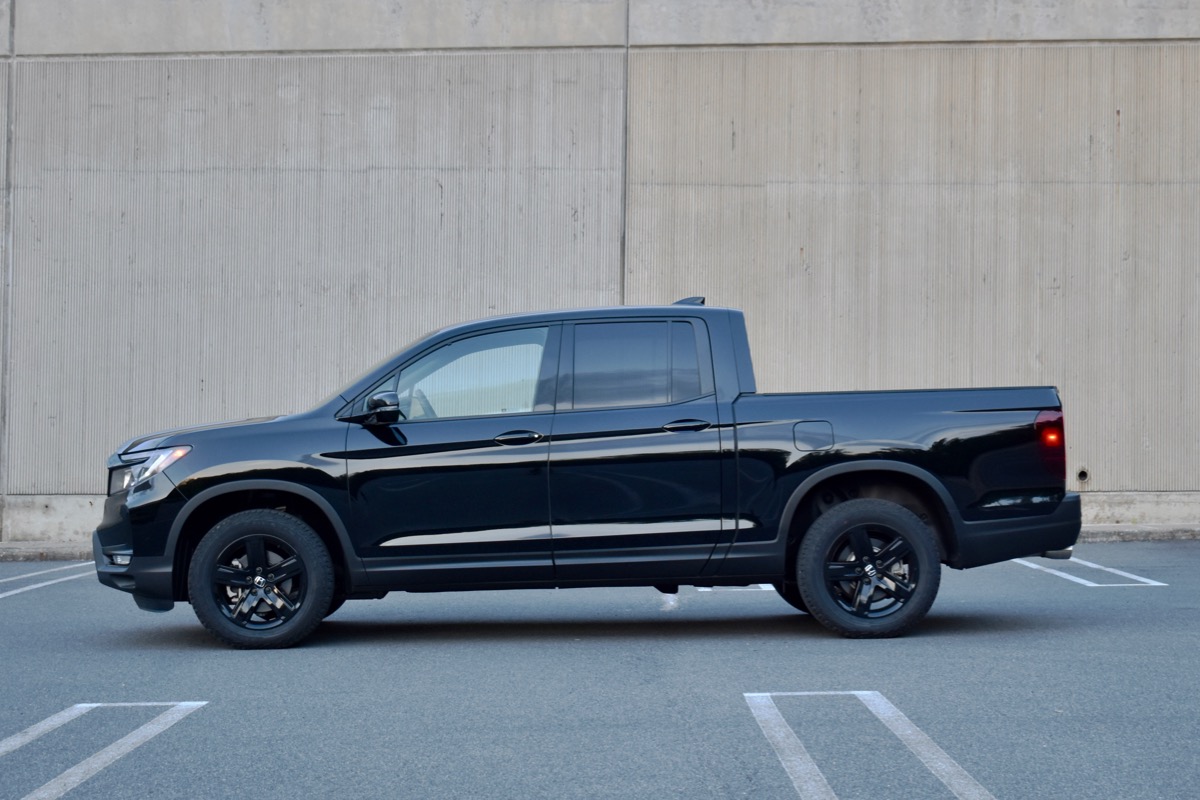
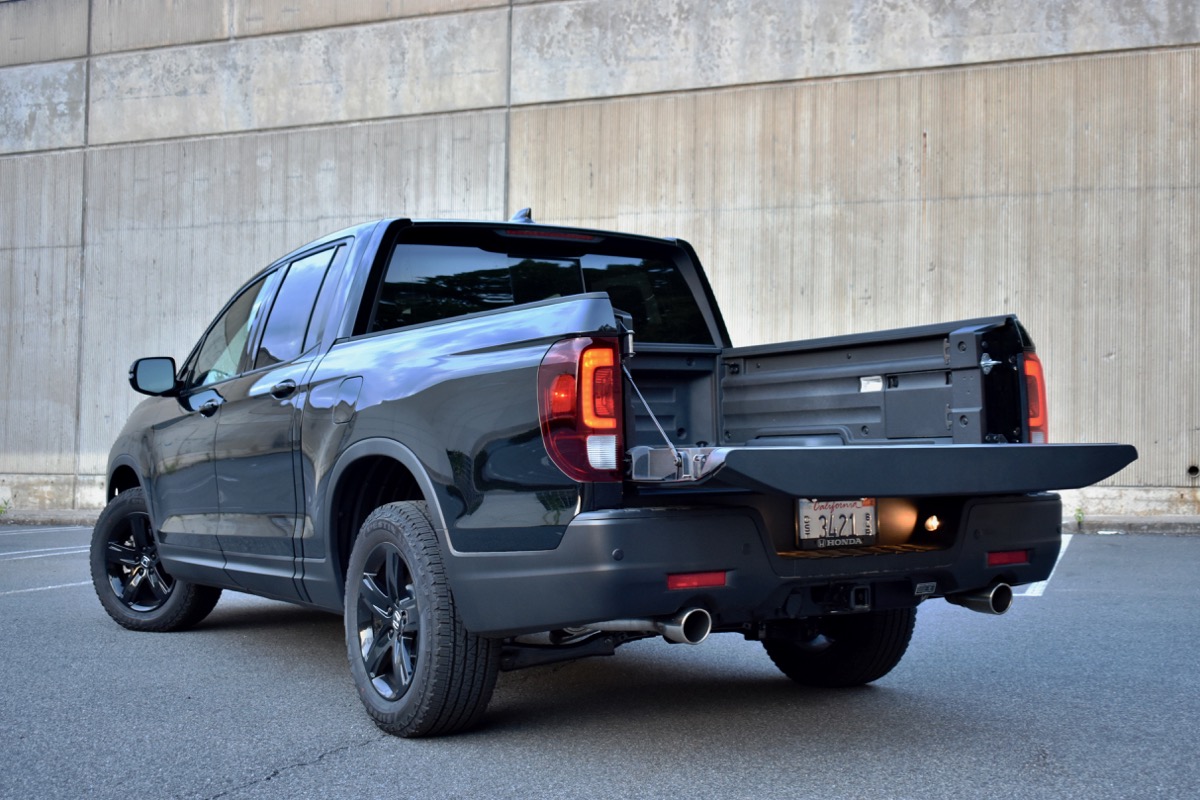
While the engineering is innovative, the styling is fairly conservative. The main giveaway that the Ridgeline is anything other than a normal truck is its snub nose, an artifact of a platform designed with front-wheel drive (FWD) vehicles in mind. The rear three quarter view is classic pickup, with vertical taillights, a big, centred badge, and dual exhaust peeking out from the rear bumper.
When the current-generation Ridgeline debuted for the 2017 model year, its front-end styling was more rounded and fairly close to its Honda Pilot cousin. For 2021, Honda reshaped the front end, making the grille blockier and more upright. It made the Ridgeline look even more like other trucks, which is not a bad thing.
Our Ridgeline Black Edition test vehicle was cloaked in darkness. The alloy wheels and nearly every piece of exterior trim matched its Berlina Black paint.
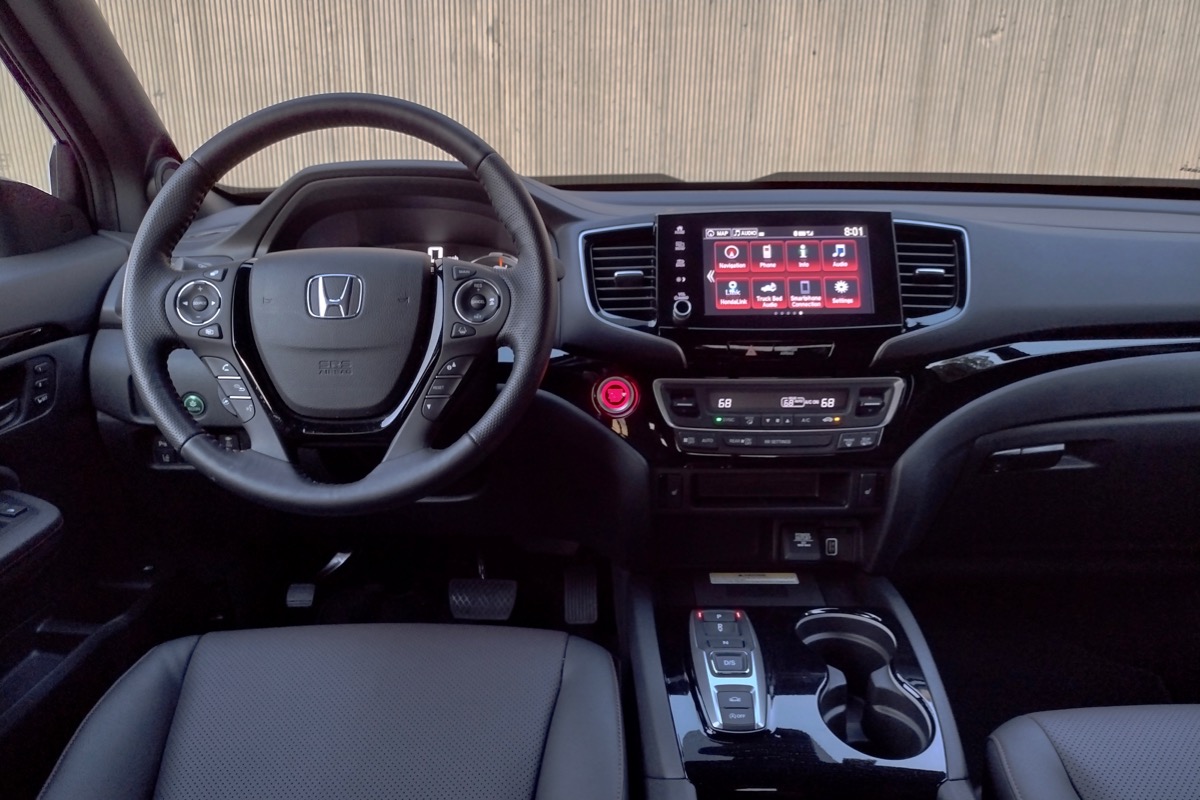
The interior’s basic, no-nonsense design felt appropriate for a truck. Fit and finish was up to the high standards we’ve come to expect from Honda, and our Black Line test vehicle was well equipped, with features like leather upholstery, heated front seats and heated rear outboard seats, a leather-wrapped heated steering wheel, tri-zone automatic climate control, power-sliding rear window, and a moonroof. However, we weren’t fans of the copious piano black trim, which is easily smudged or scratched, and didn’t really stand out from the rest of the mostly black interior.
Performance
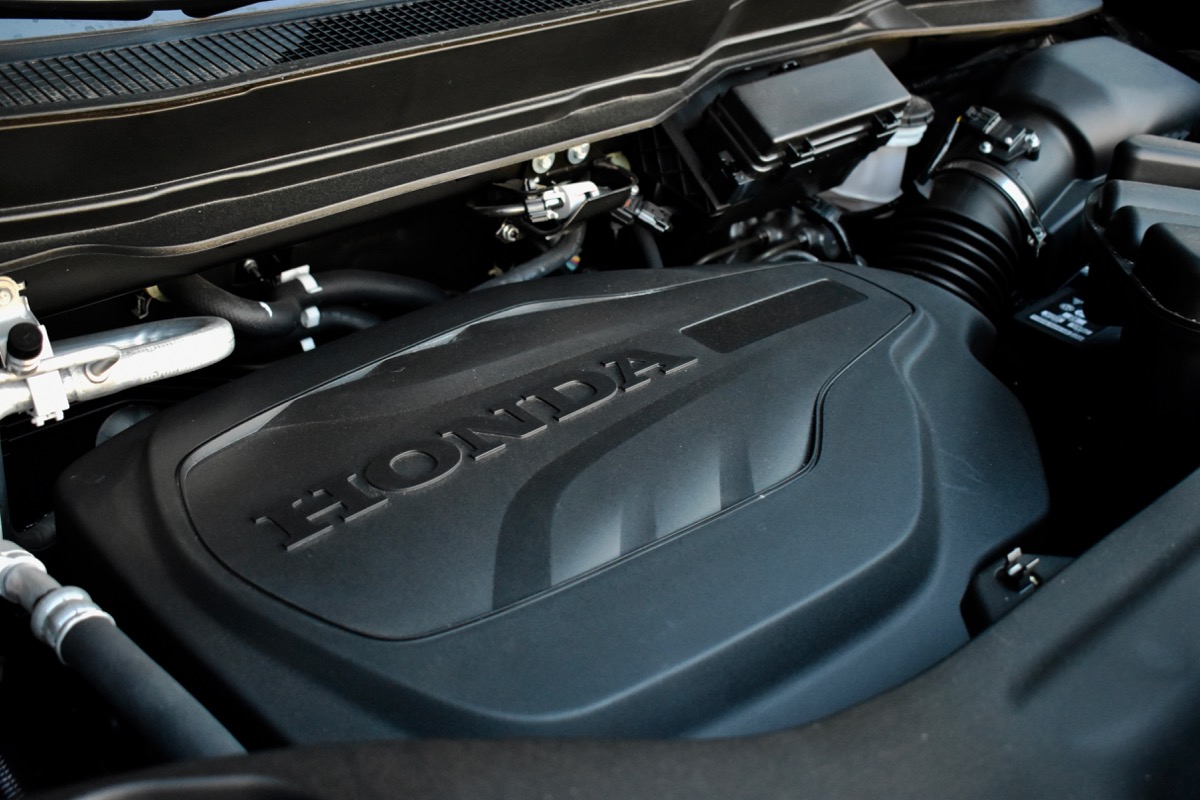
While some midsize pickups offer multiple powertrain options, the Ridgeline sticks with a 3.5-litre V6, nine-speed automatic transmission, and standard all-wheel drive (AWD). The V6 engine produces power specs of 280 horsepower and 262 pound-feet of torque.
Honda lists a maximum towing capacity of 2,267 kilograms (5,000 pounds) for all Ridgeline models. The Ridgeline Sport and EX-L have a maximum payload capacity of 690 kilograms (1,500 pounds), while the Ridgeline Touring and Black Edition are rated at 674 kilograms (1,485 pounds).
None of these figures will win any prizes. The Ridgeline’s towing capacity is about the same as many midsize crossovers, but behind other midsize pickups. The Ford Ranger, for example, has a 3,400-kilogram (7,500-pound) towing capacity and 769-kilogram (1,650-pound) payload rating, while diesel versions of the Chevy Colorado and GMC Canyon can tow up to 3,492 kilograms (7,700 pounds). But the Ridgeline should still be able to handle a small boat or a pair of jet skis.
Unladen, it was nice to have a naturally aspirated V6 under the hood in this age of turbocharged engines. The V6 had more than enough grunt to move the Ridgeline along. However, the nine-speed automatic transmission was slow to respond, detracting from the experience. A sluggish engine start-stop system added to the problem, making pulling away from stops an exercise in patience.
Once up to speed, we were impressed by the Ridgeline’s handling and ride quality. This is where the advantages of a unibody platform are apparent. Compared to traditional pickup trucks, the Ridgeline felt like a luxury car. Other trucks can’t hope to match its comfortable ride and quiet cabin. Fully independent suspension and torque vectoring AWD also give the Ridgeline a level of handling precision you won’t get in other trucks.
The Ridgeline’s design does limit off-road capability, however. The torque vectoring AWD system helps somewhat, but it doesn’t provide the same level of traction management as the old school four-wheel drive (4WD) systems in other pickups. The maximum 19.4 centimetres of ground clearance is less than you get in a Subaru Outback. You also won’t find a dedicated off-road version of the Ridgeline comparable to the Chevrolet Colorado ZR2, Toyota Tacoma TRD Pro, or Jeep Gladiator Rubicon. The Ridgeline can still go fairly far off the beaten path, but if you plan to do serious off-roading, look elsewhere.
Form & function
Other midsize pickup trucks offer multiple cab and bed configurations, but the Ridgeline is available only with a four-door crew cab and 162.5-centimetre (64-inch) bed. That’s a decent balance of passenger space and cargo space, as the Ridgeline bed is a bit longer than the beds you get with crew-cab versions of the Ford Ranger or Toyota Tacoma.
Honda’s truck bed is also more than just an open box. It includes a 207-litre lockable in-bed trunk underneath the floor for storing items that are too dirty to keep in the cab without having to leave them exposed in the bed. A drain plug allows this compartment to be washed out afterward.
Ahead of the trunk is a slot that houses the spare tire, so you won’t have to crawl underneath the truck to access it. Honda also included an in-bed audio system that uses four “exciters” to turn the bed itself into a speaker. A 115-volt in-bed AC outlet is also available. The Ridgeline also gets Honda’s exclusive Dual-Action Tailgate—which can open down or to the side—and the bed is wide enough to carry 4-foot-wide sheets of plywood between the wheel wells, Honda claims.
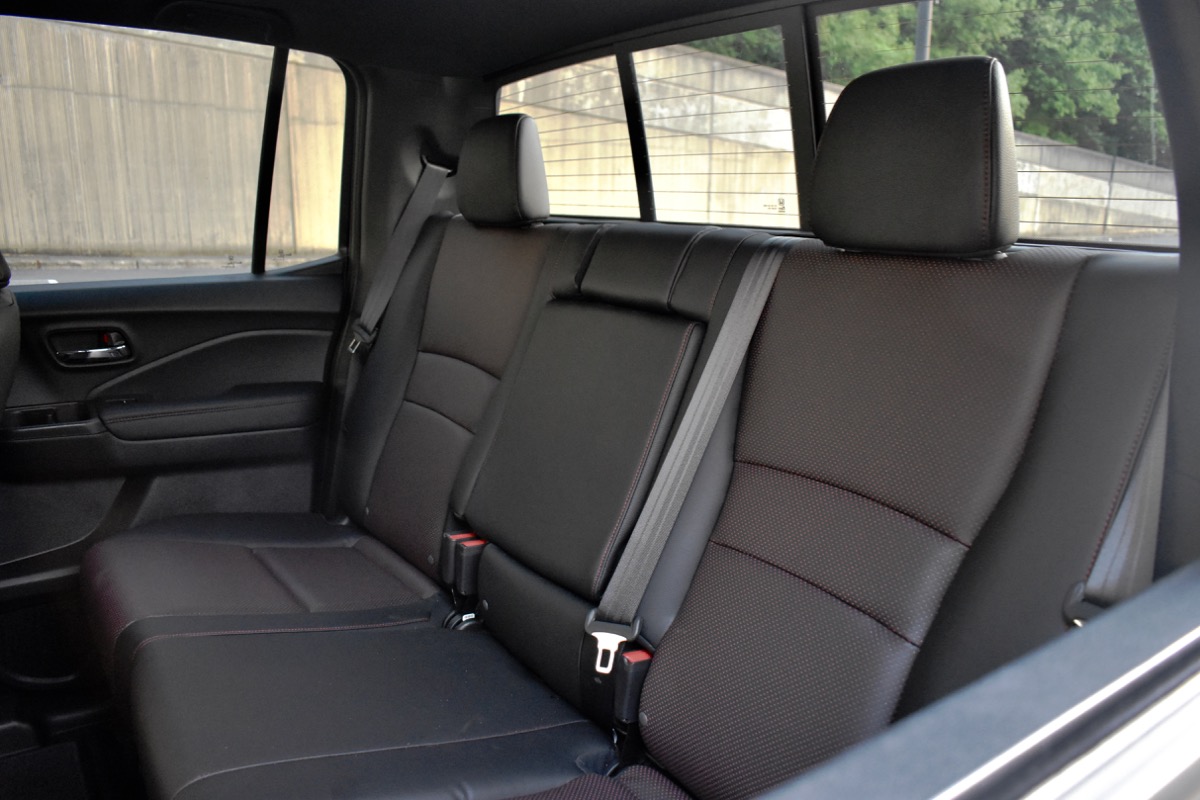
Inside, the Ridgeline offers additional storage space under the rear seats. Rear USB ports are available as well, but only on higher trim levels. Up front, a pushbutton shifter makes room for cupholders, a large centre console storage bin, and a large wireless phone charger. Controls are sensibly laid out and easy to use. We especially liked the toggle switches for cabin temperature.
On paper, the Ridgeline doesn’t have a clear advantage over other midsize pickups in headroom or legroom. Subjectively, though, it feels more roomy thanks to a wider stance that puts more space between occupants, and a lower cowl height that eliminates the pillbox-like feel you get from behind the wheel of a Toyota Tacoma.
Technology
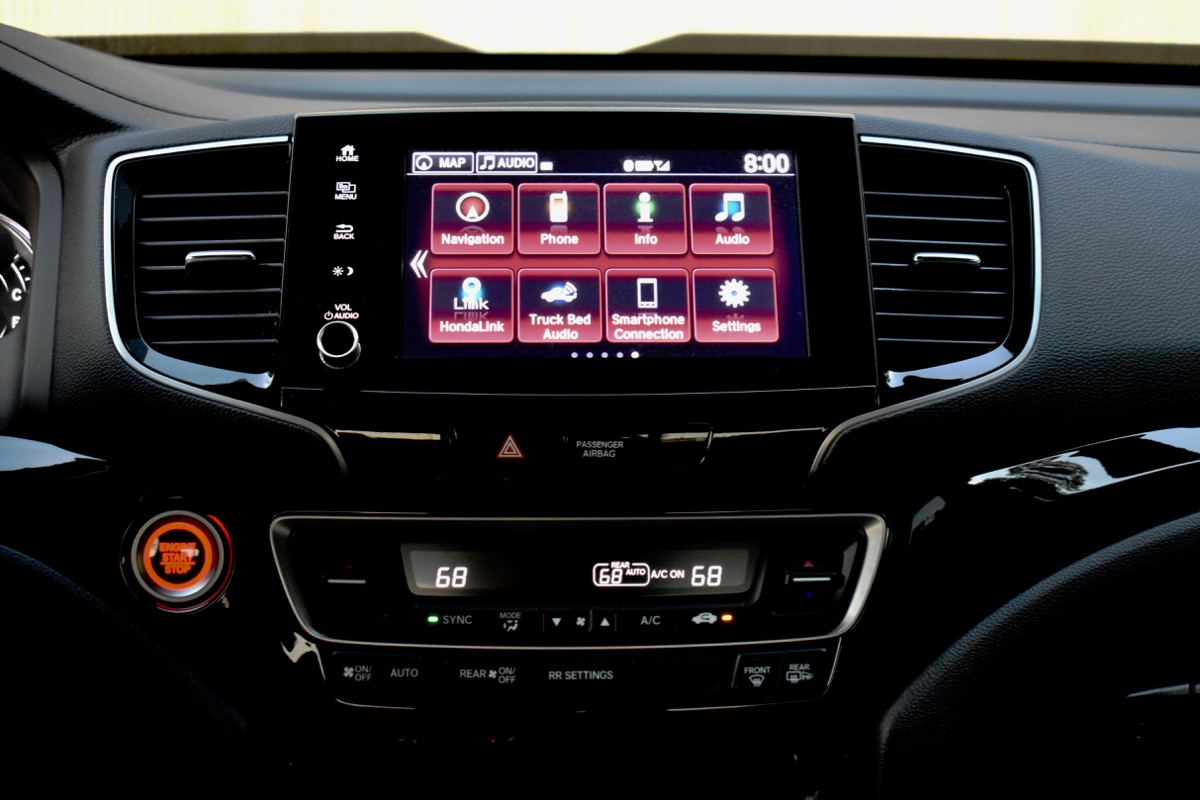
The Ridgeline comes standard with an 8-inch touchscreen infotainment system, including Apple CarPlay/Android Auto connectivity, and Bluetooth. SiriusXM satellite radio is available on all but the base Sport trim level, while navigation is available on the Touring and Black Edition models.
Nothing about the interface is cutting edge, but it works. The screen is small by current standards, the graphics are a throwback to the 1990s, and Honda can’t claim any unique infotainment features. However, the touchscreen is easy to navigate; we always found what we needed with little fuss. Analog controls (including a volume knob) on the dashboard and steering wheel also handle vital functions, so you won’t need to use the touchscreen much.
So, while the Ridgeline doesn’t offer much for tech-savvy new car buyers, its infotainment system isn’t impossible to live with, either. It’s also worth noting that most of the Ridgeline’s rivals only offer fairly basic tech as well.
Safety
The Ridgeline received top “Good” scores in most Insurance Institute for Highway Safety (IIHS) crash tests, but received a lower “Average” score in the passenger-side small overlap frontal test. The IIHS gave the Ridgeline a top “Superior” rating for front-crash prevention tech, but a “Marginal” headlight rating and an “Average” rating for LATCH child seat anchor ease of use.
The National Highway Traffic Safety Administration (NHTSA) gave Honda’s truck a five-star overall safety rating, with five stars in frontal and side crash tests, and four stars in rollover crash testing.
Like other Honda models, the Ridgeline gets the Honda Sensing array of driver aids as standard equipment. That includes automatic emergency braking, Road Departure Mitigation, forward collision warning, lane departure warning, lane keep assist and adaptive cruise control.
Additionally, automatic high beams and blind spot monitoring with rear cross-traffic alert are standard in Canada. We liked the placement of the warning light for the blind spot monitoring system. It’s inside the cabin at the base of the forward pillar, making it easier to see. One thing that’s missing from the safety-feature list, however, is a 360-degree camera system. That would be useful in a vehicle of this size.
Cost-effectiveness
Despite its nine-speed automatic and engine start-stop system, the Ridgeline isn’t especially efficient. All models get Natural Resources Canada rated fuel consumption of 11.5 litres per 100 kilometres combined (12.8 city, 9.9 highway). We averaged 11.9 L/100 km over a week of driving, according to the truck’s trip computer.
The Ridgeline at least gets slightly better combined fuel economy than V6 4WD versions of the Chevy Colorado/GMC Canyon, Nissan Frontier, and Toyota Tacoma. The Ford Ranger achieves 10.9 L/100 km combined thanks to a smaller 2.3-litre turbocharged four-cylinder engine. Diesel 4WD versions of the Colorado/Canyon and Jeep Gladiator get 10.5 L/100 km combined and 9.8 L/100 km combined, respectively.
Honda offers a three-year, 60,000-kilometre, limited warranty and five-year, 100,000-kilometre, powertrain warranty. Those are pretty standard warranty terms for a mainstream automaker.
Pricing starts at $46,440 for the base Honda Ridgeline Sport trim level (all prices do not include a mandatory $1,950 destination charge). The Ridgeline EX-L starts at $49,440 and the Touring at $53,640, while the range-topping Honda Ridgeline Black Edition has a $55,440 base MSRP. That positions the Ridgeline on the high end of midsize-truck pricing, but mainly because Honda skips the fleet-oriented base models other manufacturers offer. And high-end versions of the Jeep Gladiator or Toyota Tacoma can easily crest $60,000 with options.
The Honda Ridgeline is a unique proposition among midsize pickup trucks. It trades ultimate towing and off-road capability for on-road refinement and greater overall utility. Its interior will be familiar to anyone who has driven a Honda crossover, and it offers many of the same safety features as those vehicles. So while Honda does things differently than other truck makers, the Ridgeline is still a compelling option.
Note: Images show a US model.

What owners say
"Overall, owners of the 2022 Honda Ridgeline appreciate its comfort, spacious interior, and solid value compared to other midsized trucks. Many drivers love the smooth ride and useful features like the in-bed trunk and dual-function tailgate. However, some reviewers mentioned drawbacks such as a steep price, lower ground clearance for off-road use, and issues with the touch screen responsiveness."
This was a great buy. I had a pre-purchase inspection done by my mechanic and he said, "I don't often say this, but I could not find one thing wrong with this vehicle. it's a great truck!" It has all the features I was looking for and at the right price.
November 2, 2025Very good value, and as an owner of the older 2013 version of the RTL , this included very nice additions including warnings and dashboard abilities to select personal choices.
February 21, 2024This is my third Ridgeline. 2018, 2019 and now a 2023. Best mix of truck and suv. Great ride, solid fuel economy. Enough truck for me. I don’t think I will ever own anything else.
August 19, 2023What owners say
This was a great buy. I had a pre-purchase inspection done by my mechanic and he said, "I don't often say this, but I could not find one thing wrong with this vehicle. it's a great truck!" It has all the features I was looking for and at the right price.
November 2, 2025Very good value, and as an owner of the older 2013 version of the RTL , this included very nice additions including warnings and dashboard abilities to select personal choices.
February 21, 2024This is my third Ridgeline. 2018, 2019 and now a 2023. Best mix of truck and suv. Great ride, solid fuel economy. Enough truck for me. I don’t think I will ever own anything else.
August 19, 2023We have had “real trucks” the past decade (2 raptors and a tundra Trd pro)… we actually traded in a 2018 raptor on the ridgeline black edition. So far it’s been great. The trunk inside the bed is genius. It’s obviously not a raptor and it’s not trying to be but for the average customer it’s more than enough truck. It drives comfortable and gas mileage has been awesome compared to what we were used to. On the highway we had to drive super conservative to get 18 mpg. Around town I’m getting 22 and on the highway 25.
March 14, 2023This car has great features compared to other small trucks. The trunk bed speakers alone are amazing. It’s compared to other small trucks like a Tacoma or canyon but this car can’t be compared. It’s so comfortable, it doesn’t even feel like a truck. When I describe this truck to other people, I say it’s like an SUV with a bed. Love it!
March 5, 2023The Honda Ridgeline is a technological marvel. It has all the bells and whistles and it drives like a dream.
January 2, 2024The Ridgeline 2022 RTL-E is very well equipped. The value gets better as used care prices come down. The dealer reduced the price by $4000 before we arrived. It is roomier and a bit more refined than the Tacoma, Frontier, Ranger and the Colorado.
November 24, 2022Very roomy interior compared to other midsized trucks. I have owned a 2005 Toyota Tacoma and a 2017 Nissan Frontier previously, and liked both of those trucks, although the sketchy seating position of the Tacoma kept me from buying another one. I wanted primarily a road truck for light towing that was quick and got decent gas mileage and the Ridgeline checked those boxes the best.
August 10, 2022The Ridgeline is often looked over as not being rugged enough. Well, not only is it rigged enough, it has one of the best AWD systems on the market. Also, because it isnt a separated bed and cab, its unibody gives you one of the smoothest and most comfortable ride youll ever have in a truck. Pulls my camper, sits everyone comfortably for hours, car seats are an easy fit, the technology and infotainment is top notch, the eco boost, its just a wonderful ride.
July 24, 2022Truck is a good value and stands on its own as the only true mid-sized truck. Trunk is very useful as is the duel function tailgate. Ability to load 4x8 boards flat is handy, Gas mileage is good at about 22mpg overall and Ive hit 30 on the highway.
April 15, 2022Trims & specs
Base MSRP N/A | Seating N/A |
Engine N/A | Cargo Capacity N/A |
Combined MPG N/A | Drivetrain N/A |
Base MSRP $45,570 | Seating 5 |
Engine 3.5L 280 hp V6 | Cargo Capacity 7.3 cu ft |
Combined MPG 21 | Drivetrain AWD |
Base MSRP $44,070 | Seating 5 |
Engine 3.5L 280 hp V6 | Cargo Capacity 7.3 cu ft |
Combined MPG 21 | Drivetrain AWD |
Base MSRP $38,140 | Seating 5 |
Engine 3.5L 280 hp V6 | Cargo Capacity 7.3 cu ft |
Combined MPG 21 | Drivetrain AWD |
Base MSRP $41,120 | Seating 5 |
Engine 3.5L 280 hp V6 | Cargo Capacity 7.3 cu ft |
Combined MPG 21 | Drivetrain AWD |
Base MSRP N/A | Seating N/A |
Engine N/A | Cargo Capacity N/A |
Combined MPG N/A | Drivetrain N/A |


Pricing trends
MSRP range
$38,140 - $45,570
Current avg. market price
$39,768
Trending down by 1.7% this month
May 2026 - October 2026

