2021 Chevrolet Camaro Reviews, Pricing & Specs




The CarGurus verdict
It might not be perfect, but if you want the full muscle car experience the 2021 Chevrolet Camaro is impossible to ignore.
The 2021 Chevrolet Camaro is over 3,000 pounds of pure American muscle. It’s an iconic nameplate that hasn’t received many updates for the 2021 model year, continuing to deliver the power, handling, and style buyers expect. But, that doesn’t mean it’s perfect.
out of 10 expert review
Look & feel
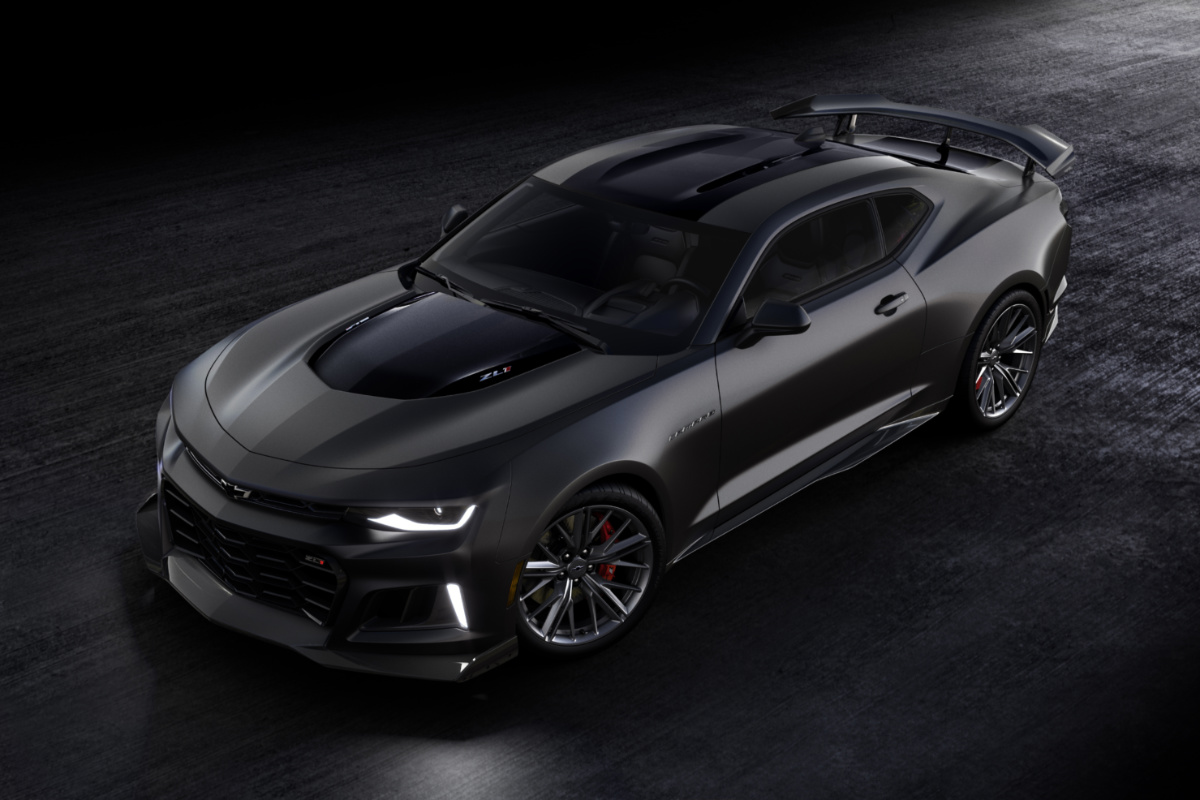
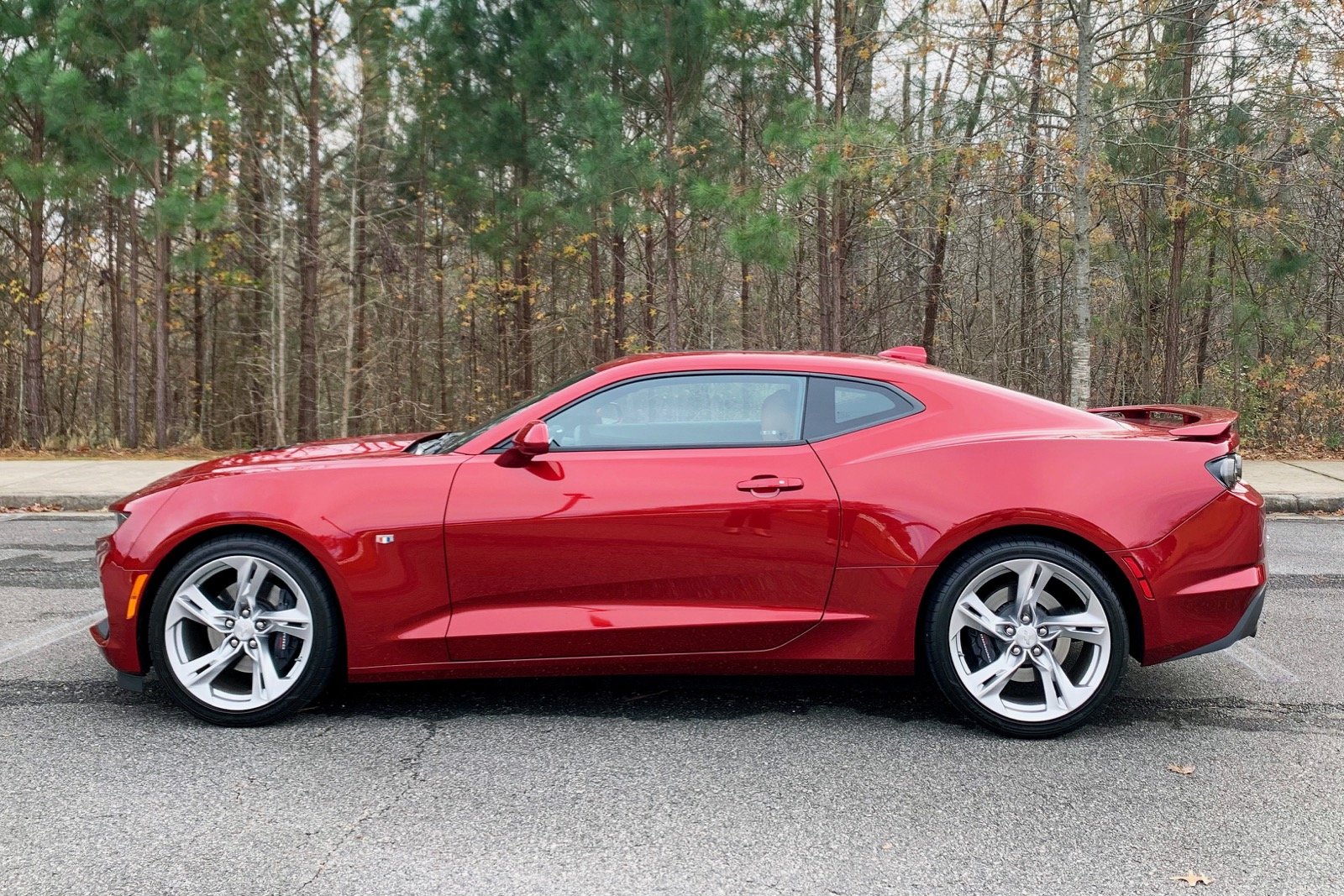
Buyers configuring their perfect Chevrolet Camaro have coupe or convertible body styles to choose from right off the bat. The look of both is remarkably similar with the soft roof of the convertible simply taking the place of the traditional fixed roof of the coupe. With the top down, the car looks ready to tour classic coastal landscapes at low speed. As a coupe, its looks are fierce.
Buyers can get the Camaro coupe in their choice of eight trim levels: 1LS, 1LT, 2LT, 3LT, LT1, 1SS, 2SS, and ZL1 models. The convertible has seven trim levels, dropping the entry-level 1LS. The Chevrolet Camaro ZL1 is the car's most performance-focused variant, while the Camaro SS provides the best blend of daily-driver performance. The tester for this review was a 2021 Chevrolet Camaro 2SS Coupe.
The car rides on standard 18-inch silver-painted aluminum wheels wrapped in 245/50R18 all-season, blackwall tires. Up to 20-inch wheels are available and the Camaro can be had with summer tires. Wheel design is undoubtedly as subjective as it is functional, but even in the sporty 2SS variant, the polished silver design worked to age the car rather than make it look flashy or modern.
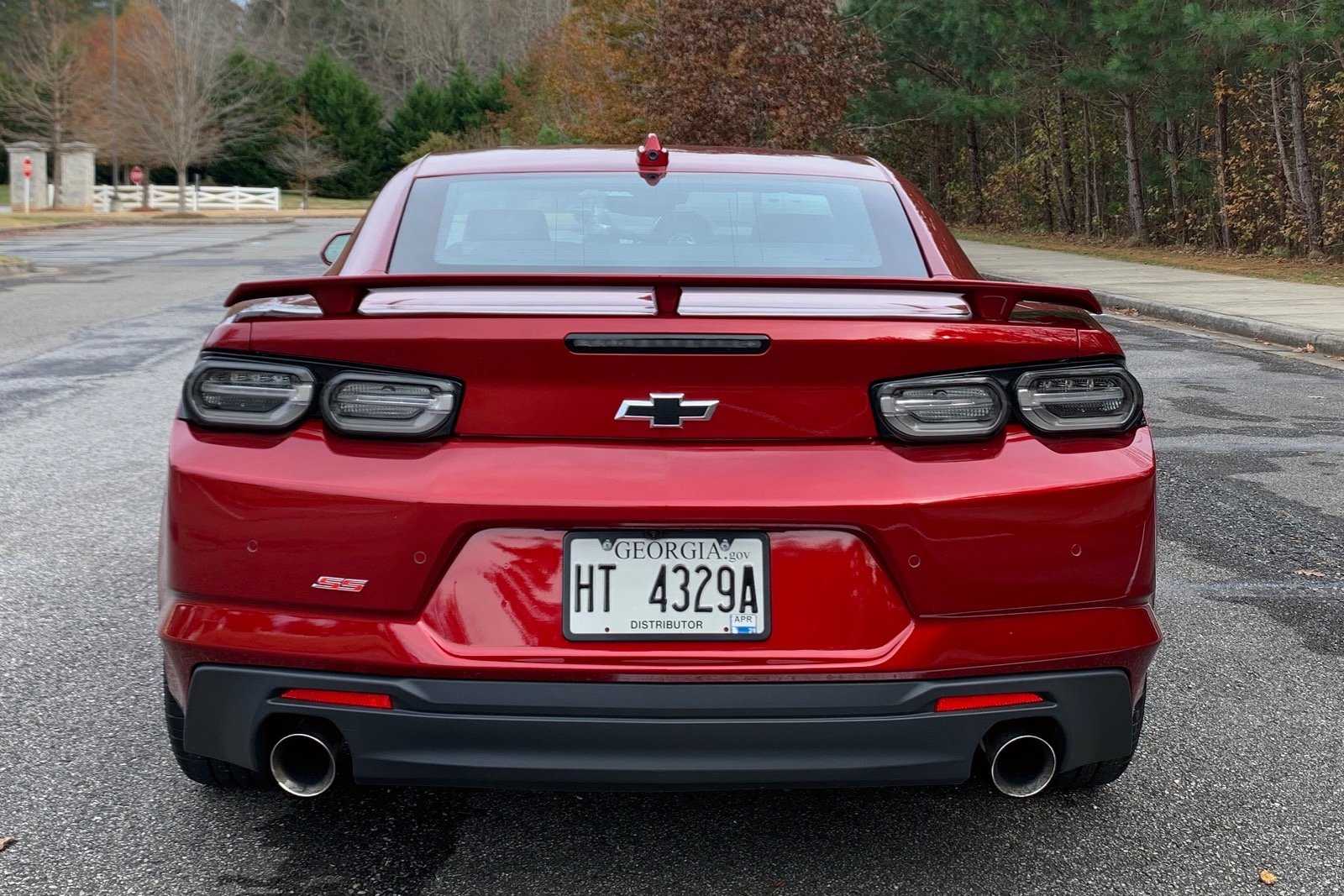
A limited-slip differential, dual-outlet stainless steel exhaust with bright tips, and LED daytime running lights are also standard. LED headlights, a sunroof (coupe only), and power outside heated mirrors are available.
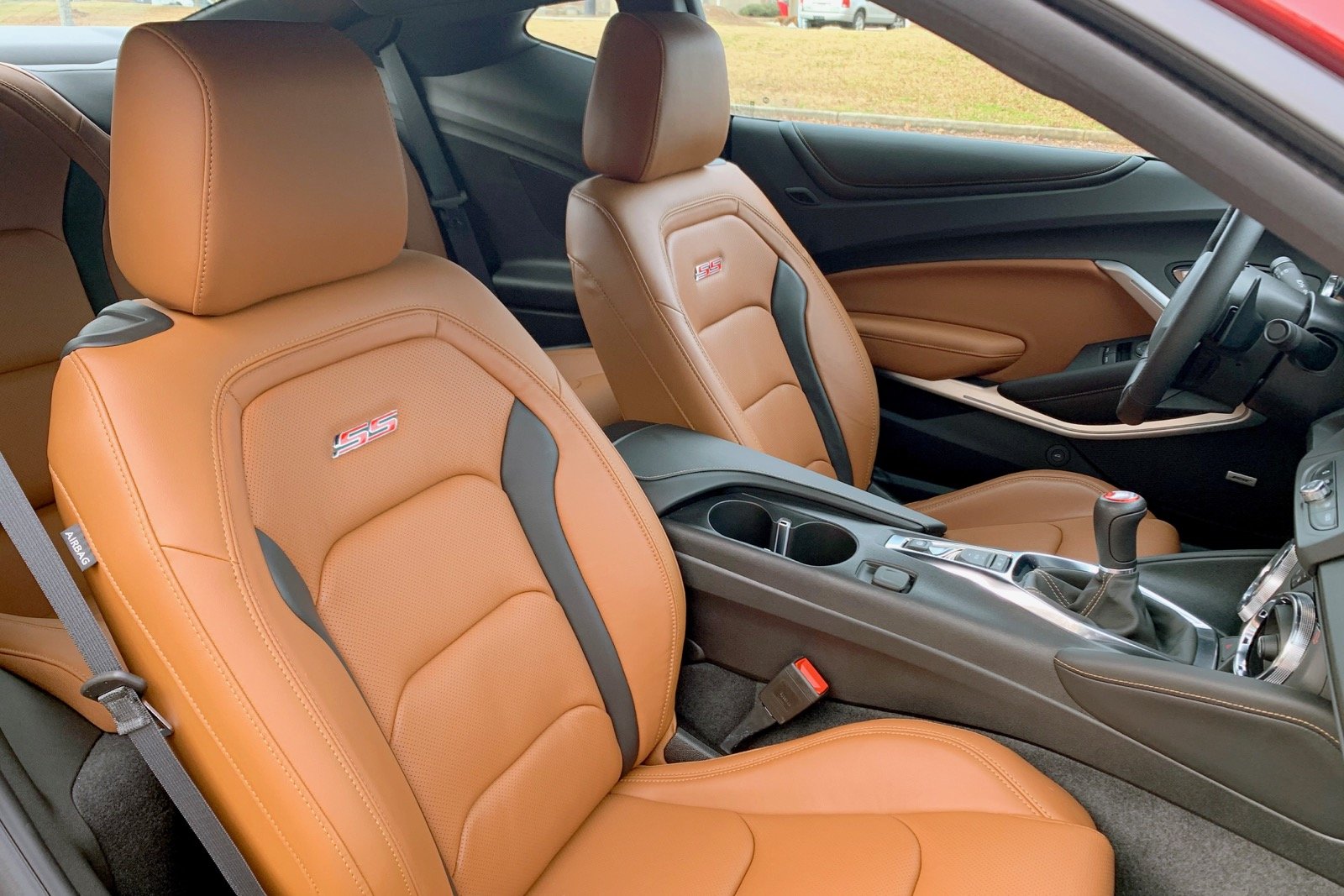
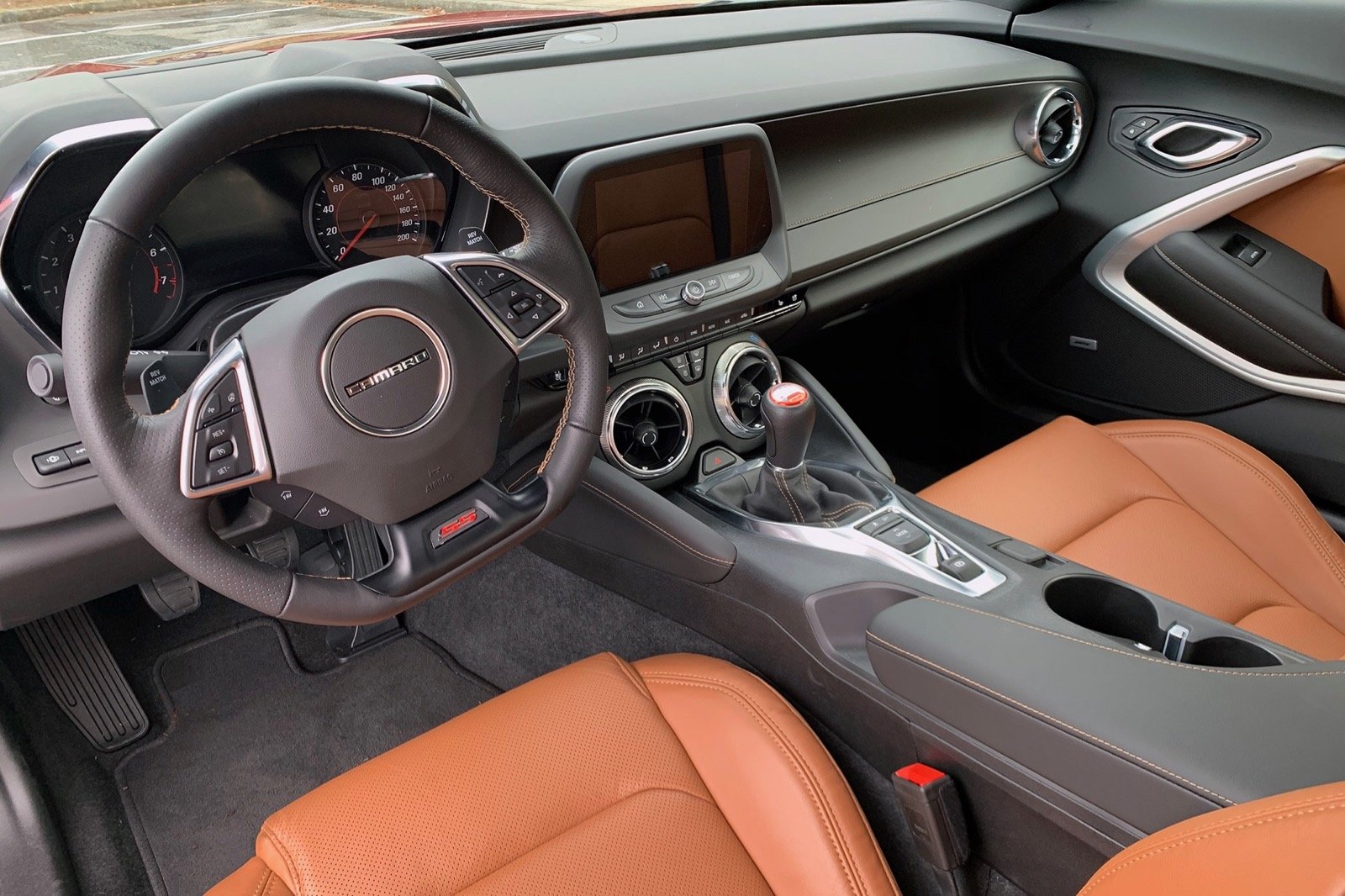
The interior of the Camaro is less appealing. The car’s 2019-model-year cabin refresh is holding up as stylish, but its design leads to some major functionality questions (more on that later). The screens, controls, and appointments all appear to be parts-bin specials, which is, for better or worse, a General Motors hallmark trait. The Camaro gets the easy-to-use vent design of the Chevy Blazer while other elements like silver finishers are more generic.
Chevy offers the Camaro with a variety of Wild Cherry design packs, the availability of which varies by trim level. The packs offer a variety of content including unique wheel and graphics designs, as well as ground effects, carbon fibre accents, and suede knee pads.
Performance
A turbocharged 2.0-litre four-cylinder engine is standard on the Chevy Camaro. It makes 275 horsepower and 295 pound-feet for torque and is paired with a six-speed manual transmission as standard.
Buyers can upgrade to the 3.6-litre V6 engine, which makes 335 hp and 284 lb-ft of torque. Two more powerful V8 engines are also available. A 6.2-litre V8 churns out 455 hp and 455 lb-ft of torque, while a supercharged version of that engine goes even further delivering 650 hp and 650 lb-ft of torque.
Like most manual-transmission vehicles with an automatic transmission option, the Camaro’s six-speed is not as fuel-efficient as its automatic-transmission options (in this case eight-speed and 10-speed gearboxes).
The turbo-four paired with the manual gearbox gets a Natural Resources Canada estimated 12.6 litres per 100 kilometres in the city, 8.0 on the highway, and 10.5 combined. Its eight-speed automatic counterpart gets 10.9 in the city, 7.8 on the highway, and 9.5 combined. The same pattern holds true for the V6, which has its manual achieve 14.4/9.0/12.0 L/100 km city/highway/combined fuel consumption with the 10-speed automatic getting 12.8/8.1/10.7 city/highway/combined.
The more powerful V8 engines are nearly equally as fuel-efficient with either transmission. The 6.2-litre V8 with the 6-speed manual transmission sees 14.9/9.9/12.6 L/100 km city/highway/combined while the automatic gets 14.6/8.9/12.0 L/100 km city/highway/combined. The supercharged V8 version of the Camaro 17.2/12.0/14.8 L/100 km with the manual and 18.3/11.2/15.1 L/100 km with the automatic.
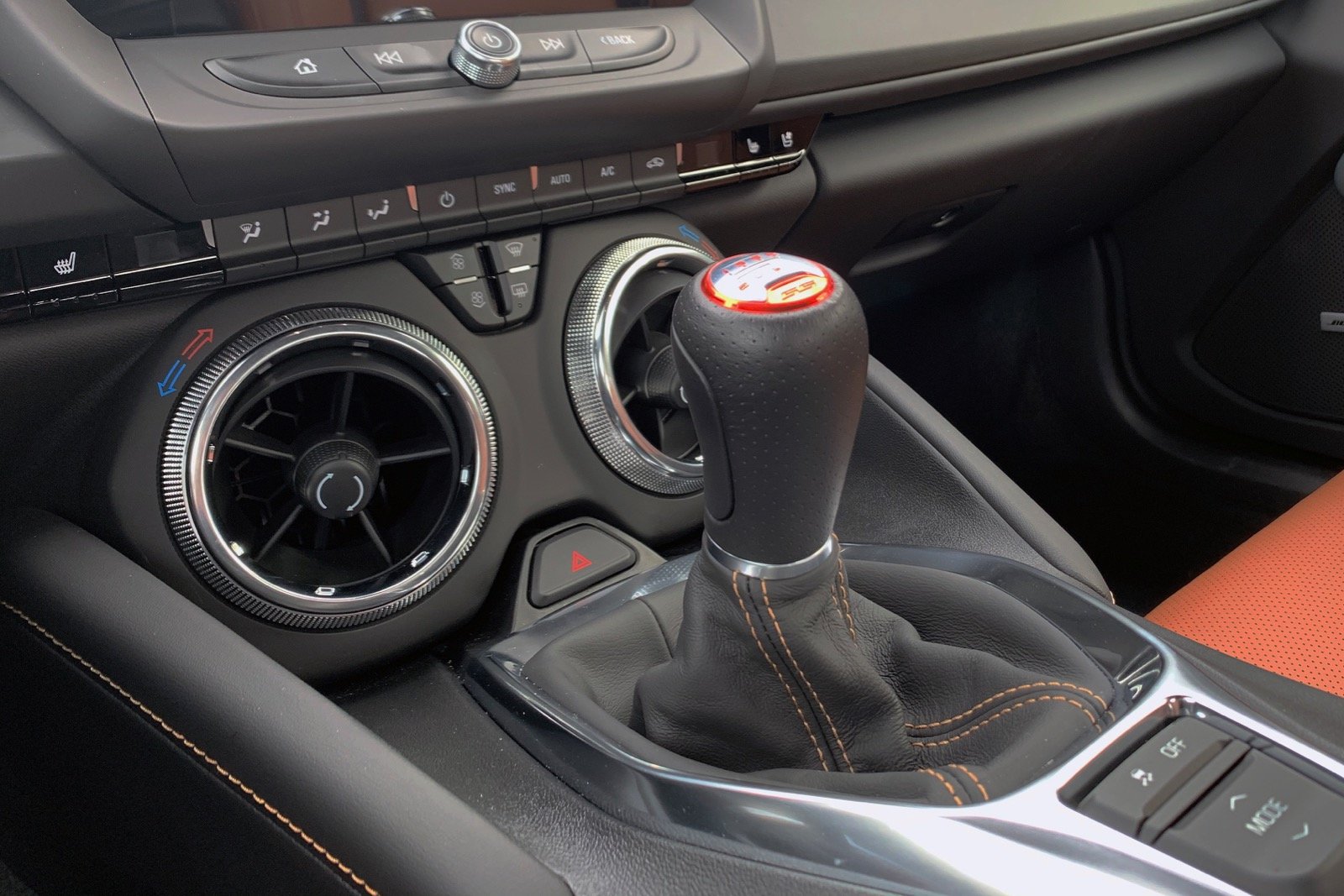
As tested in the Camaro 2SS, the direct-injection, non-supercharged, V8 was plenty powerful and Brembo brakes provided adequate stopping power. It came equipped with the standard six-speed manual transmission that sucked every ounce of joy one can get from rowing through the gears out of the car. With long, narrow channels and an even longer stick, simply operating the car was a chore. Add to that the numb clutch and gas pedal and GM’s skip-shift technology, which requires the driver to skip gears to save on fuel, and the entire experience is enough to make you want to stop driving the car.
Buyers who opt for the six-speed in their Camaro 1LT, SS, and ZL1 get active rev-matching technology included. This tech stabilizes gear selections on the way back down. It is especially helpful in driving situations where you have to slow but not stop, such as where the person in front of you is moving into a turn lane, or when you’re traversing a rotary.
However, in this particular GM product, it takes away a big part of the reason why you opt for the manual to begin with. You simply shouldn’t be able to stay in sixth through a roundabout or drop below 1,000 rpm in a gear without serious feedback from the powertrain. Downshifting to gain more torque is a thrill and an exercise in the type of control buyers of this type of transmission crave so to have it mellowed by technology for perceived convenience and fuel efficiency is maddening.
The Camaro comes standard with rear-wheel drive; all-wheel drive is not available. With the manual transmission such high rpm is required to get the car moving that the inevitable rearward sway of the car off the line is more than the usual in a six-speed.
The manual transmission simply isn’t the way to go when Chevy’s impressive and smooth-shifting eight-speed and 10-speed automatics are available. If you want a car with the increasingly rare manual gearbox, you’ll want to seek out other, non-General Motors, purchasing opportunities.
Buyers are able to tailor their drive using the drive mode selector, which offers eight customizable attributes and up to four selectable drive modes: Tour, Sport, Snow/Ice, and Track. Track mode is exclusive to Chevrolet Camaro SS, ZL1, and models with the available 1LE Track Performance Package.
Form & function
Cloth upholstery and front bucket seats are standard in the Camaro. Buyers get an eight-way power-adjustable driver’s seat, four-way manual front passenger seat with power recline, and a rear folding bench seat (on the coupe) also as standard. The seats up front are relatively comfortable and not particularly sporty. Recaro sport seats are available. Leather upholstery, a heated steering wheel, a six-way power-adjustable passenger seat, and heated and ventilated front seats are available. (Note that even in Canada, heated seats and steering wheel are not standard equipment.) The heated seat works particularly well with more than the usual amount of seatback coverage.
The position of the front seats would be conducive to good visibility—if the windscreen allowed it. It does not. While the narrow glass limits outward visibility, the issue is made worse by the oversized hood over the instrument cluster that takes away much of the driver's forward view.
There’s no point in pretending that the rear seats are for adults to sit in. Perhaps a child in a car seat could be comfortable but that’s with the caveat that the driver needs to be on the short side so that they don’t end up with feet kicking the back of their seat at all times.
The car’s leather-wrapped, flat-bottom steering wheel feels good in the hands and isn’t as bulky as Dodge’s SRT wheel. The steering column’s manual tilting and telescoping capability add to its appeal.
Single-zone climate control is standard and dual-zone is available in higher trim levels. The Camaro’s in-cabin real estate and seating positions are not conducive to a pleasing climate control system experience. Even with the optional dual-zone controls, there’s a ton of bleed-over and the design of the vents makes closing them and aiming them away from the body a challenge.
The position of the two front cupholders in the centre console is good for Camaros with an automatic transmission. Those driving the six-speed version will find that having drinks in the cupholders makes it nearly impossible to shift with any sort of ease, rendering the forward-most holder completely unusable and the rear one mildly in the way.
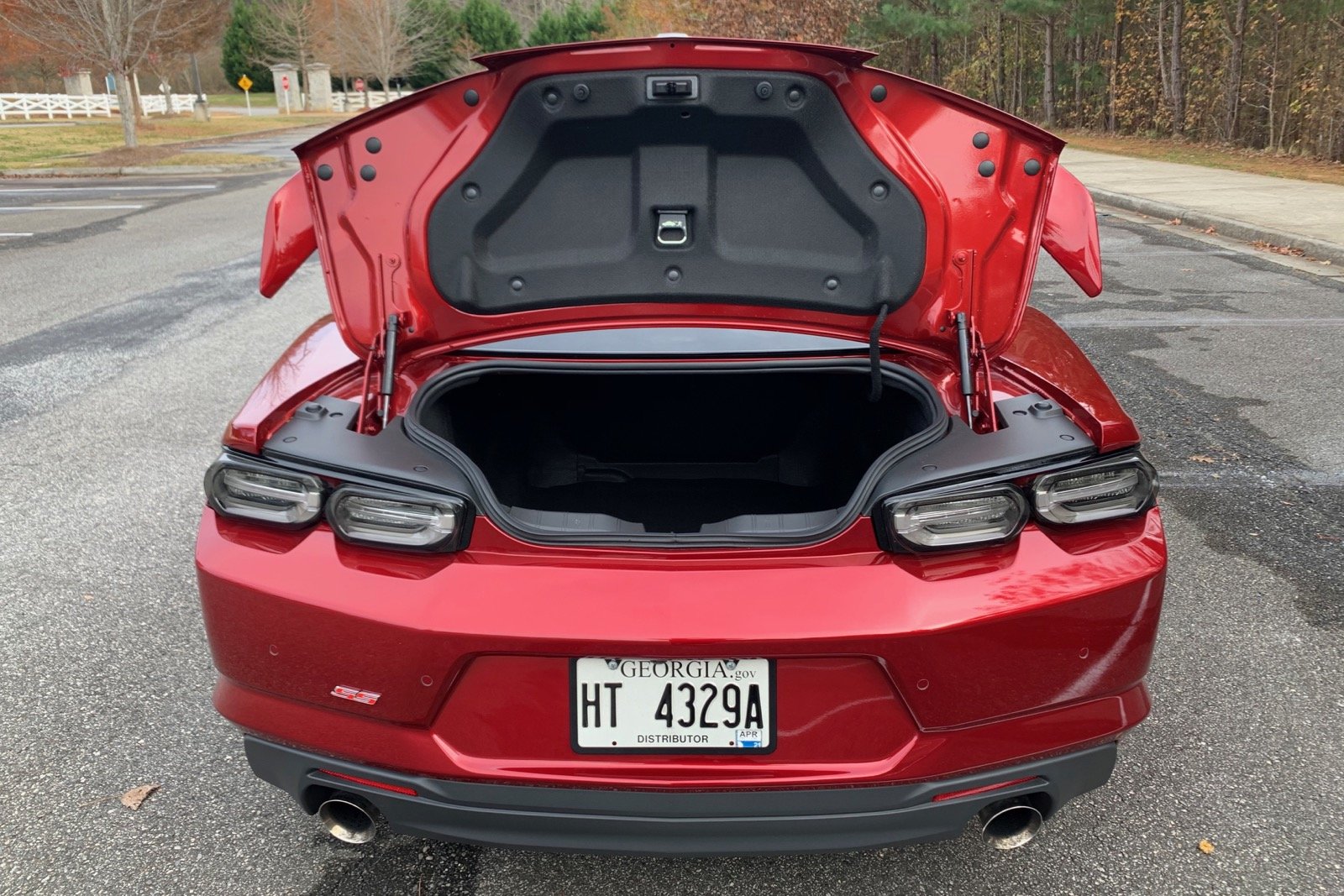
Though the car has a good amount of trunk space compared to other muscle cars, its high load height and narrow opening severely limit usability. Above the trunk, the car’s tiny back window requires a driver to rely solely on a rearview camera when backing up. Opting for the Camaro convertible gives owners about 20% less cargo space than the coupe model.
Technology
Chevy equips the Camaro with a good roster of standard technology including a 7-inch infotainment system touchscreen, Bluetooth, voice command, wireless Apple CarPlay, wireless Android Auto, a six-speaker audio system, 4G LTE WiFi hot spot, and keyless entry and start. A head-up display, navigation, Bose premium audio system, satellite radio, 8-inch infotainment touchscreen with cloud-based personalization options, wireless charging, and a rear-camera mirror are available.
The sports car’s driver-information centre displays all the requisite information in typical GM fashion. It’s functional and relatively straightforward in its operation proving that at least here, and with the infotainment touchscreen, once you’ve used them in one GM product, you know how to use them in all GM products.
Both the driver information screen and infotainment touchscreen suffer from a forward lean that is puzzling, to say the least. Whether GM’s design team was unable or unwilling to prevent glare in any other way should be seen as a major misstep. The overall aesthetic of the styling is incredibly awkward. However, both screens are perfectly functional.
Also functional are the USB ports, which are hidden in the centre console, and the wireless charging pad, which protrudes into the rear seat space solidly and awkwardly just beyond the reach of the driver behind the centre console.
Safety
The safety ratings for the Chevrolet Camaro are a bit disappointing for a newer car (it was last redesigned for the 2016 model year). The Insurance Institute for Highway Safety (IIHS) gave the Chevy a mix of "Good," "Acceptable," and "Basic" ratings while the U.S. National Highway Traffic Safety Administration (NHTSA) scores the car with five-star and four-star ratings in crash tests (out of a possible five stars). These ratings are similar to the Dodge Challenger, which is much older than the Camaro.
A good list of safety technology is available including rear cross-traffic alert, blind-spot monitoring, forward-collision warning, lane-change alert, and rear parking sensors. Some technology is not available on Camaro convertible models.
Cost-effectiveness
The 2021 Chevrolet Camaro coupe starts at an MSRP of $29,598 Canadian. The Camaro convertible has a starting MSRP that is significantly higher—$37,298. This isn’t unusual. Convertibles require additional structural elements hidden from the untrained eye that work to keep the car safe despite its rooflessness—helping to drive up the cost.
Pricing for the Camaro feels right and there are certainly plenty of options to choose from. Each of the car’s trim levels is available with multiple powertrain options which gradually step the price of the car up. With a price range topping out around $84,000 with all the options boxes checked, there is plenty to choose from.
The Camaro naturally competes against the Ford Mustang and Dodge Challenger. The Mustang has a better manual transmission option and more powerful engines (though more limited in choices) while the Challenger has gobs of cabin space—including a spacious back seat, a giant trunk—and Hellcat high-performance variants with up to 797 hp. Performance enthusiasts will want to go with the Ford over the Chevrolet while buyers that need more sensible cabin and cargo space will want to choose the Dodge.
Note: Images show a US model.
What owners say
"Overall, owners of the 2021 Chevrolet Camaro are very pleased with their vehicles, praising the impressive performance and great value for the price. Many drivers love the power and handling, especially with the performance packages, which enhance their driving experience. On the downside, some have mentioned that the Camaro can be a bit challenging to get in and out of, and while it offers sporty looks, it may not be the most practical choice for everyone."
It’s a good fast car for a cheap price and reliable
January 24, 2025The 2021 Camaro SS1LE is more than just a great value. It is a performance beast and looks great as well
February 21, 2021This 2021 zl1 camaro is way beyond what I thought it would be
May 8, 2022What owners say
It’s a good fast car for a cheap price and reliable
January 24, 2025The 2021 Camaro SS1LE is more than just a great value. It is a performance beast and looks great as well
February 21, 2021This 2021 zl1 camaro is way beyond what I thought it would be
May 8, 2022As long as you get at least a v6 engine this can be a very fun and comfortable car to drive
December 3, 2021The car is amazing . I love the technology package, interior, and the fact that the vehicle conserves energy/gas. I thought it was a great value. Before buying the Camaro,, I had a 2019 Dodge Charger GT. With that being said, I definitely think Chevy is giving Dodge a run for their money in regard to muscle cars/ sports cars.
October 25, 2020Camaro is a great choice. The total performance that you get in this car is exceptional. It does the straights and twisty the best. Not just one dimensional. Best bang for the buck for sure.
March 15, 2021This cars features are just amazing, no other muscle car has what it takes to beat this beast of a car!
June 24, 2022If you’re looking for a good sports car the Camaro is the car for at an affordable cost.
June 23, 2023I bleed Camaros since 86 Great car period . Handles.corners. like a.charm
June 3, 2021So far I like everything I have seen. I really like the 1LE performance package.
October 14, 2020Trims & specs
Base MSRP $37,500 | Seating 4 |
Engine 6.2L 455 hp V8 | Cargo Capacity 9.1 cu ft |
Combined MPG 20 | Drivetrain RWD |
Base MSRP $27,500 | Seating 4 |
Engine 2.0L 275 hp I4 | Cargo Capacity 9.1 cu ft |
Combined MPG 24 | Drivetrain RWD |
Base MSRP $31,500 | Seating 4 |
Engine 2.0L 275 hp I4 | Cargo Capacity 7.3 cu ft |
Combined MPG 24 | Drivetrain RWD |
Base MSRP $40,000 | Seating 4 |
Engine 6.2L 455 hp V8 | Cargo Capacity 7.3 cu ft |
Combined MPG 20 | Drivetrain RWD |
Base MSRP $69,000 | Seating 4 |
Engine 6.2L 650 hp V8 | Cargo Capacity 7.3 cu ft |
Combined MPG 17 | Drivetrain RWD |
Base MSRP $25,000 | Seating 4 |
Engine 2.0L 275 hp I4 | Cargo Capacity 9.1 cu ft |
Combined MPG 24 | Drivetrain RWD |
Base MSRP $25,500 | Seating 4 |
Engine 2.0L 275 hp I4 | Cargo Capacity 9.1 cu ft |
Combined MPG 24 | Drivetrain RWD |
Base MSRP $43,500 | Seating 4 |
Engine 6.2L 455 hp V8 | Cargo Capacity 7.3 cu ft |
Combined MPG 20 | Drivetrain RWD |
Base MSRP $31,500 | Seating 4 |
Engine 2.0L 275 hp I4 | Cargo Capacity 9.1 cu ft |
Combined MPG 24 | Drivetrain RWD |
Base MSRP $33,500 | Seating 4 |
Engine 2.0L 275 hp I4 | Cargo Capacity 7.3 cu ft |
Combined MPG 24 | Drivetrain RWD |
Base MSRP $34,000 | Seating 4 |
Engine 6.2L 455 hp V8 | Cargo Capacity 9.1 cu ft |
Combined MPG 20 | Drivetrain RWD |
Base MSRP $48,500 | Seating 4 |
Engine 6.2L 455 hp V8 | Cargo Capacity 7.3 cu ft |
Combined MPG 20 | Drivetrain RWD |
Base MSRP $63,000 | Seating 4 |
Engine 6.2L 650 hp V8 | Cargo Capacity 9.1 cu ft |
Combined MPG 17 | Drivetrain RWD |
Base MSRP $37,500 | Seating 4 |
Engine 2.0L 275 hp I4 | Cargo Capacity 7.3 cu ft |
Combined MPG 24 | Drivetrain RWD |
Base MSRP $42,500 | Seating 4 |
Engine 6.2L 455 hp V8 | Cargo Capacity 9.1 cu ft |
Combined MPG 20 | Drivetrain RWD |