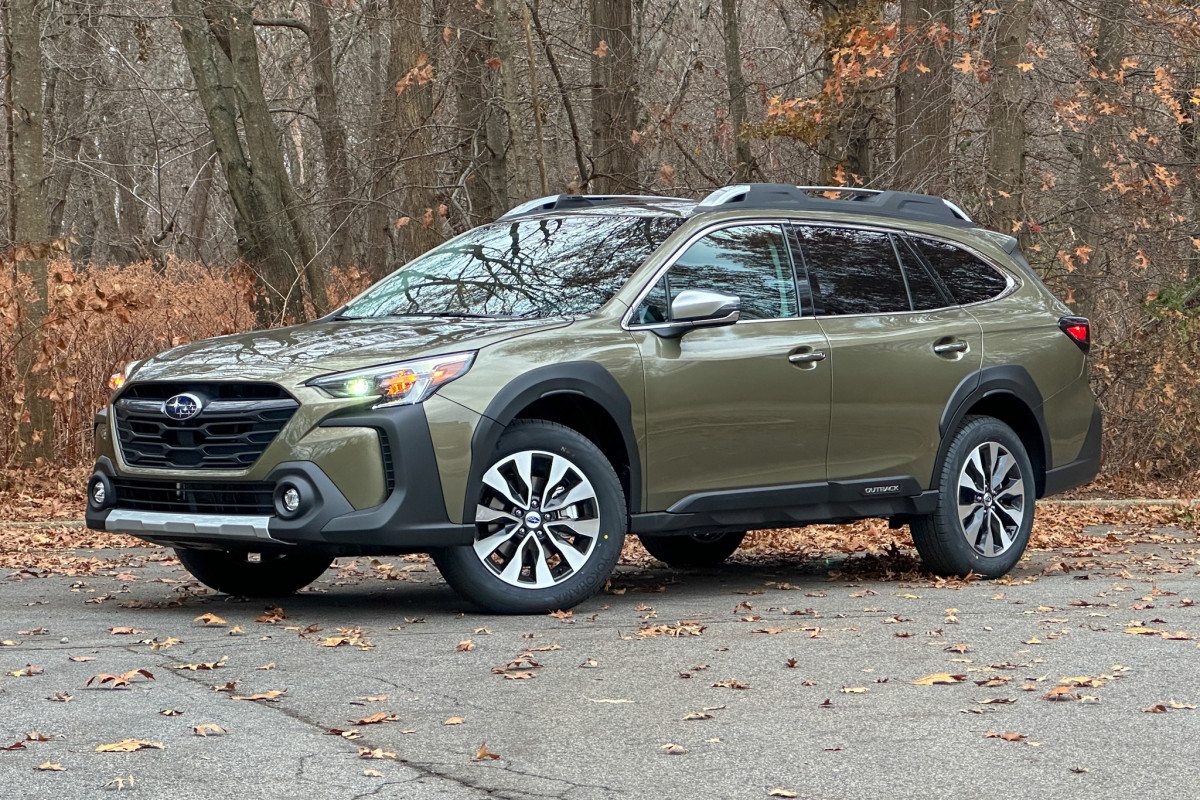
2020 Subaru Outback Reviews, Pricing & Specs


Pros & cons
What we like
Standard all-wheel drive
Excellent value for money
Spacious
What to consider
Sluggish touchscreen response
Underwhelming base engine
Expert review
A quarter-century after its debut, the Subaru Outback rolls into its sixth generation with a giant new tablet interface, fresh safety tech, and two new engines.
Subaru kept the wagon vibes rolling while the rest of the world fell in love with SUVs and crossovers. And, although the 2020 Outback is technically a midsize crossover, one look will have you remembering summer drives in an overstuffed station wagon down a busy highway, whether you actually took those trips or not. And that’s not a bad thing. The Outback has always provided utility, performance, and looks, and those things have made it Subaru’s top-selling model. With the updates for this sixth generation, I wouldn’t be surprised to see people falling in love with the station wagon again.
out of 10 expert review
Look & feel
Subaru knew it had a winning formula with the Outback, and it wasn’t eager to do much messing with ingredients, especially since those ingredients include a wealth of utility, safety, and performance—not to mention a rather handsome profile. For the 2020 model year, the aim was incremental improvement. Of course “incremental” is a relative term. The new Outback is underpinned by Subaru’s Global Platform, a chassis that provides a claimed 70% increase in structural rigidity. The base 2.5-litre engine, which at first glance looks to be the same base engine powering the 2019 Outback, actually has 90% new parts in its updated design. If you decide more power is your preference, Subaru has slotted the 2.4-litre turbocharged engine from the Ascent into higher trims.
Outside you’re going to have trouble noticing the differences between this and the last generation, but pay close attention to the head- and taillights and the changes will be more obvious. Still, most buyers will be more interested in the changes that happened inside. The 2020 Outback debuts with an 11.6-inch touchscreen for all but the base Convenience trim level, which instead gets dual 7-inch screens.
There’s also an innovative bit of new tech that you usually see only from more luxury brands: DriverFocus. This uses an infrared monitor to detect and notify sleepy or distracted drivers before accidents occur. It also uses facial recognition to identify and adjust settings between drivers. Fancy. No more, “Is this my key or your key?” mysteries.
In Canada, the Outback is offered in 7 trim levels—Convenience, Touring, Limited, Premier, Outdoor XT, Limited XT, and Premier XT—with the XT trims employing the turbo engine. Starting with an MSRP of $30,695 (fees are $2,113 extra), the Outback Convenience delivers heated front seats and a power-adjustable driver’s seat, keyless entry, LED headlights and automatic climate control. Android Auto, Apple CarPlay and Bluetooth connectivity are on hand through the StarLink infotainment system. Otherwise, things can seem a little spartan at this trim level. Still, it’s a Subaru, so you can expect an abundance of safety features, even here. This includes wiper-linked automatic headlights, adaptive cruise control with forward-collision warning, automatic emergency braking, and lane departure alert and lane-keep assist.
The next step up puts customers in the Outback Touring trim level, with an MSRP of $34,795. This is where the 11.6-inch touchscreen enters the picture, followed by dual-zone auto climate control, a sunroof, a power liftgate, reverse auto braking, and blind-spot monitoring, which oddly isn't standard.
Next is the $38,995 Limited trim, which also gets you a memory system for the driver, an upgraded Harman Kardon stereo, and leather upholstery. Navigation is added, as well as a heated steering wheel—a popular feature in snowy climes like ours.
The Premier trim represents a really attractive trim level for a lot of shoppers, with its upgraded Nappa leather and ventilated front seats. It's especially appealing considering the price climbs to only $40,995. But there’s a new trim this year as well—the Outdoor XT. This starts with the Limited’s features and adds the more powerful engine, heated rear seats, a front-view camera (also on Premier), and performance upgrades like hill-descent control and a more aggressive version of Subaru’s X-Mode. The Outdoor also gets some unique exterior plastic cladding to set it apart from the rest of the pack, and with a $38,695 MSRP, I’m guessing it’s going to be a big hit.
From there the Outback Limited XT and Premier XT follow the specs for their non-XT counterpart trims but add the turbocharged engine for respective MSRPs of $41,795 and $43,795. My week with the Outback was spent in a Premier XT.
Performance
With 182 horsepower, the upgraded 2.5-litre engine represents a 7-hp increase over 2019, but the numbers aren’t the whole story. 90% of the components have been changed, direct injection has been added, and features Natural Resources Canada fuel consumption ratings of 9.0 litres per 100 kilometres in the city, 7.1 hwy, and 8.2 combined.
The 2.5-litre engine serves just fine for most situations, but if you plan to do a bit of towing or mountain climbing, or if you just prefer your highway passing to be a bit zippier, the 2.4-litre turbocharged engine that comes with XT trims will not disappoint. It produces 260 hp and 277 pound-feet of torque.
Both engines are mated to a continuously variable transmission (CVT), and while I’d usually consider that a negative because of the CVT’s tendency to drone and provide a rubberbanding effect during acceleration, Subaru has tuned this particular CVT to act more like a traditional automatic transmission. It still provides moments of droning and rubberbanding, but for the most part, I don’t even notice it working away beneath me, and that is a very good thing.
But powertrain considerations aren’t the whole story with the Outback. If you’re not talking symmetrical all-wheel drive (AWD), you’re telling only half the tale. Because Subaru’s system is active all the time, you’re not going to feel a wheel slip followed by the system intervening, which can be distracting and even alarming right at the point you would rather not be distracted or alarmed. Additionally, you don’t have to wait for the system to activate, which can take precious milliseconds (and every millisecond is precious in a potential accident). Further, the design of the AWD system, paired with the boxer engine's low centre of gravity, means less wear on components, less disruption of weight balance, and more consistent power delivery.
And that’s just for on-road performance. It might not look it, but the Outback can hold its own when you leave the pavement. With 22.1 centimetres of ground clearance, you’ll be able to glide over everything but the deepest snow. But don’t get delusions of grandeur here—this isn’t a Jeep. With an approach angle of 18.6 degrees, a departure angle of 21.7 degrees, and a breakover angle of 19.4 degrees, you might find yourself stuck on some rocks or doing a good impression of a teeter-totter on the edge of a descent. Barring those limitations, with the upgraded X-Mode on the Outdoor XT coupled with hill-descent control, there’s not a lot the Outback can’t handle.
Form & function
Go ahead, try and argue against the functional benefits of the station wagon. They offer plenty of room for passengers, plenty of room for cargo, a low load height for trunk and roof storage, and a lower centre of gravity than an SUV for better braking and handling, as well as less chance of rollover. Why’d these vehicles ever go away?
Strictly by the numbers, the Outback offers 920 litres of cargo space, and if you drop those rear seats (which can be done via two handy handles at the rear of the trunk) you’ll be blessed with a full 2,144 litres of cargo area. Subaru says that increase over the previous generation is largely helped by an increase in width between the rear wheels. And before you go checking the numbers versus last year, Subaru changed how it measures cargo volume for 2020. Rest assured, it’s bigger inside.
In fact, it’s big enough that at 6’4”, I can keep the driver’s seat in my preferred position and still sit tandem behind the driver. If a shorter person were driving, the backseat legroom would be substantial. Headroom is great as well, which is especially impressive given the Outback’s ground clearance and short roofline. It definitely looks smaller from the outside, and in a world where every car seems to grow in proportion every year, that’s appreciated.
This attention paid to proportion has another benefit: visibility. Subaru has continually valued visibility and made sure to design its cars with this in mind. Nearly every car I test suffers from poor visibility past the hood, past the A-pillars, and to each of the rear quarters. The Outback offers great sightlines in nearly every direction, but the rear quarters still present a bit of a challenge with a blind spot large enough to hide anything Prius-size or smaller. This is a special shame given the redesign would’ve been the perfect time to address this issue, but keep your head on a swivel (or opt for a trim with blind-spot monitoring) and you should be fine.
Technology
Subaru is betting on a tablet-style, 11.6-inch touchscreen to attract technophiles, and at first glance, I can see it succeeding. But a closer look and some time spent with the system may dissuade shoppers, sadly.
First, let’s get the good points out of the way. The screen is huge, gorgeous, easy to understand, and, for the most part, easy to navigate. Some of the climate-control functions are a bit buried for my liking—it took me a couple of days to even realize this car came with ventilated seats, for instance, as the button was buried a few screens deep—but for the most part, things are well laid out.
The issue is lag. It’s ridiculous we have to deal with something like lag when moving around the map in the navigation app, but that’s something many manufacturers struggle with currently. Still, I experienced lag with this system in nearly every screen and function. Swiping between pages, opening apps, even station changes on the radio can have actual seconds of lag. At one point, even the volume input was lagging both ways, leading to a rather comical few seconds of bouncing back and forth between mute and way too loud before the system caught up. That’s unacceptable, and it's something that should be addressed ASAP.
Likewise, the camera resolution feels way behind the times. Subaru has never had the crispest cameras on the market, but with this huge screen, the problem is only exacerbated. Let’s hope things get fixed quickly because there’s a lot of potential here.
Safety
Strange as it seems to say, safety is a bit of a mixed bag here as well. I say strange because Subaru has always had such a strong commitment to safety in its engineering, design, and marketing. Here, the standard safety suite does impress, especially for the price, and the standard AWD system is not going to leave you stranded. But DriverFocus is a big disappointment.
Before I get into the issues with DriverFocus, I want to put things in perspective. I’ve always had a bit of an issue with Subaru’s EyeSight system. While I applaud Subaru for making it a standard inclusion, the fact that it’s an optical system has its drawbacks. Anything that obstructs its view can make it turn itself off—snow, mud, fog, even direct sunlight. I tested the Outback during October in an area where there’s not a lot of inclement weather at that time of year, and yet every time I drove the Outback, the system would turn off at least once for whatever reason. That’s not ideal, of course, but it’s a small issue.
With DriverFocus, the system is designed to give you a little alert in the form of a bell and a message on the screen in the middle of the gauge cluster telling you to, “Keep your eyes on the road.” It sounds like a great idea, right? The problem is, it just doesn’t work very well. During one trip with the Outback, I got a phone call and during that short, 10-minute conversation, the alert went off no less than 20 times. And not one of those times had my eyes left the road… except to look down and read a message that told me to keep my eyes on the road. This needs fixing. Until then, I just deactivated it.
Cost-effectiveness
Despite those bits of bad news, I can still recommend the Outback. With a pricing structure that spans between $30,000 and $45,000, there’s an Outback for nearly everyone, whether you’re looking for an affordable, off-road-capable family funster or a near-luxury distance cruiser (that can also handle itself very, very well off-road). I predict the new Outdoor XT trim will succeed this year, due to its looks and price point. That’s a lot of car for $39,000, and with the added appeal of its off-road chops, I see it tempting plenty of shoppers. Personally, I’d wait a year or two to see if Subaru plans to address any of the technical issues I mentioned, but even if you don’t, I can’t see you being disappointed with the Outback.
Note: Images show a US model.

What owners say
"Overall, owners really enjoy their 2020 Subaru Outback, praising its impressive power, comfort, and ample interior space. Many appreciate the smooth ride and excellent safety features, making it feel both safe and luxurious. On the downside, some drivers wish it included features like a heads-up display or remote start, and a few noted the standard engine could have more power."
This is an Amazing Car.. I’m so Blessed. Leather seats, huge screen.. all the bells and whistles.
December 10, 2025Outback XT limited had everything we wanted from the luxury feel to the pick up in the motor. Everything we could’ve expected and more!
April 13, 2021I love this car. Never had a Subaru before and wish I had. Always had Hondas and Acura’s. Great car for a great price.
November 22, 2020What owners say
This is an Amazing Car.. I’m so Blessed. Leather seats, huge screen.. all the bells and whistles.
December 10, 2025Outback XT limited had everything we wanted from the luxury feel to the pick up in the motor. Everything we could’ve expected and more!
April 13, 2021I love this car. Never had a Subaru before and wish I had. Always had Hondas and Acura’s. Great car for a great price.
November 22, 2020More money yields a better, quieter, smoother ride and features. I think the Suburu Outback has many such benefits without having to spend an extraordinary amount of money for them. It has great safety features, extras such as 3 position headrests, gets good mileage, and is well equipped with convenience items. Its a good value for what it offers and has a particularly good reputation for quality and reliability.
June 3, 2020It’s only missing a HUD and from factory it should come with remote start.
May 3, 2020I adore this car. If you’re young, it has everything you could want. If you’re old, it has everything you could want. This car is the perfect car for those who love the outdoors, love family trips, love driving around with their pets, etc. If you’re getting this car, it truly is amazing.
July 14, 2024The Outback is exactly what we are looking for and are not disappointed with our choice. Although it is a mid-size SUV, it doesnt feel and ride like one. Very smooth on the road and handles great. Plus it has plenty of interior room. Seats are amazingly comfortable. Love the advanced smart systems and the huge visibility and simplicity of the center dash screen that lets you pretty much control everything by the touch of the screen. The only thing not offered that would greatly enhance this model is cooled seats. It does have heated seats and steering wheel, but I have little use for that feature in Florida.
June 22, 2022I love my car! This car outshines every car in its class. The options that come standard would cost thousands to purchase in another vehicle. It rides amazing. More room than other cars. I have the limited with the heated steering wheel. Cant say enough about it! Love all the safety features. They take getting used to but are worth it. It even comes with a full-sized spare tire. The attention to detail in this car is wonderful.
April 24, 2021The 2020 Touring Turbo rides like a magic carpet but it has rocket ship capacity. It has the Subaru practicality about it on the outside but the interior is refined, very well appointed and roomy.
February 28, 2021This vehicle does everything well. The all wheel drive is fantastic, it is rugged yet refined Subaru quality goes a long way. I would definitely recommend
February 28, 2021Trims & specs
Base MSRP $41,225 | Seating 5 |
Engine 2.4L 260 hp H4 | Cargo Capacity 32.5 cu ft |
Combined MPG 25 | Drivetrain AWD |
Base MSRP $29,995 | Seating 5 |
Engine 2.5L 182 hp H4 | Cargo Capacity 32.5 cu ft |
Combined MPG 29 | Drivetrain AWD |
Base MSRP $44,365 | Seating 5 |
Engine 2.4L 260 hp H4 | Cargo Capacity 32.5 cu ft |
Combined MPG 25 | Drivetrain AWD |
Base MSRP N/A | Seating N/A |
Engine N/A | Cargo Capacity N/A |
Combined MPG N/A | Drivetrain N/A |
Base MSRP $34,995 | Seating 5 |
Engine 2.5L 180 hp H4 | Cargo Capacity 32.5 cu ft |
Combined MPG 28 | Drivetrain AWD |
Base MSRP $47,995 | Seating 5 |
Engine 2.4L 260 hp H4 | Cargo Capacity 32.5 cu ft |
Combined MPG 25 | Drivetrain AWD |
Base MSRP N/A | Seating N/A |
Engine N/A | Cargo Capacity N/A |
Combined MPG N/A | Drivetrain N/A |
Base MSRP N/A | Seating N/A |
Engine N/A | Cargo Capacity N/A |
Combined MPG N/A | Drivetrain N/A |
Base MSRP $41,715 | Seating 5 |
Engine 2.5L 180 hp H4 | Cargo Capacity 32.5 cu ft |
Combined MPG 28 | Drivetrain AWD |
Base MSRP N/A | Seating N/A |
Engine N/A | Cargo Capacity N/A |
Combined MPG N/A | Drivetrain N/A |
Base MSRP $45,395 | Seating 5 |
Engine 2.5L 180 hp H4 | Cargo Capacity 32.5 cu ft |
Combined MPG 28 | Drivetrain AWD |


Pricing trends
MSRP range
$26,645 - $39,695
Current avg. market price
$22,951
Trending down by 1.8% this month
May 2026 - October 2026