2021 Dodge Charger vs 2020 Hyundai Elantra
Overview | |
MSRP$19,300 | MSRP$31,125 |
Listings212 | Listings33 |
Ratings & Reviews | |
User Reviews | User Reviews |
Expert reviews8.3 out of 10 | Expert reviews7.8 out of 10 |
Pros
Cons
| |
2020 Hyundai Elantra Reviews SummaryHyundai isn’t pulling any punches when it comes to the compact car segment, where value is of utmost importance. And though a completely redesigned 2021 Elantra is coming soon, the automaker bestows several value-enhancing improvements upon the outgoing 2020 Hyundai Elantra compact sedan. They include improved fuel efficiency ratings and newly packaged safety features. | |
2021 Dodge Charger Reviews SummaryWhen it comes to American muscle cars, few do it better than the Dodge Charger. It’s a unique breed—new four-door muscle cars just aren’t sold anymore. There is a new track-ready variant for the 2021 model year that pushes the limits of the car’s Hellcat V8 engine. Tamer versions of the car offer less horsepower but can still fit three car seats across the back of the car’s roomy cabin and have accommodations comfortable enough to make it a daily driver. | |
No video found | No video found |
Popular Features & Specs | |
Engine2.0L 147 hp I4 | Engine3.6L 292 hp V6 |
DrivetrainFWD | DrivetrainRWD |
Seating Capacity5 | Seating Capacity5 |
Horsepower147 hp @ 6200 rpm | Horsepower292 hp @ 6350 rpm |
MPG City31 | MPG City19 |
MPG Highway41 | MPG Highway30 |
Engine | |
Engine Name2.0L 147 hp I4 | Engine Name3.6L 292 hp V6 |
Torque132 lb-ft @ 4500 rpm | Torque260 lb-ft @ 4800 rpm |
Horsepower147 hp @ 6200 rpm | Horsepower292 hp @ 6350 rpm |
DrivetrainFWD | DrivetrainRWD |
Fuel Economy | |
MPG City31 | MPG City19 |
MPG Highway41 | MPG Highway30 |
Interior | |
Seating Capacity5 | Seating Capacity5 |
Safety | |
Front Crash Overall4 | Front Crash Overall4 |
Side Crash Overall4 | Side Crash Overall5 |
Dimensions & Capacity | |
Cargo Space14.4 cu ft | Cargo Space16.5 cu ft |
Curb Weight2844 lbs | Curb Weight3957 lbs |
Height56.5 in | Height57.8 in |
Length181.9 in | Length198.4 in |
Width70.9 in | Width82.7 in |
Wheelbase106.3 in | Wheelbase120.0 in |
Maximum Payload1080 lbs | Maximum Payload1143 lbs |
Number of doors4 | Number of doors4 |
Maximum Towing Capacity | Maximum Towing Capacity1000 lbs |
Overview | ||
MSRP | $19,300 | $31,125 |
Listings | ||
Ratings & Reviews | ||
User reviews | ||
Expert reviews | 8.3 out of 10Read full review | 7.8 out of 10Read full review |
Pros & cons | Pros
Cons
| |
Summary | Hyundai isn’t pulling any punches when it comes to the compact car segment, where value is of utmost importance. And though a completely redesigned 2021 Elantra is coming soon, the automaker bestows several value-enhancing improvements upon the outgoing 2020 Hyundai Elantra compact sedan. They include improved fuel efficiency ratings and newly packaged safety features. | When it comes to American muscle cars, few do it better than the Dodge Charger. It’s a unique breed—new four-door muscle cars just aren’t sold anymore. There is a new track-ready variant for the 2021 model year that pushes the limits of the car’s Hellcat V8 engine. Tamer versions of the car offer less horsepower but can still fit three car seats across the back of the car’s roomy cabin and have accommodations comfortable enough to make it a daily driver. |
Video | No video found | No video found |
Popular Features & Specs | ||
Engine | 2.0L 147 hp I4 | 3.6L 292 hp V6 |
Drivetrain | FWD | RWD |
Seating Capacity | 5 | 5 |
Horsepower | 147 hp @ 6200 rpm | 292 hp @ 6350 rpm |
MPG City | 31 | 19 |
MPG Highway | 41 | 30 |
Engine | ||
Engine Name | 2.0L 147 hp I4 | 3.6L 292 hp V6 |
Torque | 132 lb-ft @ 4500 rpm | 260 lb-ft @ 4800 rpm |
Horsepower | 147 hp @ 6200 rpm | 292 hp @ 6350 rpm |
Drivetrain | FWD | RWD |
Fuel Economy | ||
MPG City | 31 | 19 |
MPG Highway | 41 | 30 |
Interior | ||
Seating Capacity | 5 | 5 |
Safety | ||
Front Crash Overall | 4 | 4 |
Side Crash Overall | 4 | 5 |
Dimensions & Capacity | ||
Cargo Space | 14.4 cu ft | 16.5 cu ft |
Curb Weight | 2844 lbs | 3957 lbs |
Height | 56.5 in | 57.8 in |
Length | 181.9 in | 198.4 in |
Width | 70.9 in | 82.7 in |
Wheelbase | 106.3 in | 120.0 in |
Maximum Payload | 1080 lbs | 1143 lbs |
Number of doors | 4 | 4 |
Maximum Towing Capacity | 1000 lbs | |
The 2020 Hyundai Elantra retained its bold geometric styling from the previous year, which was a departure from its earlier Genesis Jr. design cues. This design was intended to pave the way for the more angular 2021 model. Available in five trims—Essential, Preferred, Luxury, Ultimate, and Sport—the Elantra's price ranged from $17,099 to $27,549, excluding a $1,825 destination charge. The Ultimate trim, tested here, featured a striking black paint job that highlighted its angular design elements, contrasting with chrome detailing. Inside, the Elantra's interior was updated with silver trim accents, though it still featured some hard plastics, reminding occupants of its mainstream compact car status.
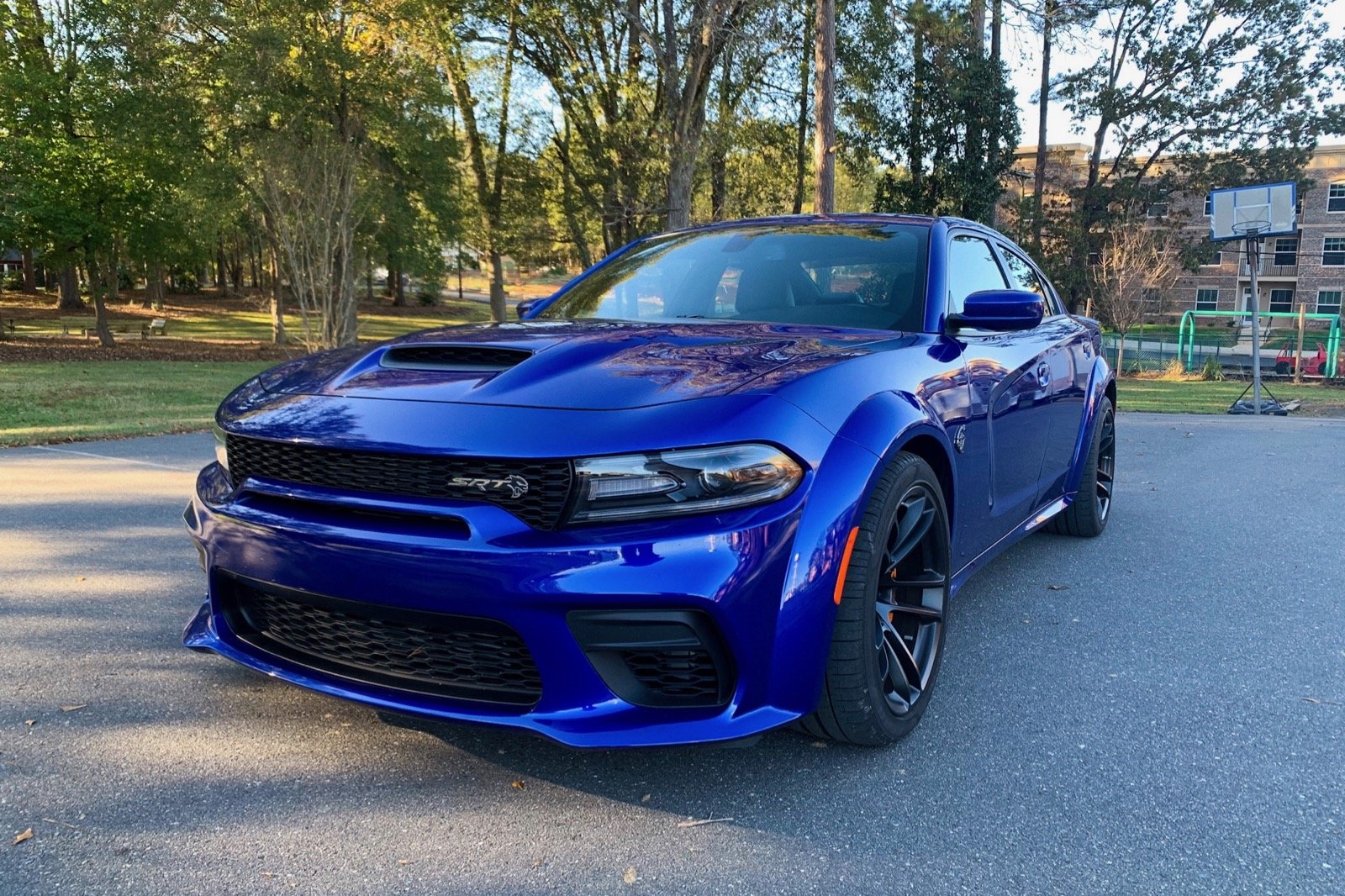
The 2021 Dodge Charger, a staple in the muscle car segment, continued to appeal to buyers with its wide range of variants, including the top-tier SRT Hellcat Redeye. Despite its decade-old design, the Charger maintained its iconic look, with subtle differences between models. The widebody format added an athletic stance, complemented by options like a Satin Black performance hood. The Charger offered a plethora of wheel, brake, and colour options, with 18 wheel choices and 13 paint jobs. The interior, while updated over the years, still lacked some modern comforts, with a mix of hard plastics and rubberized surfaces. Cloth seats were standard, with Nappa leather available on higher trims.


The 2020 Hyundai Elantra featured a base 147-horsepower, 2.0-litre four-cylinder engine paired with a new continuously variable transmission (CVT), replacing the previous six-speed automatic. The CVT, dubbed "Intelligent Variable Transmission" by Hyundai, offered simulated gear shifts for a more traditional driving feel. Despite claims of improved fuel efficiency, real-world tests showed an average of 8.0 L/100 km, falling short of the expected 6.8 L/100 km. The Elantra Sport trim offered a more engaging drive with a 201-horsepower, 1.6-litre turbo engine and independent rear suspension, providing a superior ride compared to the standard torsion beam axle.
The 2021 Dodge Charger excelled in performance, offering a range of powerful engines. The SXT and GT models featured a 3.6-litre V6 with up to 300 horsepower, while the R/T boasted a 5.7-litre HEMI V8 with 370 horsepower. The Scat Pack models upped the ante with a 6.4-litre HEMI V8 delivering 485 horsepower. The SRT Hellcat Redeye, with its supercharged 6.2-litre V8, produced a staggering 797 horsepower. Despite its power, the Hellcat Redeye managed its output well, though it was the least fuel-efficient, with a combined rating of 15.6 L/100 km. The Charger offered a connected driving experience, with configurable drive modes and Brembo brakes for enhanced performance.
The 2020 Hyundai Elantra was among the roomier compact cars, comfortably accommodating four adults. The test car featured power driver’s seat adjustment, leather upholstery, and a sliding centre console armrest. Upper trims included dual-zone automatic climate control, though rear passengers lacked air conditioning vents. The trunk offered 407 litres of space, nearly matching some midsize sedans, with a convenient interior grab handle for easy closure.
The 2021 Dodge Charger, a four-door, five-passenger sedan, balanced performance with practicality. Its spacious back seat and 60/40 split-folding rear seat expanded the trunk's storage capacity. The interior, while dated, was functional, with easy-to-read instruments and a well-designed steering wheel. Paddle shifters were standard on most models, though they could be accidentally engaged during spirited driving. The Charger's cargo space was average for its class.
The 2020 Hyundai Elantra came standard with a touchscreen infotainment system, Bluetooth, and a USB port. The base Essential trim featured a 5-inch screen, while the Preferred trim offered a 7-inch display with Apple CarPlay, Android Auto, and SiriusXM. The Ultimate trim added a wireless charging pad, an 8-inch touchscreen, and a premium Infinity sound system. The infotainment system was user-friendly, with shortcut buttons and a responsive voice recognition system.
The 2021 Dodge Charger offered basic standard features, including a 7-inch infotainment touchscreen, Bluetooth, and Apple CarPlay. Optional upgrades included an 8.4-inch screen, premium audio systems, and navigation. The Uconnect system was easy to navigate, though some functions were buried in menus. The lack of a head-up display and the use of interchangeable switchgear contributed to a lower-tech feel.
The 2020 Hyundai Elantra offered advanced driving assistance systems on the Preferred trim, including forward-collision warning and lane-keeping assist. The Ultimate grade added adaptive cruise control and pedestrian detection. With full LED headlights, the Elantra earned a Top Safety Pick from the IIHS and a four-star overall rating from the NHTSA, though there was a concern about rear-door intrusion in side-impact tests.
The 2021 Dodge Charger had not been crash-tested by the IIHS, but the 2020 model received mostly "Good" ratings. The NHTSA awarded the Charger a four-star overall safety rating. Standard safety features included brake assist and electronic stability control, with adaptive cruise control and blind-spot monitoring available in packages.
CarGurus highlights

According to CarGurus experts, the overall rating for the 2020 Hyundai Elantra is 8.3 out of 10, while the 2021 Dodge Charger scores 7.8 out of 10. Based on these ratings, the Hyundai Elantra is the recommended choice, offering a better balance of features, efficiency, and value for most consumers.
Choose the 2021 Dodge Charger if:
- You desire a powerful engine lineup with high-performance capabilities.
- You need a spacious sedan that can double as a family car.
- You appreciate a classic muscle car design with a wide range of customization options.


Choose the 2020 Hyundai Elantra if:
- You prioritize fuel efficiency and a lower price point.
- You value a user-friendly infotainment system with modern connectivity options.
- You seek a compact car with spacious interior accommodations.


CarGurus highlights
According to CarGurus experts, the overall rating for the 2020 Hyundai Elantra is 8.3 out of 10, while the 2021 Dodge Charger scores 7.8 out of 10. Based on these ratings, the Hyundai Elantra is the recommended choice, offering a better balance of features, efficiency, and value for most consumers.
Choose the 2021 Dodge Charger if:
Shop Now- You desire a powerful engine lineup with high-performance capabilities.
- You need a spacious sedan that can double as a family car.
- You appreciate a classic muscle car design with a wide range of customization options.
Choose the 2020 Hyundai Elantra if:
Shop Now- You prioritize fuel efficiency and a lower price point.
- You value a user-friendly infotainment system with modern connectivity options.
- You seek a compact car with spacious interior accommodations.

By: CarGurus + AI
At CarGurus, our team of experienced automotive writers remain at the heart of our content operation, conducting hands-on car tests and writing insightful guides that are backed by years of industry experience. To complement this, we are harnessing AI to make our content offering more diverse and more helpful to shoppers than ever. To achieve this, our AI systems are based exclusively on CarGurus content, ratings and data, so that what we produce is both unique to CarGurus, and uniquely helpful to car shoppers.
