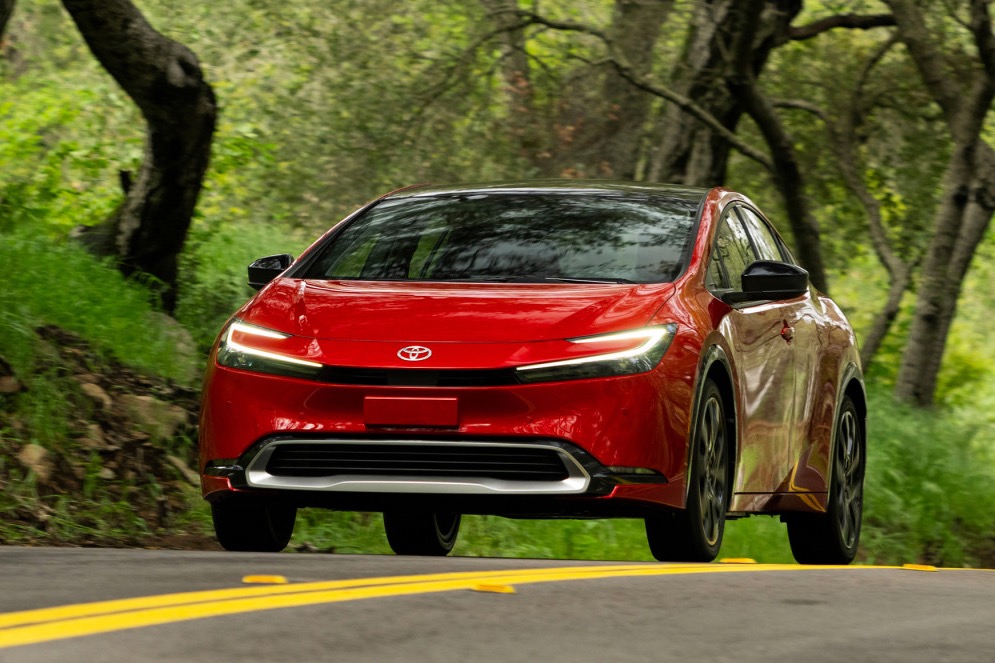
The Toyota Crown, one of the brand’s longest-running nameplates, returned to North America for the 2023 model year after a five-decade absence. The modern Toyota Crown is something of an odd duck. Priced and marketed like a premium alternative to the Lexus ES, Audi A6, and Acura TLX, it’s built on a mainstream Toyota platform and could also be cross shopped with a loaded Camry. It landed in Toyota's lineup as the de facto replacement for the discontinued Avalon, competing in a full-size sedan segment that keeps shrinking as more buyers move to crossovers and SUVs.
Today’s Toyota Crown blends full-size sedan proportions with the ride height and visibility of a crossover, a look that reminds us of the old Honda Accord Crosstour and BMW 5 Series Gran Turismo. Every Crown is now a hybrid, designed to deliver Lexus-level quality and comfort for Toyota money for buyers who want a quiet and comfortable daily driver without paying for a luxury badge.
Toyota introduced the Crown name in 1955, where it soon became the brand's premium sedan — arguably the Lexus of its day. The second, third, and fourth generations were sold in Canada from 1965 through 1972. None of these early Toyota Crowns are meaningfully represented in the used market, and they’ve become collector cars thanks to rarity and limited sales when new.
The original Crown was engineered for Japanese roads and sold in the United States where it struggled on highways. Toyota fitted a larger engine to compensate, then pulled the Crown from the U.S. lineup in 1960 to focus on the Land Cruiser. The second generation returned in 1962 with more contemporary American-influenced styling in sedan or station wagon form. Toyota Japan signed an agreement with an importer named Canadian Motor Industries Ltd. (CMI) in 1964 to bring its vehicles into Canada. (In 1980, that importer became Toyota Canada.)
The third generation followed in 1967 with a new frame and a more powerful inline six-cylinder engine. Toyota sold the fourth generation from 1972 to 1973, the last Crown offered in North America before the Corona replaced it here, but the Crown lived on in Japan.
Thanks to Canada’s 15-year import rule, newer right-hand-drive Japanese-market Crowns have been known to pop up on CarGurus.ca. Because those cars were never officially sold here, this guide doesn't cover them.
Toyota Crown Buying Guide: Cost, Reliability, and the Best Years to Buy
Frequently Asked Questions
Which Toyota Crown years are the best?
There is no clear best model year. As a premium Toyota product, all available model years are quite reliable and easy to own. The 2025 model year featured some meaningful quality updates from additional sound deadening to improved interior materials. At the time of writing, the 2027 model year promises to further improve the Crown with an updated hybrid system.
Which Toyota Crown years are the worst?
As with the best, there is no clear worst model year. The latest Toyota Crown is built on a proven platform using a well-known hybrid system. There are some recalls to watch out for on earlier 2023 to 2025 model years, but they don't affect the overall reliability. User reports are positive, and the Crown holds up to Toyota’s well-known reputation for reliability.
Is a used Toyota Crown a good deal?
Yes, the Toyota Crown can be a great deal. It's easy to own, reliable, and has low operating costs. Sales have been relatively low due to its obscure position as a “crossover” luxury sedan, and that low demand continues into the used market, which means deals can be found. Even the base XLE trim is well equipped, so stepping up to the Limited or Platinum isn’t required for a luxurious experience.
Pros and Cons
Pros:
- Fuel-efficient
- Stylish design
- Comfortable
Cons:
- Pedestrian performance
- Limited cargo space
- Questionable interior materials
Toyota Crown Generations
Toyota Crown First Generation (2023-Present)
The latest 16th-generation Toyota Crown marked the nameplate's return to North America after a roughly 50-year absence. It launched for the 2023 model year as a direct replacement for the Avalon. It shares a platform with other Toyota hybrids and pairs sedan proportions with a taller ride height, perfect for buyers who want the driving feel of a car with an SUV's sightlines and easy entry and exit. Every Crown is a hybrid, and every Crown comes standard with all-wheel drive.
Two hybrid powertrains are available, and both pair with Toyota’s electric all-wheel drive system. The XLE (which was only sold in Canada for 2023) and Limited trims use the standard hybrid system, a naturally aspirated 2.5-litre four-cylinder engine paired with three electric motors and rated at a combined 236 horsepower for an estimated 5.7 litres per 100 kilometres combined.
Toyota launched the Crown with its fourth-generation hybrid architecture rather than the newer and more efficient fifth-generation system used elsewhere in the lineup, favouring the older version's proven track record. However, the brand has confirmed the Limited grade will move to the fifth-generation hybrid system for the 2027 model year.
The range-topping Platinum trim uses Toyota's Hybrid MAX system, which pairs a turbocharged 2.4-litre four-cylinder engine and a six-speed automatic transmission with a two-motor hybrid setup tuned for performance. Total output is 340 horsepower for a 0 to 100 km/h time of 5.8 seconds, which is genuinely quick for the segment. Fuel economy suffers as a result, though, and the Platinum is rated at 7.8 L/100 km combined.
Both powertrains send power to the rear wheels through a dedicated electric motor rather than a mechanical link to the front axle. Toyota calls this Electronic On-Demand All-Wheel Drive on the XLE and Limited and Full-Time Electronic All-Wheel Drive on the Platinum. It's not built for off-roading but instead trades that capability for better fuel economy. On the XLE and Limited the rear motor engages only as needed, while the Platinum's Hybrid MAX system runs full-time all-wheel drive.
The Crown lineup was launched for the 2023 model year in XLE, Limited and Platinum trims. The XLE and Limited share the standard hybrid powertrain. The Platinum alone gets the more powerful Hybrid MAX system, an adaptive suspension that automatically adjusts for road conditions, and unique, 10-spoke 21-inch wheels.
Buyers who want performance should focus on the Platinum, while those who want value or fuel economy are better served by the Limited, which comes with leather upholstery, heated and ventilated front seats, heated rear seats, a heated steering wheel, a JBL sound system and a panoramic moonroof. The XLE trim, which was only sold in Canada for the first model year in 2023, used Toyota's SofTex synthetic leather rather than genuine leather.
Every Crown uses Toyota's latest multimedia system with a 12.3-inch touchscreen, wireless Apple CarPlay and Android Auto, and over-the-air updates through Toyota's Connected Services. Charging ports are plentiful throughout the cabin: USB-C ports and a wireless phone charger are equipped up front, and there are more USB-C ports in the rear. Toyota insulated the cabin well, and the Crown stays notably quiet at highway speeds for the class.
Every Crown comes standard with Toyota Safety Sense 3.0, the brand's suite of driver assistance features. It includes pre-collision braking with pedestrian detection, full-speed adaptive cruise control, lane departure warning with steering assist, lane centring assist, high beam assist, and traffic sign recognition. A Panoramic View Monitor is standard in later model years, as is a smart key that works on all four doors rather than just the fronts.
The 2023 Toyota Crown earned the Insurance Institute for Highway Safety (IIHS) Top Safety Pick+ award, its highest honour, with Good ratings across every crashworthiness test and a superior-rated front crash prevention system.
The most significant issue to watch for on the used market is a 2024 recall filed with the U.S. National Highway Traffic Safety Administration (NHTSA) covering roughly 13,000 model-year 2023 Crowns built at Toyota's Motomachi plant between February and August 2023. Insufficient welding on the front and rear camera housings could allow water to seep in and short-circuit the cameras, cutting out the image. The fix is a free dealer inspection and camera replacement where needed. Shoppers considering a 2023 model should confirm with the seller or a VIN check that the recall has been addressed.
A broader October 2025 recall covering several Toyota models — including certain 2023-2025 Crowns — addressed a software glitch that could freeze or blank the backup camera image while reversing.
Beyond the recalls, complaints have been light. CarComplaints.com, which tracks complaints filed with NHTSA, lists only a handful across the 2023-2025 model years. That’s a favourable sign this early in the car's life, though it's still a small sample from which to draw. Subscriber survey data from Consumer Reports goes further, predicting the Crown will be more reliable than the average new car.
According to CarGurus.ca pricing data, the Toyota Crown's average price was around $43,200 at the time of writing. By model year, 2023 Crowns average roughly $37,000 with higher-kilometre examples starting at around $25,000, while 2024 models average around $43,000 and 2025 models about $52,000. Shoppers focused on value should look at 2023-2024 Limited trims, which pair the smarter leather interior and JBL audio system with the more efficient hybrid powertrain.
Related Topics