In continuous production since 1972, the Honda Civic is one of the best-known and longest-lasting cars in the world. Over 11 generations, Honda has sold more than 27 million Civics across 170 countries. The Civic Hybrid is a very small part of that success. Compared to the regular Civic, the hybrid's premium price and low volume over three generations have made it an uncommon sight on the road. But the Civic Hybrid's technological innovations proved that gas-electric hybrid cars were worth the extra cost and time to develop — and that car buyers would actually like them.
Honda Civic Hybrid Buying Guide: Cost, Reliability, and the Best Years to Buy
Search for Honda Civic Hybrid
See all


The new Honda Civic Hybrid was introduced for 2025 after the model had been off the market since the 2015 model year, so finding a used Civic Hybrid for sale can be a challenge. Be prepared to expand your search nationwide because the pool of listings is comparatively slim. If you know what to look for, though, you can get yourself a very affordable and fuel-efficient compact sedan.
Honda Civic Hybrid Buying Guide: Cost, Reliability, and the Best Years to Buy
- Frequently Asked Questions
- Pros and Cons
- Honda Civic Hybrid Generations
- Honda Civic Hybrid Third Generation (2025-Present)
- Honda Civic Hybrid Second Generation (2006-2015)
- Honda Civic Hybrid First Generation (2003-2005)
Frequently Asked Questions
Which Honda Civic Hybrid years are the best? The current Civic Hybrid (2025-present) is the best. It is both quick and efficient with the build quality and driving polish of a much more expensive car.
Which Honda Civic Hybrid years are the worst? The battery of any first-generation Civic Hybrid — or that of a high-kilometre second-generation model — is likely to be reaching the end of its life. If the battery fails, the car cannot be driven without a major service. Replacing a battery costs thousands of dollars, which may not be worth the effort depending on the car's value. A recall affected 2006-2007 Civic Hybrids for a faulty DC-DC converter that could stall the car while driving.
Is a used Honda Civic Hybrid a good deal? Yes, a Civic Hybrid can be a good deal, but only if you can estimate the remaining life of the hybrid battery, so buy the newest, lowest-kilometre car you can afford.
Pros and Cons
Pros:
- Incredible fuel economy
- More standard equipment than other Civics
- Comfortable and quiet when cruising
Cons:
- Slow and noisy under hard acceleration (first and second generations)
- Older batteries are not as efficient and are prone to failure
- Limited availability
Honda Civic Hybrid Generations
Honda Civic Hybrid Third Generation (2025-Present)
After Honda canceled the Civic Hybrid to focus on the Clarity Plug-in Hybrid, the Clarity EV, and the Accord Hybrid, the time was right to bring it back with the 11th-generation Civic. This time, instead of Integrated Motor Assist, the hybrid powertrain uses a dual-motor system shared with the latest CR-V Hybrid and Accord Hybrid for an EV-like driving experience and performance that matches the Civic Si.
With 200 horsepower and 232 pound-feet of torque from a 2.0-litre four-cylinder engine and two electric motors, the 2025 Civic Hybrid uses direct drive — no CVT or traditional transmission — by clutching the two motors directly to the front axle and the gas engine. The result is incredibly smooth, quiet, and quick performance for an economy-minded hybrid car. It offers significantly improved fuel economy at a Natural Resources Canada-estimated 4.7 litres per 100 kilometres in the city, 5.1 highway, and 4.9 combined. It’s good to drive, too: it’s not sporty, but it has a better balance between comfort and agility than many compact cars.
For the first time, the Hybrid is also available in the hatchback body style (at a higher 4.8 L/100 km city, 5.4 highway, and 5.0 combined). In our testing of a 2026 Civic Hybrid Hatchback, which is unchanged from 2025, we found the performance — and the four levels of brake regeneration that can be adjusted on the steering wheel paddles — to be excellent. In addition to its sleeker body style, the Civic Hatchback has significantly more cargo space than the sedan at 694 litres versus 419 litres.
The Civic Hybrid is available in Sport or Sport Touring trim levels in either body style. Standard equipment includes Honda Sensing, a suite of driver assistance features including forward emergency braking, adaptive cruise, lane keep assist, and Road Departure Mitigation. A blind spot monitor, auto high beams, and Traffic Jam Assist — which is a semi-automated feature — are also standard. Rear side airbags, along with front knee airbags, are standard.
Hybrid trims have a body-coloured headlight surround and lower spoiler along with two-tone 18-inch wheels. A 7-inch touchscreen, an eight-speaker stereo, a half-digital instrument panel with a 7-inch display, USB-C ports, dual-zone climate control, LED headlights and brake lights, an acoustic laminated windshield, and a sunroof are all standard. The Sport Touring adds a 9-inch touchscreen with Google Maps, Assistant, and Play apps, a digital instrument panel, wireless Apple CarPlay and Android Auto, leather, a 12-speaker Bose stereo, and a wireless phone charger.
Beginning with this generation, the Honda Civic Hybrid sedan is assembled at Honda of Canada Mfg. in Alliston, Ontario. The Honda Civic Hybrid hatchback is built in the United States.
As of this writing, the base MSRP for the 2026 Civic Sedan Hybrid as a new car in Canada is $37,071 for the Sport and $40,571 for the Sport Touring, including destination charges and other fees. The Civic Hatchback Hybrid is $38,971 for the Sport and $42,471 for the Sport Touring Hybrid. The average used list price on CarGurus for the Honda Civic Hybrid ranged from just under $30,000 for exceptionally high-kilometre units and roughly $40,000 for like-new 2026 cars at the time of writing.
Honda Civic Hybrid Second Generation (2006-2015)
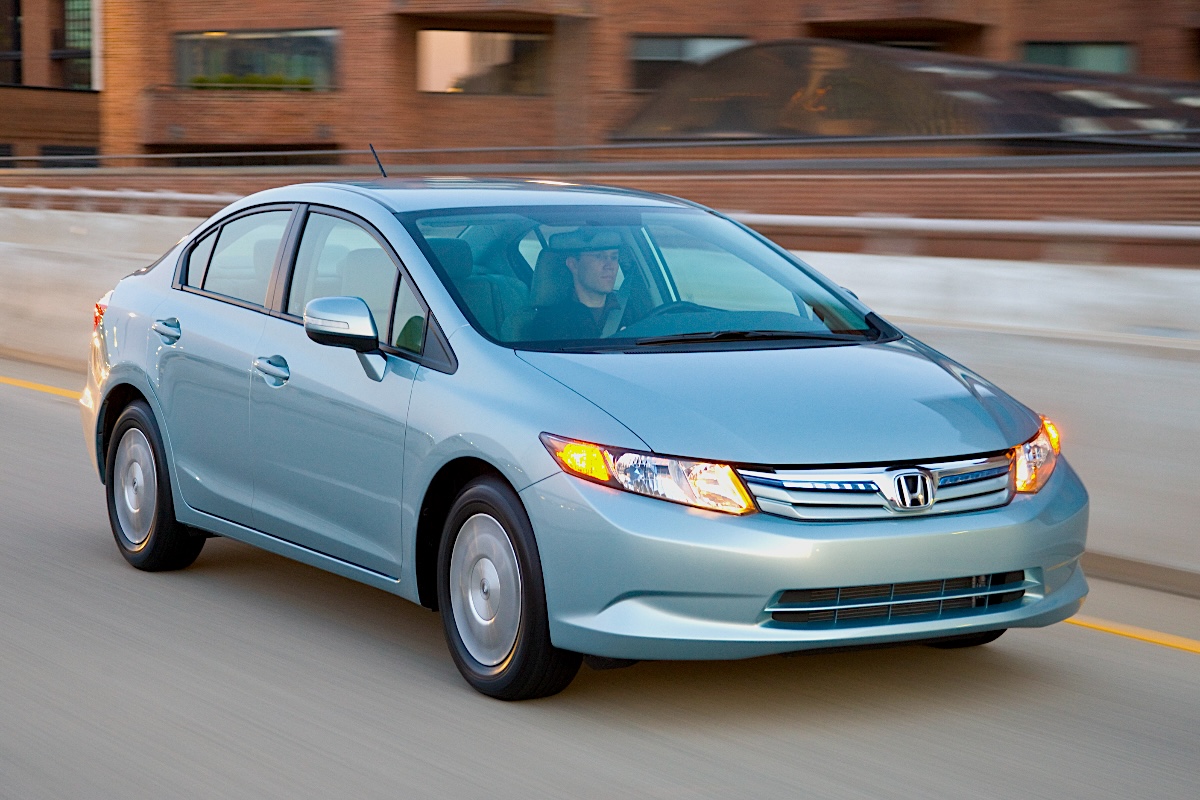
The spacy-looking eighth-generation Civic, with its lengthened windshield, opposing wipers, and wider body, was the basis for the second-generation Civic Hybrid. The fourth-generation Integrated Motor Assist powertrain could now handle electric-only acceleration (albeit only with limited throttle input and at low speeds). Combined output was 110 horsepower and 123 pound-feet of torque due to a more powerful electric motor and battery and the introduction of i-VTEC, which allowed for more control of the valves at higher speeds, among its many mechanical functions.
Improvements to the continuously variable transmission (CVT), air conditioning, brakes, and the switch to an electronic throttle led to the Civic Hybrid's greater fuel efficiency. NRCan estimates were 5.8 L/100 km city, 5.2 highway, and 5.5 combined. The steering, suspension, and chassis were all heavily revised or completely changed. Like all Civic Hybrid models, it’s available only with front-wheel drive.
Newly standard features included side curtain airbags, active front headrests, 15-inch alloy wheels (one inch larger than previously), and a six-speaker stereo (up from four) with iPod connectivity. A fully digital instrument panel, which looked like an alarm clock, was on a new two-tier dash.
For 2007, Honda included XM radio with the navigation system. There were no changes for 2008. For 2009, Honda added stability control (Vehicle Stability Assist) and a USB port. Leather seats and steering wheel, Bluetooth, and heated front seats and side mirrors were available on models with navigation. New headlights and taillights used clear lenses with amber bulbs, and the front bumper had a new air intake. There were no changes for 2010 or 2011.
A refresh for the entire Civic lineup in 2012 was panned by the automotive press for its downmarket interior design, quality, and performance. But there were many improvements, including more rear legroom (up four centimeters). The hybrid received a new 1.5-litre engine and a lithium-ion battery that replaced the nickel-metal hydride battery. Efficiency was improved across all tests and torque increased to 127 lb-ft. A new five-inch digital display on the top of the centre stack could show album artwork and directions, and the instrument panel could change colours depending on the vehicle's current speed and efficiency. On models with navigation, a 16GB flash drive replaced the DVD setup.
For 2013, due to the bad press and negative customer reactions, Honda refreshed the Civic Hybrid again with new exterior styling, revised suspension and steering, more noise insulation, soft-touch dash materials, and better build quality. Specs were improved with a backup camera, Bluetooth, and text message readouts now standard. For 2014, Honda made more interior updates including a new 7-inch touchscreen with LaneWatch, which displayed the right-side blind spot as a live feed when using the turn signal. Push-button start with keyless smart entry was also standard. Enhancements to the fuel pump, ignition coil, engine sensors, and increased regenerative braking led to a better NRCan rating of 5.4 L/100 km city, 5.1 highway, and 5.3 combined. There were no changes for 2015.
Second-generation Honda Civic Hybrids are now hard to come by on the Canadian used vehicle market. In our research, prices started at less than $5,000 for a 2009 example with more than 400,000 kilometres. Later-model and lower-kilometre units go for closer to $11,000 to $12,000.
Honda Civic Hybrid First Generation (2003-2005)
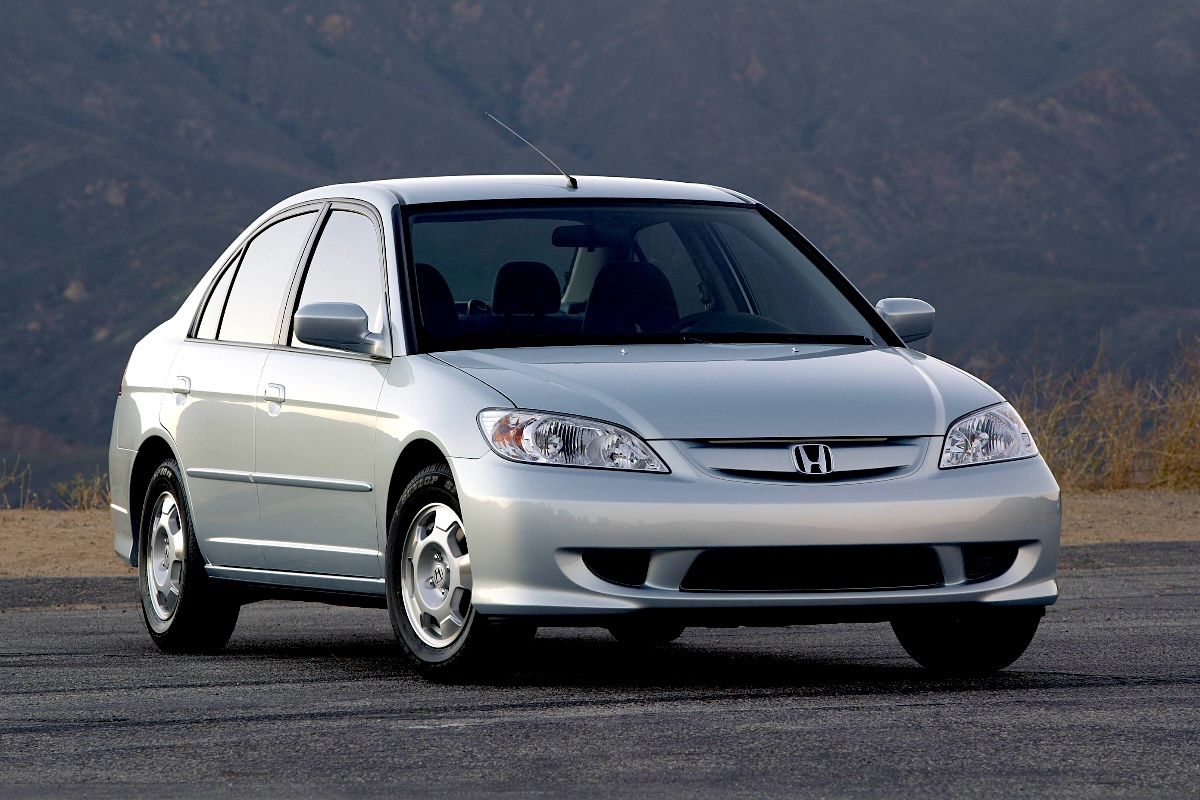
Honda brought the first Civic Hybrid to North America in 2002 as a 2003 model. Back then, it was only the third gas-electric hybrid on the market after the Toyota Prius and the two-door Honda Insight. While using a modified version of the Insight's Integrated Motor Assist powertrain, the Civic Hybrid's major distinction was that it was a normal, everyday Civic. The Insight was a tiny two-seater that was styled like an experiment, while the Civic Hybrid was no different from an ordinary Civic. The back seat, trunk, and all the usual controls that debuted in the Civic's seventh generation for 2001 were retained.
Honda's approach to early hybrids was the opposite of Toyota's, and as such the Civic Hybrid could not drive solely under electric power. Rather, the 13-horsepower electric motor served as a boost, which foreshadowed today's "mild" hybrids because it was installed between the engine and the five-speed manual transmission or optional CVT.
A 1.3-litre four-cylinder engine, larger than the Insight's but smaller than the regular Civic's, was a marvel of efficiency. It burned extremely lean by using two spark plugs on each cylinder instead of one so that the air-fuel mixture could be adjusted. It could also shut off three of the cylinders to reduce friction under deceleration so the battery could recharge more effectively. In fact, it was so clean that it achieved an Ultra-Low Emission Vehicle rating. A small battery rated under 900 Wh was mounted between the trunk and the rear seats (which could not fold down). In total, the Civic Hybrid made 93 hp and 116 lb-ft of torque.
Aerodynamic improvements compared with the standard Civic included a reshaped front bumper and grille, underbody covers, lighter aluminum alloy wheels, a rear spoiler, and low rolling resistance tires. UV-reducing glass and automatic climate control, a feature not found on any other Civic trim of the time, reduced energy usage from the air conditioning. Electric power steering, a rare feature at the time, removed the hydraulic pump driven by the engine for further fuel savings. Due to the change in weight and weight distribution, Honda went so far as to install a thicker front stabilizer bar, stiffen the springs, increase the damping rate, enlarge the rear drum brakes, and make anti-lock brakes (ABS) and electronic brake distribution standard. Even the radio antenna was moved from the glass to the roof to reduce interference with the car’s added electronics.
Fuel economy measured an NRCan-estimated 6.0 L/100 km city, 5.6 highway, and 5.8 combined with the CVT. But achieving these numbers meant customers had to pay a premium. For many people, this did not compute when a mid-level Honda Accord cost just as much.
Honda made amends by piling on more equipment as standard such as front side airbags, keyless entry, a CD player, cruise control, variable intermittent wipers, automatic climate control, and power windows with auto down for the driver’s window. Softer fabric upholstery on the seats and front door armrests, along with a black and tan dash, silver accents on the dash, chrome trim around the gear selector, and a partially digital gauge cluster helped to dress up the interior. For 2004, Honda refreshed the Civic Hybrid along with the rest of the Civic lineup with a new hood, headlights, grille, and front and rear bumpers. The rear headrests could now be adjusted. There was a centre console with an armrest and storage, better speakers, a different pattern on the seats, and floor mats were included as standard.
The first Civic Hybrid is an extremely rare sight at dealerships, and this generation of Civic has a worse reliability record than many other Civic models. We weren’t able to find any examples on the Canadian used vehicle market in our research. If you find one, approach it with caution. If a test drive reveals any battery concerns, it’s best to walk away.
Related Topics

by Clifford Atiyeh
Clifford Atiyeh has hosted, directed, and produced more than 300 series-length videos for CarGurus since 2016. He has reported and photographed for dozens of websites, magazines, and newspapers over 20 years, including The Boston Globe, Car and Driver, and Road & Track. Clifford runs CHA Creative, which provides industry analysis and brand marketing to automotive clients.
The content above is for informational purposes only and should be independently verified. Please see our Terms of Use for more details.


