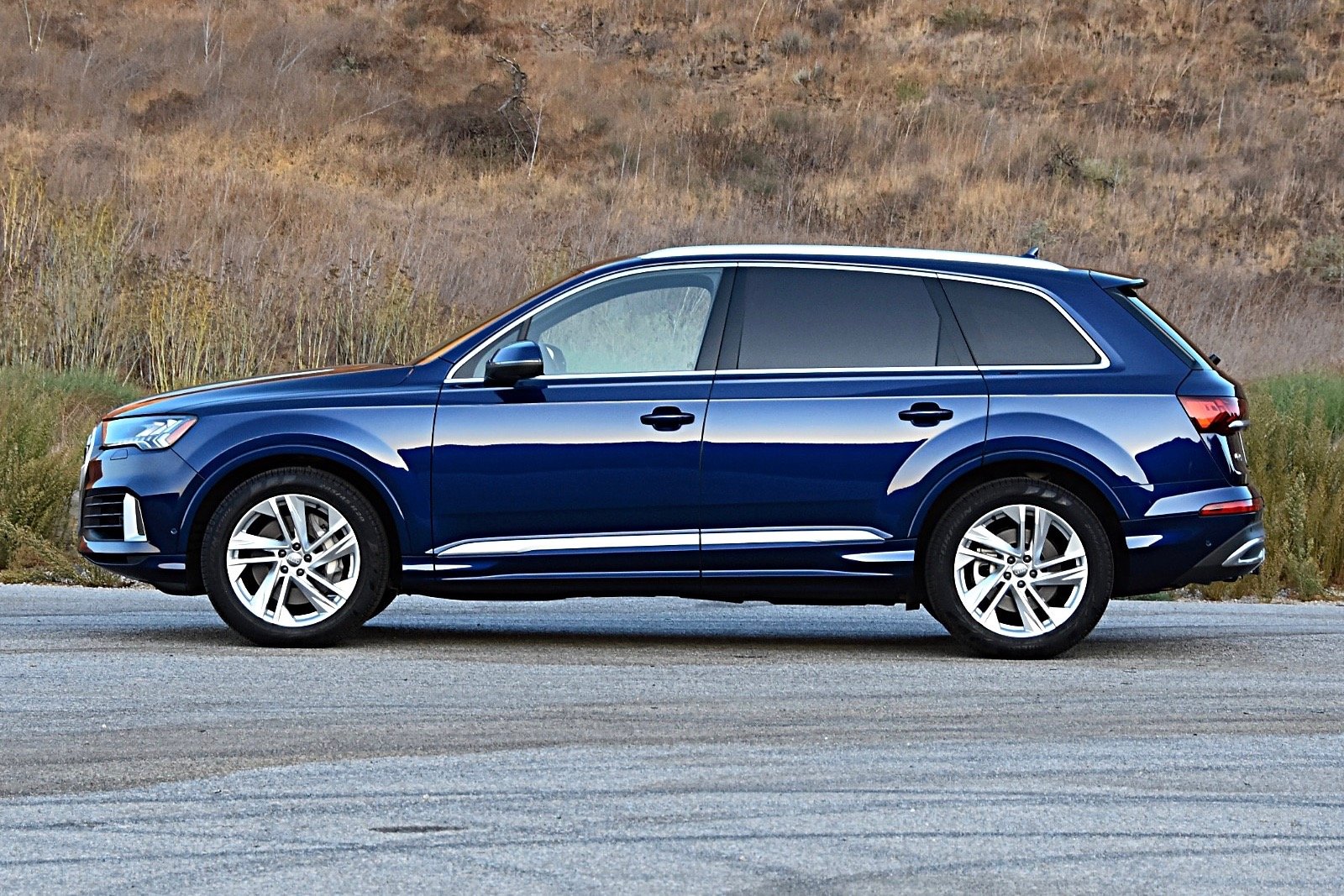
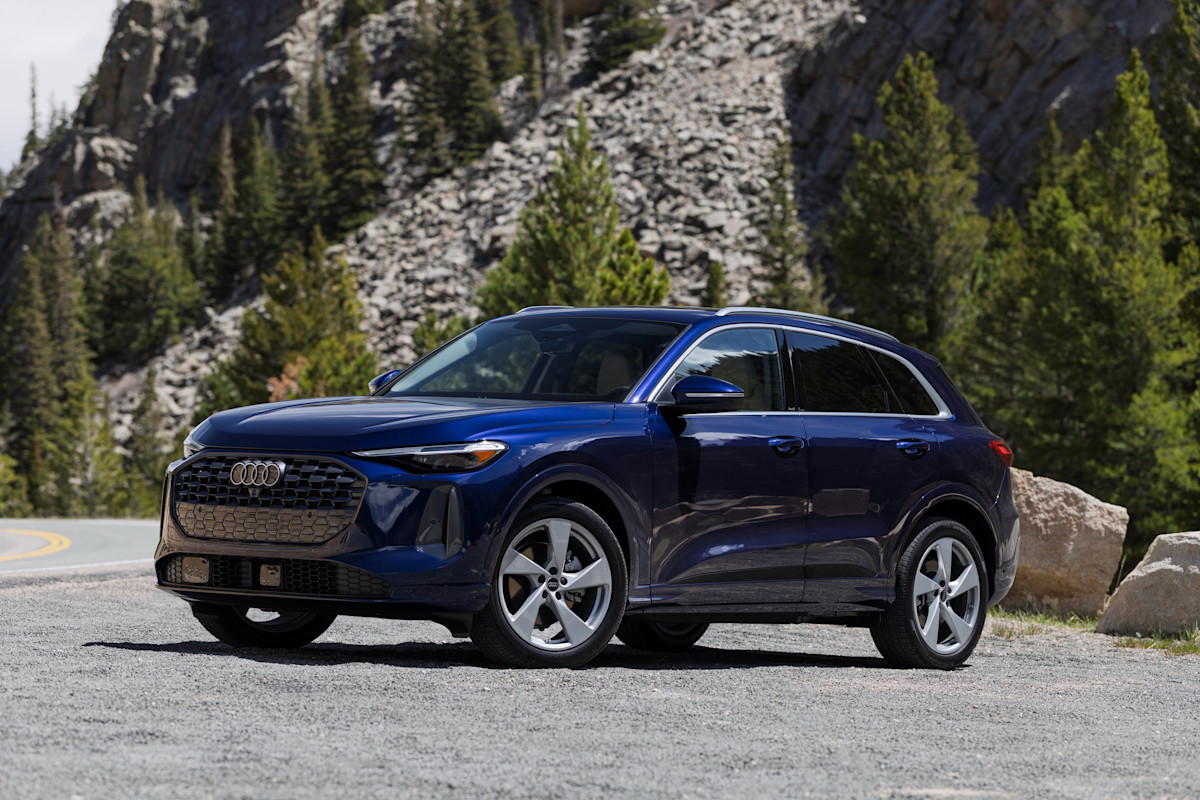
The Audi Q8 is the German brand’s flagship SUV. It’s based on the three-row Q7 but is slightly shorter and wider and has only two rows of seats. It’s sportier and more luxurious than the Q7, and it competes with cars such as the Mercedes-Benz GLE, BMW X5 and X6, Porsche Cayenne, Land Rover Range Rover Sport, and Genesis GV80 Coupe. The high-performance SQ8 and RS Q8 versions (which we consider separate models) rival cars such as the Maserati Levante, Alfa Romeo Stelvio Quadrifoglio, and Aston Martin DBX.
While it shares many parts with the Q7, the Q8 is more exclusive, costs more, and has more high-end features. The exterior and interior have a sporty, coupe-like design, while the available engines, suspensions, and transmissions are more aggressively tuned for high performance. Sold since the 2019 model year, the Q8 is unrelated to the Q8 e-tron and the Q8 Sportback e-tron (previously badged e-tron and Sportback e-tron), both of which are electric and ride on completely separate platforms.
Our buying guide looks at how the Audi Q8 has evolved over the course of its single generation, which are the best and worst versions, and how much buyers can expect to pay for one.
Audi Q8 Buying Guide: Cost, Reliability, and the Best Years to Buy
Frequently Asked Questions
Which Audi Q8 years are the best?
According to Consumer Reports and J.D. Power, the Audi Q8 has average reliability across every model year. Nothing significant has changed since it was introduced. The overall number of issues raised on CarComplaints.com is so low that it’s hard to say there’s a best year with just one complaint each in the 2020 and 2022 model years.
Which Audi Q8 years are the worst?
There are more issues for the first model year (2019) listed at CarComplaints.com, but with such a low number (five), it really isn't that bad. Buyers should generally be aware of high maintenance costs and potential issues with the 48-volt mild hybrid system, air suspension, and glitchy infotainment software.
How much does a late-model Audi Q8 cost?
On CarGurus.ca, a 2025 Audi Q8 lists for around $69,000 on average, while a 2023 model averages about $58,000. Step back to a 2021 Q8 and the average falls to roughly $42,000.
Is a used Audi Q8 a good deal?
Yes. For a premium SUV that starts above $90,000 brand-new, a used Q8 is a good deal after three to five years. On CarGurus.ca, the average listing price is around $51,000.
Pros and Cons
Pros:
- Clean and classic design
- Superb powertrains
- Great handling and refinement
Cons:
- Less headroom and cargo space than a Q7
- More reliance on touchscreens than other Audi models of this era
- Poor fuel efficiency
Audi Q8 Generations

Audi Q8 First Generation (2019-Present)
The Audi Q8 was introduced in North America in late 2018 for the 2019 model year. It was among the last of an era of Audi models that delivered on clean-cut design, rich interior materials, satisfying powertrains, and excellent build quality, and the first generation remains on sale today.
Although based on the seven-seat Q7, the Q8 is less a family hauler and more of a high-end coupe-styled SUV. The Q8 also shares many of its chassis, electronic, and powertrain components with the Lamborghini Urus, Bentley Bentayga, and Porsche Cayenne, and it feels closer in intent to these more expensive models.
On the outside, the Q8 looks quite different from the Q7 with a powerful character defined by large wheels stretched to each corner, steeply raked tailgate glass, and defined creases in the body panels. The Q8's standout features are its huge grille and unique lighting that no other Audi shares. The headlights, for instance, are more closely integrated with the grille than other models, and the full-width taillights have a blacked-out middle section.
Inside, the relationship between the Q7 and Q8 is more obvious, and the two cars have almost identical dashboards. Despite being slightly shorter than the Q7, the lack of a third row means the Q8 has more legroom for the second row. Cargo space, at 605 litres, is also good for the class.
In Canada, the first-generation Q8 was introduced with two trims, Progressiv and Technik, and a single powertrain: a 3.0-litre turbocharged V6 with 335 horsepower and 369 pound-feet of torque. Audi's quattro all-wheel drive system and an eight-speed automatic transmission came standard. Drivers who wanted more performance could go for the SQ8 or RS Q8, which use a turbocharged V8 (tuned to as much as 631 hp in the RS Q8). In the Q8, a 48-volt mild hybrid system, which uses a separate battery from the main 12-volt battery, helps to provide smoother engine auto stop-start behaviour.
An air suspension system with rear-wheel steering was available. Standard equipment included on-board navigation, a digital instrument panel, full LED headlights and taillights with dynamic turn signals, a panoramic sunroof, four-zone climate control, 20-inch wheels, Apple CarPlay and Android Auto integration, heated and ventilated power-adjustable front seats, a heated steering wheel, heated outboard rear seats, and adaptive suspension.
Optional features included a heated steering wheel, 21- or 22-inch wheels, a Bang & Olufsen stereo, a wireless charger, a head-up display, power door closers, leather dashboard trim, and additional driver assistance features such as intersection and traffic jam assist. Base prices for the 2019 Q8 ranged from $81,200 to $88,800.
Minor additions to standard equipment were made in the four years that followed. Most notably, the air suspension was made standard for the Technik trim in 2021.
The 2024 Q8 featured refreshed front and rear fascias as well as standard Matrix LED headlights and new wheels, colours, and interior stitching.
At the time of writing, base prices for a new 2026 Audi Q8 in Canada started at $97,360 including destination. This means adding options will put a new Q8 into federal luxury tax territory, which is charged on the portion of the price above $100,000. CarGurus.ca pricing data shows that a used Q8 starts at about $30,000 for higher-kilometre models, though most units still show less than 130,000 km on the odometer. For cars with fewer than 100,000 kilometres, buyers can expect to pay at least $35,000, while post-facelift models start at roughly $60,000.
Related Topics