2027 Toyota Land Cruiser Reviews, Pricing & Specs


Pros & cons
What we like
Impressive off-road capability
Comfortable seats
Easy-to-use technology
What to consider
Runs on premium gas
Big water bottles don’t fit in the cupholders
High, uneven cargo load floor
The CarGurus verdict
A 2027 Toyota Land Cruiser might be more affordable than shoppers think.
A well-equipped Land Cruiser costs about the same as loaded examples of the rival Ford Bronco, Jeep Wrangler, and Toyota’s own 4Runner, and the Land Cruiser likely holds its value better than the non-Toyota competition. The company isn’t messing with a good thing, so changes to the 2027 Land Cruiser for Canada are limited to adding standard heated and ventilated rear seats to the Premium Package.
Verdict: With the 2027 Land Cruiser, Toyota has a refined yet rugged SUV that easily pulls commuting duty during the week and provides an escape from the daily grind on the weekends.
out of 10 expert review
Look & feel
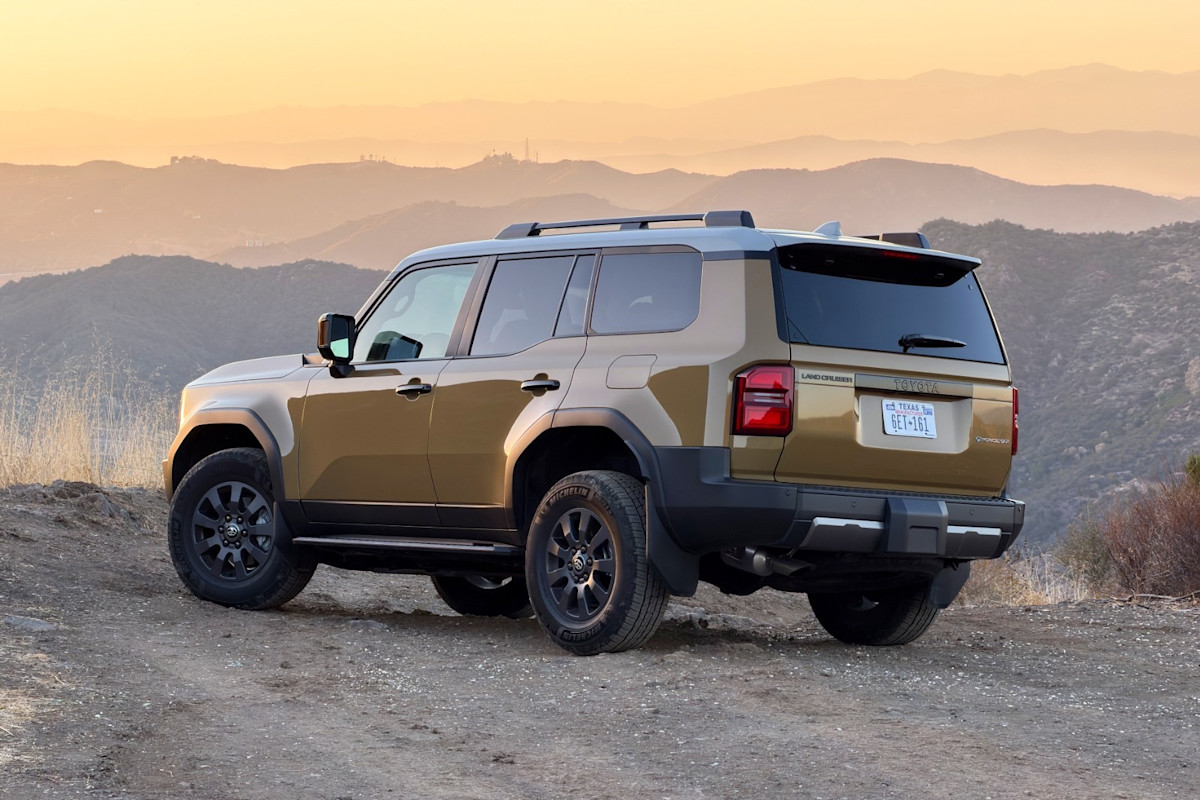
Two versions of this SUV are available for 2027 — the Land Cruiser 1958 and an unnamed higher trim level — and it's easy to them tell apart. The 1958 has round headlights and cloth seats, while the other version has rectangular lamps and standard artificial leather upholstery. The higher trim level is also available in more colours than the 1958’s limited palette of black or Brown Sugar beige, and it's available with more features and optional upgrades.
Starting in Canada at $73,600 including the $1,930 destination charge, the 1958 exists for people who love a basic but functional vehicle and might be stretching their budget to reach Toyota’s legendary SUV. Priced from $82,390 including destination, the upmarket Land Cruiser is made for those seeking a little more for their money.
Our Land Cruiser test vehicle had several options, including two-tone Trail Dust paint with a light grey roof and the Premium Package. The manufacturer’s suggested retail price (MSRP) was $89,155 including destination.
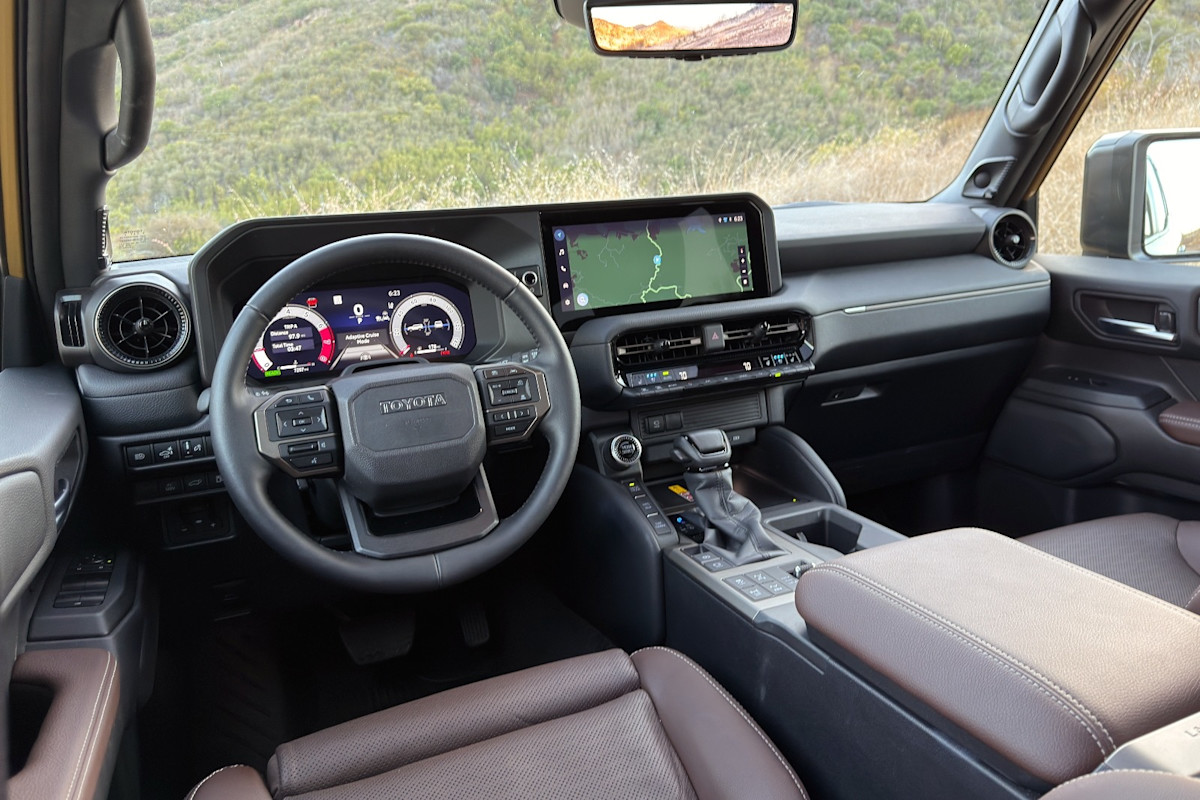
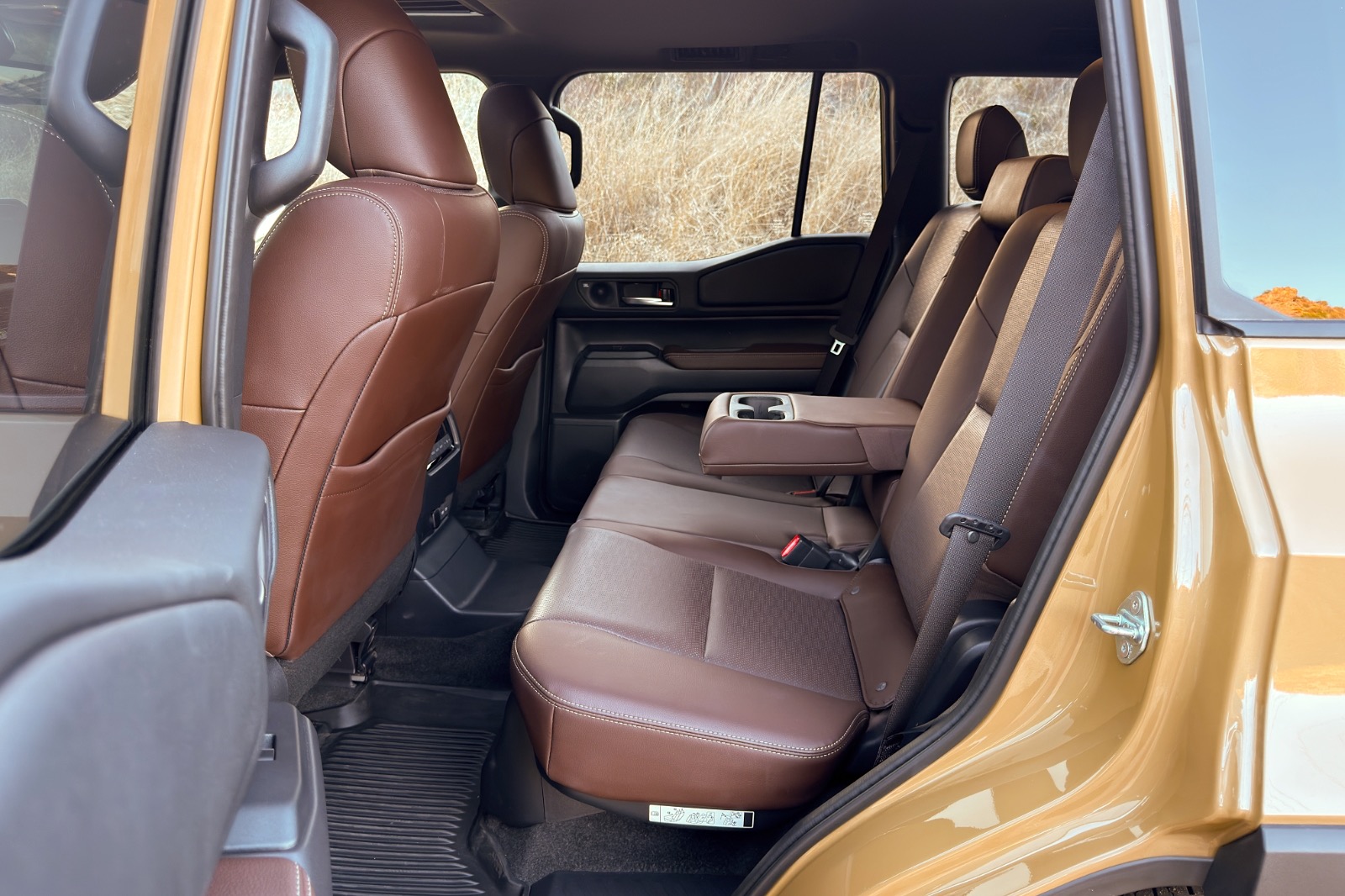
Climb aboard, and the Cruiser’s cabin emphasizes function over form. It’s not as upscale as its platform-mate, the Lexus GX, but the test vehicle’s optional Premium Package included soft leather upholstery in a rich Java brown and generous padding on common contact surfaces.
The displays and switchgear are similar to those of the Lexus, which costs more, so this is one Toyota that seems a cut above the norm. Aside from a thin metallic echo when a door slams, the Land Cruiser exudes quality in its construction and materials.
Performance
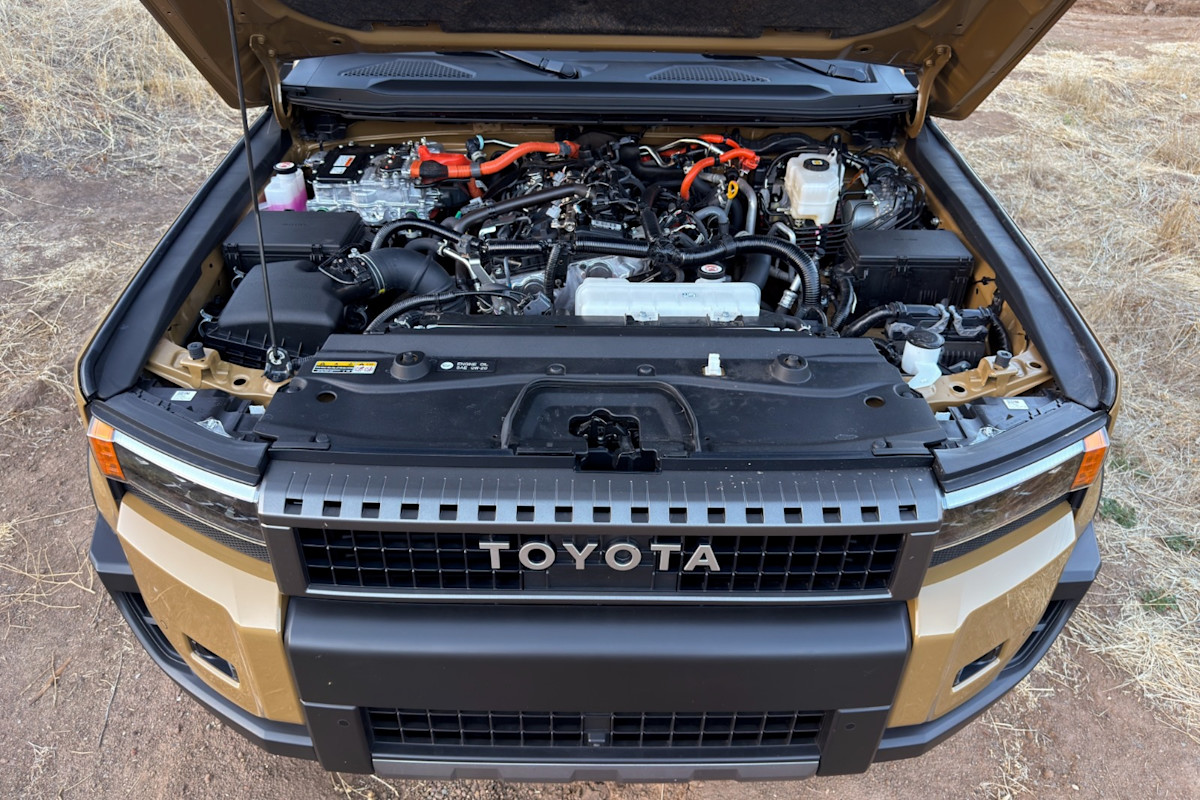
Toyota equips the Land Cruiser with the same i-Force Max hybrid powertrain as the 4Runner SUV and Tacoma pickup truck. This hybrid system pairs a turbocharged 2.4-litre four-cylinder engine with an electric motor to produce 326 horsepower and 465 pound-feet of torque. An eight-speed automatic transmission is standard along with full-time four-wheel drive (4WD), a trailer brake controller, and 2,722 kilograms (6,000 pounds) of towing capacity.
According to Natural Resources Canada, a 2027 Land Cruiser should consume 10.1 litres per 100 kilometres combined on premium fuel, which Toyota recommends. During a significant heat wave, our test vehicle averaged 11.6 L/100 km on our fuel economy loop. Later during cooler weather, the Land Cruiser returned 13.0 L/100 km on our mountainous evaluation route.
To ensure the latest Land Cruisers live up to the expectations set by their predecessors, the newest generation has centre and locking rear differentials, a limited-slip rear differential, hill start assist, hill descent assist, and Crawl Control, a low-speed cruise control system for off-roading. Ground clearance measures up to 21.6 centimetres, and the angles of approach, breakover, and departure measure 32, 22, and 23 degrees respectively.
Upgrade from the 1958 to the higher-spec Land Cruiser and there's a different 18-inch wheel design with wider 265/70R18 tires, while 20-inch wheels are part of the Premium Package. Additionally, the more expensive versions feature Multi-Terrain Select (MTS) modes (including Mud, Dirt, and Sand), the Multi-Terrain Monitor (MTM) surround-view camera system, and a front stabilizer bar disconnect system.
With up to 2,460 kilograms (5,423 pounds) to motivate, the i-Force Max powertrain has its work cut out for it, but it offers more than adequate oomph. That 465 lb-ft of torque feels impressive, especially when drivers gently roll into it instead of mashing their foot on the accelerator pedal. Ultimately, though it feels quick, it’s not.
Designed and engineered for serious off-roading, the Land Cruiser effortlessly scaled a local mountain trail, picking its way across treacherous ruts and dips in 4WD Lo with the MTS Dirt setting active. We didn’t need to lock the diffs or disconnect the front stabilizer bar, though doing so may have prevented some of the wheel slip we occasionally experienced. The test vehicle’s tires might also have been to blame as they lacked bite. Later, a steep descent was no trouble at all thanks to the standard Crawl Control system.
In daily driving, the Land Cruiser is mostly agreeable. It often rides like a truck but feels impervious to crumbling urban infrastructure. It soaks up speed bumps and humps, and while occupants are aware of poorly maintained pavement, they should expect to feel the road in a rugged off-roader like this. A few times when driving in the city or in traffic, we felt and heard an odd drivetrain clunk but nothing worrisome. The primary downside here is a touchy brake pedal that can make it hard to slow down smoothly.
Nevertheless, the Land Cruiser was a pleasing conveyance during a day trip into the city. It navigated narrow residential streets just as easily as it did the rutted trail in the mountains. The boxy dimensions, clear view out, and surround view cameras made parallel parking a breeze. We also had no trouble squeezing into cramped parking garages thanks to a tight turning radius and reasonably tidy dimensions.
On the mountainous evaluation route, the Land Cruiser proved predictably reluctant to hustle down a canyon road. The tires felt squishy and howled in curves, and the SUV exhibited a lot of nose dive when braking, rear squat when accelerating, and body roll in corners. The handling is predictable, though, even over undulating pavement.
On a four-lane coastal highway, the Land Cruiser proved smooth and easy to drive. Road noise was not an issue, but wind noise sure was. It seemed like one of the windows was slightly cracked, but we checked multiple times to make sure they and the power sunroof were all tightly sealed. If not for that flaw, we think the Land Cruiser would be a quiet and comfortable road trip vehicle.
Form & function
As we mentioned, the 1958 model is basic. It’s equipped with manually adjustable (including for height) and heated front seats with cloth upholstery. Buyers who choose the higher trim level get a power-adjustable driver’s seat, ventilated front seats, a power sunroof, and Toyota’s SofTex artificial leather. Our test vehicle had the optional Premium Package, which adds power adjustment for the front passenger, genuine leather, memory for the driver’s preferred settings, heated and ventilated rear seats, and several technology upgrades.
The Land Cruiser’s front and rear seats are quite comfortable with plenty of room for up to five people. A third-row seat is not available — that's the Lexus GX's territory.
Storage is a mixed bag. For example, the test vehicle’s optional centre console cool box is sized to hold just four beverage cans, so it’s not particularly large. It also seems to be smaller than whatever storage bin is standard, so unless buyers are really big fans of chilled beverages, it’s not worth picking the Premium Package for this option. And speaking of drinks, the cupholders can’t hold larger water bottles such a one-litre flask.
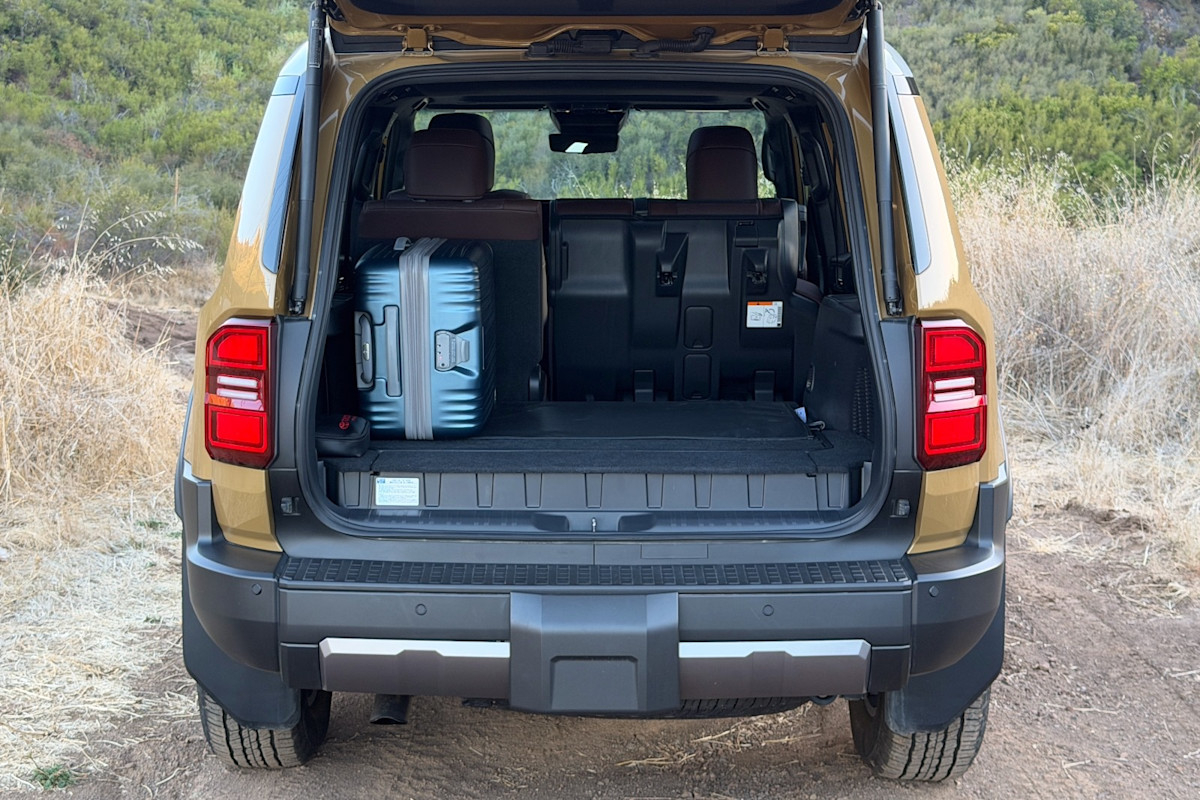
A power liftgate is standard with the upper trim level, granting access to a 1,062-litre cargo area. The liftover height is extremely high due to the placement of the hybrid powertrain’s battery pack underneath the cargo floor. Also, unlike with a Toyota 4Runner, the rear window doesn’t power down to create an open and airy cabin environment when driving with the windows down.
The cargo space expands to a maximum of 2,327 litres. The 60/40-split rear seat folds down or tumbles forward. Either way, it isn't possible to achieve a flat surface, which makes it even harder to load bulky or heavy items.
Technology
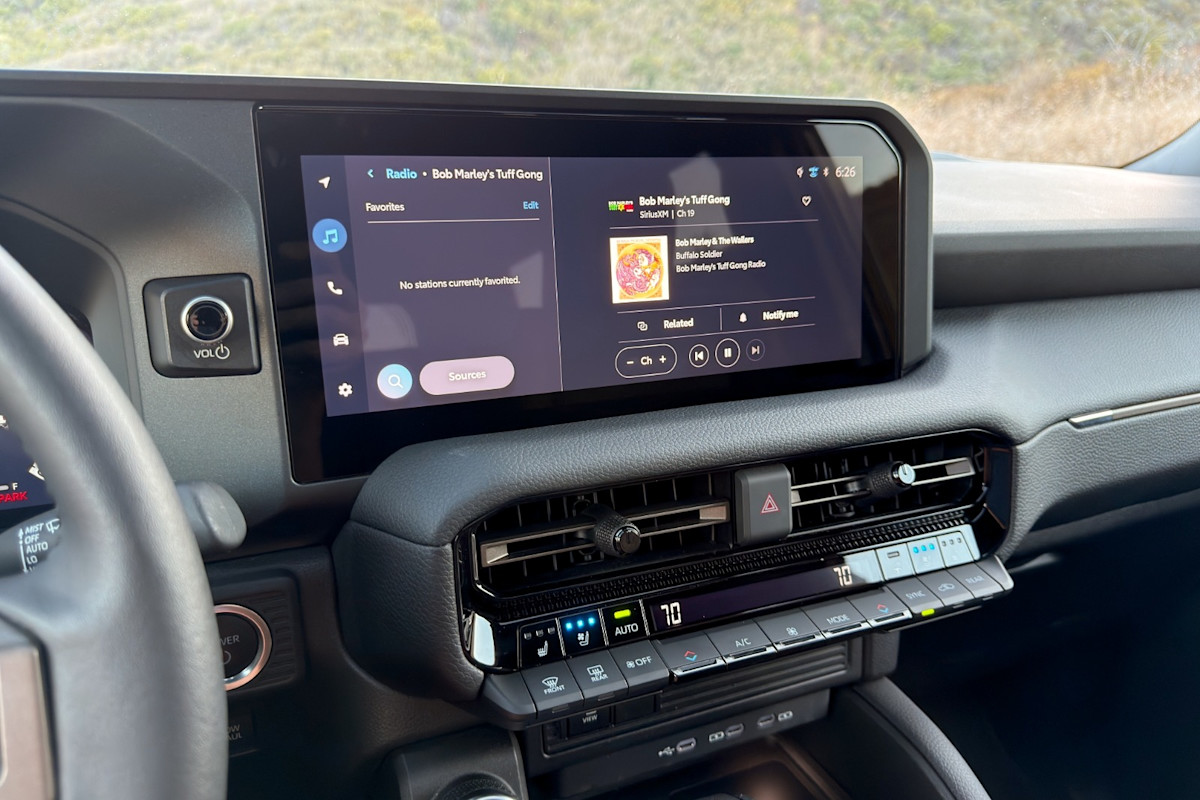
A 7-inch digital instrument cluster and an 8-inch touchscreen infotainment system are standard in the Land Cruiser 1958. There's a more sophisticated tech stack in the higher trim level featuring a 12.3-inch digital instrumentation cluster and a 12.3-inch touchscreen for the infotainment system. Either way, wireless Apple CarPlay and Android Auto are included along with trial periods for Toyota’s connected services.
Our test vehicle had the bigger displays along with wireless phone charging. The Premium Package equipped our Land Cruiser with a 14-speaker JBL audio system, a digital rearview mirror, and a head-up display.
Four connected service plans are available. They include Service Connect, Safety Connect, and Remote Connect with complimentary five-year subscriptions to each. Drive Connect, which adds a cloud-based navigation system, an Intelligent Assistant voice recognition system, and concierge services, is free for three months.
During testing, the Intelligent Assistant worked almost flawlessly as it quickly and accurately responded to our commands. The exception, as usual, was the prompt: “I want to listen to reggae music,” which the system interpreted as “ragtime music.” We also noticed that the response to “I need to go to a hospital” did not consistently list the hospitals in order of distance.
This infotainment system is simple and easy to use. It lacks a home screen showing different data panels, but it's possible to replicate the experience to some degree by programming the data panels in the digital instrument cluster. We prefer the Night mode even during the day because the Day mode offers low-contrast graphics that can be hard to see.
Safety
Every Land Cruiser has Toyota Safety Sense 3.0 (TSS 3.0), which includes high beam assist, forward collision warning with pedestrian detection, automatic emergency braking, adaptive cruise control, lane departure warning, lane keep assist, and lane centring assist with automatic emergency stop capability.
Proactive Driving Assist (PDA) is also part of TSS 3.0. It can automatically add subtle braking and steering inputs to provide an extra layer of safety. While it is effective, it can also be a bit too aggressive with those braking inputs for our liking.
Additional standard features include blind spot monitoring and rear cross-traffic alert. A surround-view camera system is equipped on the higher trim, and the Premium Package adds lane change assist, front cross-traffic alert, and Traffic Jam Assist (TJA).
At speeds below 40 km/h, TJA offers hands-free driving in heavy traffic. We found it effective in thickening afternoon rush hour traffic, but 40 km/h is a low threshold. The system kept switching on and off, becoming a distraction instead of a solution.
On a four-lane coastal highway, the lane centring assist was overly intrusive and seemed to require more effort to override than we'd like. It didn’t help that the Land Cruiser’s steering was relatively slow, a common trait of off-road vehicles. When we counter steered to choose a different line through a turn, the SUV would wobble a little on its soft suspension.
The U.S. National Highway Traffic Safety Administration (NHTSA) gave the 2027 Toyota Land Cruiser an overall safety rating of four stars. It also gave the Land Cruiser four-star ratings for the driver and front passenger in the frontal impact crash test, five-star ratings in the side impact crash test, and a three-star rollover resistance rating.
The Insurance Institute for Highway Safety (IIHS) gave the Land Cruiser mostly Good ratings with some Acceptable and Marginal scores in the mix. That Marginal result is from the updated moderate overlap frontal impact test, which measures protection for rear seat passengers. The rectangular headlights on the more expensive Land Cruiser model score lower (Marginal) than the more affordable 1958’s round headlights (Good).
Cost-effectiveness
A Toyota Land Cruiser’s cost-effectiveness depends on what it's measured against.
There are more affordable ways to explore deep into the backcountry such as a low-spec Ford Bronco or Jeep Wrangler. Compared to those two models, the more refined Jeep Grand Cherokee can also hold its own off-road and is also priced lower than the Land Cruiser (though a fully loaded model costs about the same).
Add the Land Rover Defender 110 and the Lexus GX to the mix, and then the Land Cruiser seems like an economically prudent decision. Toyota has a well-known reputation for reliability that Land Rover can only dream of, and a Defender starts in the same price bracket as the base Land Cruiser. The Lexus GX is based on the Land Cruiser but is more powerful and has exclusive features — upgrades that require a higher price tag.
The upshot is that it's possible to buy a less refined vehicle for less money that can tackle the same terrain as the Land Cruiser — or an equally refined Land Rover, but it won’t offer an equal promise of reliability and resale value. The other option is to spend more and get the nicer Lexus version of the Land Cruiser. In that context, the 2027 Land Cruiser strikes us as a good value.
What owners say
Car is a tremendous value for countless reasons, state of art tech, smooth quiet yet solid ride with plenty of power. Comfort has been incredibly well thought out, a luxury car that is a beast off road as well. Cherry on top is how it holds value verses comparably priced pretend SUVs
October 6, 2026Trims & specs
Base MSRP $57,880 | Seating 5 |
Engine N/A | Cargo Capacity 46.2 cu ft |
Combined MPG N/A | Drivetrain N/A |
Base MSRP $62,725 | Seating 5 |
Engine N/A | Cargo Capacity 46.2 cu ft |
Combined MPG N/A | Drivetrain N/A |


