2026 Toyota GR Corolla Reviews, Pricing & Specs


Pros & cons
What we like
Incredible poise and stability
Serious drivetrain and suspension hardware
Very engaging to drive
What to consider
Limited choice of exterior and interior colors
Cramped interior
Rough ride
The CarGurus verdict
The Toyota GR Corolla is a hot hatch and a tiny ball of fury in an everyday wrapper.
The purest expression of Toyota's motorsports expertise is the GR Corolla. What starts as a humble mass-market car — the bestselling car in the whole world, ever — becomes a handmade racer with custom parts that are not shared with any other model in Toyota's North American lineup. With a turbo three-cylinder engine, a six-speed manual transmission, all-wheel drive (AWD), and a level of engineering scrutiny reserved for cars costing double or triple its price, the GR Corolla is a very special offering.
Verdict: This is the best new driver's car under $60,000.
out of 10 expert review
Look & feel
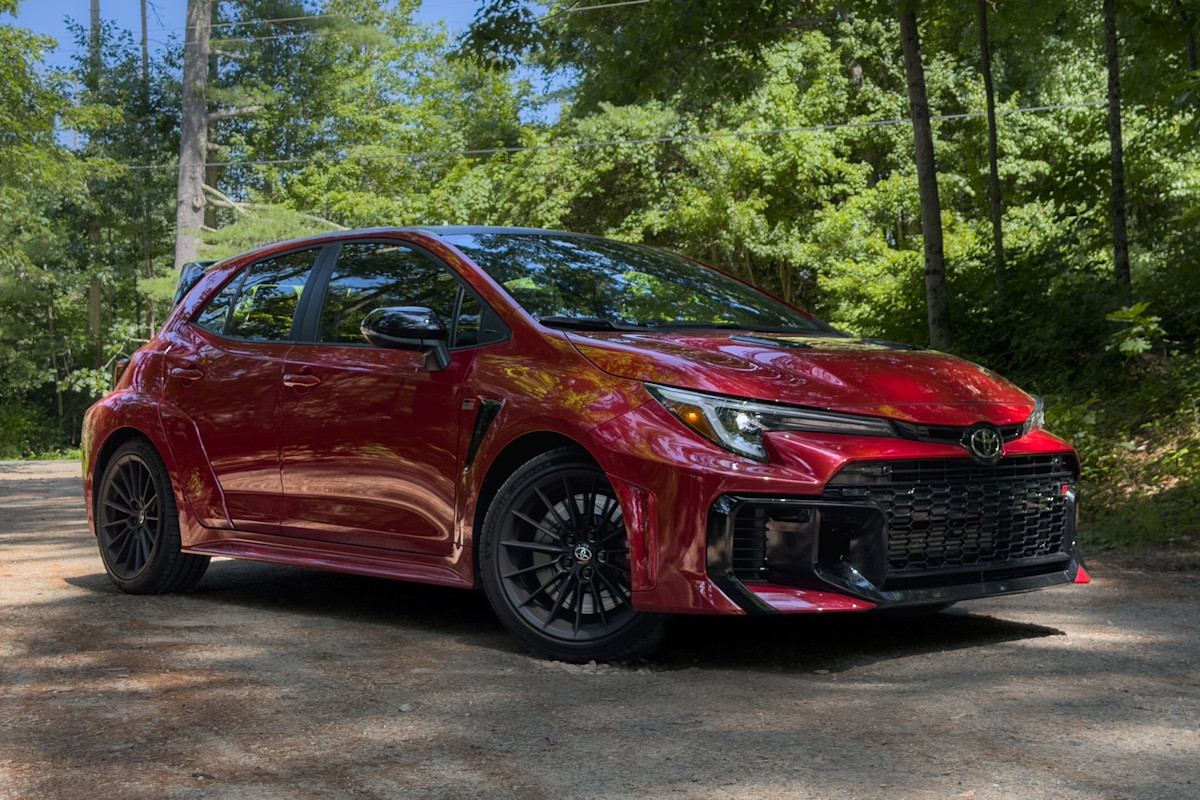
Based on the Corolla hatchback (those who want a sedan will have to shop for something else), the GR Corolla is wider, lower, and longer. This allows it to fit a racing suspension system, apply downforce, and keep all its hot performance parts at the ideal temperature. These changes blend well with the carryover styling elements from the standard Corolla.
The oversized headlights occupy the majority of the front end while pointing down to a boxy egg-crate grille with large ducts and vents at each corner. A domed hood rises to reveal two air vents. Bulky fenders jut out on all corners, and three exhaust outlets pierce through a bulbous and squared-off bumper.
What keeps this racing aesthetic in check are small grey 18-inch wheels, a short wing, and an absence of bright accents, tacky badges, or silly decals. An available carbon fibre roof is the loudest flex, and yet its dark satin finish is purposeful like the rest of the car. The doors still feel like they're hollow, the hood has no struts, and the all-black interior is uninviting. It is a Corolla, after all.
Interior materials are quite good. Padded rubber on the doors, dash, and console ensure the driver and passenger press against something soft during hard cornering. The leather and faux-suede seats are heavily bolstered and supportive. A GR-specific three-spoke steering wheel, shifter, handbrake, and driving mode selector are subtle upgrades over the regular Corolla, along with red stitching on certain versions that livens up the dark cockpit. (The base model has grey stitching.) It’s otherwise basic, unadorned and, thankfully, devoid of giant screens.
GRMN models, available in a very limited run, have even more vents, canards on the front lip, a larger wing, bronze wheels, and extra carbon fibre including on the entire unpainted hood. The seats are further upgraded to be thinner, lighter, and adorned with more red accents. Faux suede also covers more of the interior surfaces including the steering wheel. The GRMN comes in two colours, black or grey, while white and red are available on the standard versions.

Performance
A three-cylinder block is an unusual basis for a racing engine. Yet Toyota went there, out of manufacturing efficiency and for the technical achievement of creating one of the most power-dense engines on earth. The 1.6-litre turbocharged unit makes 300 horsepower and 295 pound-feet of torque with smooth and linear delivery, a sonorous intake, and baritone exhaust notes.
Paired with a six-speed manual transmission with tall lower gears, the GR Corolla takes off like it's been rear-ended and does not run out of steam. It's a forceful and steady build of speed, and like the Volkswagen Golf R, the GR Corolla accelerates with a calmness that belies its tuner car appearance. The heavy clutch spring requires a lot of throttle modulation at low speeds and there's drivetrain rattle, but the engagement point is easy to place and the shifter's short throws are satisfying.
Honda's laser-precise manual is still the best, but the GR Corolla's wow factor is the GR-Four AWD system that outpaces VW and Subaru in its uncanny ability to route torque everywhere. Two limited-slip differentials and a multi-plate clutch pack ensure no wheel is spinning under hard acceleration or cornering. In normal mode, the GR-Four system sends 60% of torque to the front wheels. Gravel locks the split to 50-50, and Track mode is the most variable as it can switch from a 60/40 split to a 30/70 split and anywhere in between. This is the type of robust AWD that used to be available on rally-inspired performance cars such as the Mitsubishi Lancer Evo and the Subaru WRX STI.
The GR Corolla is fun and controllable in any weather. The steering is perfectly weighted and quick without being twitchy — a hard feat on a short-wheelbase chassis, which inherently amplifies small movements. The suspension, however, is rock hard all the time. During a daily commute, the GR Corolla is uncomfortable and plagued with road noise. Insulation and adaptive dampers are not on the order sheet, but riding like a stone also translates to feeling rock solid at higher speeds. A MacPherson strut front and double wishbone rear, along with thick stabilizer bars and high spring rates, keep the car settled without it scampering over dips and bumps. Those inside will bounce around, but the car won't. For 2026, Toyota added exactly 13.9 metres of structural adhesive to further stiffen the Corolla's body. Combined with that stiff suspension, the forged carbon roof, an optional rear chassis brace, and sticky Michelin Pilot Sport 5 tires, the GR Corolla can outpace cars with double the power on a tight back road. This little car makes it look easy.
Braking is exemplary thanks to 14-inch front rotors and a relatively light curb weight that tops out at 1,515 kilograms (3,341 pounds) on the Premium with the eight-speed automatic transmission. The latter adds more weight and a launch control function, but unlike the dual-clutch automatic in the Hyundai Elantra N, it's not worth the extra cost and detracts from the car's sprightliness. Also worth a cursory mention is Active Sound Control, a new feature that ratchets up the already loud engine in the cabin with a choice of three volume levels. We left it off.
Fuel economy is rated by Natural Resources Canada at 11.1 litres per 100 kilometres in the city, 8.3 on the highway, and 9.8 combined with the manual transmission and 12.1 L/100 km city, 8.6 highway, and 10.5 combined with the automatic. A tiny 50-litre fuel tank, combined with the driver's eagerness, equals mediocre real-world range.

Form & function
As a high-performance car, the GR Corolla should score a 10 in the form and function category. But running to the hilt in a road car is unrealistic, and as a practically designed hatchback meant to be used as a daily driver, the GR Corolla loses points for being cramped and unusable for more than two people.
The rear door cutouts are narrow, and there is virtually no toe space — let alone legroom — for rear passengers. The cargo area, at 503 litres, is smaller than the number suggests. The steep rake of the hatch, the small opening, and the positioning of the rear seatbacks are permanent roadblocks to accommodating anything more than one large suitcase. The regular Corolla hatchback suffers from the same tight quarters. Even when compared to other compact cars, the GR Corolla feels the most confined. Door pockets are slim, and there is no covered centre console. Any phone placed on the standard wireless charging pad will slide off during hard driving or lose contact with the pad during regular driving.
Sightlines are at least good from the large windshield and front side glass. The tiny rear window really makes drivers appreciate the backup camera. Analog controls for the climate, stereo, powertrain, and standard heated seats are very welcome, as are the many buttons on the steering wheel to operate the cruise control, stereo, and information displays on the instrument panel. The mirrors don't power fold, the mirror doesn't auto-dim, and there is no sunroof. Dual-zone climate, one-touch up/down for all windows, a crank handbrake, and alloy pedal covers are among the most practical conveniences.

Technology
An 8-inch touchscreen and 12.3-inch digital instrument cluster come standard, while a head-up display is reserved for the Premium versions. Toyota's user interface is optimized for models with larger touchscreens such as the RAV4 and Tacoma. Here, typefaces and icons are small. It's best to use the standard wireless Apple CarPlay or Android Auto for free navigation and for apps that appear properly sized in proportion to the screen.
The vehicle settings are also unorganized. Only a few appear in the menu with the vehicle icon. Others are in the main settings menu, and yet more are accessed only via the steering wheel controls and the instrument panel where they’re buried behind multiple menu layers. Changing the driver assistance features, for example, is a long process.
The instrument cluster is much better. Drivers can adjust what appears in the left, centre, and right corners of the display and save three presets that are easily switched with buttons on the wheel. Want to see the turbo boost and tire pressure with the selected gear? Or want the trip odometer with the adaptive cruise markings? The presets let users customize the look at a moment's notice independent of the driving mode.
A proximity key, wireless charging pad, full LED lighting, and six-speaker stereo with SiriusXM come standard. Navigation is standard but requires a subscription after three years. A three-year trial of Toyota's Remote Connect smartphone app is also included. A five-year trial for Toyota Safety Connect is standard, which includes emergency assistance and stolen vehicle tracking, along with Service Connect, which provides maintenance reminders.

Safety
The GR Corolla comes with 10 airbags including front knee and rear side airbags. A full suite of active safety features is also standard including automatic emergency braking with pedestrian detection, adaptive cruise control, lane departure warning and lane keep assist, high beam assist, traffic sign recognition, blind spot monitoring, and rear cross-traffic alert. Front and rear parking sensors are included with the Premium versions. Only automatic models come with adaptive cruise that works at low speeds (advertised as "Full-Speed Range") along with Proactive Driving Assist, which automatically slows the car around turns, when other cars slow down, or when it's about to stop.
While safety ratings for the GR Corolla were not available at the time of writing, the 2026 Corolla Hatchback on which it’s based received a five-star safety rating from the U.S. National Highway Traffic Safety Administration (NHTSA) and top scores in both front and side crashes. Full ratings from the Insurance Institute for Highway Safety (IIHS) also weren’t available at the time of publication. The non-GR Corolla received the top Good score in the small overlap front test and Acceptable for the side crash test.

Cost-effectiveness
The 2026 Toyota GR Corolla comes in three versions. In Canada, pricing starts at $52,055 with the $1,760 destination charge for the base model. The Premium is $59,377 with the manual transmission and $61,597 with the automatic. The GRMN is priced at $79,040 in Gravel and $80,865 with Zero Gravity matte paint. Supersonic Red or Heavy Metal paint costs $350. There are no standalone options or packages from the factory, only dealer-installed performance accessories such as lowering springs, a rear chassis brace, and a dual-tip exhaust.
This is an expensive small car with tremendous value. It manages to be as explosive and fun as a Civic Type R or an Integra Type S but with superior control and all-weather capabilities. The Subaru WRX and the Hyundai Elantra N are impressive but ultimately can't hang at the GR Corolla's limit. Only the Volkswagen Golf R beats it in terms of everyday refinement, but for performance and driver involvement, it too loses. With the GR Corolla, Toyota has built a special car that drivers won't regret spending a premium to own.

What owners say
Trims & specs
Base MSRP N/A | Seating N/A |
Engine N/A | Cargo Capacity N/A |
Combined MPG N/A | Drivetrain N/A |
Base MSRP N/A | Seating N/A |
Engine N/A | Cargo Capacity N/A |
Combined MPG N/A | Drivetrain N/A |
Base MSRP $40,520 | Seating 5 |
Engine 1.6L 300 hp I3 | Cargo Capacity 17.8 cu ft |
Combined MPG 24 | Drivetrain AWD |
Base MSRP $46,565 | Seating 5 |
Engine 1.6L 300 hp I3 | Cargo Capacity 17.8 cu ft |
Combined MPG 24 | Drivetrain AWD |


