2026 Porsche Cayenne Coupe Electric Reviews, Pricing & Specs
Write a review--
Original MSRP
6.5
of 10
expert review
avg user rating
(0 reviews)
Pros
Acceleration that hurts so good
Clever touchscreen layout
Fast charging, with wireless option coming
Cons
Potentially polarizing styling
Size and weight are always apparent
Poor value for money
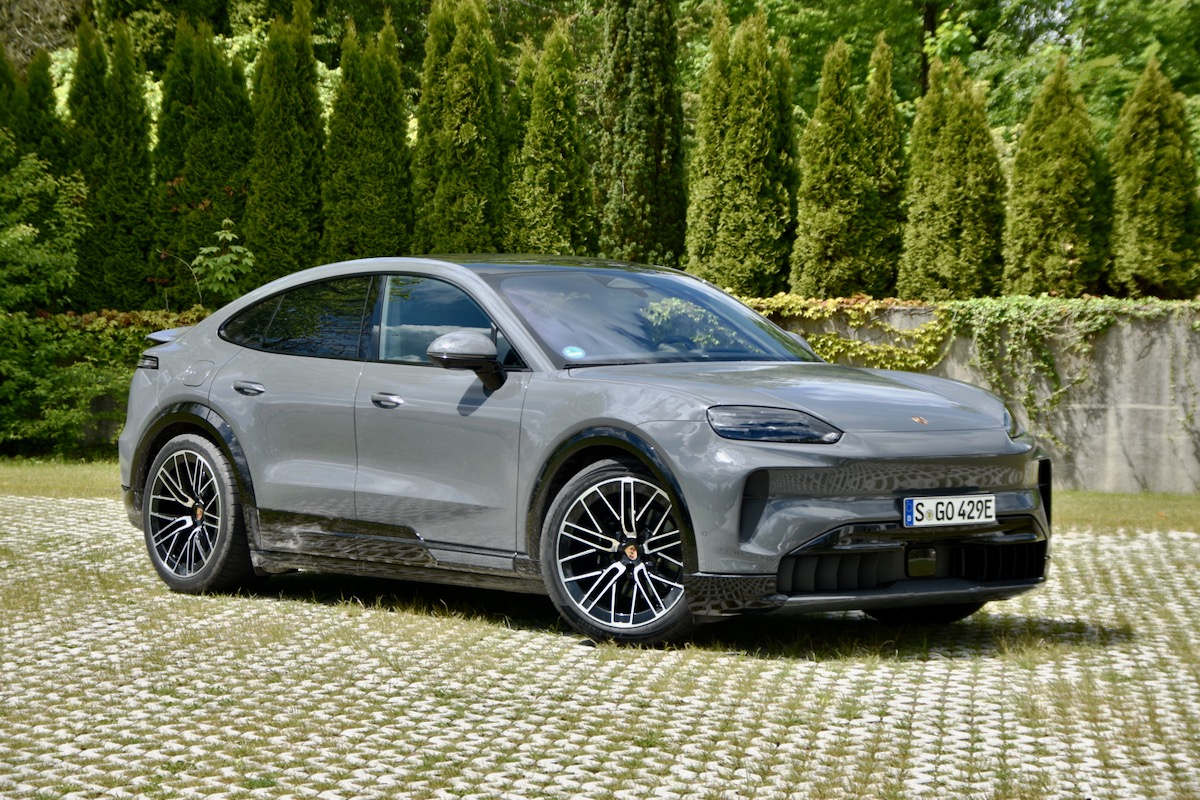
A coupe body style adds even more choice to the Cayenne Electric lineup.
For the 2026 model year, Porsche’s original SUV goes electric. Like the gasoline Cayenne, the 2026 Porsche Cayenne Electric offers an array of choices. This includes not just multiple powertrain options but also conventional SUV and coupe body styles. The latter is the subject of this review.
Verdict: Porsche once again pushes the boundaries of what’s possible with both EVs and SUVs, creating a vehicle that can do pretty much anything.

Both the standard Cayenne Electric and the Cayenne Coupé Electric share only a name with internal-combustion Cayennes. Porsche considers the electric models to be a whole generation ahead of the gasoline equivalents. They’re based on a dedicated EV architecture known as Premium Platform Electric (PPE) that’s also used by the Porsche Macan Electric, Audi Q6 e-tron, and Audi A6 e-tron.
With that in mind, it’s not surprising that the Cayenne Coupé Electric bears only a passing resemblance to the combustion-engine Cayenne Coupé. It’s not necessarily an improvement — the various surfaces don’t blend into a cohesive whole — but the active aero elements shared with the regular Cayenne Electric are at least functional. The “aeroblades” that pop out of the rear fenders to reduce drag are a unique party trick. They work with a Coupé-specific pop-up rear spoiler to give it a range-enhancing drag coefficient of 0.23, down from 0.25 for the standard Cayenne Electric.
The choice of trim levels is the same as for the standard Cayenne Electric: base, S, and Turbo. Yes, the name “Turbo” doesn’t make sense on an electric vehicle that categorically cannot be equipped with a turbocharger, but Porsche and its customers don’t care. Base models come standard with 20-inch wheels and all-season tires, but this being Porsche, there are many optional designs to choose from in 21-inch and 22-inch sizes as well as summer tires.
The interior has some familiar Porsche touches — including a wonderful thin steering wheel — but they play second fiddle to the screens that occupy nearly all of the dashboard space. The surfaces that aren’t meant to project pixels are suitably smart for an EV of this price, but a fully leather interior isn’t standard. While the base Cayenne Coupé Electric’s eight-way power-adjustable Sport Seats might seem adequate at first, that is only the case until drivers try the optional 14-way Comfort Seats or 18-way Adaptive Sport Seats Plus.
Alternatively, an available Lightweight Sport Package includes fabric seat inserts in the classic Pepita pattern, carbon fibre interior trim, a carbon fibre roof, and 22-inch wheels with performance tires. The package saves up to 17.6 kilograms (38.8 pounds), according to Porsche, but that’s a drop in the bucket considering the baseline 2,557-kilogram (5,637-pound) curb weight.

All three versions have dual-motor, all-wheel drive powertrains. The base Cayenne Coupé Electric is tuned for 435 horsepower and 615 pound-feet of torque when using launch control. That gets it from 0-100 km/h in 4.8 seconds and on to a top speed of 230 km/h, according to Porsche. All models have a 113-kilowatt-hour battery pack.
The mid-range Cayenne Coupé S Electric generates 657 hp and 796 lb-ft of torque (again, with launch control), will get to 100 km/h from a standstill in 3.8 seconds, and tops out at 250 km/h. Things just get silly with the Cayenne Coupé Turbo Electric, which produces 1,139 hp and 1,106 lb-ft. That gets it from 0-100 km/h in just 2.5 seconds and on to 260 km/h.
Rear-axle steering is optional on all models, along with the typical Porsche Sport Chrono Package. In this case, the latter adds a Sport mode for the standard Porsche Stability Management system on the base model and a Sport Plus drive mode (affecting more systems) and push-to-pass function on the S and the Turbo that provides a 10-second horsepower boost. Air suspension is standard with active suspension and torque vectoring available as options on higher trim levels.
The base model feels adequately quick for a six-figure car wearing the Porsche crest. It didn’t break a sweat on sections of unrestricted German autobahn. But the ride quality on optional 22-inch wheels was unimpressive, and there wasn’t a handling benefit, either. While the Cayenne Coupé is capable of strong regenerative braking — as much as a Formula E race car, according to Porsche — it rarely deploys it because Porsche does not believe in one-pedal driving.
The optional Active Ride suspension made a big difference in both the Cayenne Coupé S and the Turbo models we tested. It erases body roll and even the pitch that normally occurs under acceleration and braking, providing a massive improvement in ride quality. Pair that with the Turbo’s 1,139 hp — so much that acceleration actually hurts — and it is something truly stunning. But the driving experience is more about reining in that power and the Cayenne Coupé Electric’s weight rather than outright joy. Precise but uncommunicative steering doesn’t help.
Like the standard Cayenne Electric, the Coupé can be equipped with an off-road package that includes a different front fascia to improve the approach angle, reinforced side skirts, and skid plates. We didn’t get to test any of this, but in a demonstration we saw Cayenne Electric prototypes climb steep hills and ford mud bogs without getting stuck. That bodes well for adventurous owners.

A four-seat configuration is standard with cupholders between the rear seats, but a conventional five-seat configuration with a second-row bench is also available at no cost. (Porsche calls it a “2+1” in reference to how little the middle seat is actually used.) The rear seats are two-way adjustable and have power folding. There’s plenty of headroom despite the pinched roofline, and legroom is more generous than it appears. A standard dimmable glass roof, controlled by a swipe gesture on the touchscreen, creates an airier feeling in the back.
Up front, the high cowl height somewhat impedes forward visibility, while the distinctive roofline leaves room for only a small rear window. In this respect, the Cayenne Coupé Electric is the worst of both worlds between traditional SUVs and coupes. There’s still plenty of space for the driver and front passenger, though, and an elaborate centre console with two sliding elements that contains the expected cupholders, a wireless phone charger, and small item storage. The height of the console also makes it a decent armrest.
Cargo space suffers a bit from the Coupé’s lower roofline. The Cayenne Coupé Electric’s 534 litres of cargo space behind the rear seats is 247 litres less than with the standard body style. Behind the rear seats, the Coupé offers 1,347 litres — 241 litres less than the standard Cayenne Electric. That’s at least supplemented by the same 90-litre front trunk (frunk) as the standard version. However, there is more cargo space than either Cayenne Electric body style in a BMW iX, Mercedes-Benz EQS SUV, or Lucid Gravity. The Lucid also has a front trunk big enough to double as a bench.
What most other electric SUVs can’t do is tow 3,500 kilograms (7,716 pounds). To match that, buyers would need a Rivian R1S, which is a real truck designed more for off-road capability than on-road performance and handling.

The Coupé's bevy of screens matches that of the standard Cayenne Electric. A 14.25-inch OLED digital gauge cluster shares the dashboard with the Flow Display, a vertically oriented 14.1-inch touchscreen that follows the shape of the dashboard, hence the name. A 14.9-inch front-passenger touchscreen is also available. Shared backgrounds for all three screens work with the ambient lighting to make the interior feel more high-tech and less like the TV section of Best Buy.
Wireless Apple CarPlay and Android Auto are standard, but Porsche isn’t following through on its bid to integrate CarPlay Ultra. That’s okay, as the level of integration from the current generation of CarPlay already covers the bases.
The split-screen Flow Display isn’t just a design gimmick. Widgets live on the lower half of the screen, and larger graphics such as the map view when using navigation occupy the bigger top section. Just below is a substantial hand rest that makes it easier to use the screen. Locating functions can be difficult, but that’s as much about the sheer number of features and controls as the design of the UI itself. Climate controls and a volume scroll wheel are situated below the main touchscreen, which also helps. We’d still prefer a volume knob, but that wasn’t in the cards given the amount of available space.
The main touchscreen is also equally accessible by driver and passenger, making the dedicated passenger screen redundant. When our passenger played one of the built-in video games — in this case, a knock-off of Colin McRae Rally — the noises were also very distracting even though the images were filtered out.
A 10-speaker audio system is standard, but even the base model we tested had the optional Bose 14-speaker surround-sound system. It had the typical bass-heavy Bose quality, but dialing that back left it sounding flat. An augmented-reality head-up display is also available, showing arrows to help avoid missed turns when using the navigation system.

Spending Porsche money doesn’t mean drivers get more advanced driver assist systems. Features such as adaptive cruise control, automatic emergency braking, forward collision warning, traffic sign recognition, a surround-view camera system, and lane keep assist are standard, as is expected of a car in this class. But there is nothing more sophisticated.
The optional Drive Assist system adds a higher degree of automation for highway driving, including automated lane centring and lane changes. The latter can be triggered using the turn signal stalk, but the Cayenne Coupé Electric will also try to change lanes automatically if the vehicle in front is traveling slower than the system’s set speed.
Because the Cayenne Electric models are so new, crash test results from the Insurance Institute for Highway Safety (IIHS) and the U.S. National Highway Traffic Safety Administration (NHTSA) were not available at the time of writing.

Natural Resources Canada range estimates were unavailable at the time of writing, but despite its big 113-kWh battery pack, the Cayenne Coupé Electric should charge quickly after eating up a few klicks. It can DC fast charge at up to 400 kilowatts and go from 10%-80% charge in 16 minutes, according to Porsche. A NACS port is standard, but owners will likely need to use the included CCS adapter to reach that power level. The DC fast-charge port is located in the driver’s side rear fender, while a J1772 port for the Cayenne Coupé Electric’s 11-kW AC onboard charger is located on the opposite side.
A wireless charging system will also be available after launch, allowing the Cayenne Coupé Electric to charge from a pad on the ground or a garage floor using a plate mounted under the vehicle at the same 11-kW rate as the conventional AC charger. Customers need to order cars pre-wired for wireless charging, but the actual pad and under-car plate won’t be available until a later date.
Pricing in Canada starts at $137,150 for the base Cayenne Coupé Electric, including the $2,950 destination charge but excluding the federal government’s luxury tax that applies to the portion of the price above $100,000. The Cayenne Coupé S Electric starts at $148,450, and the Cayenne Coupé Turbo Electric starts at $184,850. That means buyers pay a $2,900 to $3,600 premium (depending on the trim level) for the Coupé over the standard body style. That’s before options, which often pile on quickly with Porsche purchases.
The Cayenne Coupé Electric is not a rational choice. For just under $140,000, shoppers could have a Lucid Gravity Grand Touring with three rows of seats, a larger front trunk, and up to 724 km of range. For what is essentially a minivan without sliding doors, the Gravity Grand Touring is also very entertaining to drive and still does 0-100 km/h in 3.6 seconds—0.2 seconds quicker than the pricier Cayenne S Coupé Electric.
For buyers who just want a fast SUV or EV, there are other options. But for those who want a Porsche, as the ads say, there is no substitute.


