2026 Nissan LEAF Reviews, Pricing & Specs


Pros & cons
What we like
Stylish design
Comfortable
Excellent value for money
What to consider
Fairly pedestrian performance
Cramped back seat
The CarGurus verdict
A car that helped launch the modern EV age, the Nissan Leaf, gets a much-needed redesign for the 2026 model year.
The 2026 Nissan Leaf represents the latest redesign of Nissan’s pioneering EV, the first since the 2017 model year. This third-generation Leaf boasts more range, up-to-date tech and charging hardware, and new styling that looks more crossover than hatchback. But where the original Leaf was pioneering, the new Leaf returns to a mature segment populated by competent rivals from Chevrolet, Ford, Hyundai, Kia, Subaru, Toyota, and Volkswagen.
Verdict: The new Leaf picks up where the old one left off, and only occasionally reminds you of its relatively frugal nature.
out of 10 expert review
Look & feel
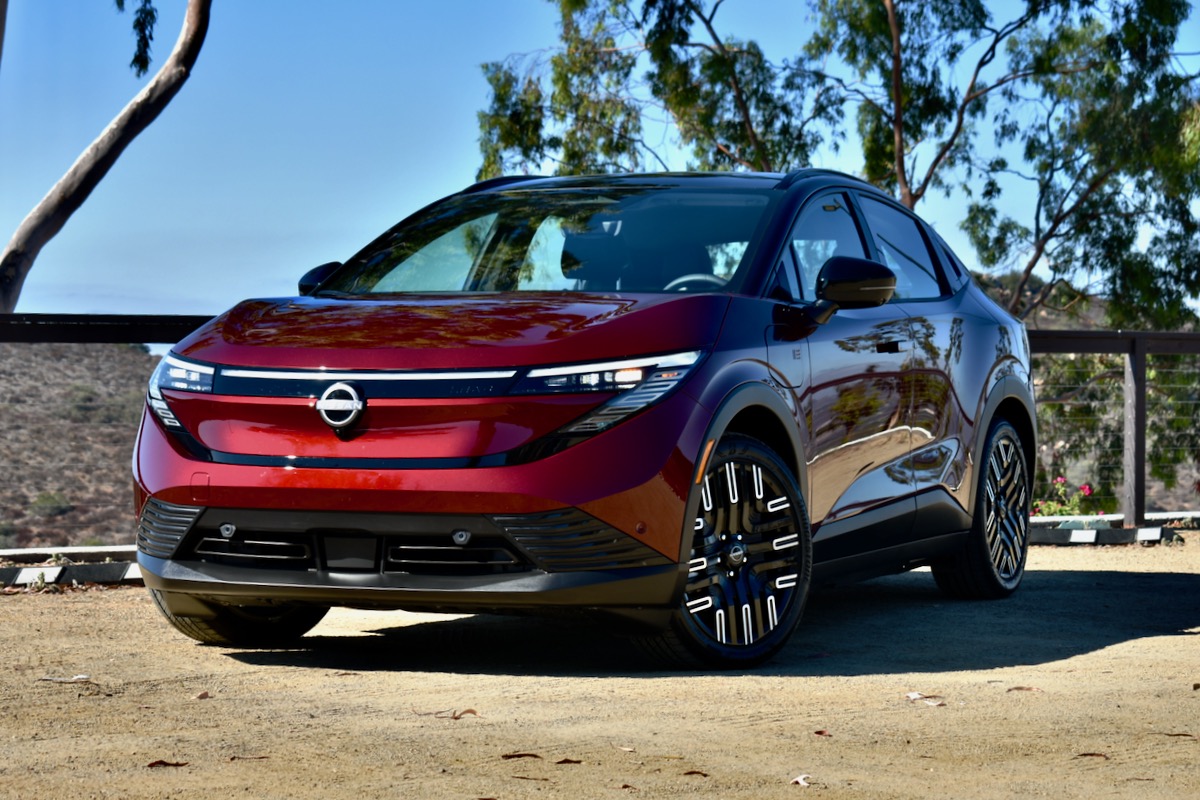
The Nissan Leaf’s redesign was worth the long wait. Instead of attempting to blend in with gasoline cars such as the outgoing second-generation Leaf, the new model finds its own styling path without resorting to EV cliches.
The friendly looking front fascia lacks a grille, but Nissan didn’t simply leave a blank space. Instead, the designers curved the surface and extended the headlights into a smiling countenance. A high belt line makes the new Leaf seem taller than the outgoing version even though it isn’t. The redesigned model is virtually the same height, and a bit wider, but also about 7.5 centimetres shorter. That compactness is emphasized by a chopped-off tail that recalls the Nissan Z sports car, with a strategically placed spoiler contributing to a low 0.26 coefficient of drag, compared to 0.29 for the previous Leaf.
Some of these new styling features were made possible by sacrificing what had been one of the Leaf’s most distinctive elements: a charge port located in the centre of the front fascia. That’s due to a switch to the North American Charging Standard (NACS) from the previous CHAdeMO standard, with a NACS DC fast-charging port on the passenger-side front fender and an SAE J1772 AC charging port on the opposite side.
Designers also hid a few Easter eggs throughout the car in the form of shapes in patterns of two and three. The most obvious is the taillights, which have three elements in the corners and two on the surface of the rear hatch. That’s a nod to the Japanese pronunciation of “2-3”, which is “ni-san”. That iconography is also incorporated into the wheel designs, which include 18-inch and 19-inch alloys for the mid-level SV Plus and top-level Platinum Plus, and 18-inch steel wheels for the Leaf S Plus model.
The interior gets a similar rethink with an unusual stepped dashboard that nestles the screens in their own alcove below the top of the dash, which is quite deep owing to the windshield’s laid-back angle. The computer-mouse shifter of the previous Leaf has been replaced with more straightforward buttons, the “2-3” motif is repeated on the floor mats, and the steering wheel has a two-spoke design that ensures an unobstructed view of the instrument cluster.
While it has some neat design features, the interior’s materials definitely remind you that this is a value-focused EV. A test drive will get you acquainted with all the different types of plastic the auto industry is using these days. Nissan offers a leather alternative called TailorFit, made from 65% recycled materials that the automaker claims are softer and more durable than real stuff. It’s available with both rows of seats with Platinum Plus models, as well as the front seats on SV Plus models. It feels less stiff and rubbery than typical leatherette upholstery, and has a cool textured pattern.

Performance
The third-generation Leaf retains the single-motor front-wheel drive (FWD) powertrain configuration of its predecessors. In Canada, all models are rated at 214 hp and 261 lb-ft of torque, with a 75-kWh pack. Last year’s SV Plus—the more powerful of two models available—had 214 hp like the higher-output 2026 Leaf models, with 250 lb-ft and a 60-kWh pack.
This gives the Leaf an output that comes close to the 220 hp of the single-motor Chevrolet Equinox EV. However, Nissan doesn’t offer a dual-motor all-wheel drive (AWD) option as many entry-level EVs do. Our Platinum Plus test car—the heaviest spec available—felt reasonably peppy off the line and when accelerating to overtake at highway speeds, so it’s certainly adequate.
With this redesign, the Leaf swaps its e-Pedal braking control system for the e-Step version used in the larger Nissan Ariya. The e-Pedal system blended friction and regenerative braking, while e-Step is essentially a higher level of regen on top of the four accessible through the Leaf’s steering wheel paddles. Both methods provided plenty of regen when needed—enough that we barely had to use the brake pedal on twisty roads—but it’s also good that Nissan offers options for lower regen for drivers that want it, or for highway driving when coasting can be more efficient.
The new Nissan Leaf has a multilink rear suspension in place of the old model’s torsion beam, giving it a planted feel while allowing for enough compliance to absorb bumps—even with our test car’s 19-inch wheels. However, despite its relatively small size, the Leaf doesn’t feel particularly agile. The turning circle is unusually large, and tight curves are hard work. The steering’s lack of precision is compounded by what feels like sudden weight transfer, which requires frequent mid-corner corrections. We also noticed more wind and tire noise than expected. The Leaf isn’t a sports car or a luxury car, but it certainly could be better to drive than it is.

Form & function
Because the new Nissan Leaf is a similar size to the old Leaf, interior space hasn’t changed much. First-row headroom actually shrinks by more than three centimetres, while second-row legroom contracts by more than four cm. That still leaves the 2026 model with about five cm more front-seat headroom than a Subaru Solterra, and roughly the same rear-seat headroom as the rest of its competitive set. The 2026 Nissan Leaf also has the same amount of front-seat legroom as a Kia EV6, but passengers will find the rear seats a lot more cramped than in other EVs.
It's a similar story when it comes to cargo space. The new Leaf has 566 litres of space behind its rear seats, compared to 668 litres before. But folding the rear bench yields 1,571 litres—a big improvement over the 2025 model’s 849 litres. A motion-activated liftgate is available, but only with top Platinum Plus models. But the Leaf offers the least cargo space in its competitive set with the rear seats in place, and it only beats the EV6 with the rear seats folded.
While little else about the Leaf feels genuinely crossover-like, its step-in height should please crossover shoppers. It’s easier to get in and out of than conventional hatchbacks, and once inside, Nissan’s Zero Gravity seats provide excellent support without feeling too hard. However, the Leaf’s front seats seem a bit narrow, which does at least provide clearance for large door-panel storage bins. Those are definitely needed as the covered storage space in the centre console and cupholders is quite small. The slot-like wireless device charger is clever, though; it uses minimal space, keeps phones secure, and still allows easy access to USB-C ports for connectivity.

Technology
Leaf S Plus models have a 12.3-inch digital instrument cluster and infotainment screen, while SV Plus and Platinum Plus models have dual 14.3-inch screens. Regardless of size, the screens are placed side-by-side to create the impression of one continuous display. The Leaf features standard wireless Apple CarPlay and Android Auto, and its new screens provide a stark contrast with the outgoing model’s dated interface.
SV Plus and Platinum Plus models add Google built-in apps as well as two rear USB-C ports and a wireless device charger in addition to the two front USB-C ports on the lowest trim level. A four-speaker audio system is standard on S Plus models, while SV Plus cars get a six-speaker system and Platinum Plus models have a 10-speaker Bose Personal Plus system with speakers in the front headrests.
For our first drive of the redesigned Leaf, we were able to sample only a Platinum Plus model with the larger screens, Google built-in apps, and Bose audio system. It’s quite a contrast from the outdated previous generation, but pretty much on the same level as more recent EVs from other brands. The headrest speakers elevate the audio system, though, if only because they make directions from Google Maps easier to hear.
Crucially, Google Maps can also help plan charging stops and even automatically start preconditioning the battery pack as you approach a station for the best charging performance. However, this functionality isn’t available with the lower-level S Plus model. A five-year complimentary subscription is included with the SV Plus and Platinum Plus (customers will have to pay for a data plan for continued use). The Leaf’s new liquid-cooled battery pack allows for pre-cooling in all models, and in Canada, a heat pump is standard.

Safety
Standard driver-assist features include: forward collision warning, automatic emergency braking (with pedestrian and cyclist detection), blind-spot monitoring, rear cross traffic alert, lane departure warning, lane keep assist, traffic sign recognition, driver monitoring, and a 360-degree camera system. The latter includes an extra-wide view and a simulated view through the hood, features normally limited to high-end vehicles.
Nissan’ ProPilot Assist highway driving system is also standard, combining automated lane-centring with adaptive cruise control. The basic version used in the Leaf can also recognize changes in the speed limit and prompt the driver to reset the speed, but it can’t execute automated lane changes or sync with the navigation system like the version available in the Nissan Ariya. In our test car, ProPilot Assist wobbled a bit when trying to follow lanes, emphasizing that this is a basic version of a high-tech feature.
We drove the 2026 Nissan Leaf just as it was going on sale, so crash-test ratings from the Insurance Institute for Highway Safety (IIHS) and U.S. National Highway Traffic Safety Administration (NHTSA) were not available.

Cost-effectiveness
All three Nissan Leaf trims offered in Canada have a range exceeding 400 kilometres. The S Plus trim has the longest range at 488 kilometres, while the SV Plus rates at 463 kilometres and the Platinum Plus offers an estimated 417 kilometres.
As noted above, the new Leaf switches to the North American Charging Standard (NACS), allowing it to connect to Tesla Supercharger stations. However, it still offers just 150 kilowatts of DC fast-charging power, meaning a 10-80% charge takes 35 minutes, according to Nissan. A more-powerful 7.2-kW onboard charger for Level 2 AC charging is now standard, though Nissan doesn’t say how long a full charge takes. The 2026 Leaf also features Plug and Charge compatibility and vehicle-to-load (V2L) power-offboarding capability (the latter is only available with Platinum Plus models).
Warranty coverage from Nissan Canada includes the basic three-year/60,000-kilometre new vehicle warranty and an eight-year/160,000-kilometre warranty covering the battery pack for both mechanical issues and loss of capacity beyond a set amount.
In Canada, the 2026 Nissan Leaf S Plus starts at $47,935 (all prices include a mandatory $2,095 destination charge and other fees). This is roughly equivalent to the starting price for other small long-range EVs such as the Kia Niro EV, the Chevrolet Equinox EV, and the Hyundai Kona Electric, and it qualifies for provincial and territorial EV rebate programs where they still apply. The SV Plus and the Platinum Plus have base MSRPs of $50,935 and $56,530 respectively, fees included.
The new Leaf is stylish, offers impressive range and features for its price, and it's right-sized—big enough to be practical, but not too big. There’s room for improvement with charging performance and handling, and the inability to combine the Google-based route planning with the maximum 488-kilometre range is a bit disappointing. But overall, this is an impressive effort arriving just at the right time. Customers have been clamouring for more affordable cars in general, and cheaper EVs in particular. Nissan has answered the call.

What owners say
Trims & specs
Base MSRP $38,990 | Seating 5 |
Engine 214 hp Electric | Cargo Capacity 20.0 cu ft |
Combined MPG 104 | Drivetrain FWD |
Base MSRP $34,230 | Seating 5 |
Engine 214 hp Electric | Cargo Capacity 20.0 cu ft |
Combined MPG 114 | Drivetrain FWD |
Base MSRP $29,990 | Seating 5 |
Engine 214 hp Electric | Cargo Capacity 20.0 cu ft |
Combined MPG 122 | Drivetrain FWD |
Base MSRP N/A | Seating 5 |
Engine 174 hp Electric | Cargo Capacity 20.0 cu ft |
Combined MPG 122 | Drivetrain FWD |