2026 Mercedes-Benz GLS Reviews, Pricing & Specs


Pros & cons
What we like
Premium interior materials
Comfortable
Impressive technology
What to consider
Unimpressive fuel economy
Third-row seat entry and exit
Less cargo space than some rivals
The CarGurus verdict
For maximum comfort, luxury, and technology in a Mercedes SUV, look no further than the 2026 GLS.
It could be said that the Mercedes-Benz GLS is the S-Class of SUVs, but that’s not entirely accurate. The S-Class sedan commands a significant premium over the GLS, while the legendary G-Class SUV is even more expensive than the S-Class. Nevertheless, for buyers who want a three-row SUV with a three-pointed star on its grille, the 2026 Mercedes-Benz GLS is the right choice. It offers more passenger room and cargo space than any other model in the automaker’s lineup.
Verdict: Large luxury SUVs are a lot more expensive than they used to be. While the 2026 Mercedes-Benz GLS can’t match them for sheer size and capability, its manageable dimensions, undeniable comfort, refinement, and rewarding driving dynamics make a strong case.
out of 10 expert review
Look & feel
The 2026 Mercedes-Benz GLS lineup consists of the GLS 450, GLS 580, AMG GLS 63, and Maybach GLS 600. Prices in Canada range from $125,395 to $247,795, including a $3,995 destination charge. Note this SUV is built in Alabama and was therefore subject to tariffs at the time of writing. Also, these prices don’t include the federal luxury tax, which applies to the portion of the purchase price above $100,000.
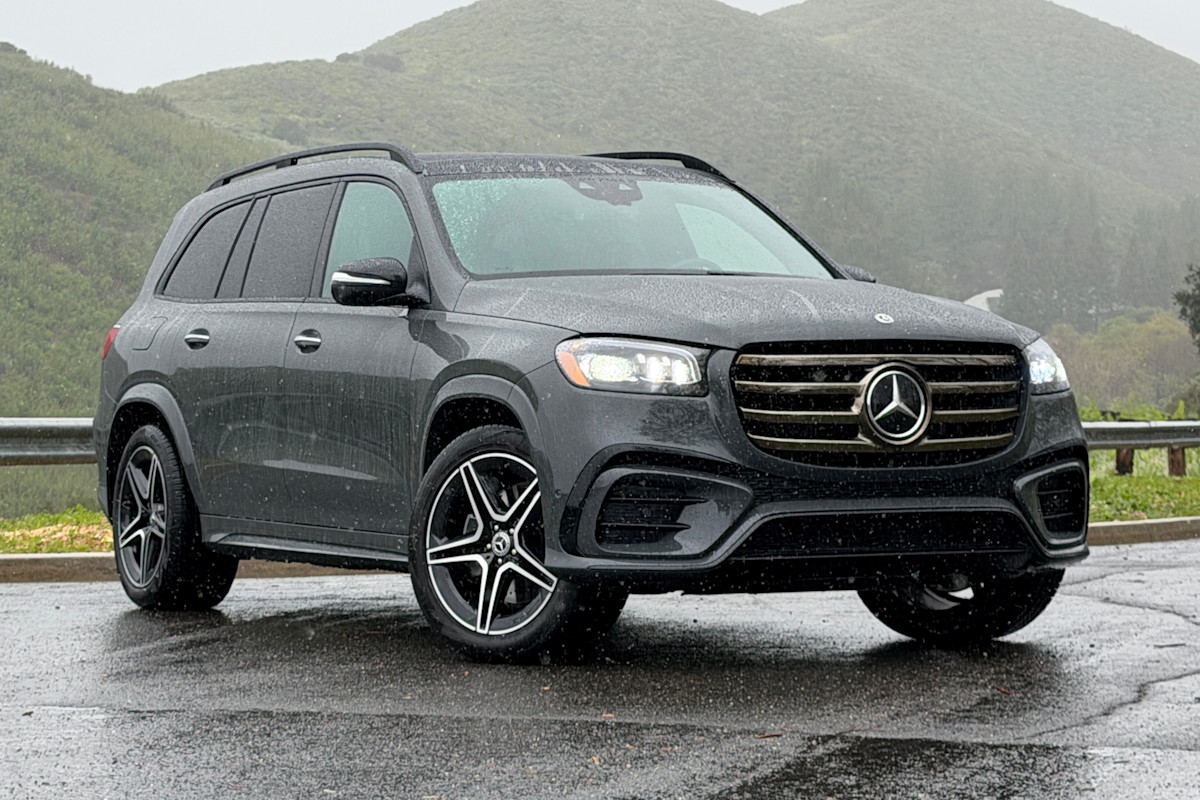
Our GLS 450 test vehicle—the base version—arrived with 21-inch AMG wheels, the AMG Line Exterior Package, a premium grade of leather upholstery, and a black headliner (note that the test vehicle is in U.S. specification, so not all features shown are available in Canada).
We liked the AMG styling details, which make the GLS look sporty and resolve the awkward fake front skid plate that's standard on the GLS 450.
The interior is similar but not identical to the smaller Mercedes-Benz GLE. It boasts high-quality materials and detailing for a look and feel commensurate with the price tag. However, we noticed body creaks on chilly mornings while reversing from a residential driveway.
Mercedes offers leather as the standard upholstery choice for the GLS 450. Nappa leather is available, and buyers can select from aluminum, wood, or black lacquer interior trim. Standard ambient lighting and a panoramic sunroof add to the ambience.
It doesn’t take long to acclimate to Mercedes' idiosyncratic control layout of seat adjusters on the doors and transmission gear-selector stalk jutting from the steering column. We also like the dual 12.3-inch displays, preferring their paired landscape orientation to the two individual screens found in some other Mercedes models. They look better integrated with the rest of the dashboard than the portrait-oriented centre display used elsewhere in the lineup.

Performance
A turbocharged 3.0-litre inline-six-cylinder engine provides the 2026 GLS 450’s motive force with a bit of mild-hybrid assist. The powertrain supplies 375 horsepower and 369 pound-feet of torque, and it’s coupled with a nine-speed automatic transmission and standard 4Matic all-wheel-drive (AWD). Together, these propel the GLS 450 from 0-100 km/h in 6.1 seconds, according to the manufacturer.
Mercedes offers more powerful versions of the GLS, but the six-cylinder 450 comes the closest to having acceptable fuel economy. It’s rated by Natural Resources Canada at 11.3 litres per 100 kilometres combined, but with the standard Dynamic Select system in the Comfort driving mode for most of the test drive we observed 12.1 L/100 km on our mountainous evaluation route.
In addition to Comfort, owners can choose between Eco, Sport, Off-Road, and Individual driving modes. Every GLS has a standard Airmatic adaptive suspension and boasts a maximum towing capacity of 3,500 kilograms (7,700 pounds), which is only 83 kilograms (200 pounds) less than a Cadillac Escalade equipped with four-wheel drive (4WD) and a burly V8.
Not long before testing the GLS, we evaluated a Mercedes-Benz GLE 450 4Matic on the same roads. The GLE did not have Airmatic adaptive suspension, and its ride and handling qualities were unexpectedly dissatisfying. Airmatic makes a significant, positive difference to the larger SUV’s driving dynamics.
That GLE also had a Sport brake system upgrade that made it hard to execute smooth, clean stops when driving in the city and in traffic. Our GLS did not have that option, and while we experienced a subtle loss of bite and slightly dull pedal feel when hustling the GLS in the mountains, those trade-offs were well worth the larger three-row SUV’s smoother driving character in everyday situations.
Like the GLE 450, the GLS 450’s powertrain exhibited occasional delays in responsiveness and unwanted lurching in Comfort mode. Sport mode limits those characteristics, but it's worth remembering that the turbocharged inline-six is the least powerful engine in the GLS lineup. Most people won’t feel they need more muscle, and the turbo-six sounds sensational under hard acceleration.
Compared with typical full-size three-row luxury SUVs, the GLS has a tailored feel from behind the wheel, like a properly fitted suit. It holds just as many people in nearly equal comfort to competitors, but swaps maximum cargo volume for tidier, tauter dimensions. As a daily driver, that makes the GLS far easier to manage in urban and suburban situations, especially when parking. Additionally, should drivers venture off-road, the GLS fits better on a trail than the behemoths it calls rivals.
Those oversized alternatives also lack the supple ride and deft handling of the Mercedes. The GLS consistently rewards drivers with a quiet cabin, a composed ride, and solid dynamics. That’s not always the case with most of the segment's alternatives.

Form & function
Seven-passenger seating is standard on the GLS with a six-passenger arrangement featuring second-row captain’s chairs as a $700 option. The Maybach GLS 600 does not offer a third row, limiting maximum passenger capacity to five.
It’s no surprise that the GLS is an exceptionally comfortable SUV, and it can legitimately carry up to seven adults as long as the passengers in the second row are willing to slide up a bit. Standard equipment with the GLS 450 in Canada includes a four-zone climate control system, heated, ventilated, and massaging front seats, heated outboard second-row seats, and a heated steering wheel. Soft-close doors are available as well as an Air Balance purification and fragrance system.
Comfort-related upgrades include ventilated and massaging outboard second-row seats, a rapid heating system for interior surfaces, five-zone climate control, heated third-row seats, and heated and cooled cupholders. In addition, an executive-style rear seat package is available that equips many of these features as well as a second-row wireless charging pad, an infotainment tablet, and pillowed head restraints.
The six-passenger seating configuration includes power-operated and heated second-row captain’s chairs with height-adjustable inboard armrests and a pass-through to the third-row seat. Power sunshades are available, but the test vehicle did not have that option. Legroom is generous with the seat powered all the way back, but the seating position is too low. Fortunately, the deeply angled cushions offer outstanding leg support.
For passengers who prefer to sit higher for a more expansive view, assign them to the third-row seat. It sits high off the floor, and while the cushion is short, it nevertheless provides good thigh support. Legroom is snug and third-row entry/exit can be a little challenging, but that's to be expected in this class.
Storage locations are lacking. For example, the bin underneath the centre armrest is surprisingly stingy with space, the door pockets are not deep enough to hold a small umbrella, and second-row passengers do not get a storage console. On a positive note, the glove compartment is large and Mercedes provides a lovely cover for the cupholders and the wireless charging pad.
Opening the standard hands-free power liftgate reveals 355 litres of space behind the third-row seat. A good-size spare tire lives under the cargo floor, and there's space for items buyers would prefer to keep hidden.
Power-fold the third row flat (which takes a while), and the cargo space expands to between 1,209 and 1,379 litres depending on how the second-row seats are positioned. Maximum capacity with the second row folded down is 2,400 litres. All these measurements fall short of traditional full-size luxury SUVs such as the Cadillac Escalade and the Lincoln Navigator.
We picked up the GLS at an airport following a family vacation and, after powering the third-row seat down, all our luggage fit easily with room to spare. However, the cargo cover remained in place and got in the way of loading and unloading, and it can’t be moved to a different anchor point behind the second row.

Technology
During our test, the assistant stumbled when we said we needed to go to a hospital by returning potential destinations that were clearly not hospitals. Otherwise, it performed flawlessly.By modern standards—including those Mercedes-Benz itself has set with its Superscreen and Hyperscreen technologies—the dual 12.3-inch displays decorating the GLS’s dashboard are quaintly retro. Still, one tenet of luxury is simplicity, so more and bigger screens aren’t always desirable. We like the Mercedes old-school approach with the GLS.
Besides, this iteration of the Mercedes-Benz User Experience (MBUX) infotainment system delivers a capable collection of features. Wireless Apple CarPlay and Android Auto and a navigation system with augmented reality enhancement are standard, and online music access is part of the Mercedes-Benz Digital Extras connected services. A complimentary one-year subscription to Digital Extras is included.
The GLS is fitted with a standard Burmester surround-sound system with Dolby Atmos technology. A high-end Burmester 3D audio system is also available, but we found the standard speaker array immensely satisfying, so only true audiophiles might wish to upgrade. Additional options include a 9.5-inch head-up display, a 7-inch tablet for rear passengers, and dual 11.6-inch rear infotainment screens.
We found MBUX extremely easy to use. It's possible to configure the 12.3-inch digital driver display using a variety of stylistic themes, and the 12.3-inch touchscreen in the middle of the dashboard is easy to understand and navigate. Users can execute many commands by saying “Hey Mercedes” to rouse the digital assistant, including tasks such as turning on the front-seat massage program.

Safety
Nearly 40 safety and driver assistance systems appear on the 2026 GLS’s standard equipment list, including Mercedes’s innovative Pre-Safe and Crosswind Assist technologies. It even has a Car-to-X Communication system in preparation for an anticipated future where cars can exchange warnings of road hazards.
Parking is no problem thanks to front and rear parking sensors, a surround-view camera system, and a button on the centre console that quickly displays parking-related views on the MBUX touchscreen.
However, those who want hands-free highway driver assistance technology as Cadillac, Infiniti, and Lincoln offer are out of luck. Instead, buyers will have to settle for a hands-on system with a touch-sensing steering wheel that works well enough in most situations. The four-lane coastal highway we tested on is not one of them, though, as any bend in the road more dramatic than a gentle curve produced unacceptable wandering into the oncoming travel lane or the bike lane. Also, the tech’s curve speed reduction technology reduces curve speeds too much.
Still, it’s important to remember that the GLS requires more than just hands on the steering wheel. It asks drivers to be an active participant in guiding the vehicle, so we can’t fault it for drifting wide in curves the tech isn’t expected to navigate. Also, it’s very easy to override the system, so if drivers remain alert and active, it behaves like a smooth and refined partner instead of a belligerent adversary on longer drives.
As we noted when testing the GLE, the GLS braked harder than necessary when exiting a local highway onto a long ramp that doesn’t require slowing for at least 200 metres. After signaling and driving onto that exit ramp, the GLS braked relatively hard and scrubbed at least 15 km/h off the cruising speed before we took control. Nobody followed us down that exit ramp, which is a good thing as that behaviour would have been a nasty surprise to another motorist.

Cost-effectiveness
The 2026 Mercedes-Benz GLS strikes us as a good value in a segment full of clunky truck-based models. For reference, the GLS 450 4Matic costs more than an Infiniti QX80 or Lincoln Navigator, roughly the same as a BMW X7 xDrive40i, and less than a Cadillac Escalade or a Lexus LX. The Mercedes falls short of the Escalade’s towing capacity by only 83 kilograms (200 pounds) and cannot match the largest of these competitors when it comes to cargo space. In exchange, it’s far more satisfying to drive than nearly all the alternatives. The only rival listed here that can match the GLS for sophistication and driving satisfaction is the BMW.
Considering its list of standard features—and that GLS buyers probably prioritize a quiet and comfortable cabin, the latest technology, and responsive driving dynamics over anything else—many buyers would likely be quite satisfied with a base GLS 450 4Matic. For those with money to burn, Mercedes offers numerous ways to upgrade and customize a GLS with even more style, performance, and opulence.

What owners say
Trims & specs
Base MSRP N/A | Seating 5 |
Engine 4.0L 550 hp V8 | Cargo Capacity 521 L |
Combined MPG 15 | Drivetrain AWD |
Base MSRP N/A | Seating 7 |
Engine 4.0L 510 hp V8 | Cargo Capacity 493 L |
Combined MPG 17 | Drivetrain AWD |
Base MSRP N/A | Seating 7 |
Engine 3.0L 375 hp I6 | Cargo Capacity 493 L |
Combined MPG 21 | Drivetrain AWD |
Base MSRP N/A | Seating 7 |
Engine 4.0L 603 hp V8 | Cargo Capacity 493 L |
Combined MPG 17 | Drivetrain AWD |


Pricing trends
Current avg. market price
$101,225
Trending down by 0.8% this month
May 2026 - November 2026