2026 Audi Q3 Reviews, Pricing & Specs


Pros & cons
What we like
Powerful engine
Standard all-wheel drive
Excellent value for money
What to consider
Fairly pedestrian performance
Irritating transmission
Expert review
Audi’s smallest crossover SUV enters its third generation with more of everything.
The entry-level model in Audi’s SUV lineup, the Q3, has been redesigned for the 2026 model year. While it rides on the same Volkswagen Group MQB platform as before, the new Q3 boasts more interior space, more power, and more tech features. That combination keeps its competitors honest, which include the Acura ADX, BMW X1, Lexus UX, Mercedes-Benz GLA, and Volvo XC40.
Verdict: While not a thrill to drive or to look at, the redesigned 2026 Audi Q3 delivers impressive utility, technology, and convenience features for its price.
out of 10 expert review
Look & feel
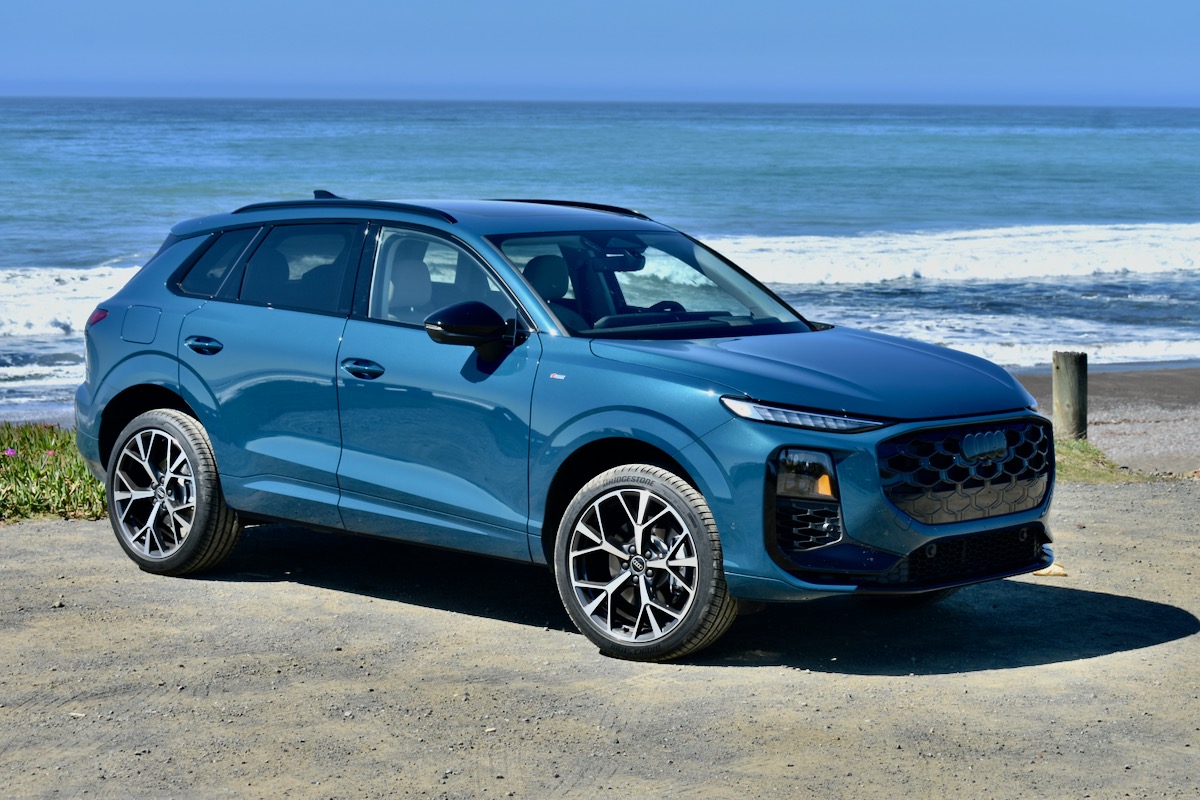
Audi strove to give the third-generation Q3 a more SUV-like appearance, and it certainly achieves that with a tall front end and sides and an elongated hood. The traditional Audi “singleframe” grille is separated from the rest of the front fascia by contrasting black sections that look like air intakes (although very little air actually flows through them), a bit like on the bigger Audi Q8.
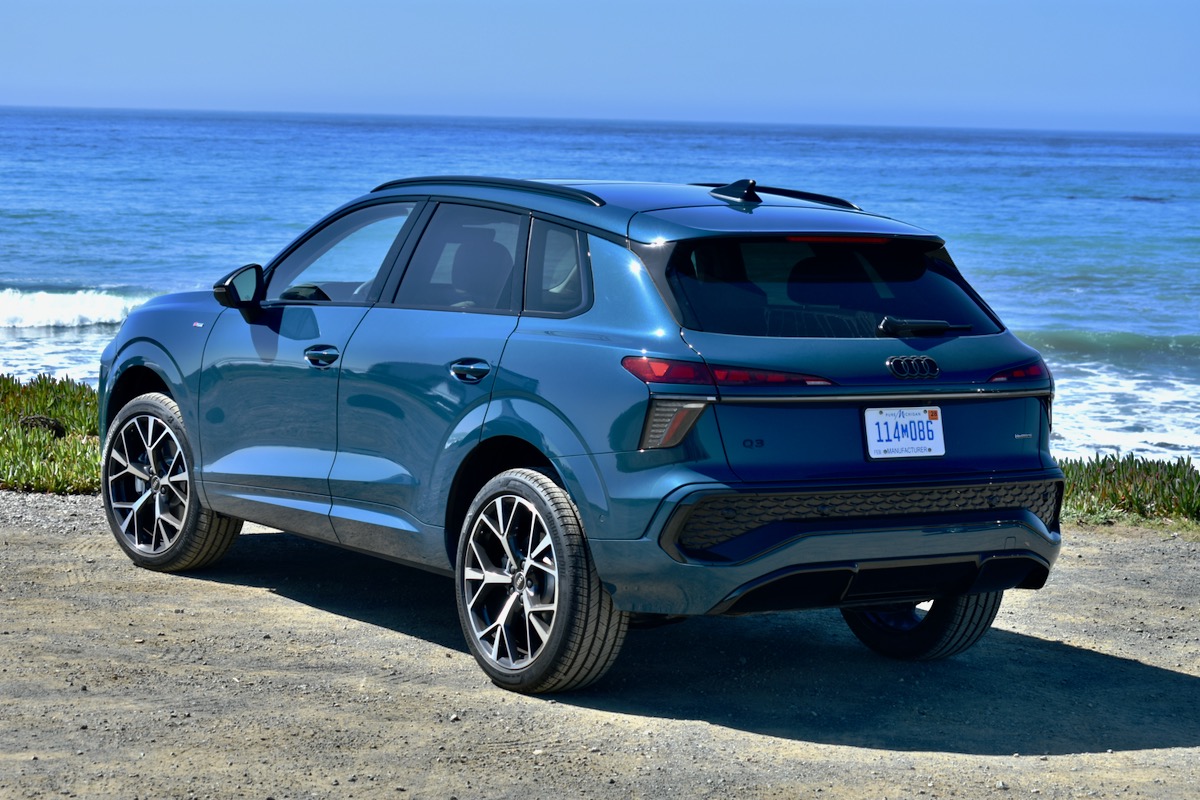
It may look more like a true SUV, but the new Q3 isn’t pretty. Designers crammed in styling elements such as those faux air intakes, or the belt of textured plastic on the rear bumper, to break up the surfaces. They look cluttered, although the crisp line separating the upper and lower sections of the body works more successfully. Audi calls it the “UFO line” because it casts shadows on the lower part of the body, making the upper section appear to float. It also prevents the Q3 from looking like a hatchback having an allergic reaction in profile view.
Like other current Audi models, the 2026 Q3 has available headlights with different programmable looks. Organic light-emitting diode (OLED) taillights are also available on the Technik trim, with a programmable upper section and a fin-like lower section, as in the 2026 Audi A6 sedan. Behind the fancy new lights is the same Volkswagen Group MQB architecture used by the outgoing Q3, as well as the Audi A3 sedan and various VW models. But this is definitely a case of “if it ain’t broke, don’t fix it.”
Audi made certain sportier S Line styling features standard on all North American Q3 models. These include a black grille and rear diffuser, with subtle silver trim across the exterior. Also standard are 18-inch wheels, but 19-inch and 20-inch wheels are available as standalone options, with all-season tires in all cases.
Leather upholstery is now standard and wood dashboard trim is available at no extra cost, although the latter invites questions about its authenticity. Some padded material around the dashboard and the concave surfaces of both the dash and doors give the Q3 cabin a distinct look and feel. And while there’s still plenty of plastic, the overall level of quality is worthy of the Q3’s entry-luxury price point.
Performance
The Q3 remains available only with a 2.0-litre turbocharged four-cylinder engine, but output increases to 255 horsepower and 273 pound-feet of torque — 27 hp and 22 lb-ft more than before. As a result, Audi says the 2026 Q3 will do zero to 100 km/h in 5.9 seconds, compared to 7.4 seconds for the 2025 model. The eight-speed automatic transmission has also been replaced with a seven-speed dual-clutch gearbox, but all-wheel drive (AWD) remains standard.
According to manufacturer estimates, the Q3 is now quicker than a BMW X1 xDrive28i or a Mercedes-Benz GLA 250 4Matic. These entry-level AWD models would have previously dusted the Audi, but BMW and Mercedes still offer more powerful versions that can do that. Matching Audi's quoted numbers might be difficult in the real world, though, as the transmission isn’t calibrated for quick getaways and the accelerator pedal is difficult to modulate at low speeds. The same goes for the brakes, and the use of “progressive” steering, with a ratio that gets faster the more the wheel is turned, implies the Q3 should be nimbler on city streets than it turns out to be.
This behaviour ceases at higher speeds and is replaced by a confident and laid-back character appropriate for a premium vehicle, even if it isn't much fun. Vague steering and indifferent suspension make good driving roads less entertaining than they might be in a BMW X1, but the Audi is still composed in corners.
Adding to the sense of refinement is new laminated acoustic front-door glass that reduces wind noise. However, it doesn’t do anything about the occasional bumps from the tires on our test car’s enlarged 20-inch wheels crashing into pavement imperfections. Even with the bigger wheels, though, ride quality is fairly good for a vehicle in this segment, and it’s certainly good enough to justify the Q3’s premium positioning.
Form & function
The new Q3 is just over 4.5 centimetres longer, 3 cm taller, and 6 cm wider than the 2025 model, but with a nearly identical 2,681-millimetre wheelbase. That translates to identical legroom in both rows, but a standard reclining and sliding second-row bench seat helps make the most of that space. Scoot that 40/20/40 split-folding bench all the way forward and leave it upright, and the 2026 Q3 boasts 707 litres of cargo space — up from 672 litres in the outgoing model. Cargo room with the rear seat folded also increases from 1,360 to 1,414 litres in total.
While it has lost some first-row headroom compared to the 2025 model, the redesigned Q3 is otherwise an admirable feat of maximizing interior space while keeping overall size in check. However, that doesn’t give it an advantage over other subcompact luxury crossovers. Maximum first-row headroom is about mid-pack, but rear-seat headroom trails all competitors except the Lexus UX. Competitors also offer an additional 2.5 to 5 cm of front-seat legroom. Second-row legroom matches the Volvo XC40 and once again exceeds that of the UX, but it trails the Acura ADX and the Mercedes-Benz GLA.
The Audi offers much more cargo space than its rivals behind the second row. Acura and Volvo provide more space with the rear seats folded, but Audi leads in the configuration that most customers are likely to use. Those extra litres also make a better case for choosing the Q3 over a small sedan as there’s more usable space while carrying passengers. And while the Q3’s 680-kilogram (1,500-pound) towing capacity isn’t remarkable by traditional SUV standards, it’s pretty good for the segment with only the XC40 exceeding it at 1,587 kilograms (3,500 pounds).
The 2026 Q3 also debuts a new control layout. The shifter and turn signal/wiper stalks are replaced with a bar that runs across the steering column. Drivers shift and signal by tapping and flicking small tabs, and there’s a small click wheel for some of the wiper settings. A conventional stalk still handles cruise control. This sounds more confusing than it is, and it makes for a cleaner look, according to Audi. Our only complaint is that it’s easy to accidentally brush the steering wheel touchpads, making it difficult to shift from Park to Drive without also switching radio stations.
Moving the shifter off the centre console also frees up more space for cupholders and a cooled 15-watt wireless device charger. The door panels also have a surprising amount of storage space with a deep crevice aft of the expected bottle holder.
Technology
It may be an entry-level model, but the Q3 gets its own version of the Digital Stage screen setup seen elsewhere in the Audi lineup. An 11.9-inch digital instrument cluster and a 12.8-inch touchscreen are combined in one curved housing for easier viewing. Audi’s decision to bring back the map view for the cluster was a good one, but the way the housing dwarfs the two screens makes the whole setup appear a bit cheap. At least the driver won’t notice it as much because the gauge cluster was moved so its widescreen shape is perfectly framed by the steering wheel.
The current version of Audi’s Multimedia Interface (MMI) infotainment system is based on the Android Automotive OS, but it still includes standalone wireless Apple CarPlay and Android Auto along with USB-C ports in both rows. Other apps, including YouTube (for use when parked) can be downloaded from a built-in app store, and a natural-language voice recognition system includes ChatGPT integration to answer trivia questions and do other silly things on the move. As in other recent Audi models, it’s also able to readily understand more useful commands such as “turn on my seat heater.” Updated graphics also include larger icons with more contrast, making it easier to use the screen for those who want to do things manually.
On the Technik trim, a head-up display is optional and a 12-speaker, 420-watt Sonos audio system is standard. The latter has Neutral, Concert, Lounge, and Podcast profiles, but it lacks midrange in all of them, making for a clear but tinny sound.
Safety
The list of standard driver-assist features covers the bases, encompassing adaptive cruise control, lane departure warning, traffic sign recognition, forward collision warning, automatic emergency braking, blind spot monitoring, and rear cross-traffic alert. Nine airbags are standard, as is Park Assist Plus, which coaches the driver during parking maneuvers but does not offer the semi-automated operation of other systems.
On the Technik trim, buyers receive a 360-degree camera system and a more sophisticated Adaptive Cruise Assist system.
Crash-test ratings from the National Highway Traffic Safety Administration (NHTSA) and the Insurance Institute for Highway Safety (IIHS) were not available at the time of writing. The outgoing generation’s mixed performance in the latest IIHS crash tests shows there’s room for improvement, though.
Cost-effectiveness
The 2026 Audi Q3 is rated by Natural Resources Canada at 9.6 litres per 100 kilometres combined (10.8 city, 8.1 highway). Our test car’s trip computer showed a 9.8 L/100 km average after a day of driving. Its rivals from Acura, BMW, and Mercedes are rated at between 8.3 and 8.5 L/100 km combined in base AWD form, while the less-powerful Volvo XC40 only manages 9.1 L/100 km combined despite its mild hybrid system. The fuel economy champ is the Lexus UX, which is rated at 5.6 L/100 km combined in AWD form thanks to a standard hybrid powertrain.
Audi’s four-year/80,000-kilometre new-vehicle warranty is also about the same as that of the majority of competitors.
Pricing starts at $54,860 with the mandatory $3,060 destination charge. That’s a jump of more than $10,000 over a 2025 model, but Audi Canada has dropped the base Komfort trim for 2026. For the equivalent model, the 2026 version is $4,400 more. The new list of standard equipment — including leather seats, three-zone climate control, and a panoramic sunroof — is indeed comprehensive, and the new Q3 has more power and more space than before. It’s also priced similarly to a base BMW X1 and Mercedes-Benz GLA. An Acura ADX, Volvo XC40, or Lexus UX will cost less, but they struggle to hide their working-class roots.
Buyers also don’t have to spend much to get a well-equipped Q3. Options such as bigger wheels, the S Line Black Package’s darkened trim, and the underwhelming Sonos audio system don’t dramatically change the experience. The Q3 fulfills its mission of providing a taste of luxury at an affordable price without any asterisks.

What owners say
Trims & specs
Base MSRP N/A | Seating N/A |
Engine N/A | Cargo Capacity N/A |
Combined MPG N/A | Drivetrain N/A |
Base MSRP N/A | Seating N/A |
Engine N/A | Cargo Capacity N/A |
Combined MPG N/A | Drivetrain N/A |
Base MSRP $43,700 | Seating 5 |
Engine 2.0L 255 hp I4 | Cargo Capacity 29.0 cu ft |
Combined MPG 25 | Drivetrain AWD |


