2025 Volvo EX40 Reviews, Pricing & Specs
Pros & cons
What we like
Looks sharp inside and out
Well-rounded driving experience
Fast charging
What to consider
Minor tech bugs
Some cheap-feeling interior materials
Drive settings lack customization
Expert review
The 2025 Volvo EX40 is a well-rounded luxury electric vehicle fit for first-time or seasoned electric vehicle (EV) buyers.
The compact EV crossover market continues to grow more crowded, and for 2025, Swedish brand Volvo’s entry is the EX40. It was previously known as the Volvo XC40 Recharge, but it gets a new name as part of Volvo’s effort to help customers more easily differentiate between its gas and electric models. Whatever it’s called, this electric SUV still possesses quintessentially Volvo features such as a comfortable and quiet interior, great ride quality, stylish looks, and an emphasis on safety. The related Volvo C40 Recharge, meanwhile, is now known as the Volvo EC40 and continues to be sold alongside the EX40 in Volvo’s Canadian lineup.
Verdict: For both first-time EV buyers and those with experience in the market, the Volvo EX40 offers a great combination of luxury, performance, and charging power for the price.
out of 10 expert review
Look & feel
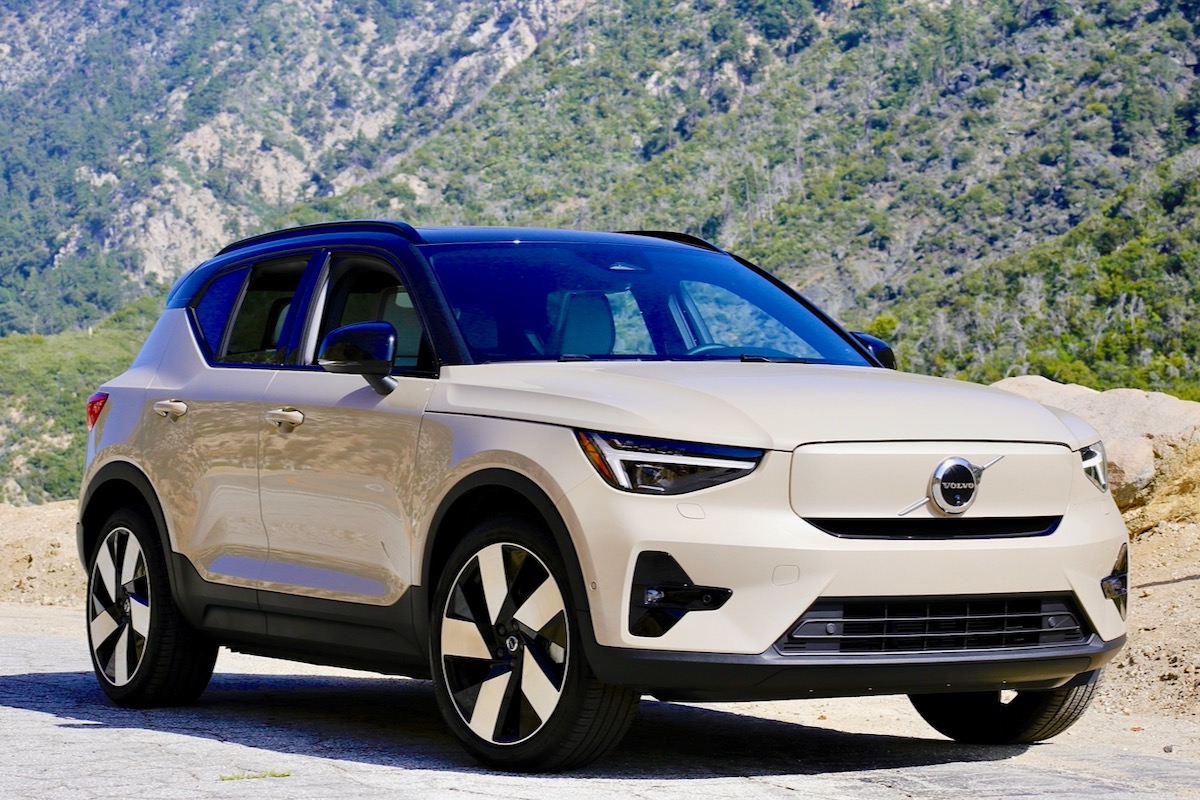
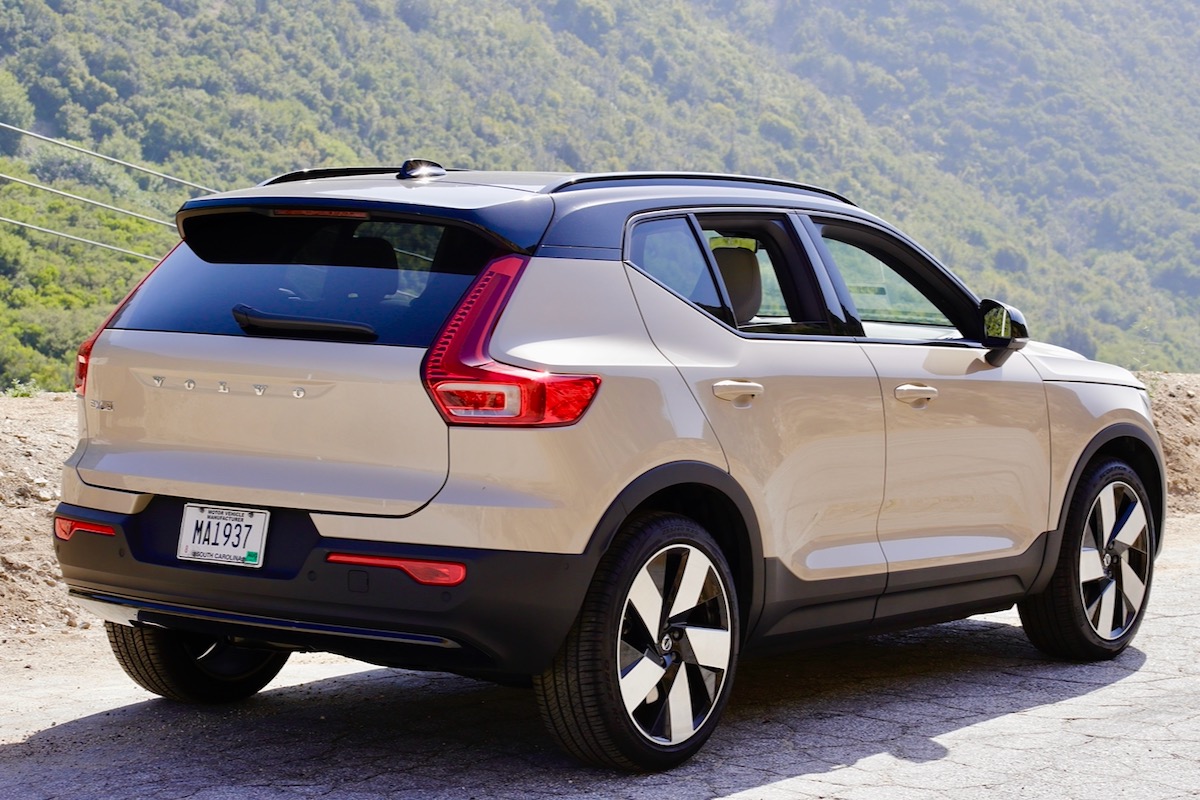
The EX40 stands out among the many other compact crossovers, both gasoline- and battery-powered, on the market. Its design is very clean with a few distinctive features that should help bolster its appeal among new car buyers.
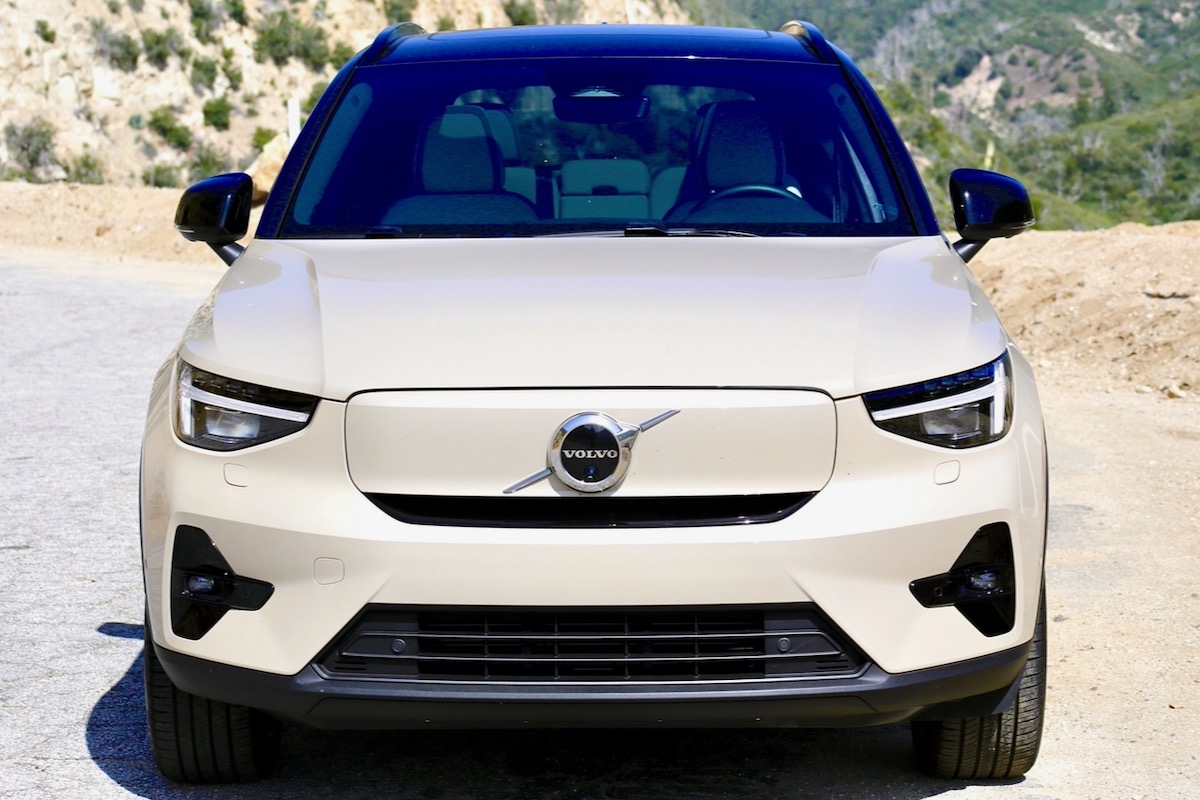
The roofline dips down aft of the rear door, which creates a chunky C-pillar. We also love everything about its chic front fascia, including how the black plastic cladding and gloss black window decor contrast with the body colour—especially in our tester’s Sand Dune khaki hue.
Inside, the EX40’s overall design is clean and minimalistic. The dash and centre console are formed from a substantial-feeling black plastic, with grey faux-wood plastic trim accents and a very minimal amount of piano black trim. A fuzzy synthetic material fills in a handful of places and feels like rough, weathered wool. This and the aforementioned faux wood err on the side of cheapness, but we appreciate the creative approach Volvo have taken to give some legitimate character.
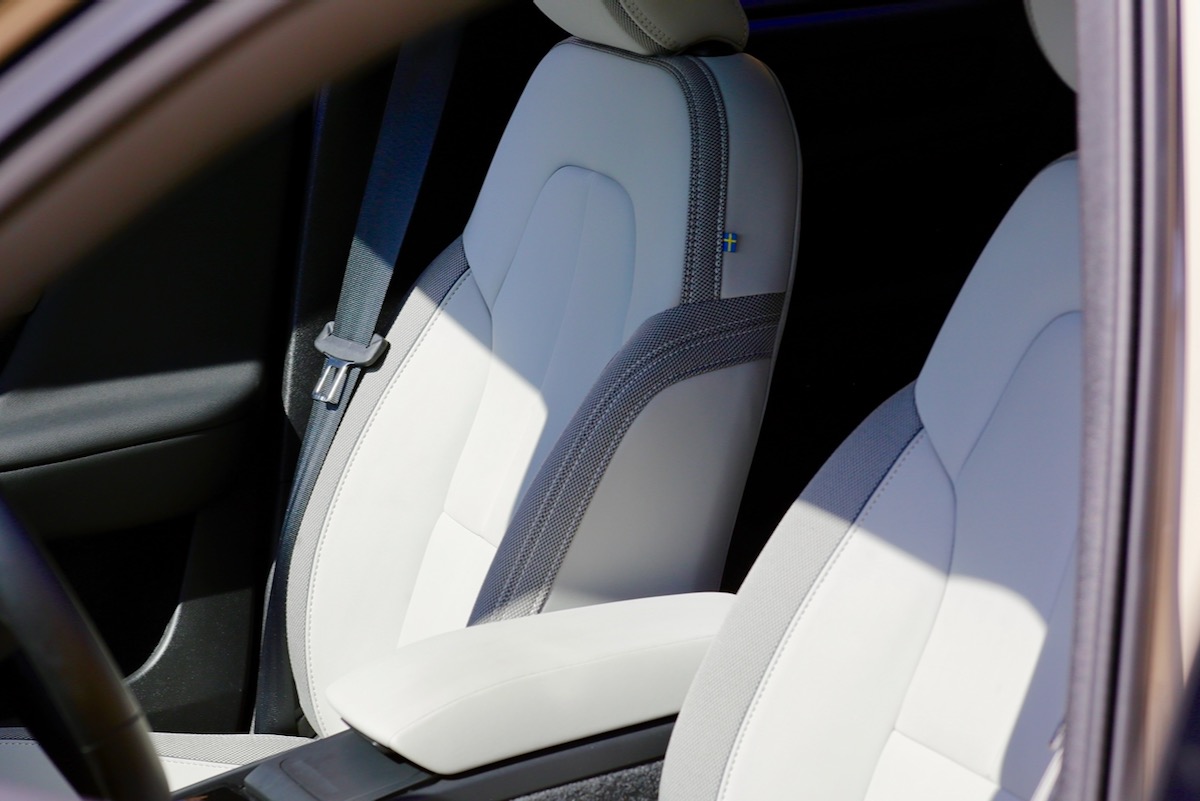
Comfortable faux leather comprises the power adjustable seats, which are amply comfortable with great overall adjustability and standard heating. Finally, our Ultra trim tester’s panoramic sunroof gave us some serenity while stuck in traffic, and it was easy to operate via its haptic touchpad.
Performance
The 2025 Volvo EX40 is available with either a rear-wheel drive (RWD), single electric motor powertrain or an all-wheel drive (AWD), twin-motor powertrain. The former produces 248 horsepower and 310 pound-feet of torque, while the twin-motor EX40 produces 402 hp and 494 lb-ft of torque. With around 2,000 kilograms (4,500 pounds) to haul, the single-motor EX40 reaches 0–100 km/h in 7.3 seconds, whereas the dual hits the mark in a fairly quick 4.8 seconds, according to Volvo.
After a full week with our twin-motor tester, we believe it. The EX40 is lightning-quick off the line and always has more than enough power on tap for easy highway passes. Unless quickly turning onto a faster thoroughfare with the front wheels pointing at an aggressive angle, there’s no hint of slip from tires at full-throttle blasts, either.
The EX40 also has great overall ride quality—and even feels reasonably athletic on twisty country roads—although its ride is harsh over the most beat-up urban streets. Its brakes have great stopping force and pedal modulation, and body roll is very well contained for a small crossover. There isn’t much in terms of steering feel or changes in weight under cornering, and the chassis is surprisingly communicative.
For 2025, both single-motor and dual-motor models have an 82-kWh battery pack (dual-motor models previously came with a 78-kWh pack). DC fast-charging power has also increased from 200 kW to 205 kW, enough for a 10%–80% charge in 28 minutes, according to Volvo. That’s very competitive but, as is often the case with fast charging, real-world variables can affect performance. At a local DC fast charger rated for up to 350 kW, we topped out at just 145 kW while charging from 26% to 79%, which also took just over 28 minutes. When Level 2 AC charging, Volvo estimates eight hours for a full recharge at 11 kW.
Natural Resources Canada-rated range is 476 kilometres for the single-motor variant and 418 km for the dual-motor variant. That’s competitive with rival crossovers like the Audi Q4 e-tron, Genesis GV60, Lexus RZ, and Mercedes-Benz EQB.
Form & function
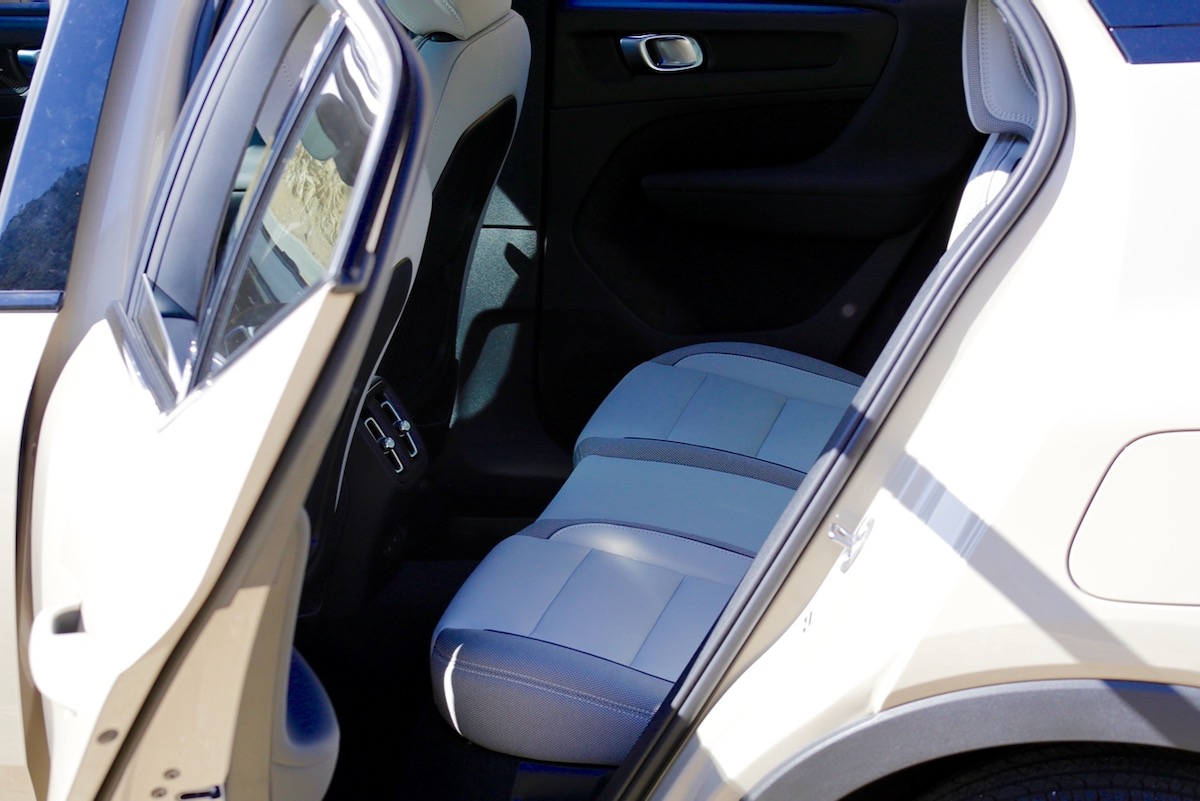
Unlike some competitors, the 2025 Volvo EX40 strikes a great balance between size and interior space. It’s small on the outside, ready for the tightest urban driving, yet has a comfortable amount of space on the inside.
Measuring 1,647 millimetres tall, 2,034 mm wide (including mirrors), and 4,440 mm long, the EX40 doesn’t feel too big or unwieldy while rolling down tight residential streets. Parallel parking is pain-free thanks to its reasonable length.
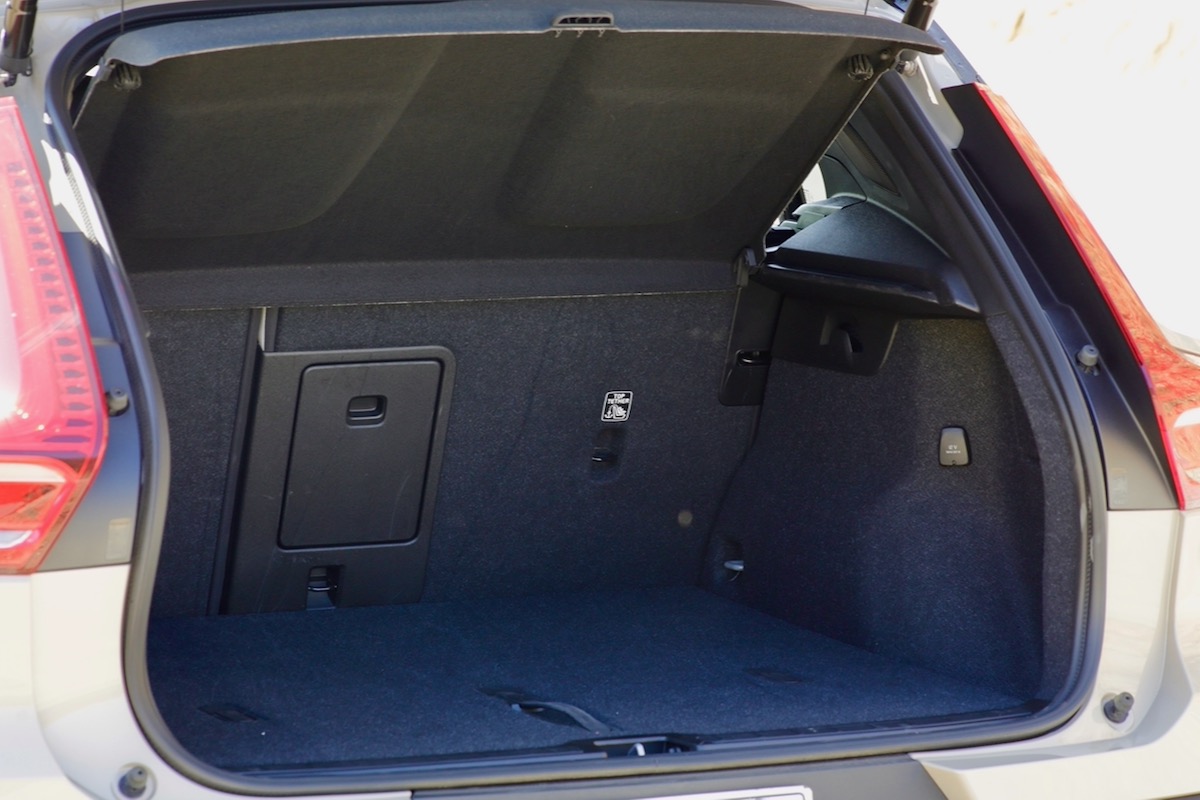
Yet the EX40’s boxy shape provides plenty of cargo capacity, at 536 litres behind the rear seats and 1,400 litres with the second row folded. There’s also a small frunk that can hold a day’s shopping. Headroom measures 997 mm up front and 994 mm in the rear-seat area, and the EX40 has 1,040 mm and 917 mm of legroom in the first and second rows, respectively, along with about 1,390 mm of hip room in both rows. Our six-foot-three tester had no issue getting comfortable or hopping in and out, nor was outward visibility an issue.
Technology
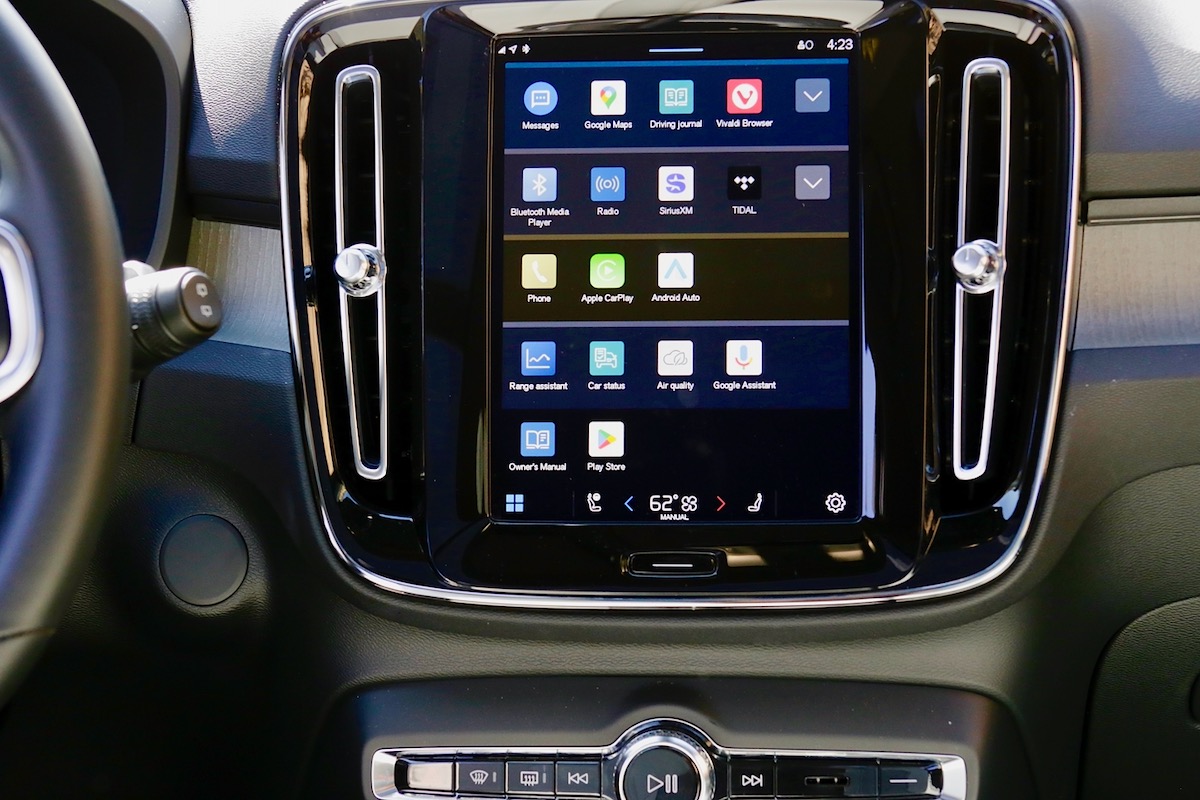
Like other current Volvos, most controls are incorporated into a 9-inch touchscreen mounted vertically in the centre dash. There’s a smattering of gloss black plastic shortcut buttons just below it, plus a charging pad and two USB-C ports down below, but otherwise the screen is one’s gateway into the EX40’s dual-zone climate control, stereo, and navigation.
The EX40’s Android-based infotainment system means some functions can be handled by Google Assistant voice control, which we find easy to use. The system also has over-the-air update capability and a 12.3-inch digital instrument cluster that shows the driver everything they need to know, including speed, battery charging and discharging, and range.
The infotainment software may be Android-based, but wired Apple CarPlay is still present (as is available SiriusXM satellite radio), and Bluetooth connectivity is quick and seamless. The overall design matches the rest of the EX40’s simple interior layout, as does the typeface of basically every Volvo from the past 20 years. This surely makes the transition to the plugged-in life easy for faithful Volvo fans.
Navigating through screens is easy, albeit occasionally laggy. Music would at times seem to randomly pause or not start playing when shifting to drive or reverse after sitting for a while. (There’s no on/off switch. You just unlock the car, belt in, and go).
In vehicle settings, there are a handful of ways to customize interior lighting, locking, alert volume, and more, making the driving experience nicely customizable. However, we were surprised to see that regenerative braking intensity couldn’t be changed, which is common on other new electric luxury SUVs. It’s just on or off, and while the default level enables one-pedal driving (meaning you use only the throttle to accelerate and slow down/stop), it’s nice to have the option of smoothing it out or cranking it up depending on the driver’s mood (or the passengers’ mood, for that matter).
Safety
The 2025 Volvo EX40 comes standard with a massive array of driver assistance technology, including: blind spot monitoring, steering assist, rear cross-traffic alert, traffic sign recognition, parking assistance, lane departure warning, lane-keep assist, forward collision warning, adaptive cruise control, automatic emergency braking, and pedestrian/cyclist detection. Besides some false collision warnings while driving on twisty local streets, every feature worked quite well, and we were impressed by the rear cross-traffic alert’s range while backing out of particularly tight parking lots.
On the not-so-open road—meaning, stuck in traffic on the highway—the EX40’s adaptive cruise control produced mixed results. Drivers may find it to be a hair confusing to figure out and adjust at first, and it’s rather lazy to get going from a stop in especially crowded conditions. Ask anyone who’s had the honour of dealing with this kind of scenario deep in city traffic: it’s an open invitation to get cut off by everyone and their mother. Once moving, though, adaptive cruise control is smooth in operation and responds well to people who sit right on the edge of cutting us off. Lane-keep assist also does well at steering down the centre of the lane—even amongst hard-to-see, worn-out lane markers.
Also standard on the Ultra trim is a 360-degree camera system. This works quite well and has excellent clarity, and it makes it easy to determine how close we are to loading and no parking zones—again, maximizing its appeal for urban duty.
At the time of writing, the U.S. National Highway Traffic Safety Administration (NHTSA) has not released safety ratings for the 2025 EX40. However, the Insurance Institute for Highway Safety (IIHS) gives this Volvo top “Good” marks in its small overlap front, original moderate overlap front, and original side-impact crash tests. It also receives an “Advanced” rating for daytime front-crash prevention and an “Acceptable” rating for LATCH child-seat anchor ease of use.
Cost-effectiveness
The 2025 Volvo EX40’s pricing kicks off at $59,950 for the Core trim level with the single-motor powertrain, not including the destination charge or other fees. For that MSRP, you get a substantial amount of driver-assistance technology, 476 kilometres of range, 19-inch wheels, a comfortable and well-appointed interior, dual-zone climate control, and other niceties.
Opting for the dual-motor powertrain raises the price of the EX40 Core to $63,500. From there, the Plus features some minor upgrades in materials and amenities throughout, including a panoramic sunroof, and bumps the price up to $68,000 for the single-motor drivetrain and $70,500 for the dual-motor version. Finally, the loaded Ultra trim costs $72,450 for the single-motor and $74,950 for the dual-motor powertrain. It adds a powerful Harman/Kardon stereo and self-cleaning LED matrix headlights, makes 20-inch wheels available, equips a standard heated steering wheel and heated windshield washer nozzles (which ought to be standard in lower trims in Canada) and heated outboard rear seats, and adds the Pilot Assist hands-on highway driving aid, among other features.
Looking at competing electric cars, the Genesis GV60 starts at $73,000 but includes many add-ons such as all-in pricing, at-home concierge service, five years of scheduled maintenance, and more. The Audi Q4 e-tron starts at $59,950 before fees while achieving 414 to 463 kilometres of range but offers less interior space.

What owners say
Trims & specs
Base MSRP $54,250 | Seating 5 |
Engine 402 hp Electric | Cargo Capacity 18.9 cu ft |
Combined MPG 95 | Drivetrain AWD |
Base MSRP $60,750 | Seating 5 |
Engine 402 hp Electric | Cargo Capacity 18.9 cu ft |
Combined MPG 95 | Drivetrain AWD |
Base MSRP $57,050 | Seating 5 |
Engine 402 hp Electric | Cargo Capacity 18.9 cu ft |
Combined MPG 95 | Drivetrain AWD |
Base MSRP $52,500 | Seating 5 |
Engine 248 hp Electric | Cargo Capacity 18.9 cu ft |
Combined MPG 107 | Drivetrain RWD |
Base MSRP $59,000 | Seating 5 |
Engine 248 hp Electric | Cargo Capacity 18.9 cu ft |
Combined MPG 107 | Drivetrain RWD |
Base MSRP $55,150 | Seating 5 |
Engine 248 hp Electric | Cargo Capacity 18.9 cu ft |
Combined MPG 107 | Drivetrain RWD |


Pricing trends
MSRP range
$52,500 - $60,750
Current avg. market price
$62,101
Trending down by 1.0% this month
September 2026 - October 2026

