2025 Lexus GX Reviews, Pricing & Specs


Pros & cons
What we like
Top on- and off-road capability, especially among Overtrail models
Easy-to-use tech
Great looks
What to consider
Poor fuel economy
Off-road features not standard
High base price
Expert review
Lexus’s stylish midsize SUV talks the talk and walks the walk, but it demands a princely sum.
One year on from the latest-generation Lexus GX’s debut, the excitement is still there. The 2025 Lexus GX looks great, drives well, and handles itself incredibly well off-road. The latter is something for which that the GX has always been renowned, at least among those who’ve been inclined to find out.
Verdict: With great standard tech, safety equipment, looks, and overall versatility, the Lexus GX is worth the attention of any shopper who’s in the market for a luxury SUV.
out of 10 expert review
Look & feel
The new Lexus GX’s most notable exterior feature is, well, everything. Redesigned for the 2024 model year, it looks completely different over the previous generation, which had been in production in one way or another since the 2010 model year. We didn’t have any qualms with the previous model’s appearance, especially the 2020 model year’s facelift, but this new model is quite a looker.
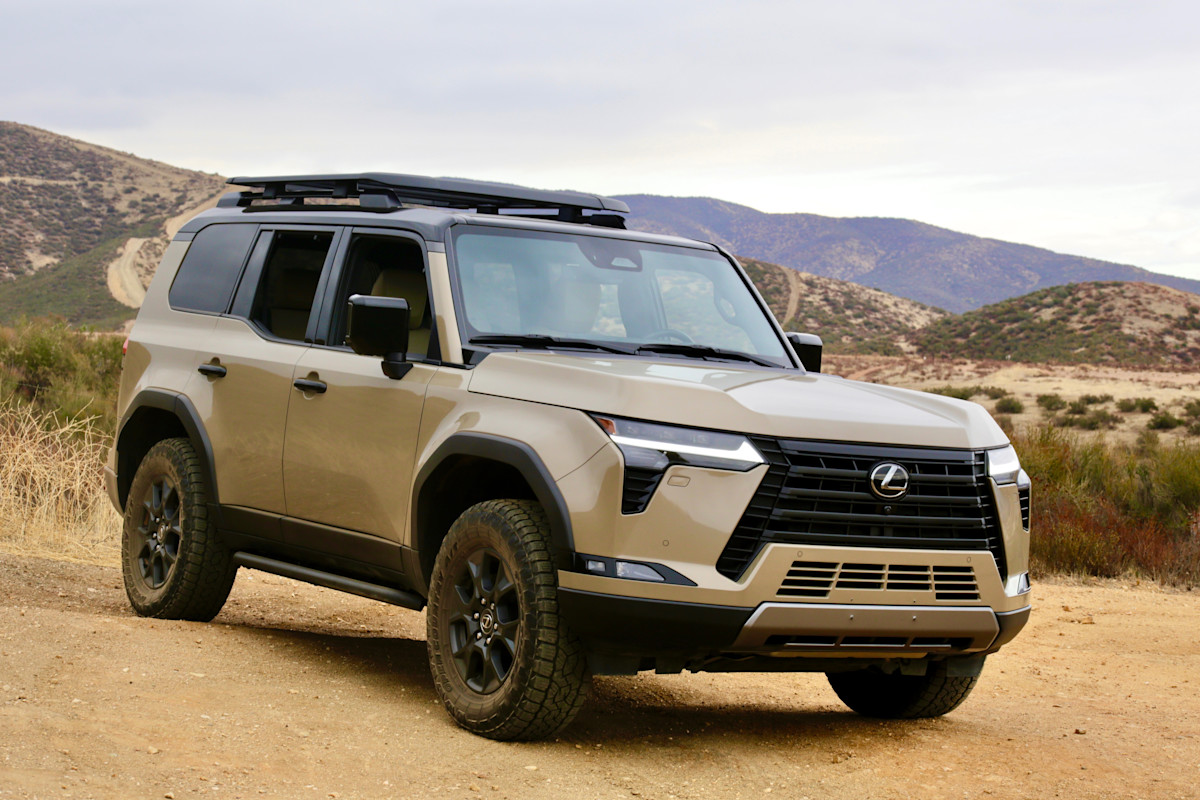
Take, for instance, its shape. There are notes of boxy, old-school Land Rover throughout. It's missing the safari-style windows found on first- and second-generation Land Rover Discovery models, but otherwise there are few obvious styling differences. A brawny facial expression is nicely accented by LED headlights and draws attention to the GX’s large (but not too large) grille. The overall geometric flavour of everything looks great, and pairs nicely with our GX 550 Overtrail+ test vehicle’s 33-inch tires wrapped around matte grey 18-inch wheels, raised ride height, rock rails, and fitting brown colour, dubbed Earth by Lexus.
On the inside, it’s a lot of the same: clean and elegant, with a strong air of luxury. Switchgear has a pleasant, quality feel to it, plastic trim pieces look nice, and the overall design of the dashboard, centre console, and door trim is rather chic. There are just enough switches to quickly figure out HVAC and off-road driving controls without developing a wandering index finger while trying to safely roll down the road.
The front and rear seats have ample headroom, even for tall drivers. We found ample clearance even with the driver’s seat raised. Our tester came equipped with a head-up display that we could adjust to be perfectly in view, which isn’t always the case with this feature in other new models. The seats themselves were a clean mix of stitched black and tan faux leather (dubbed NuLuxe by Lexus) with heating, ventilation, and massaging functions. Overall visibility was excellent, as it ought to be with such tall windows and the elevated ride height that comes with the Overtrail+ package.
Performance
All Lexus GX trims come equipped with a twin-turbo 3.4-litre V6, which produces 349 horsepower and 479 pound-feet of torque. That’s dispensed to all four wheels via full-time four-wheel drive (4WD) with a limited-slip centre differential, and a 10-speed automatic transmission. The old GX was equipped with a 4.6-litre naturally aspirated V8. The six-cylinder is smaller, but it is also mightier.
Lexus claims the GX will do 0-100 km/h in roughly 6.5 seconds. That’s not bad considering the current GX’s 2,570-kilogram (5,666-pound) curb weight, and it’s a whole second faster than its V8-powered predecessor. The GX is also substantially heartier in its performance than its down-market chassis-mate, the Toyota Land Cruiser.
While possessing hearty twin-turbo specs, the GX still feels substantially faster than one might expect. Full-throttle pulls have ample shove all over the rev band, but especially up high. It just keeps pulling and pulling all the way to redline. This made highway merges an absolute cinch, though the transmission was a little slow to react at times. Once the right gear was picked for peak acceleration, this stylish behemoth quickly pulled up to speed with little effort.
All this weight and turbo-sourced torque comes with a catch: The 2025 GX’s fuel economy shakes out to a Natural Resources Canada-rated 15.3 litres per 100 kilometres in the city, 11.2 on the highway, and 13.5 combined. In our week of mixed driving, we averaged 19.0 L/100 km. That figure's not good, but we also partly blame this on enthusiastic highway merges and spending plenty of time in the dirt in low range.
Still, all that power translated to great around-town manners. The GX’s quick-off-the-line demeanour made passes and positioning ourselves in around-town traffic quite seamless. Its chassis — sporting double-wishbone suspension up front and four-link fare out back, all tied together with adaptive dampers — made it feel far more athletic than one would assume for such a hulking physique.
On-road ride quality was good in all modes, which we think was supplemented by our tester’s standard 33-inch all-terrain tires. But there was a distinguishable amount of typical truck jiggliness on the rear axle. After all, it’s a good ol’ fashioned, non-independent straight axle. You won’t find that in any modern unibody crossover, but it didn’t prove to be much of a liability in this body-on-frame SUV.
We had the opportunity to take our very off-road-ready tester to a great off-roading area and put its trail chops to the test. We enjoyed the previous GX in a similar environment, but this latest Overtrail+ possessed even more off-road capability.
It was so easy to knock the transmission into neutral, flip a switch to swap over to its low gear range, press a button to lock the centre differential, knock it back into drive, and then simply crawl up a wide variety of steep, craggy, and rear axle articulation-testing hills. The GX never broke a sweat, even when we initially thought we’d bitten off more than we could chew on a particularly menacing stretch of dirt and rocks. It proved no issue at all, even without engaging any of the GX’s Multi-Terrain Select off-road driving modes.
On one occasion, we slightly exceeded the GX’s maximum descent angle of 30 degrees, but its downhill assist control prevented any ice-cold perspiration over such a harrowing experience. It was also smoother in operation than in the old GX — which produced ABS actuation that sounded like a Gene Krupa drum solo under the hood — without allowing any slippage from the tires.
Between its comfortable and competent highway and local-street manners, as well as impressive off-road aptitude, the 2025 Lexus GX 550 Overtrail+ is one of the best all-rounder midsize luxury SUVs we’ve ever driven. But there’s a slight catch: where the old model came standard with a host of off-road-centric accoutrements, you have to pony up for the Overtrail or Overtrail+ packages to get the locking rear differential, bigger tires, Multi-Terrain Select drive modes, crawl control, and downhill assist. This increases its base model’s price of $89,399, including the $2,205 destination charge and other fees, all the way up to $99,086 for the Overtrail, and $114,364 for the Overtrail+.
Form & function
The 2025 Lexus GX is not only tall-folk-friendly in its interior dimensions, it’s every-folk-friendly. Front headroom measures 1,001 millimetres for front seat passengers, while those in back benefit from a more generous 1,095 mm. Our tester didn’t sport a third row, but that offers around 900 mm in models so equipped. Legroom measures 1,047 mm up front and 933 mm in the second row, and the GX boasts a generous 1,512 mm of shoulder room in the first row and 1,453 mm in the second row. So, for those in search of a spacious four-person family hauler, the GX is a top candidate.
But the GX’s real party piece is its cargo space. When the third row is equipped, which is included on all packages except the Overland and Overland+, this is 291 litres with all seats deployed, increasing to 1,138 litres with the third row stowed, and a generous 2,177 litres with both the second and third rows tucked away. The Land Rover Defender 110 mirrors these figures for the most part, though falls short by a few litres behind the second row in its two-row configuration. The BMW X5 offers less all around, as does the Mercedes G-Class.
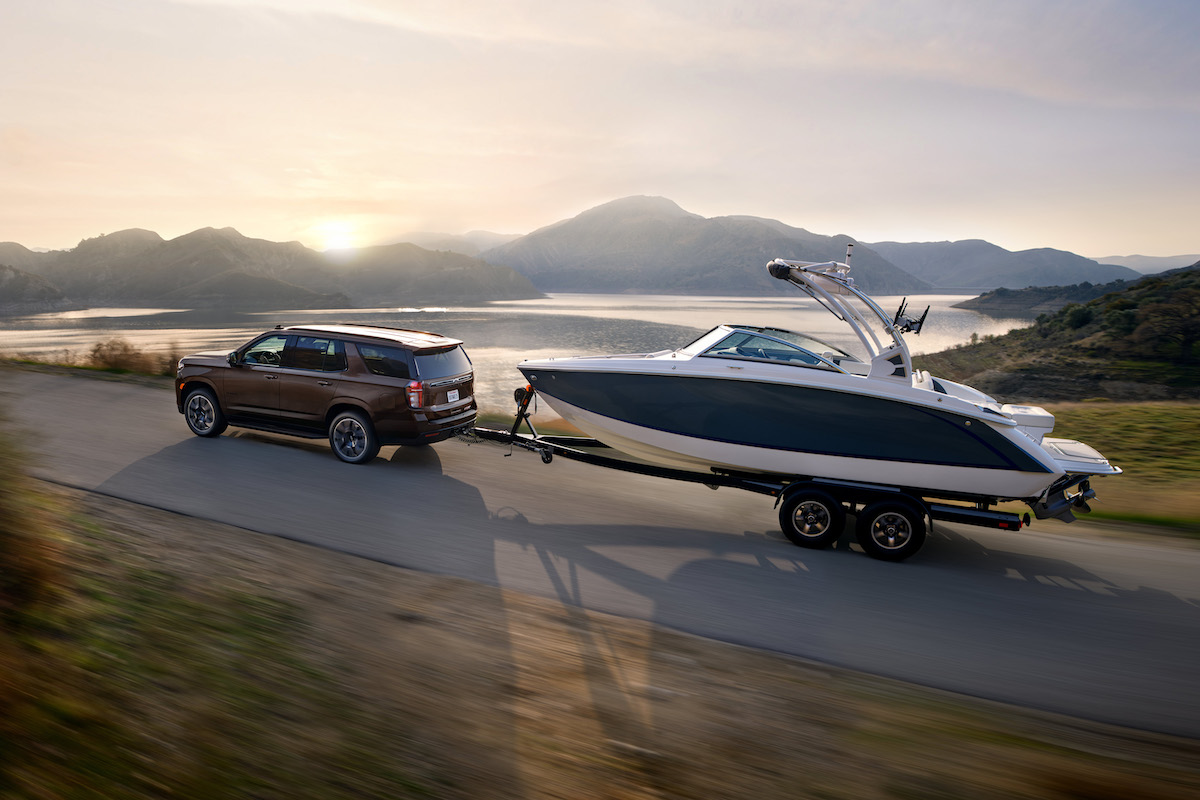
Opt for the Overtrail packages, for which no third row is available, and the second row easily folds out of the way to offer a massive 2,563 litres of space, which reduces to 1,291 litres with the second row in place. We were able to haul a set of 18-inch wheels and tires behind the second row with ease during our time with the GX 550 Overtrail+, which shows how adventure-ready the Lexus could be as an overlanding and camping excursion rig. Plus, at 4,111 kilograms (9,063 pounds), its towing capacity is ready to help expand any adventurist’s horizons.
Conveniently, all of these dimensions don’t translate to a massive footprint, or at least it didn’t feel as such. The GX’s overall width sans mirrors reaches 1,999 millimetres, matching Land Rover’s Defender 110 and BMW’s X5. The GX’s overall length is 5,005 mm, which mirrors the Land Rover but is a few more than the X5. We point this out because the GX was a little easier to parallel park on tight streets than other midsize SUVs we’ve tested in the past couple of years. Once parked, it tucked in nicely away from the flow of traffic. This may not seem like a massive deal, but we’ll take all the peace of mind we can.
Technology
We found the 2025 GX’s infotainment and overall tech quick and easy to get acclimated to, even for those unfamiliar with the current Lexus interface. The 12.3-inch gauge cluster has great clarity and graphics, and it is simple to page through. The 14-inch infotainment touchscreen sitting stage right is similarly impressive. It has great haptic feedback, no lag, overall smooth operation, an intuitive layout of menus and apps, all wrapped up in a pleasing design. Wireless Apple CarPlay, Android Auto, and Bluetooth are standard, and the former paired seamlessly.
A 10-speaker generic-brand audio system is standard, but a Mark Levinson Premium Audio system is included with the Luxury, Executive, and Overtrail+ packages. It had good overall audio quality and clarity, but it requires a bit more volume than usual at highway speeds. We assume this due to the GX Overtrail+ and its large, air-catching shape, all-terrain tires, and ladder-style roof rack.
Six USB-C ports are standard in Canada for wired connectivity and charging. The massive, deep armrest storage includes cooling with the Executive and Overtrail+ packages.
Safety
Lexus’s comprehensive suite of standard driver-assistance systems — dubbed Lexus Safety System+ 3.0 — is very user-friendly. Adaptive cruise control with Curve Speed Management and lane-centring assistance (called Lane Tracing Assist by Lexus) operates quite smoothly and without hiccups. There are a few winding roads in our area that often trip up some automakers’ pre-collision alert systems, but this never happened at the GX’s helm.
Other standard driver-assist features include road sign assist, lane-departure alert, automatic high-beams, rear cross-traffic alert, and blind-spot monitoring. Our Overtrail+ tester also included pedestrian detection as standard. None of these were too intrusive during our testing, and they automatically disabled once we shifted to low range and set off up and down our local off-road trails.
An available 360-degree camera system supplement the standard rearview camera with good overall optical quality. Trail-viewing cameras on our Overtrail+ tester helped aid off-road visibility. As of this writing, the 2025 Lexus GX has not been rated by the Insurance Institute for Highway Safety (IIHS) or National Highway Traffic Safety Administration. But it sports 10 airbags situated in the steering wheel, dashboard, side curtains, and seat bolstering to protect occupants during a crash.
Cost-effectiveness
Canadian pricing for the 2025 Lexus GX 550 starts at $89,399, including destination charges and fees. This gets you an athletic powertrain, great handling characteristics for a midsize SUV, stylish looks, good interior space, solid safety and driver-assistance technology, and one of the easier-to-use infotainment systems.
Buyers can also select from a series of packages. The Premium package adds $8,738 to the invoice, while the Overtrail commands $9,731 extra. The GX 550 Luxury package costs $21,583 extra while shifting the focus more toward comfort than trail-readiness. The Overtrail+ package on our test unit adds $25,107 to the base price, while the range-topping Executive package is $26,383 more. Different packages have different focuses, and there are a few scenarios where an option isn’t available, such as third-row seating in the Overtrails. But for adventure-minded consumers who want do-it-all capability, it’s hard to argue with these.
The competition is fairly stiff in the luxury midsize SUV market. The base Land Rover Defender 110 S starts at $79,250, though only with an asthmatic 2.0-litre turbocharged four-cylinder engine, while the BMW X5 starts at $91,533. The Genesis GV80 has the lot beat at $75,150 and is beloved by reviewers.
Note: Images show a US model.

What owners say
Love it price is too dam high but great suv
December 17, 2025Trims & specs
Base MSRP $64,735 | Seating 7 |
Engine 3.4L 349 hp V6 | Cargo Capacity 10.3 cu ft |
Combined MPG 18 | Drivetrain AWD |
Base MSRP $77,200 | Seating 7 |
Engine 3.4L 349 hp V6 | Cargo Capacity 10.3 cu ft |
Combined MPG 18 | Drivetrain AWD |
Base MSRP $81,200 | Seating 7 |
Engine 3.4L 349 hp V6 | Cargo Capacity 10.3 cu ft |
Combined MPG 18 | Drivetrain AWD |
Base MSRP $69,200 | Seating 7 |
Engine 3.4L 349 hp V6 | Cargo Capacity 10.3 cu ft |
Combined MPG 18 | Drivetrain AWD |
Base MSRP $79,845 | Seating 5 |
Engine 3.4L 349 hp V6 | Cargo Capacity 45.6 cu ft |
Combined MPG 18 | Drivetrain AWD |
Base MSRP $72,380 | Seating 5 |
Engine 3.4L 349 hp V6 | Cargo Capacity 45.6 cu ft |
Combined MPG 18 | Drivetrain AWD |
Base MSRP N/A | Seating N/A |
Engine N/A | Cargo Capacity N/A |
Combined MPG N/A | Drivetrain N/A |
Base MSRP N/A | Seating N/A |
Engine N/A | Cargo Capacity N/A |
Combined MPG N/A | Drivetrain N/A |


Pricing trends
MSRP range
$64,735 - $81,200
Current avg. market price
$111,016
Trending up by 1.3% this month
May 2026 - October 2026