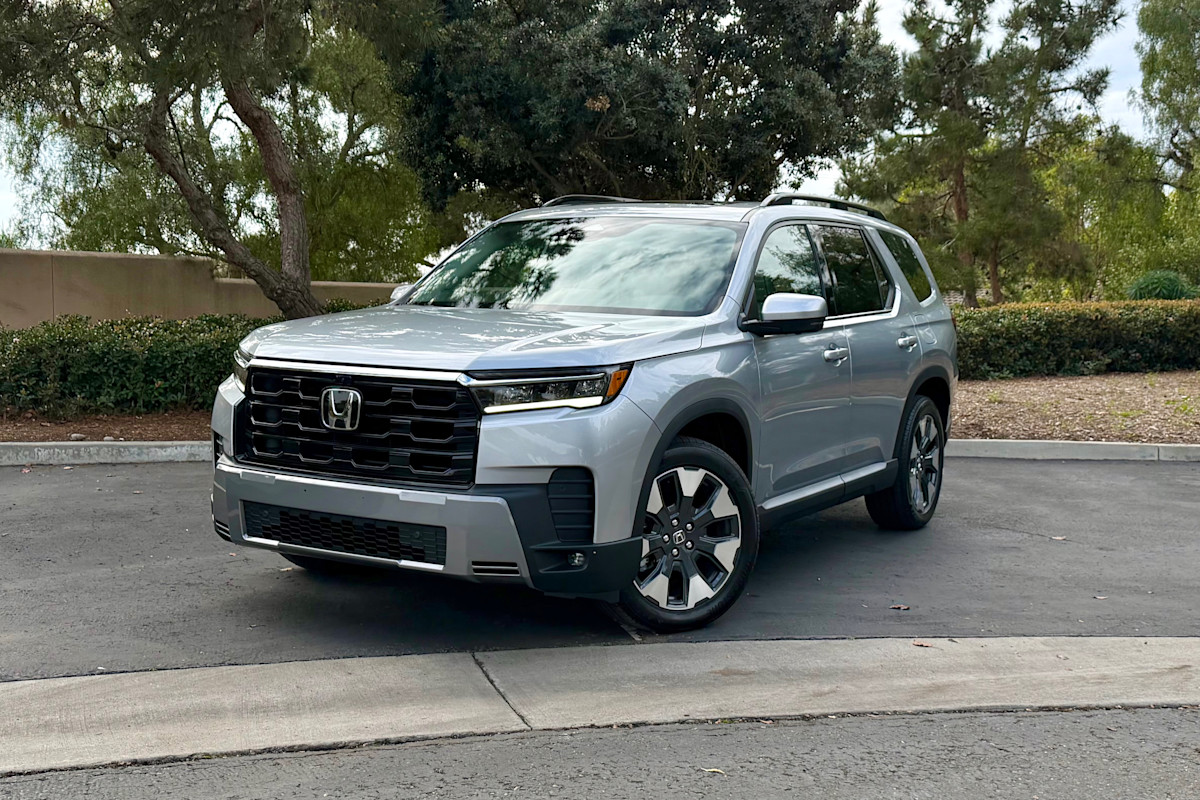
2025 Kia Telluride Reviews, Pricing & Specs


Pros & cons
What we like
Stylish design
Comfortable
Great safety ratings
What to consider
Outdated technology
Irritating lane-assist system
Sticky brakes in thick traffic
The CarGurus verdict
The 2025 Kia Telluride isn’t one of the newest three-row SUVs on the block, but it remains one of the best.
Nearly every mainstream car company offers at least one family-friendly, midsize three-row SUV. Kia has three, and the Telluride is the largest of its gas-powered models. (The electric-only EV9 is slightly larger). The Telluride debuted in 2020 to critical acclaim and commercial success. Since then, it has received several updates but not a redesign. We took a 2025 Kia Telluride on a nearly 2,000-kilometre family road trip and remain impressed with this stylish and capable Kia.
Verdict: Aging technology caused some irritation during a five-day road trip in the 2025 Kia Telluride. Otherwise, it was perfectly suited to long-distance travel whether rolling down a highway, roaming a major city, or romping down trails.
out of 10 expert review
Look & feel
In Canada, the 2025 Kia Telluride is available in five trim levels: EX, SX, SX Limited, X-Line, and X-Pro. The base prices range from $53,840 to $66,540, including the destination charge of $2,100 and other fees. All-wheel drive (AWD) is standard.
The X-Line trim adds increased ground clearance, improved approach and departure angles, and a self-levelling rear suspension, along with a blacked-out look and exclusive wheel designs. The X-Pro trim installs 18-inch wheels wrapped in all-terrain tires and increases the towing capacity to 2,500 kilograms (5,500 pounds).
Our test vehicle featured the X-Pro trim, which included the most comprehensive standard equipment, towing capacity, and off-roading capability. The extra-cost Midnight Lake Blue paint increased the manufacturer’s suggested retail price (MSRP) to $66,916, including the destination charge and other fees.
Fundamentally, the 2025 Telluride is a good-looking SUV with attractive proportions, distinctive design, and upscale details. However, the blacked-out X-Line and X-Pro treatment erases some of the SUV’s personality and doesn’t offer much contrast with the otherwise appealing Midnight Lake Blue paint. Nevertheless, in a world swamped with two-box SUVs, the Telluride manages to look original and different, which is no easy task.
Inside, the available black-over-Terracotta interior stands in sharp contrast against the blue exterior paint. Simulated wood trim, metallic accents, chevron-pattern Nappa leather, and an artificial suede headliner lend the top-of-the-line Telluride a luxurious look and feel. However, in the lower portions of the cabin, the quality of the plastic reveals how Kia can sell a Telluride LX for just over $50,000.
A dual-screen display dominates the upper half of the dashboard, looking more technologically advanced than it is. Fortunately, Kia hasn’t eliminated buttons and knobs from the Telluride, making it easy to select primary infotainment menus, operate the stereo, and control the climate system. However, some markings are hard to discern in daylight due to Kia’s use of metallic finishes.

Performance
Every 2025 Telluride features a 3.8-litre V6 engine that generates 291 horsepower and 262 pound-feet of torque, with power sent via an eight-speed automatic transmission and standard AWD. Eco, Comfort, Sport, Snow, and Smart driving modes are standard. Smart mode attempts to adjust to driver behaviour, and it usually does so successfully. Sometimes, though, the powertrain seemed a little confused about what it should be doing.
Several Telluride competitors have switched from a V6 engine to a turbocharged four-cylinder, and some of them make more power and torque than Kia’s 3.8-litre V6. Still, we prefer this smooth, refined, and amply powered six. While road tripping, aside from occasional breathlessness at higher elevations, the V6 provided plenty of acceleration when we needed it. It returned a respectable 11.6 litres per 100 kilometres over nearly 2,000 kilometres of driving. That fuel economy result aligns almost perfectly with the Natural Resources Canada rating of 11.7 L/100 km in combined driving.
Unless you’re planning to spend significant time on unpaved roads, we suggest skipping the X-Pro trim in favour of the similar X-Line. The X-Pro’s 18-inch all-terrain tires give up some on-pavement grip in exchange for their enhanced off-pavement traction. On one of the most treacherous highways we’ve ever driven due to its lack of road shoulders, guard rails, and steep drop-offs, we wished for as much tire grip as possible.
Still, the all-terrain tires were perfect for a different narrow, winding road with a patchwork surface. Here, the X-Pro’s tires and compliant suspension effortlessly soaked up the impacts. We appreciated those same traits when navigating aging city streets, and the tire sidewalls stick out far enough that curbing one of the black-painted 18-inch wheels is unlikely.
Furthermore, the X-Pro’s tires added confidence when exploring trails, and while we didn’t encounter situations that might tax its off-roading limits or require the use of its centre locking differential, we know from previous experience that this SUV is more capable than you might expect. If you decide to go off-road, remember that the standard ground clearance is 20.3 centimetres while the X-Line and X-Pro versions provide 21.3 cm.
Generally, the Telluride X-Pro provided a pleasurable driving experience on this road trip. The only sticking point (literally) was brake pedal behaviour in thick traffic. Occasionally, when we stepped on the pedal, there was a delay in reaction to input. Then, the brakes would engage with more force than expected, feeling sticky in the process. In all other driving situations, pedal feel and response were excellent.

Form & function
Kia is a thoughtful car company. You can tell by how it outfits the Telluride’s interior, which has numerous surprise-and-delight features that make it almost impossible not to love this SUV. Heated and ventilated front seats are commonly available in the midsize three-row SUV segment, but heated and ventilated second-row seats are not. Our Telluride had them, and the kids loved them. Additionally, Kia equips every door armrest with a narrow tray suitable for holding a variety of items, embeds USB-C charging ports into the front seatbacks, and provides dedicated smartphone storage sleeves for second-row passengers to use.
Teenagers riding in the second row were happy with their accommodations. Two reclining captain’s chairs with adjustable armrests, a rear climate control zone featuring overhead controls and air vents, and ample charging and storage solutions made the Telluride X-Pro a satisfying spot for them to pass the time. There was plenty of legroom, while the overhead glass roof panel enhanced their travel experience.
We kept the third-row seat folded flat to accommodate luggage. However, after the trip, we tried it out and found it a reasonably comfortable and accessible location for adults to ride. Kids will find it acceptable on longer journeys.
Behind the third-row seat, the Telluride offers 601 litres of cargo space. There is a hidden compartment under the load floor that can hold plenty of gear, groceries, or what-have-you. However, the carpeted cargo mat makes accessing this compartment a hassle.
Fold the third-row seats down, and cargo space expands to 1,304 litres. Use the helpful release buttons in the cargo area to flatten the second-row seats, and the maximum volume measures 2,455 litres. These numbers are not class-leading, but there is enough space in the Telluride that you won’t often feel like you should have purchased an even bigger SUV.

Technology
In all Canadian trims but the base EX, you’ll get a 12.3-inch digital driver display that lives next to a 12.3-inch touchscreen infotainment system under a single piece of glass. This arrangement is excellent, and the simple landscape presentation is clean and aesthetically pleasing. A 10-inch head-up display complements them when you get a Telluride SX Prestige, X-Line, or X-Pro.
Small details enhance the usability of these three screens. For example, the head-up display alerts the driver to vehicles in the SUV’s blind spots, which helps to reduce distraction. In addition, Tellurides with the larger 12.3-inch digital driver display also have a Blind Spot View Monitor, which shows a live video feed of what’s in the SUV’s blind spots when you use the turn signal to indicate a lane change. Kia also equips the 12.3-inch centre touchscreen with a blue light filter to reduce eye strain and fatigue.
Still, we would trade these features for a next-generation infotainment system. The Telluride doesn’t have wireless Apple CarPlay or wireless Android Auto. Additionally, the data port is a USB-A, not a USB-C (although there are plenty of USB-C charging ports scattered throughout the cabin). We discovered this after leaving home to start our road trip, and it meant we could not use Apple CarPlay. Plan B was to use the native technology to find our way. Unfortunately, the standard voice recognition system is rudimentary at best. Fortunately, by agreeing to a disclaimer, it is possible for the front passenger to manually enter addresses via the touchscreen while the Telluride is in motion. Still, it was simpler to use an iPhone for directions, rendering the onboard tech obsolete.
Fortunately, the SiriusXM satellite radio subscription was active, and while it suffered sketchy reception in spots, it worked well in other locations where cell service was non-existent. We also streamed Pandora and Apple Music via the multi-device Bluetooth connectivity, and the 10-speaker Harman Kardon audio system equipped on most trims delivered impressive sound quality.

Safety
Standard equipment includes forward collision warning, pedestrian and cyclist detection, intersection assistance when turning left across traffic, automatic emergency braking, blind spot monitoring, lane departure warning, lane keeping assist, lane centring assist, and rear cross-traffic alert. Adaptive cruise control is also standard, along with a rear occupant alert and safe exit assist system.
For the 2025 model year, every Telluride trim level comes standard with Highway Driving Assist. This technology pairs the adaptive cruise control and lane-centring assist to create a semi-autonomous highway driver assistance system. On higher trim levels, it adds a lane-change assist function.
Most trims also have the camera-based Blind Spot View Monitor system, reverse automatic braking, front cross-traffic alert with automatic braking, oncoming collision avoidance, and lane-change collision avoidance.
We ensured all this technology was active during our road trip, and the only one that consistently irked us was the lane-centring assist system (Kia calls it Lane Following Assist). It had trouble with bends and curves in the road, and it was argumentative enough with the driver to sometimes cause erratic driving. Its tendency to try to hug lane markers in curves was especially problematic on roads where the margin for error is thin. We should have pulled off the road, entered the driver assistance system menu, and deactivated it.
Thanks to how the head-up display communicates blind-spot warnings, we had little use for the Blind Spot View Camera. That’s a shame because the technology is good. Fortunately, we did not experience many of the Telluride’s safety net systems such as evasive steering assist, intersection assist, and others. Additionally, the Telluride could back out of our angled driveway without slamming on the brakes, which is an increasingly rare experience.
If the advanced driver assistance systems (ADAS) technologies can’t prevent a collision, you can rest easier knowing the Telluride earns a five-star overall rating in crash tests performed by the U.S. National Highway Traffic Safety Administration (NHTSA). Additionally, it earns a Top Safety Pick+ rating from the Insurance Institute for Highway Safety (IIHS), the highest available rating.

Cost-effectiveness
In Canada, Kia offers a five-year/100,000-kilometre new car warranty and a five-year/unlimited-kilometre roadside assistance program.
As for prices, you can drive home in a new Telluride EX for $53,840. The Telluride’s prices overlap with other midsize three-row crossover SUVs such as the Honda Pilot and Toyota Grand Highlander. But even so, the Kia seems to offer a little more for a little less.
Ultimately, there isn’t much to complain about with the 2025 Kia Telluride. Get a USB-A adapter if you want to use Apple CarPlay or Android Auto. Turn off the Lane Following Assist system if you’d rather not wrestle with the semi-autonomous steering technology. Skip the X-Pro package’s all-terrain tires if you’re not heading off-road. And enjoy one of the best midsize SUVs you can buy.

What owners say
Love the look inside and out of the Telluride and all it to offer. The only thing that was holding me back from purchasing is the drive… I felt all the bumps in the road during the test drive. I personally like a more comfortable/cushiony ride.
January 5, 2026Trims & specs
Base MSRP $49,885 | Seating 7 |
Engine 3.8L 291 hp V6 | Cargo Capacity 21.0 cu ft |
Combined MPG 20 | Drivetrain AWD |
Base MSRP $36,390 | Seating 8 |
Engine 3.8L 291 hp V6 | Cargo Capacity 21.0 cu ft |
Combined MPG 23 | Drivetrain FWD |
Base MSRP $46,485 | Seating 7 |
Engine 3.8L 291 hp V6 | Cargo Capacity 21.0 cu ft |
Combined MPG 20 | Drivetrain AWD |
Base MSRP $53,685 | Seating 7 |
Engine 3.8L 291 hp V6 | Cargo Capacity 21.0 cu ft |
Combined MPG 20 | Drivetrain AWD |
Base MSRP $42,090 | Seating 8 |
Engine 3.8L 291 hp V6 | Cargo Capacity 21.0 cu ft |
Combined MPG 23 | Drivetrain FWD |
Base MSRP $48,190 | Seating 8 |
Engine 3.8L 291 hp V6 | Cargo Capacity 21.0 cu ft |
Combined MPG 20 | Drivetrain AWD |
Base MSRP $39,390 | Seating 7 |
Engine 3.8L 291 hp V6 | Cargo Capacity 21.0 cu ft |
Combined MPG 23 | Drivetrain FWD |
Base MSRP $41,390 | Seating 7 |
Engine 3.8L 291 hp V6 | Cargo Capacity 21.0 cu ft |
Combined MPG 20 | Drivetrain AWD |
Base MSRP $52,785 | Seating 7 |
Engine 3.8L 291 hp V6 | Cargo Capacity 21.0 cu ft |
Combined MPG 20 | Drivetrain AWD |
Base MSRP $46,190 | Seating 8 |
Engine 3.8L 291 hp V6 | Cargo Capacity 21.0 cu ft |
Combined MPG 23 | Drivetrain FWD |
Base MSRP N/A | Seating N/A |
Engine N/A | Cargo Capacity N/A |
Combined MPG N/A | Drivetrain N/A |
Base MSRP N/A | Seating N/A |
Engine N/A | Cargo Capacity N/A |
Combined MPG N/A | Drivetrain N/A |
Base MSRP $47,385 | Seating 7 |
Engine 3.8L 291 hp V6 | Cargo Capacity 21.0 cu ft |
Combined MPG 20 | Drivetrain AWD |
Base MSRP $51,390 | Seating 7 |
Engine 3.8L 291 hp V6 | Cargo Capacity 21.0 cu ft |
Combined MPG 20 | Drivetrain AWD |
Base MSRP $44,090 | Seating 8 |
Engine 3.8L 291 hp V6 | Cargo Capacity 21.0 cu ft |
Combined MPG 20 | Drivetrain AWD |
Base MSRP N/A | Seating N/A |
Engine N/A | Cargo Capacity N/A |
Combined MPG N/A | Drivetrain N/A |