2025 BMW M3 Reviews, Pricing & Specs
Pros & cons
What we like
Breathtaking overall performance
Intuitive traction control systems
Commodious interior dimensions
What to consider
Styling isn’t everyone’s cup of tea
Infotainment takes some getting used to
Feels heavy and dimensionally large
Expert review
The 2025 BMW M3 has to be one of the most capable and versatile super sedans, ever.
For six generations, the BMW M3 sedan has long exemplified everyday-friendly high-performance, and for 2025, its current G80 generation possesses a handful of exterior and tech mid-cycle updates to keep the formula fresh. It’s what brand enthusiasts refer to as the LCI model, or life-cycle impulse.
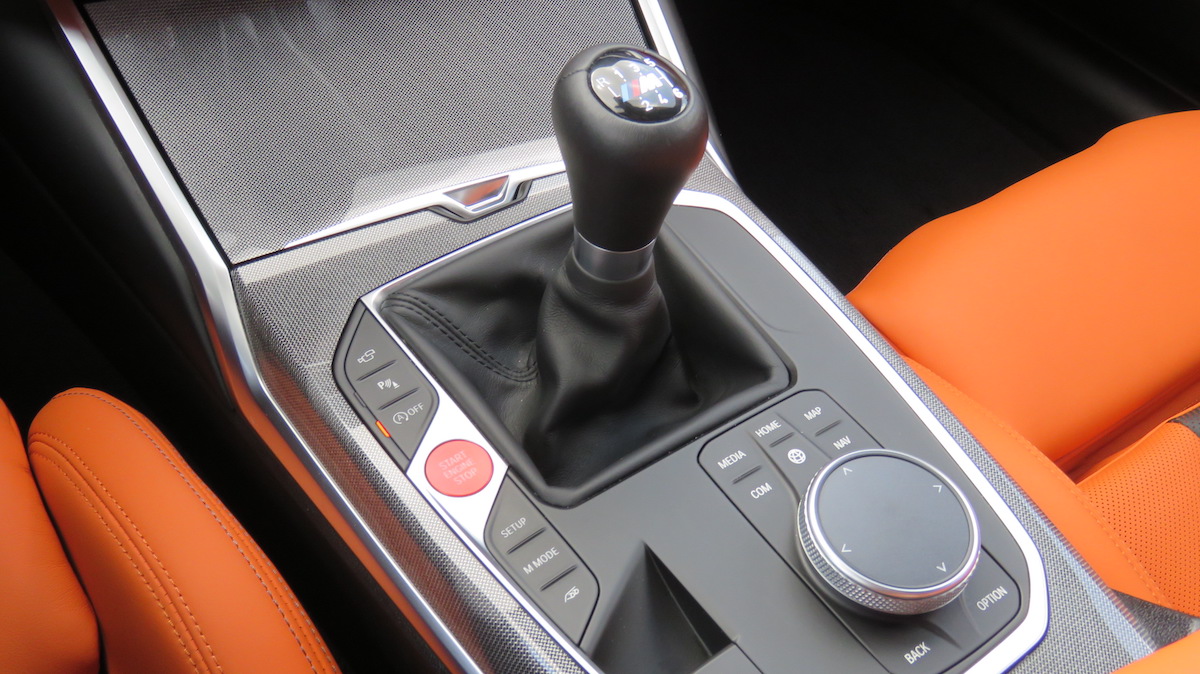
Since 2021, the M3 been offered in either standard or Competition trims, xDrive all-wheel drive (AWD) or rear-wheel drive (RWD), and with either a six-speed manual or eight-speed automatic transmission. The Bavarian brand maintains its inline-six engine layout, a cornerstone of its history. There’s no hybrid assistance to be found; just two mono-scroll turbochargers to help produce thrilling acceleration all over the rev band.
Verdict: There are few purpose-built-yet-all-purpose vehicles on the road that offer the same thrills as BMW’s most iconic four-door performance badge.
out of 10 expert review
Look & feel
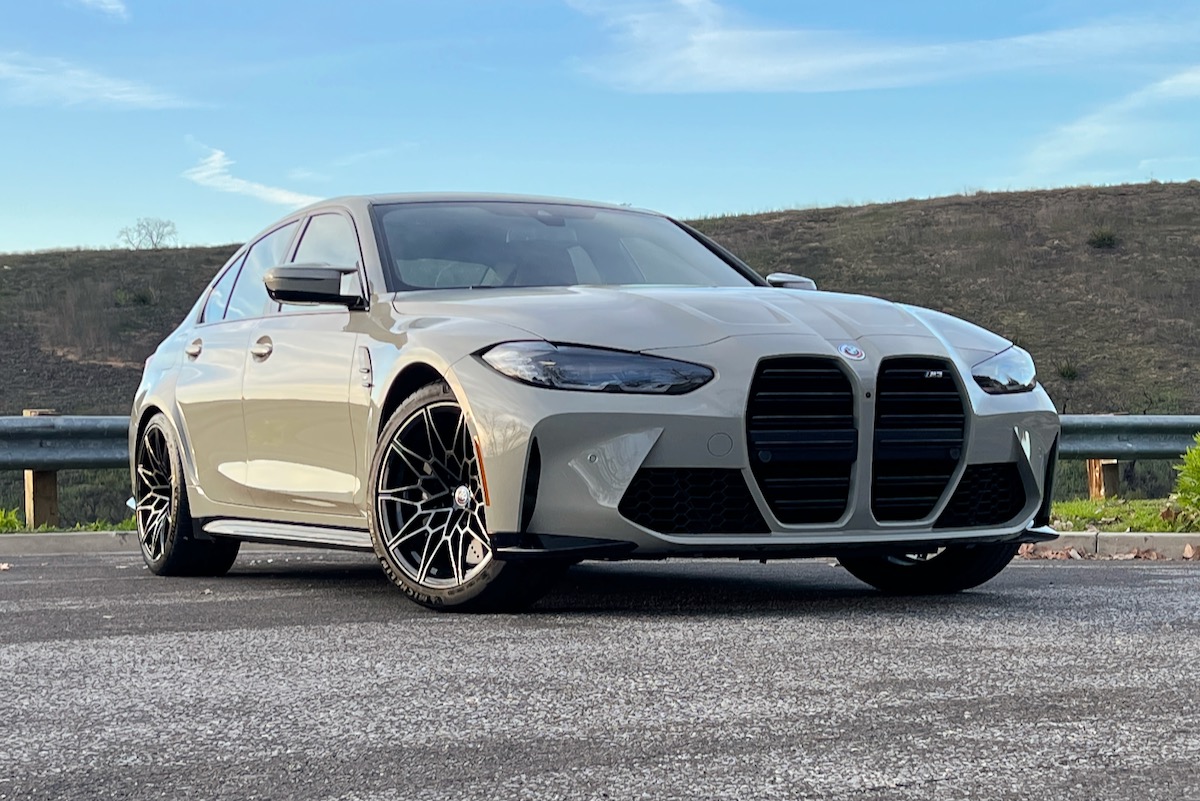
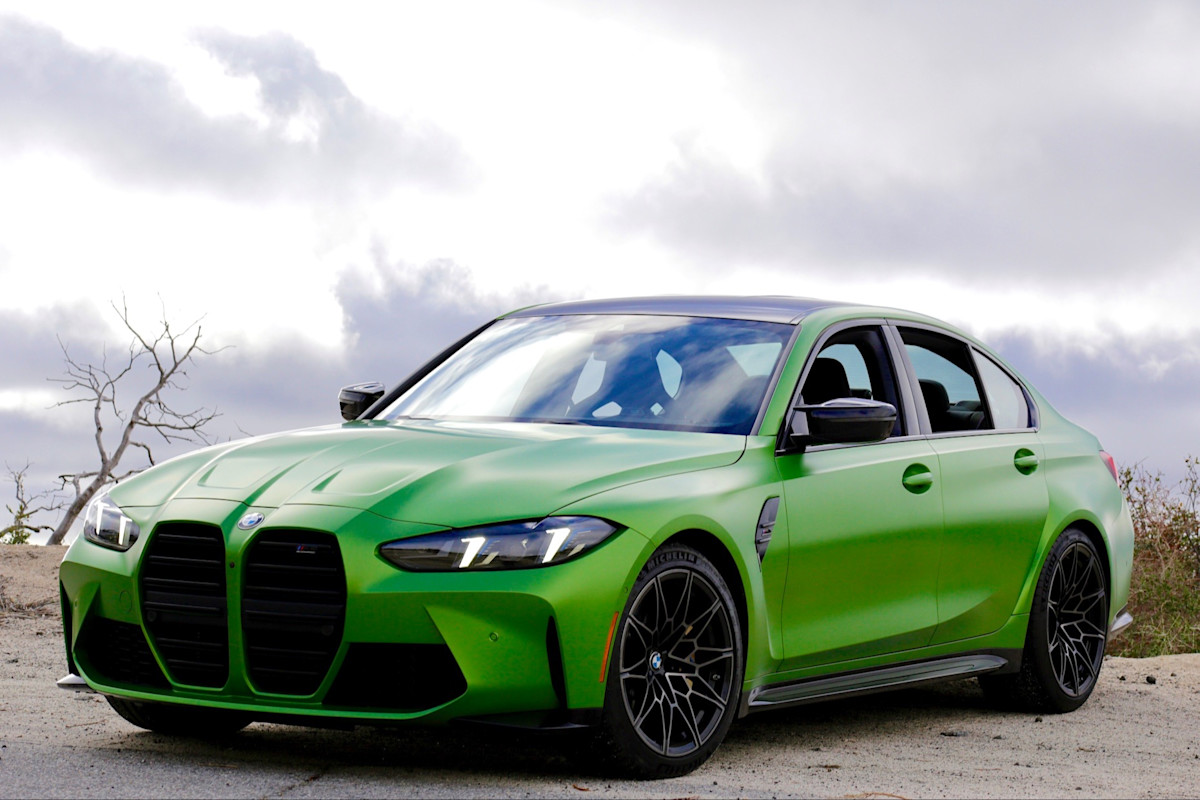
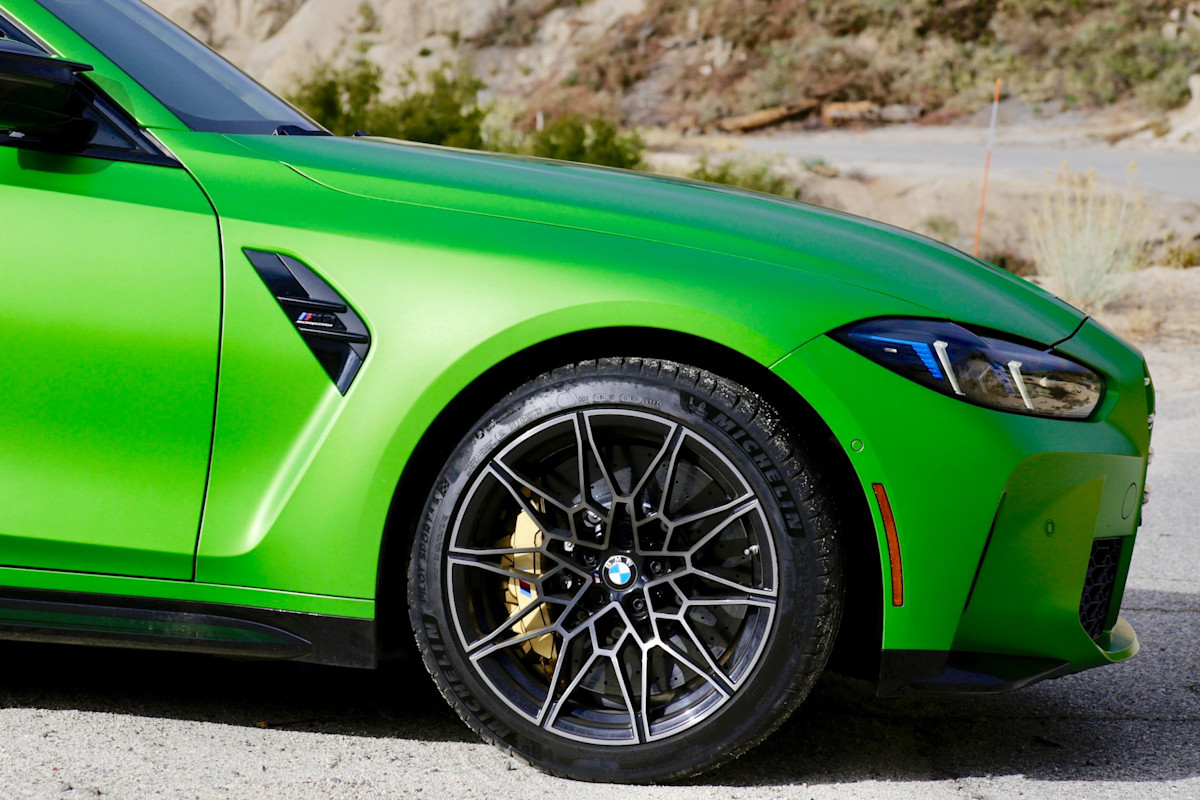
While we’re a few years into the current BMW M3 generation, it’s still hard to avoid its signature, love-it-or-hate-it face. The two tall inlets situated centre stage, commonly referred to as kidney grilles, stretch out vertically between its sharp headlights and invoke a wide variety of comparisons. We’ve seen buckteeth, fangs, a Sea Lamprey… comments sections aren’t always kind. It’s an acquired taste, and we think the 2025 model year’s new headlights really freshen up and improve the overall look. Fun fact: their LED laser design is borrowed from the more exclusive M4 CS and M4 CSL.
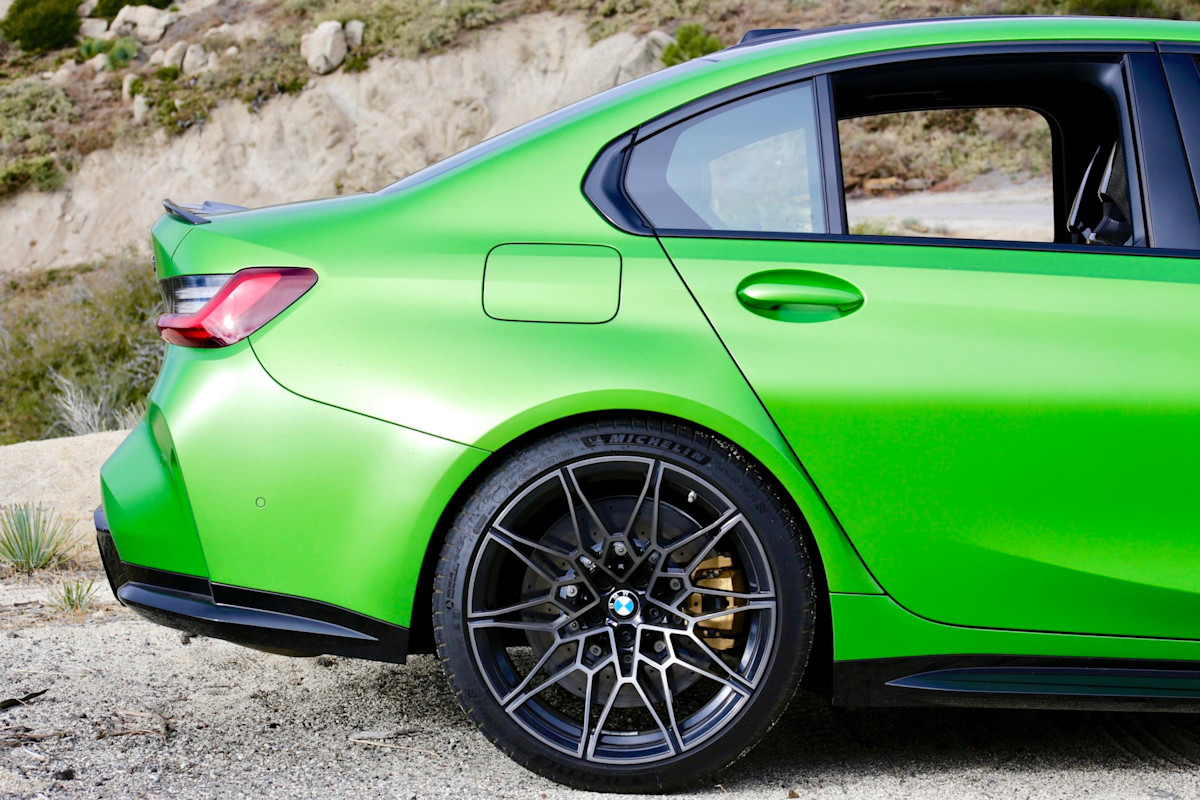
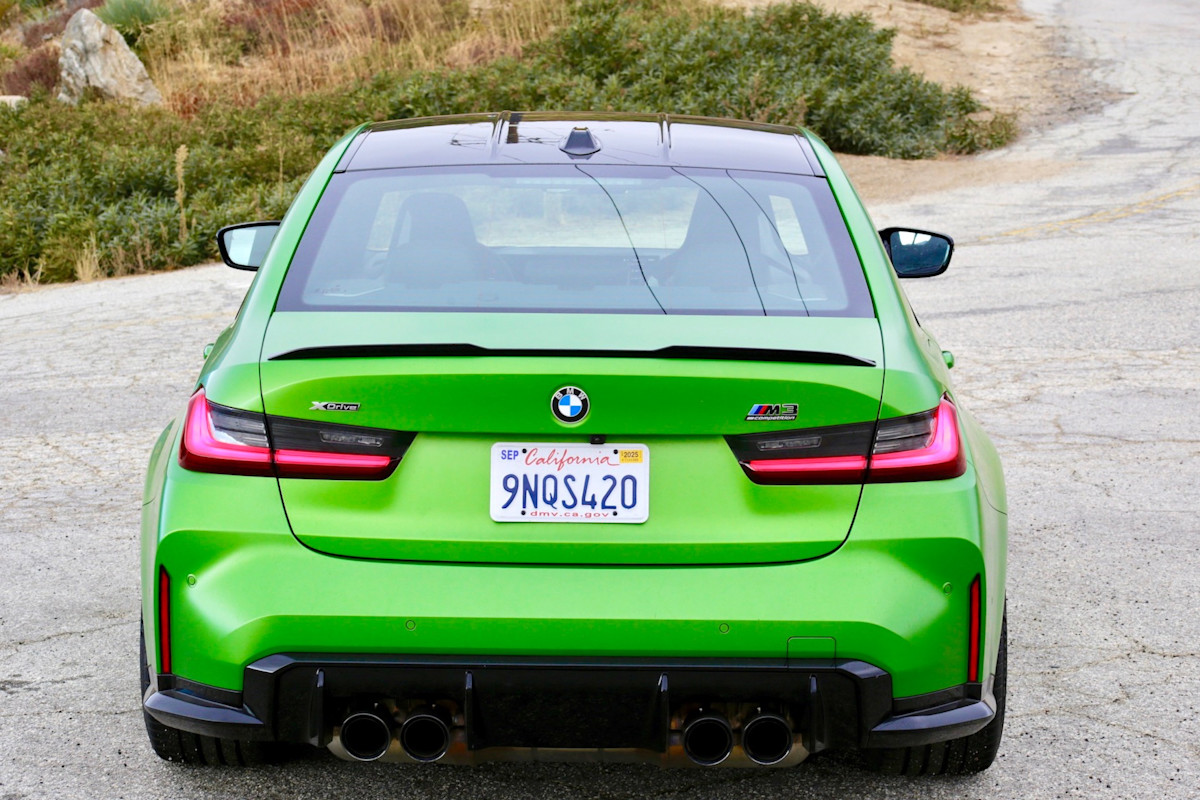
But there’s more going on regarding the smallest four-door M car’s appearance, and it’s not as polarizing: its athletic bodywork. Sporting wide rear haunches, large venting chiseled into the front lower bumper, massive wheels wrapped in sticky summer rubber — plus the massive multi-piston brakes behind them — and there’s no doubt that this big sedan means business.
Depending on who you ask, it’s also more aesthetically pleasing than its coupe sibling, the two-door BMW M4.
And there’s no mistaking this German executive express as big, either. This thing is dimensionally quite large. It’s more in-line with what its M5 big brother filled out in the late aughts, possessing an overall width (sans mirrors) of 1,887 millimetres and generous 4,804-millimetre overall length.
Besides its refreshed lenses, intertwined between the 2025 M3’s defined body lines is crisp, chic LED lighting throughout. In addition to the M3’s high-performance character, such contemporary fare certainly helps justify the M3’s $97,134 base price (including a $2,555 destination charge and other fees) and won’t create any confusion as to whether it's a legitimate European luxury performance sedan.
Performance
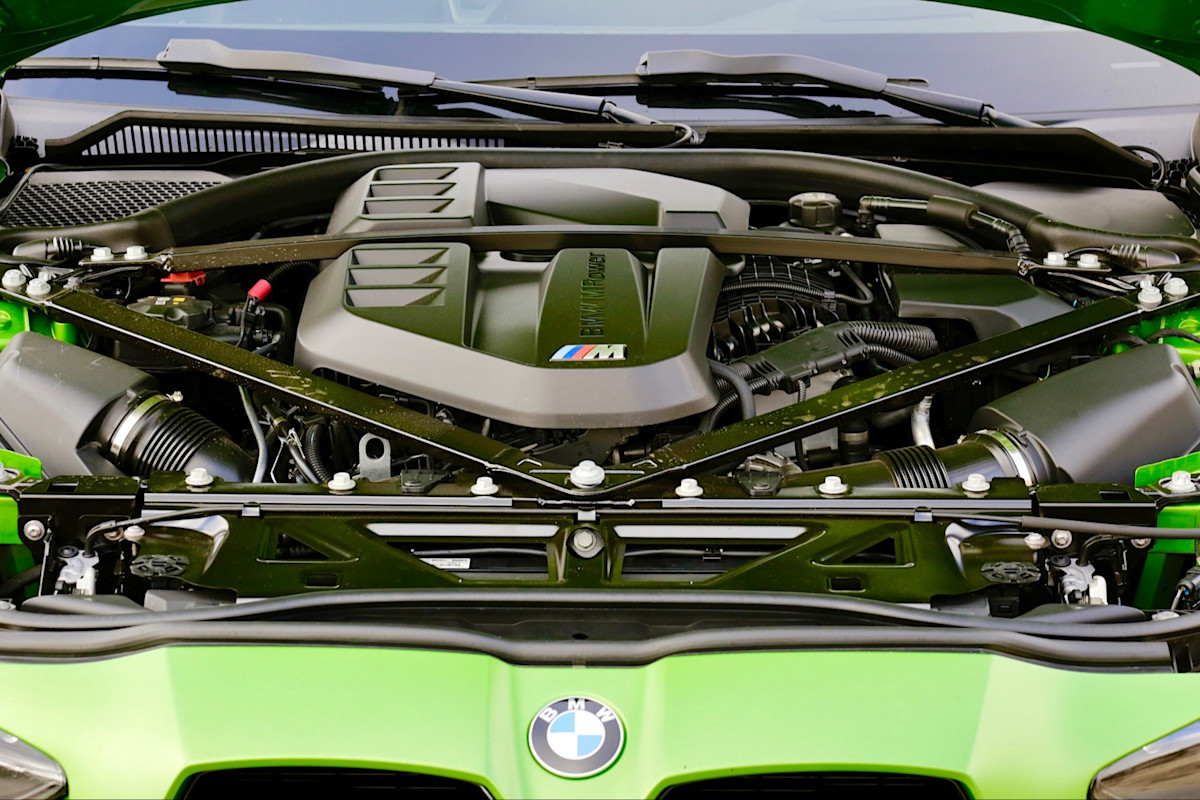
No matter the trim, all 2025 BMW M3s come equipped with the brand’s twin-turbo 3.0-litre inline six-cylinder engine, known to brand aficionados as the S58. However, power levels vary. In base spec, the M3 produces 473 horsepower and 406 pound-feet of torque, whereas jumping up to the Competition trim increases those figures to 503 hp and 479 lb-ft. These are all massive numbers made possible by being turbocharged, plus BMW’s Vanos variable valve timing, Valvetronic throttle body-less intake technology, and a big air-to-water intercooler bolted up just before the intake charge reaches the valvetrain.
RWD is the default on the base M3 in Canada, while the M3 Competition equips BMW’s xDrive AWD system.
A six-speed manual transmission is the sole option for the base model, whereas Competition trims get a ZF eight-speed automatic transmission. Curb weight is right around 1,770 kilograms (3,900 pounds). This may seem a bit portly, but their reported 0-100 km/h times tell a different story: The base hits the mark in a reported 4.2 seconds, whereas the Competition does so in 3.5 seconds. Our tester, the M3 Competition, certainly felt like it, too.
With a little courage and a heavy right foot, our AWD tester ripped off the line with reckless abandon and let out an angry howl all the way to redline. No matter the speed, we always had more than enough power on-tap, including enough to get into deep trouble while making otherwise casual passes on the highway. This powertrain means serious business. Between the 2025 M3’s power, weight, nicely insulated interior, and size, extra-legal speeds felt far lower than they actually were—talk about paying homage to German super sedans of yore, like its F80-generation predecessor, the E39 and E60 BMW M5, and so on.
When the road got twisty, particularly in the mountains, the 2025 BMW M3’s driving experience was non-stop fun. Whether ripping out of corners or heavily braking on our way into them, it always felt amply athletic and capable, offering up all the confidence. We never had any fear of overheating, as part of the reason for the M3’s iconic face is all the cooling going on behind it: oil coolers, heat exchangers, a transmission cooler, and more.
Grip was impressive while sailing through all kinds of fun corners, with nonexistent body roll when the adaptive dampers were configured to Sport, and a bit too track focused (as in, stiff) when in Sport Plus. Which brings up one of our top favourite features: Customization. We enjoyed the flexibility of diving into iDrive’s M settings and adjusting not only damper stiffness, but also throttle tuning, steering action, exhaust volume — either quiet or slightly less quiet — brake pedal sensitivity, and traction control.
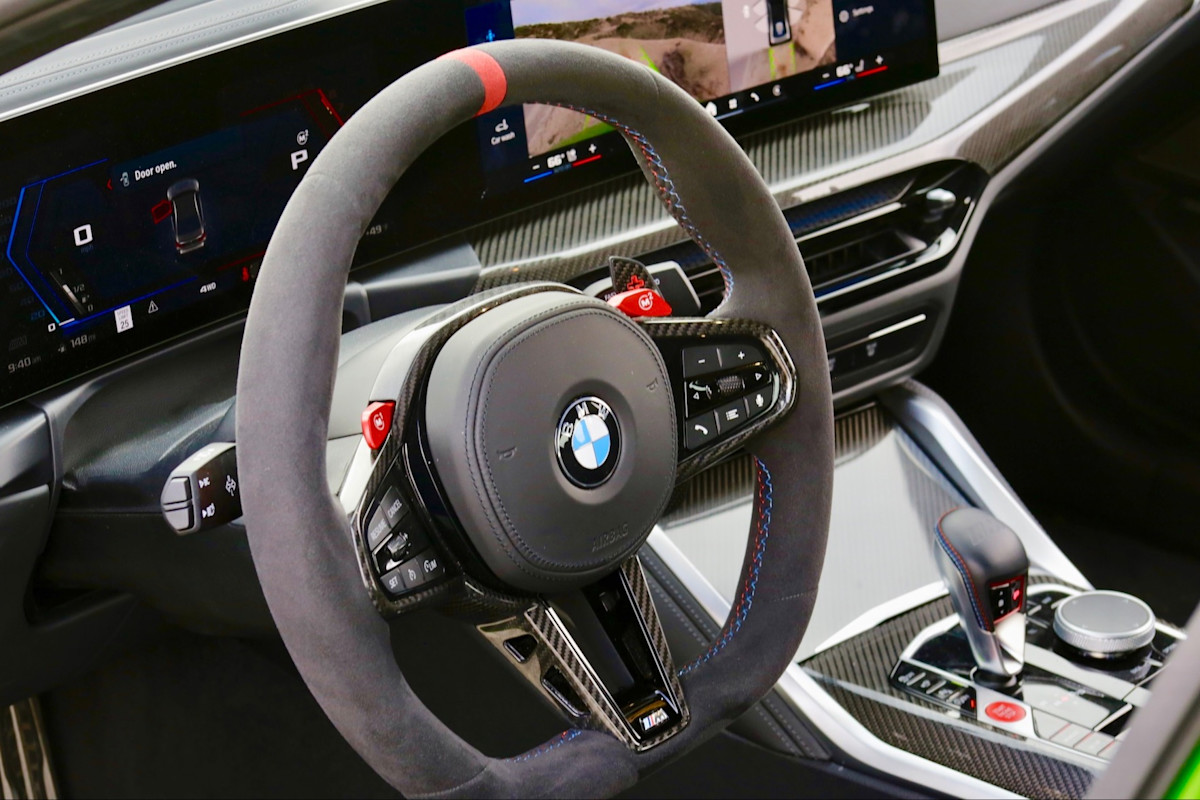
Then, two M buttons atop the steering wheel’s left and right spokes allowed us to quickly toggle our favourite mix of settings. For general around-town and highway driving, we set most everything to mid-level sporty utilizing the M1 button. Compression and rebound damping were plenty comfortable for all forms of city driving, yet never hid the M3's sports-car character.
On the other hand, the M2 button was reserved for everything cranked up to ferocious and track-ready levels for optimum poise, grip, and thrills, including barely there traction control.
With the drivetrain in RWD—that’s right, you can turn off the front wheels for classic BMW hijinks—we had a little too much fun playing with the latter. BMW’s M traction control has 10 levels of intensity, with our favourite being one notch away from fully off. If we had the sudden urge to enjoy some brief, harmless oversteer (but not risk spinning out in a haze of broken wheels and busted egos) this system was there to keep an eye on things. It made for some laughter-filled moments.
When it came to steering, handling, and braking, the M3’s fast steering ratio and very direct input made for precise front-end control, though its weight was too light for our liking at speed. Overall, this big German sedan was incredibly grippy and capable, but we could still feel its heft get slung around during rapid lateral G changes. It’s awfully tough to hide nearly two tons of steel, aluminum, and carbon fibre. Its biggest-M3-ever footprint doesn’t help it here, either. Still, the massive carbon ceramic 15.7-inch front and 15-inch rear brakes were always up to task, and the pedal had great feel and modulation in either Comfort or Sport mode.
Form & function
Diving inside the 2025 BMW M3, front-seat space is generous and the rear seat is downright commodious, even for a modern sedan in this segment. Up front, headroom measures out to 1,031 millimetres, front legroom reaches 1,057 mm, and front shoulder room comes in at 1,422 mm. In back, head- and legroom are 960 and 904 mm respectively but feel far larger, perhaps due to the shape of our tester’s front carbon bucket seats (more on those in a bit). Trunk space comes in at 480 litres.
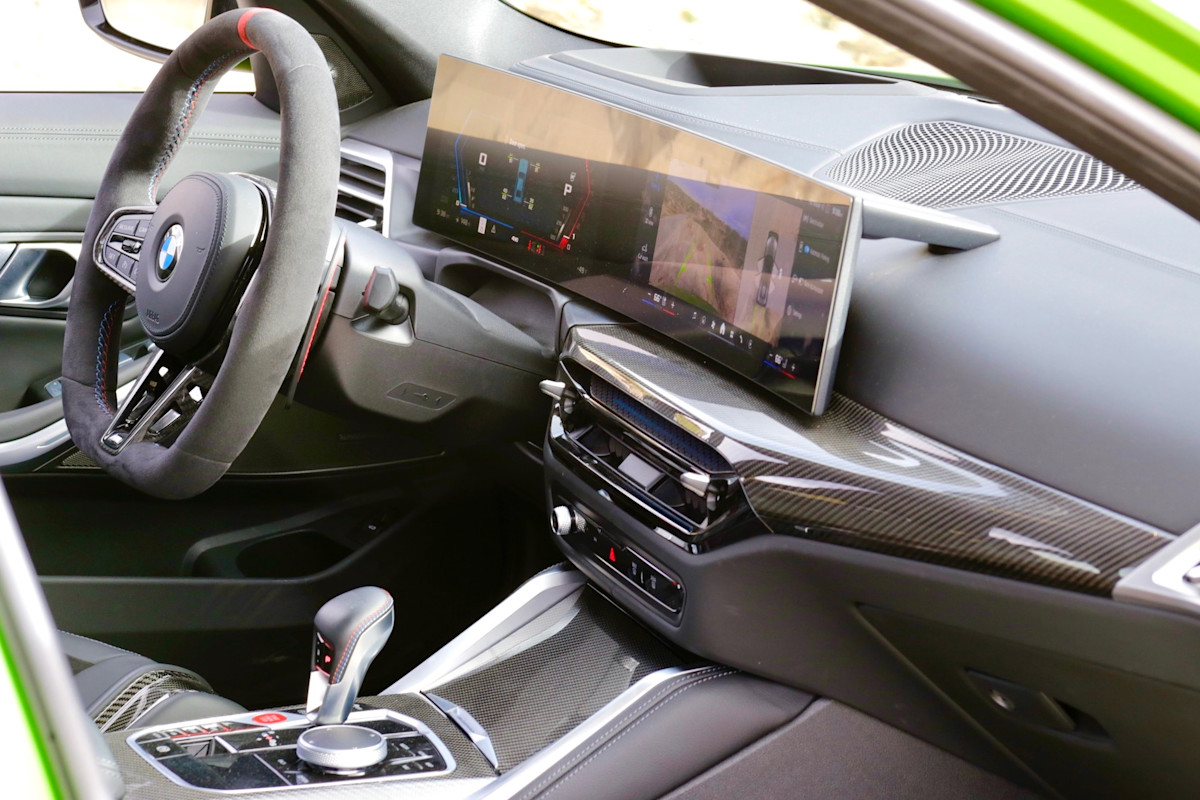
Overall materials quality is quite good, with many pleasant-to-the-touch hard plastic buttons throughout. Carbon fibre trim, a stitched leather dash, and generous amount of Alcantara on the front and rear seats certainly helped express our M3’s performance car personality. The centre touchscreen measures out to a massive 14.9 inches and runs BMW’s latest iDrive 8.5 software. For those who avoid fingerprints at all costs (waves hand), thankfully, there’s still a physical rotary dial controller nicely located on the centre console. Otherwise, the lightly rubberized switchgear around the iDrive controller had nice tactility and proved that not everything needs to be haptic feedback (we’re looking at you, Mercedes).
The M3’s interior controls are nicely laid out and within easy reach. First-time users might be a little overwhelmed with the sheer amount of them, but it’s generally easy to acclimate to after a day or two. Our Competition trim tester was optioned with M carbon bucket seats that were quite comfortable and supportive, though a little tricky to climb into (but not all body types may feel the same way). These were part of our tester’s $10,500 M Carbon Package that includes, you guessed it, many more carbon fibre accouterments. These include the aforementioned trim, and carbon fibre exterior elements. Just want the seats? That’ll only cost $5,500 (only).
Once buckled into its thickly bolstered M carbon seats, we were enveloped in the M3’s airy cabin with great overall visibility, and the low-slung front seats plus higher beltline definitely fit the M3’s four-door sports car personality. These race car-resembling units accommodate a wide variety of heights, and even a six-foot-three test driver had to raise the seat well off the floor to get a good idea of this sports sedan’s exterior dimensions. Unfortunately, we haven’t had the opportunity to compare these seats against the standard leather versions.
Technology
The 2025 BMW M3’s iDrive 8.5 infotainment system is one of the most current iDrive versions after 24 years of screen-assisted service. That’s right, it debuted all the way back in 2001 with the E65-generation 7 Series. The latest iDrive 9 system is now available on some models and sadly does away with the iconic rotary controller. Pour one out for a fingerprint-less infotainment screen.
Thankfully, iDrive 8.5 is tremendously less clunky than the systems from the early aughts, but there’s still a bit of a learning curve to it. Overall, it’s a very smooth and lag-less system, with great haptic feedback and excellent screen definition. Well, it had better be at 14.9 inches.
Above the steering wheel, the M3’s head-up display had great size and clarity, too. Connectivity was seamless as well, as once our iPhone was paired via Apple CarPlay (Android Auto, SiriusXM compatibility, and Bluetooth are also standard) it never froze up, refused to connect, needed re-pairing, or some other annoyance that’s often popped during the least-convenient moments in some other modern cars.
However, quickly moving between different screens and apps might be daunting to some first-time users. There’s a lot to scroll through, and if you choose to see all available apps at once, it looks like a very unorganized Windows desktop, cringe. But then, there are several shortcuts — including several lightly rubberized buttons surrounding the rotary controller — that make navigation a lot easier. Then, for configuring the 2025 M3’s vast suite of performance tweaks, these are logically laid out just to the right of the driver’s right leg. Finally, scrolling through different data screens on the M3’s 12.3-inch gauge cluster may be a little confusing to newbies as well.
Our biggest annoyance was the M3’s HVAC controls, which you have to either press a button or go through a series of screen taps to access. Why not just give us four or five pleasantly plastic buttons to make such adjustments, like in earlier model years? Otherwise, like with other current BMW models, the wireless charging pad made our iPhone extremely hot, rendering it unusable until it properly cooled down. We stuck to a good ol’ fashioned cable plugged into one of two USB-C outlets in the centre armrest’s compartment.
Safety
Like many other sedans in this segment, the 2025 BMW M3 comes standard with a suite of advanced safety features, including forward collision warning, automatic emergency braking, lane-departure warning, active blind-spot monitoring, lane-keep assist, and rear cross-traffic alert. For an additional $2,000, radar cruise control, lane-centring, lane-change assist, traffic jam assist, and evasion assist comprise BMW’s Advanced Driver Assistance Package.
Our tester was not equipped with this optional package, but the standard fare operated in a seamless and inoffensive manner for the most part. Forward collision warning was a little too hasty to judge our stopping distance at times, though, perhaps that’s for the better.
At the time of this writing, the Insurance Institute for Highway Safety (IIHS) and National Highway Traffic Safety Administration (NHTSA) have not rated the 2025 BMW M3. However, the NHTSA did give its less-performance-oriented 3 Series sibling a five-star overall safety rating, after acing each of its 11 tests.
Cost-effectiveness
There are two ways to look at the 2025 BMW M3. On one hand, an MSRP of $97,134 is no small sum, and that’s just at the base level. Climb into our Competition xDrive tester — sans optional extras — and that figure balloons into luxury tax territory at $105,560.
To start, you get a six-speed manual gearbox, RWD with an intuitive M-tuned limited-slip differential, adaptive dampers, nearly 480 hp, much of the same performance-oriented software (sans turning off the front wheels, naturally) a comfortable and chic interior, 18-inch wheels up front and 19-inch out back.
Stepping up the Competition xDrive ushers in a boost up to just over 500 hp, an eight-speed automatic gearbox, all-wheel drive, and a handful of mostly superficial interior and exterior improvements, such as bigger wheels. Interestingly, the Competition trim possesses a different engine code than the base.
On the other hand, no matter which trim you choose, you get a level of high-performance capability that supercars could only dream of 15 years ago, in an everyday friendly package, that’s comfortable and perfectly suitable for family hauling duty. That’s especially true if you’re one of those holdouts who refuses to stilt themselves up in one of the many sports SUVs on the market these days.
You won’t be putting up with nearly two-decade-old supercar fuel economy, either, as the M3 returns a Natural Resources Canada-rated 14.7 litres per 100 kilometres in the city, 10.1 on the highway, and 12.6 combined. In the Competition, surprisingly, figures are similar at 14.5 L/100 km city, 10.2 highway, and 12.6 combined. Either way, summoning a little hypermiling spirit could probably boost those highway figures.
In terms of direct competitors, there are three main heavyweights: the Audi RS 5 Sportback, Cadillac CT4-V Blackwing, and Mercedes-AMG C63 S E Performance. The Bimmer is the thirstiest of the bunch, and the AMG out-sips them all on account of being a plug-in hybrid.
Base price-wise, the Caddy has the lot beat at just over $74,533, whereas the tech-heavy Benz commands an astronomical $112,948. The Audi is mixed somewhere in the middle at $100,480 to start.
Note: Images show a US model.

What owners say
Trims & specs
Base MSRP $80,900 | Seating 5 |
Engine 3.0L 503 hp I6 | Cargo Capacity 16.9 cu ft |
Combined MPG 19 | Drivetrain RWD |
Base MSRP $76,700 | Seating 5 |
Engine 3.0L 473 hp I6 | Cargo Capacity 16.9 cu ft |
Combined MPG 19 | Drivetrain RWD |
Base MSRP $86,000 | Seating 5 |
Engine 3.0L 523 hp I6 | Cargo Capacity 16.9 cu ft |
Combined MPG 19 | Drivetrain AWD |


Pricing trends
MSRP range
$76,700 - $86,000
Current avg. market price
$117,183
Trending up by 2.2% this month
May 2026 - October 2026