2024 Mazda CX-90 Reviews, Pricing & Specs



Pros & cons
What we like
Excellent handling
Terrific powertrains
Stylish design
What to consider
PHEV electric range could be better
Frustrating technology
The CarGurus verdict
The Mazda CX-90 is a three-row crossover with the heart of a sports car.
The 2024 Mazda CX-90 three-row SUV is the family-hauling crossover we finally want to drive. This all-new Mazda delivers a turbocharged straight-six engine (or a PHEV, if you prefer), rear-wheel-drive architecture, brilliant handling, and up to a nearly 50% discount from the surprisingly similar BMW X5. We sampled the U.S. equivalents of the new 2024 Mazda CX-90 Turbo Signature and the CX-90 PHEV during Mazda’s hosted first drive on Northern California’s twisty roads, and we came away impressed by the big and powerful SUV’s handling and composure.
out of 10 expert review
Look & feel
If you want a luxury image, buy a BMW or a Mercedes-Benz. Those manufacturers are well-known for top-tier luxury and performance, and their high price tags convey status and wealth.
But if you want a luxury car, you can also now consider a Mazda. The Japanese automaker has soared past Honda, Nissan, and Toyota in terms of design and material quality, coming closer to the luxury arms of those competitors–Acura, Infiniti, and Lexus.
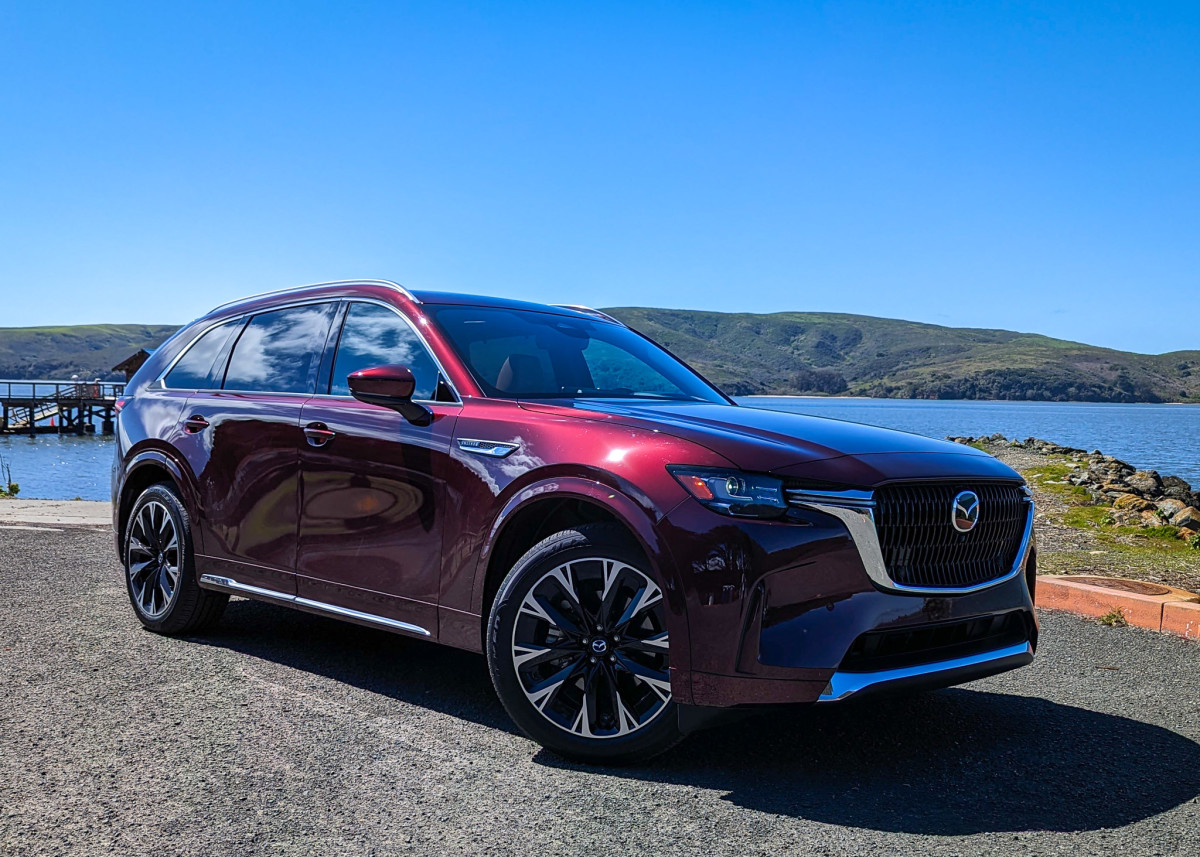
From the outside, the all-new Mazda CX-90 takes the elegant design language of the smaller Mazda CX-30 and CX-5 and supersizes it. Stretching over 5 metres, the CX-90 is an imposing SUV. Its big grille, wide-set front end, and large wheels (ranging from 18 to 21 inches) all demand attention. Add in some tasteful chrome trim, and this is an SUV that manages to look elegant despite its mass.
Things are even more impressive once you open the door. Mazda sells the CX-90 in many different trims, which we’ll get to shortly, but top-shelf models sport an interior that could match some of the best names in luxury. If you’re willing to pay for it, brown suede upholstery covers the dash, wood inlays fill the centre console, and any black plastic bits are pleasantly matte, rather than gaudy and glossy. There’s nothing tacky about a Mazda interior–next to a flagship CX-90, a BMW X5 will look similarly lovely, but massively overpriced.
Given that Mazda sells the CX-90 in a range of trims, not all of them will look quite so striking. However, all will benefit from the stylish, delicate design language and the comfortable layout. All told, there are 8 different trim levels in Canada for the CX-90, spread across three powertrains. You’ll find the CX-90 Turbo sold in GS, GS-L, GT, GT-P, and Signature trims, with the latter two being equipped with the more powerful mild-hybrid engine. There’s a plug-in hybrid (PHEV) CX-90, too, sold in GS, GS-L, and GT trims.
For this review, we took U.S. versions of the PHEV along with the top-tier Signature for a test drive.

Performance
Mazda’s big news for 2024 is the introduction of two new powertrains. The CX-90 is the first Mazda SUV to offer a plug-in hybrid option, and it aims to deliver better fuel economy and performance than the outgoing CX-9. Along with the PHEV, shoppers can choose between two iterations of an all-new turbocharged inline six-cylinder engine with a mild-hybrid system. The turbo I6 delivers 280 horsepower and 332 pound-feet of torque in base spec, but we didn’t have a chance to drive that de-tuned model. Instead, we were delighted by the upgraded I6 found in CX-90 GT-P and Signature trims.
The new powertrains illustrate a startling transformation from the outgoing Mazda CX-9 to the new CX-90. While the turbocharged four-cylinder found in the old car was capable, it has always felt more suited to a smaller SUV, like the CX-5 or the CX-50. The new, powerful inline-six and PHEV powertrains help distinguish the CX-90 as being in a separate class from those smaller crossovers. In particular, the CX-90 Signature carries an incredible exhaust note; this machine sounds unlike any Mazda to have come before.
The upgraded 3.3-litre inline-6 turbo engine increases power from 280 horses to 340–a substantial jump–when using premium fuel. Torque also jumps, climbing to 369 lb-ft. All 2024 Mazda CX-90 models get all-wheel drive (AWD) as standard equipment, and they all employ an eight-speed automatic transmission.
There are three driving modes available in the CX-90 Signature: Normal, Sport, and Off-Road. While we didn’t have an opportunity to test the CX-90’s off-roading chops, there was a noticeable difference in behaviour when driving in Normal and Sport modes. Pushing this engine high into the rev range opens up the CX-90’s lungs and creates an exceptional roar from the engine. In Sport mode, the CX-90 can hold its gears a bit longer, allowing the car to scream along at peak horsepower. However, we did notice that the eight-speed transmission demonstrated inconsistent behaviour, particularly when we drove in Sport mode. Sometimes it held gears deep into the rev range, other times it shifted frenetically, trying to find the right power band.
The more fuel-efficient 2024 Mazda CX-90 PHEV employs a 2.5-litre naturally aspirated four-cylinder engine in conjunction with a 17.8-kWh battery and a 68-kW electric motor. Total output measures 323 horsepower and 369 lb-ft of torque. Shoppers should expect an all-electric driving range of 42 kilometres, notably less than the 2023 Kia Sorento’s 51 kilometres of all-EV range. Note that because the CX-90 PHEV’s electric range falls below 50 km, it qualifies only for partial EV purchase incentive programs from federal and provincial governments. Natural Resources Canada estimates that the CX-90 PHEV will return 4.2 Le/100 km in combined driving, with 747 kilometres of total driving range. The PHEV model simply can’t match the Signature for noise and drama, but it exhibited similar handling performance.
Which is to say, both CX-90 models were brilliant through corners, tackling Northern California’s twisty roads with the composure of a much smaller vehicle.
The 2024 Mazda CX-90 is built on a larger platform than the outgoing CX-9, but a double-wishbone front suspension and transverse engine layout allow the front wheels to turn further while keeping solid contact with the ground. This helps the CX-90 feel lithe and agile in tight corners, which is not something we’re used to writing about three-row crossovers. Add in the thin, almost delicate steering wheel common on Mazda models, and the driver gets the feeling that they’re driving a much smaller car.
Mazda has developed a reputation for building outstanding driver’s cars. After all, this is the company that gave us the MX-5. However, it would be easy to shelve this goal when the product is meant for shuttling families and going grocery shopping, rather than weekend joyride and track days. We’re thrilled to report that, instead, Mazda has succeeded in imbuing the CX-90 with the attitude of an MX-5.

Form & function
The CX-90 is available in an array of trims and, fittingly, an array of seating configurations, too. The lowest trims can seat eight passengers, with three across in the second and third rows. The mid-level trims get captain’s chairs in place of the second-row bench and seat seven. We expect most shoppers will likely buy a seven-seater CX-90. The Turbo Signature trim gets an exclusive six-seat configuration–two in the front, two in the second-row seats, two in the rear seats.
You get a touch more cargo space in CX-90s fitted with the two-seater third row, but just a touch. Total cargo space measures 2,129 litres in those models, with 451 litres behind the third row and 1,155 litres behind the second. Models with the more common three-across back seat will fit 423 litres behind the available hands-free liftgate, 1,133 litres behind the second row, and 2,101 litres when all rows are folded.
Those numbers are more than what you’d get in a CX-9 (which offered 407 to 2,017 litres of cargo space). One of our regular criticisms of the CX-9 was that it felt a bit small for its segment. The CX-90 is certainly an improvement, but it’s worth noting that the CX-90 still falls short on capacity next to the Honda Pilot, Nissan Pathfinder, and Toyota Highlander, and legroom in the third row is comparatively snug.
Pleasantly, Mazda has stuck plenty of cubbies and clever storage options in the CX-90. The centre console is plenty large, there are spacious door pockets, and the cupholders are nicely sized and placed. The middle-row captain's chairs in our CX-90 Signature test car also had a centre console with its own sizeable bin, side-by-side cupholders, and a storage drawer at its base.
Add in the lovely materials and upholstery, the comfortable seats, and a big panoramic sunroof, and the CX-90 might not be as spacious as some other options, but it’s certainly comfortable.

Technology
Mazda has a very clear objective when it comes to technology: eliminate distractions to ensure safety.
In this spirit, the Mazda Connect infotainment system does not employ a touchscreen interface. Instead, it uses a set of hard buttons on the centre console and a rotary control knob.
The logic is sound: touchscreens require drivers to take their eyes off the road, while physical controls do not. The rotary knob is beautifully engineered with a satisfying action, and the buttons are smartly placed.
Unfortunately, we have yet to drive a Mazda vehicle with this technology setup and come away satisfied. Instead, there are just too many frustrating quirks and idiosyncrasies–for instance, orienting the navigation map takes multiple clicks with the rotary dial, rather than a simple press with a finger. While the intention was to reduce distraction, we inevitably end up more distracted just trying to master basic functions than we would be if they were controlled via a typical touchscreen.
Luckily, there are a few saving graces. First, the CX-90 offers personalization software which, once set up, will use facial recognition to automatically adjust the seats, mirrors, and head-up display (HUD) to your preferred driving position. It will also update myriad other settings–like radio station favourites–to your specific profile. In past Mazda models, the solution to annoyances like not being able to scroll through radio stations was to simply set your preferred stations as “favourites” and scroll through those. Naturally, anyone sharing a car with another driver knew that solution was easier said than done. With the CX-90’s personalization feature, it actually works.
Additionally, the CX-90 comes standard with Android Auto and Apple CarPlay (wireless in higher-level trims). Mazda’s rotary controller works with these projection systems, but the company seems willing to admit that touchscreen controls work even better. Thus, thankfully, both Apple CarPlay and Android Auto do employ touchscreen controls. Given the familiarity and prevalence of Apple CarPlay and Android Auto, we suspect most people will default to them when they start their CX-90.

Safety
Although Mazda’s infotainment technology is a bit of a swing and a miss, we’re happy to report that its dedicated safety features are an extra-base hit. i-Activsense, the company’s suite of advanced driver assistance systems (ADAS) comes standard on every CX-90 and includes some features that are often extra-cost options on other crossovers, such as blind-spot monitoring and adaptive cruise control.
Other standard ADAS features include automatic emergency braking, smart brake support with front-crossing and turn-across-traffic identification capabilities, rear cross-traffic alert, and a safe-exit warning. The CX-90 also benefits from lane-departure warning and lane-keeping assist.
Our top-spec CX-90 Signature test car had cruising and traffic support, too. This technology set blends lane-centring with adaptive cruise control to provide a hands-on driver support system. We were pleased to see that the CX-90 stayed evenly in its lane, and we experienced only a few minor hiccups while we tested this tech.
Neither the Insurance Institute for Highway Safety (IIHS) nor the National Highway Traffic Safety Administration (NHTSA) has crash-tested the 2024 Mazda CX-90–which is not unusual with brand-new models–but we expect it to perform well. The 2023 CX-9 was named a Top Safety Pick by the IIHS and received five stars in overall rating from the NHTSA, so a step below those accolades would be surprising for this new crossover.

Cost-effectiveness
Mazda has increased pricing alongside feature availability and build quality in recent years, meaning it’s a bit disingenuous to compare it directly with brands such as Honda, Nissan, and Toyota. However, it’s also not quite accurate to say Mazda is a direct competitor to established luxury brands; it doesn’t have exactly the same craftsmanship and its lower prices reflect that.
Ultimately, Mazda sits a bit in the middle. Like Jeep, Mazda builds cars that are a little nicer than most, but for lower prices than you’d find in the commonly accepted luxury segment.
The CX-90 follows this strategy. The starting new car MSRP of $45,900, not including the mandatory $2,195 destination charge and other fees, for a Turbo GS trim is more than $5,000 below a Honda Pilot’s starting price, and it’s even lower than the Hyundai Palisade’s starting price just shy of $50,000. The $63,300 MSRP for a Signature is roughly $10,000 less than a top-spec Acura MDX.
Across the trim lineup, you’ll find most CX-90s priced between $50,000 and $60,000, which represents a great value for what you’re getting. Few vehicles on sale today pair interior refinement, striking exterior design, and brilliant powertrain dynamics as seamlessly as the 2024 Mazda CX-90 does, and virtually none live below the luxury tier.
Note: Images show a US model.

What owners say
the car drives very good and it feels so comfortable and relaxing
March 21, 2025Just bought a 2024 Mazda CX-90 Preferred. So far I love the looks, the interior, and the Turbo Inline 6. It is a blast to drive. It is powerful, responsive, the cabin is quiet, and it feels great to drive! There is a lack of storage space. The center console is very shallow and the glove compartment is a little small as well. It has less legroom and cargo space than others that I test drove in the same class (Telluride, Pilot). I actually liked the Telluride interior a little better but the CX-90 is more fun to drive and is a better value over all.
January 15, 2025Great for freeway, longer hauls, and road trips. Smartly designed quiet cockpit with well placed interface knobs to control all CarPlay and other features. Smart cruise control has some quirks in turns if theres a vehicle in front of you in the parallel lane. It slows you down as if it thinks the other vehicle is in your lane instead of passing it properly. Heard a software update is coming for that. Smart cruise doesnt send hand on wheel but rather you have to steer a little for it to know your hands are present on the wheel. Higher end vehicles sense your hand on the wheel without having to actually turn the wheel slightly. By far the biggest pain point is the low tailgate opening height. If you are over 6-feet tall, you will hit your head on this low hanging gate. Many, many, times. Even if you think you will learn to duck, you will still hit your head. After a year, its become a deal breaker. Unfortunate because there is no engineering reason that it could not be designed to swing up a few inches higher to allow taller drivers access to the back without having duck under the tailgate. Perhaps Japanese designers did not properly consider the height of many American men who are 62 and above in height. Also to note, when using the on board fitment feature to set seat and steering wheel heights, the telescoping steering wheel does not project outward enough for tall drivers. With long legs, you want the seat far back, but the steering wheel does not come out that far, so youre reaching for the wheel, which isnt comfortable. Blanket statement, this is not a vehicle for tall people over 6-feet.. That said, this vehicle is a great driver, quiet and comfortable, with a strong spirited engine. Good design overall. Plus my driving averaged 24mpg which is excellent for the size. Not the most rugged looking vehicle. Not sure it would be the best choice for say outdoor adventures or camping considering the more lux interior. Its refined, understated, and sort of blends in the crowd a bit, which can be a good thing.
September 24, 2024Trims & specs
Base MSRP $54,400 | Seating 7 |
Engine 2.5L 323 hp I4 Hybrid | Cargo Capacity 14.9 cu ft |
Combined MPG 57 | Drivetrain AWD |
Base MSRP $50,495 | Seating 7 |
Engine N/A | Cargo Capacity 14.9 cu ft |
Combined MPG N/A | Drivetrain N/A |
Base MSRP N/A | Seating N/A |
Engine N/A | Cargo Capacity N/A |
Combined MPG N/A | Drivetrain N/A |
Base MSRP $39,300 | Seating 8 |
Engine 3.3L 280 hp I6 | Cargo Capacity 14.9 cu ft |
Combined MPG 25 | Drivetrain AWD |
Base MSRP N/A | Seating N/A |
Engine N/A | Cargo Capacity N/A |
Combined MPG N/A | Drivetrain N/A |
Base MSRP $58,500 | Seating 7 |
Engine N/A | Cargo Capacity 14.9 cu ft |
Combined MPG N/A | Drivetrain N/A |
Base MSRP $50,270 | Seating 8 |
Engine 3.3L 280 hp I6 | Cargo Capacity 14.9 cu ft |
Combined MPG 25 | Drivetrain AWD |
Base MSRP N/A | Seating N/A |
Engine N/A | Cargo Capacity N/A |
Combined MPG N/A | Drivetrain N/A |
Base MSRP N/A | Seating N/A |
Engine N/A | Cargo Capacity N/A |
Combined MPG N/A | Drivetrain N/A |
Base MSRP $53,150 | Seating 8 |
Engine 3.3L 340 hp I6 | Cargo Capacity 15.9 cu ft |
Combined MPG 26 | Drivetrain AWD |
Base MSRP $49,850 | Seating 7 |
Engine 3.3L 340 hp I6 | Cargo Capacity 15.9 cu ft |
Combined MPG 26 | Drivetrain AWD |
Base MSRP $43,450 | Seating 8 |
Engine 3.3L 280 hp I6 | Cargo Capacity 14.9 cu ft |
Combined MPG 25 | Drivetrain AWD |
Base MSRP $57,570 | Seating 7 |
Engine 3.3L 340 hp I6 | Cargo Capacity 15.9 cu ft |
Combined MPG 25 | Drivetrain AWD |
Base MSRP $45,900 | Seating 7 |
Engine 3.3L 280 hp I6 | Cargo Capacity 14.9 cu ft |
Combined MPG 26 | Drivetrain AWD |
Base MSRP N/A | Seating N/A |
Engine N/A | Cargo Capacity N/A |
Combined MPG N/A | Drivetrain N/A |
Base MSRP N/A | Seating N/A |
Engine N/A | Cargo Capacity N/A |
Combined MPG N/A | Drivetrain N/A |
Base MSRP $42,900 | Seating 8 |
Engine 3.3L 280 hp I6 | Cargo Capacity 14.9 cu ft |
Combined MPG 26 | Drivetrain AWD |
Base MSRP N/A | Seating N/A |
Engine N/A | Cargo Capacity N/A |
Combined MPG N/A | Drivetrain N/A |


