2024 Kia EV9 Reviews, Pricing & Specs




Pros & cons
What we like
Spacious third row
Exciting technology
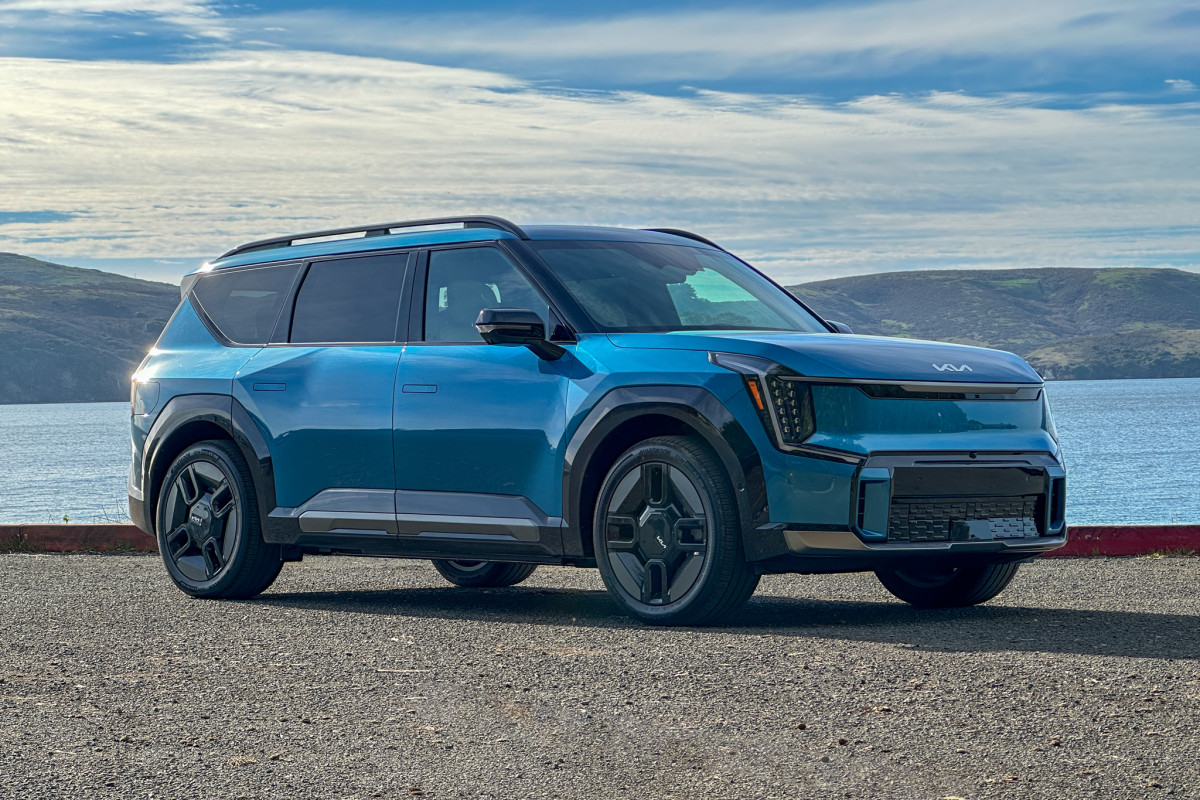
Stylish design
What to consider
Expensive
Medium electric range
The CarGurus verdict
Kia’s got an all-new flagship model, the EV9, and it’s one of very few fully electric three-row SUVs available.
With the Kia EV9, the Korean automaker innovates in more ways than one. It’s not only a new vehicle, or even only a new electric vehicle (EV). It also introduces a new business model that allows owners to continue to customize their vehicle long after they’ve left the dealership. And yet, while it breaks new ground, the EV9 manages to provide a refreshingly familiar driving experience.
It looks like Kia’s got a winner on its hands. Well-appointed, comfortably sized, and offered at a price point fit to embarrass its luxury-brand rivals, the EV9 is a compelling package. Add to that its intuitive driving feel and its potential for later-term customization, and this just may be the ambassador vehicle it takes to bring the EV-wary over to the green side.
out of 10 expert review
Look & feel

Performance
The Kia EV9 Light trim is powered by a single motor, making it rear-wheel-drive (RWD) with 215 horsepower and 258 lb-ft of torque. This base EV9 has an EPA-estimated electric range of 370 kilometres. For the best range in the EV9 lineup, you’ll want the Wind model, which swaps the base Light trim’s 76.1-kWh battery for a 99.8-kWh battery pack. This reduces horsepower a tad (to 201), but it also bumps the distance you can go on a single charge up to 489 kilometres.
The three versions of the top Land trim are offered exclusively with all-wheel drive (AWD), and each has two electric motors. The dual-motor powertrain produces 379 hp and 516 lb-ft of torque. The base and Premium Package versions come with 451 kilometres of range. The range-topping GT-Line sacrifices a bit of range for the sake of performance, bumping it down to 435 kilometres.
We spent a few hours behind the wheel of the Kia EV9 GT-Line, driving it around northern California’s Napa Valley. Power delivery is smooth and refined; even in this sportier trim, the EV9 avoids the pinning-you-to-your-seat feel that we’ve come to expect from electric cars. Instead, it simply whisks the car and its occupants up to cruising speed with a minimum of fuss or muss. Acceleration when passing during highway driving was equally matter-of-fact. We found the handling to be good—the vehicle’s weight keeps it planted and we noted no excessive body roll. We did notice some mild rocking in the suspension, but given the unfamiliar roads, we wouldn’t like to swear that the vehicle itself was to blame.
Perhaps most importantly, the EV9’s regenerative braking system can be adjusted to the point that it feels completely natural, comparable to a modern-day gas-powered vehicle. Paddles mounted on the beefy steering wheel allow the driver to easily adjust the amount of regeneration; turning it all the way up activates i-Pedal, Kia’s one-pedal driving mode.
If range is the million-dollar question when it comes to EVs, charging is at least the half-mil question. But because our research for this EV9 review was conducted on a first drive program hosted by the manufacturer, we have not yet charged the vehicle ourselves. We will plan to update the review when we have that information. For now, we will tell you what Kia told us: The EV9 has fast charging capability, and on a high-speed DC fast charger, it should be able to go from 10 to 80 percent in 25 minutes.

Form & function
Perhaps the biggest differentiator for the Kia EV9 is its third row, which remains a relative rarity for those seeking all-electric power. And this third row is no afterthought: It’s remarkably spacious, providing ample head room at 1,004 millimetres regardless of sunroof options. That beats third-row headroom in not only the Kia Telluride, but also the BMW X7 and the Rivian R1S. Third-row legroom, meanwhile, ranges from 783 to 813 mm depending on the middle row’s configuration. It’s important to note that, unlike the eight-seater Telluride, the EV9 can seat up to seven passengers, because the rear seats number just two. Maximum capacity requires a second-row bench seat, which was not available for testing on this drive. (Land models with the Premium and GT-Line packages come with second-row captain’s chairs, while Light, Wind, and Land base models have a bench seat in the middle.) We did spend some time in the second-row seats and found them comfortable, with contoured bolstering to help passengers sink in and avoid jostling.
Cargo space behind that third row measures 572 litres, competitive for the class. That can be boosted to 1,231 litres with the third row folded down or 2,313 litres with only the front-row seats in place. We appreciated the EV9’s relatively high and flat load floor, which made retrieving luggage noticeably easier.
Storage space up front is fine. Because the EV9 features a “floating” centre console, there is little usable flat surface between the driver and front passenger, even with the higher trims’ sliding cover rolled over the cupholders. The angled and partially covered wireless charging pad sits behind the cupholders, and there is a large open compartment on the floor between the driver and front passenger. Low walls around the borders of this compartment serve to hold items in place. While the shallow top-closing cubby of the centre console may disappoint those up front, second-row passengers in GT-Line trims enjoy a large drawer and tray table that expand out from the console in the back.

Technology
The EV9 takes the curved screen seen in the Kia EV6 (as well as in platform-sharers the Genesis GV60 and the Hyundai Ioniq 5) to the next level: It features three screens in a single curved display, where those others incorporate two. Centred above the steering wheel is the 12.3-inch driver information display. To the right of that sits a 5-inch screen dedicated Climate Display, which we thought was a nice touch–and yes, the EV9 does include physical switches to operate the tri-zone climate control! Finally, the right most section is another 12.3-inch display, this one for infotainment. Wireless Apple CarPlay and Android Auto as well as a wireless charging pad are standard. Light, Wind and Land base trims get an eight-speaker sound system, while the Land Premium and GT-Line packages get a 14-speaker Meridian Premium Audio sound system. The head-up display is offered only for the GT-Line package, where it is standard.
Perhaps most interesting on the tech front is the EV9’s connectedness. Over-the-air (OTA) update capability is increasingly commonplace and hardly something to brag about these days, but the depth and breadth of OTA offerings on the EV9 is absolutely noteworthy. EV9 owners will be able to upgrade their vehicles when and as they please by purchasing additional features from the Kia Connect store. Both performance upgrades and additional Digital Grille lighting patterns have already been mentioned, with more to come, including services that may currently be just a gleam in an engineer’s eye.
The implications of this Kia Connect store are quite intriguing. It diminishes arguments against buying early in a model’s run or generation, as early EV9 adopters can expect to benefit from further developments as well. It also means that buyers need not commit to the whole kit and caboodle at the dealership, as they’ll have an opportunity to further customize their vehicle later. Finally, it means that shoppers interested in a used Kia EV9, when the time comes, will not be limited to the options the previous owner selected. At least, on some fronts. Applications may be somewhat limited for now, but we could see this “future-proofing” of Kia’s becoming the standard of the future–unless it threatens the cash cow that is “planned obsolescence.”

Safety
Kia reps pointed out that the EV9’s base price sits right around the Telluride’s fully optioned price. There’s a handful of driver-assistance features that are optional on the Telluride, and the same is true of the EV9. However, as with the Telluride, the EV9’s standard suite of advanced driver-assistance systems (ADAS) is pretty comprehensive.
The adaptive cruise control, for example, is standard on the EV9 in its best possible form: navigation-based, with machine learning and stop-and-go capabilities. Blind-spot collision avoidance assist and blind-spot collision warning are standard, but the Blind-spot View Monitor (which shows real-time video of the blind spot area in the driver information display when a turn signal is active) is only on the Land trim’s Premium and GT-Line packages. Kia likewise throws its full arsenal of forward collision avoidance and rear cross-traffic collision avoidance functionality at the EV9, but reverse parking collision avoidance assist is reserved for the top two packages, and front and side versions are limited to the GT-Line.
The Kia EV9 has not been rated for safety as of this writing–the car is simply too new to have yet seen testing with the Insurance Institute for Highway Safety (IIHS) or the National Highway Traffic Safety Administration (NHTSA). However, it did earn the highest available rating from the European New Car Assessment Programme (commonly known as Euro NCAP), an analogous agency which performs its own crash testing for the European markets.

Cost-effectiveness
A fully loaded, top-trim Land GT-Line test vehicle does give us sticker shock, clocking in at a total of $82,433. That includes the (somewhat exorbitant) $3,095 destination charge as well as mandatory dealer fees. The base model EV9, while not exactly reaching the opposite end of the spectrum, looks far more reasonable with its starting price of $59,995. Once we’d sat with that information for a moment, we were reminded that both electric power and additional seating command a premium, deservingly so, and the EV9 does both quite well. (Consider the camp chair nature of the Mitsubishi Outlander’s third row.) Three-row EVs remain a rarity and were made only by luxury automakers until now.
It does help somewhat that all versions of the Kia EV9 qualify for the Canadian federal government’s $5,000 iZEV rebate as well as provincial rebates where they exist. But considering that the rebate is applied to the post-sales tax price, meaning only $4,425 of it is applied to the MSRP, the $3,000-plus delivery charge all but wipes out that rebate. This means unless you live in a province where you’ll get another rebate lopped off the invoice—namely in B.C., Quebec, the Atlantic provinces, and the territories—you won’t see as much of a benefit from buying this EV as you would on other models.
Let’s look at some of the alternatives. Assuming you’re set on a three-row electric SUV, your options include the Rivian R1S, the Tesla Model Y and Model X, and the Mercedes-Benz EQB and Mercedes-Benz EQS SUV. That’s all. (The Volkswagen ID.Buzz is set to join the list this year.) These are not makes or models spring to mind in association with the word “bargain.”
We DO associate a few of these competitors with impressive electric range. The Rivian can get up to 644 kilometres when properly configured and the Model X up to 539 kilometres. As mentioned above, the best range in the EV9 comes in the Wind trim, which has a range of 489 kilometres and a base MSRP of $62,995. Compare that to $105,250 for the Rivian or $109,990 for the Tesla Model X, and 50 fewer kilometres of range may not feel like such a big sacrifice.
Note: Images show a US model.

What owners say
The EV9 is a great people hauler with up to 5000 lbs. Of trailering capacity. If you can buy it for the listed price of 41,999 plus doc, it is a solid buy.
October 12, 2026The EV9 Wind is beautiful and packed with quality. Battery life is excellent and the cabin is spacious. 3rd row is a little tight if you have second row bench seating. The only con I have is the sound system. I would like better factory speakers.
May 14, 2024Trims & specs
Base MSRP N/A | Seating N/A |
Engine N/A | Cargo Capacity N/A |
Combined MPG N/A | Drivetrain N/A |
Base MSRP N/A | Seating N/A |
Engine N/A | Cargo Capacity N/A |
Combined MPG N/A | Drivetrain N/A |
Base MSRP N/A | Seating N/A |
Engine N/A | Cargo Capacity N/A |
Combined MPG N/A | Drivetrain N/A |
Base MSRP $54,990 | Seating 7 |
Engine N/A | Cargo Capacity 20.2 cu ft |
Combined MPG N/A | Drivetrain N/A |
Base MSRP $57,990 | Seating 7 |
Engine N/A | Cargo Capacity 20.2 cu ft |
Combined MPG N/A | Drivetrain N/A |
Base MSRP $64,090 | Seating 7 |
Engine N/A | Cargo Capacity 20.2 cu ft |
Combined MPG N/A | Drivetrain N/A |
Base MSRP $69,990 | Seating 7 |
Engine N/A | Cargo Capacity 20.2 cu ft |
Combined MPG N/A | Drivetrain N/A |
Base MSRP $71,990 | Seating 6 |
Engine N/A | Cargo Capacity 20.2 cu ft |
Combined MPG N/A | Drivetrain N/A |


