2024 Hyundai Elantra Reviews, Pricing & Specs


Pros & cons
What we like
Multiple powertrain options
Stylish design
Manual transmission available
What to consider
Potentially polarizing design
Underwhelming base engine
Interior materials feel cheap
The CarGurus verdict
The Hyundai Elantra is the sportiest-looking and most versatile compact car on sale.
For nearly 20 years over six generations, the Elantra established Hyundai as a provider of bottom-rung transportation. Not until the current seventh-generation model debuted in 2020 did the Elantra shed its cheap image and stand competitively with other compact sedans from Honda, Toyota, and Nissan. Hyundai always sold on low prices and long feature lists. Now the Elantra is a genuinely sporty, well-constructed car that competes on actual substance — namely, how it drives and feels — and offers a wider range of trim levels. For 2024, a mild refresh brings more style and standard equipment.
Verdict: Get past the strange bodywork and plasticky interior, and you’ll find a well-mannered sedan that is equally adept at being comfortable and economical as it is sporty and truly entertaining.
out of 10 expert review
Look & feel
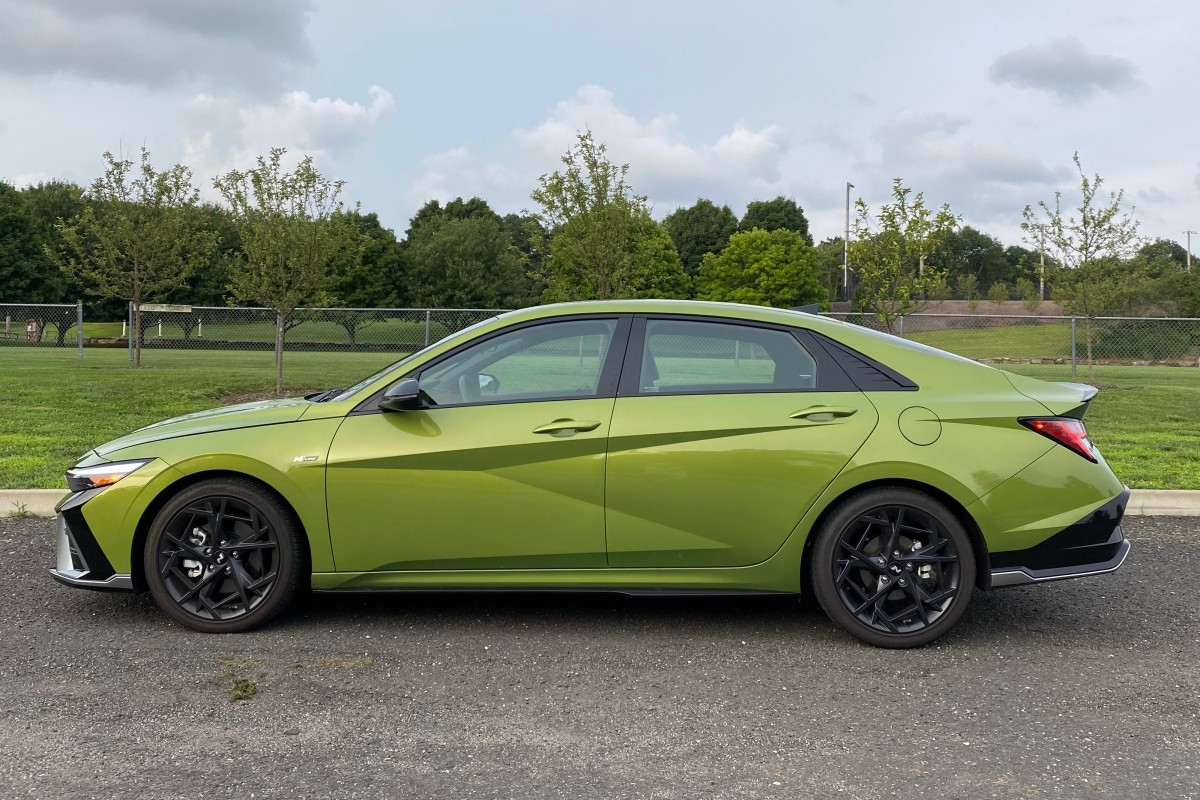
Hyundai is the hardest working company in the auto business, and its fighting spirit shows in dramatic exterior styling that changes drastically from one generation of each model to the next. Without any heritage to draw from, Hyundai lets its design teams take huge risks. Sometimes the cars are knockouts, like the 80s-vibe Ioniq 5 and the sleek Sonata. Other times, they take a few too many pen strokes. The Elantra is the latter, especially on the side, where no fewer than six hard creases cut up the doors at seemingly random angles. Designers use creases to create a sense of depth in a car's body panels and to define a car's shoulders, but on the Elantra, the doors just look dented. Darker colours hide these disjointed lines, though they're omnipresent in any light. Had Hyundai removed all but two horizontal lines, the Elantra's presence would be elevated instead of exaggerated.
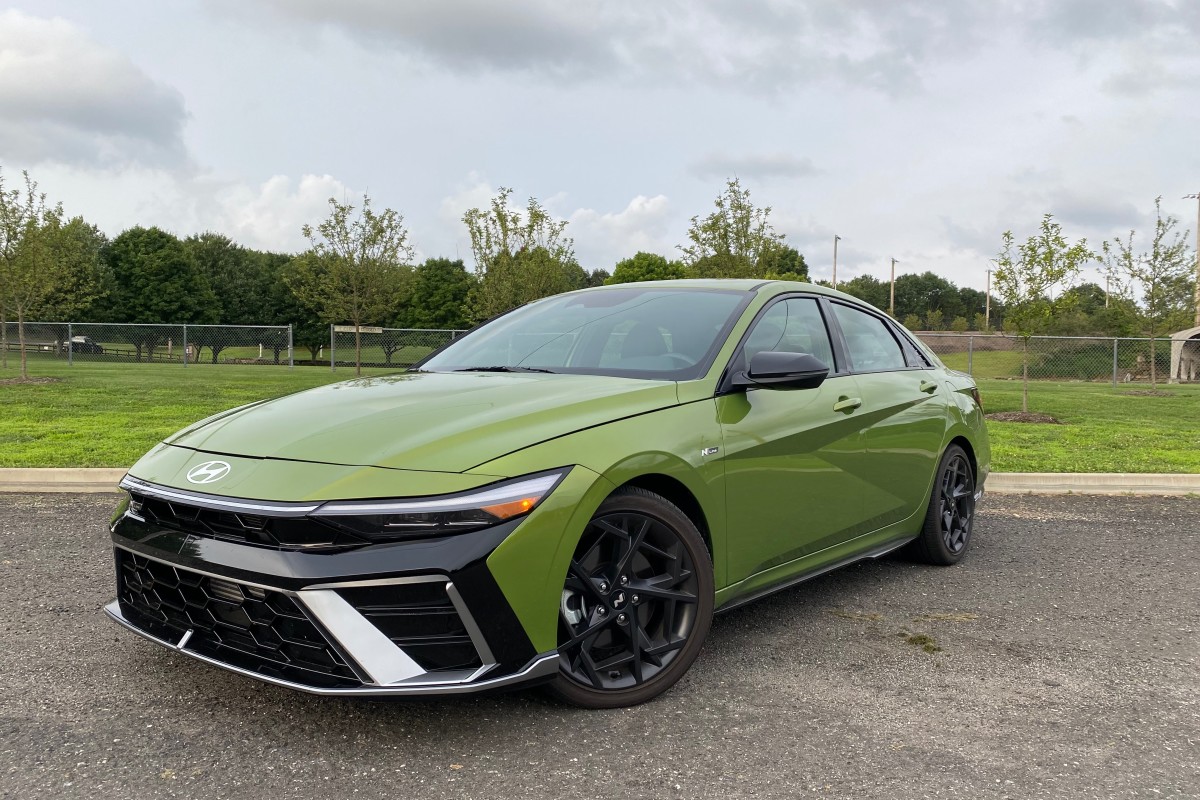
We get where Hyundai was headed: triangles, wedges, a Lamborghini theme of brashness and colour. Painted in Exotic Green on dark grey wheels — the spokes pointing every which way — with big, polished black air intakes surrounded by silver accents and wraparound headlights with thick LEDs, the Elantra in N Line Ultimate trim is a wild child.
The 2024-model-year refresh reshapes the grille so it's positioned lower, forms the headlights into the edges of the grille, and connects them with a silver band running across the trailing edge of each DRL. It's a clean, linear front end — perfect. The Hyundai badges are stainless steel, which add a subtle, premium touch. Here's another reason those crazy door creases are unnecessary: the proportions of the body mimic the character of a more expensive, rear-wheel drive sports sedan. The body is low and elongated, while the rear end echoes a fastback with a long, wide window and a short decklid with a tall, ducktail spoiler. This is lovely, tasteful design work. The toothy shapes of the outer taillights add just the right amount of aggression. In the Essential, Preferred, and Luxury trims, the Elantra loses the sporty bumpers that compliment the body. Without the N Line Ultimate treatment, the Elantra looks cheaper.
The interior looks inviting on any trim, thanks to a thin centre stack that's angled toward the driver and divides the passenger by a grab handle, plus classy silver trim on the dash that integrates the air vents and aligns with a similar three-line pattern on the door panels. It's plastic fantastic in the Elantra — nothing except the optional leather-wrapped steering wheel and shifter feel soft — yet the design brings a sense of movement and the build quality is good for the price. The base Essential dressed in grey cloth is particularly good, but the hex-patterned cloth on the N Line Ultimate was rough and abrasive. A few more soft touch points and better upholstery could do wonders for this car.

Performance
As an affordable, mass-market car, you would reasonably expect the Elantra to offer one powertrain. Instead, there are four engines and five transmissions, each of which share a front-wheel drive (FWD) layout and four cylinders. The most common Elantra trims (Essential, Preferred, Luxury) have a 2.0-litre inline-four with 147 horsepower and 132 pound-feet of torque paired to a continuously variable transmission (CVT). Performance is adequate in low-speed, around-town driving, but on highways, it's very weak and loud.
That's why the N Line's 1.6-litre turbo-four is a must-have upgrade, with 201 hp and 195 lb-ft sent through a faster-shifting seven-speed dual-clutch automatic transmission. This is a zippy car full of verve at any speed, and it injects personality into an otherwise boring conveyance. Flicking the shifter into S delivers rapid response, and the engine sounds good revving high. It's not as satisfying as a Honda Civic Si, but it's close. The problem, however, is a sometimes laggy and clunky reactions from the gearbox when accelerating from a stop. That's because this is a dry clutch system, which means the two clutches engage the gears directly like a manual transmission. You have to feather the gas for the smoothest takeoffs, but it's not consistent.
That's why the Hyundai Elantra N (not the N Line) has an eight-speed dual-clutch gearbox with the clutches bathed in oil. It reacts faster and puts more power down — and there's a serious amount of it, at 276 hp and 289 lb-ft of torque. We tested a 2022 Elantra N with a six-speed manual (this is the only trim available with a stick) and it was one of the most wildly entertaining cars we've driven in a very long time. The manual's clutch has a very vague engagement point so it's easy to stall, but if you give it lots of revs and mash the gas, this car rips. It's obnoxiously loud, too, with plenty of pops on the overrun. There's also a lot of turbo lag, abundant axle hop (where the axle bounces rapidly over the road as the tires struggle for grip), and notable torque steer (where the wheels pull the steering wheel from your grip when accelerating).
Even with adaptive dampers, the N rides like hell over imperfect roads, which is why the 2024 N has new suspension bushings and engine mounts. Hyundai also revised the steering (the gearbox, universal joint, and the power steering software) and increased the tire pressure on the front axle. We’ll see if those changes make the N more livable. In the meantime, we were smitten by the N Line’s perfect balance of comfort and response. It shares the N's multi-link rear suspension as opposed to the twist-beam axle on standard Elantra models. It's firm without being punishing and always leaves the driver feeling in full control.
At the other end of the spectrum is the Elantra Hybrid, which has a 1.6-litre inline-four running on the Atkinson Cycle, a 1.3-kilowatt-hour battery pack, and a single electric motor. Together, they're good for 139 hp and 125 lb-ft. Hyundai doesn't fit its hybrids with a CVT like most automakers. Instead, the Elantra Hybrid has a six-speed dual-clutch transmission similar to the N Line's seven-speed. Fuel economy is superb, rated at 4.8 litres per 100 kilometres in the city, 4.5 on the highway, and 4.7 combined.
Non-hybrid trims are still impressive when it comes to fuel efficiency, at 7.7 L/100 km city, 5.9 highway, and 6.9 combined for the base engine and 8.3/6.8/7.6 for the N Line Ultimate, a small concession for its significant power upgrade. The N is pretty thirsty, at 11.0/8.1/9.7 for the manual and (oddly) worse for the automatic at 11.8/8.6/10.4.

Form & function
The Elantra has a pleasant mix of analog and digital controls. There is a mechanical parking brake — a good old pull handle — with a conventional PRNDL shifter, unlike many of Hyundai's newest models that use a chunky and confusing column shifter. Shortcut buttons for navigation, audio, and other functions are below the main touchscreen, while underneath is a dedicated space for climate and heated seat controls. A drive mode button is awkwardly smack in the centre of the driver's left-side dash, which appears like a cost-saving blank plate that should have been part of the digital instrument panel, but it's at least another physical control.
Sight lines and visibility are good in all directions from the front seats. A sunroof is standard on the Luxury and N Line Ultimate trims. Headroom is especially good in all seating positions, and the rear seat offers plenty of legroom. Rear passengers also get two USB-C ports, but no air vents. Up front, there is a USB-C port and a soft-touch door panel that was not fitted to previous model years.
The trunk holds 402 litres of cargo, which is very generous for a small sedan, and 60/40 folding rear seats come standard. If you buy the N, a red X-brace that stiffens the chassis blocks most of the seat pass-through, though.

Technology
A 10.25-inch touchscreen is now standard on the Luxury trim and above. The Essential and Preferred have an 8-inch touchscreen, but to avoid a barren of black plastic around that smaller screen, Hyundai wisely moved the shortcut buttons and the volume and tuning knobs to surround it. A digital instrument panel is standard from Luxury up with a 4.2-inch TFT screen sitting between analog gauges on lower trims.
The larger infotainment system doesn't support wireless Apple CarPlay or Android Auto — oddly, the smaller one does — but the wired version is quick. The menus offer many ways to customize the car and show detailed descriptions of each setting, a big plus. The icons on the home screen, however, are too small and similarly coloured to identify what they are while driving. Newer versions of this system available in other Hyundai models are much improved.
An eight-speaker Bose stereo is standard from the Luxury trim, as are a wireless charging pad and Highway Driving Assist. While the latter is not a hands-free system, the steering assist is quite accurate on marked highways.

Safety
The 2024 Elantra received a five star overall safety rating from the National Highway Traffic Safety Administration (NHTSA) (four stars for the front passenger, five for the driver, and five for front and rear passengers in two side tests). The Insurance Institute for Highway Safety (IIHS) named the 2024 Elantra a Top Safety Pick, but a careful look shows the group did not perform all of its standard crash tests. Also, in conducting a new frontal crash test (moderate overlap), the 2024 Elantra scored worse in IIHS testing than the 2021 Elantra. Rear passengers had a higher risk of injury despite Hyundai adding two rear side airbags for 2024. There are no frontal knee airbags.
Standard safety features on the 2024 Hyundai Elantra in Canada include a simple forward braking assist system, lane keep assist and lane departure warning, lane following assist, automatic high beams, and a driver attention monitor. From the Preferred grade, blind spot monitoring, rear cross-traffic alert, and safe exit assist are added. Luxury trims up to N Line include forward collision avoidance with pedestrian and cyclist detection as well as junction turning assist, adaptive cruise control with stop and go, and highway driving assist. The Elantra N drops some of these features depending on which transmission you select.

Cost-effectiveness
The 2024 Hyundai Elantra starts in Canada at $24,559 for the Essential trim, including the $1,825 destination charge and other fees. There are five trims in total: Essential, Preferred, Luxury (available with the base engine or the hybrid powertrain), N Line Ultimate, and the performance-focused N. Pricing on the N Line Ultimate we tested rings up at $33,659 with destination. A five-year/100,000-kilometre new vehicle warranty come with every Elantra.
Compared to rivals like the Nissan Sentra, Toyota Corolla, Honda Civic, and Mazda3, the Elantra represents a great value and offers more choice across its lineup. The Elantra has always been a value, but past generations traded on their low price and skimped on driving feel and technology. No longer. The Elantra in this generation is a worthy competitor and feels properly sorted. It took Hyundai more than 20 years to get here, but it’s now got a great car.
Note: Images and video show a US model.

What owners say
The car was a great value for the money I spent. It had plenty of features, and ultimately great MPG and price. I loved that it still has manufactuer warranty and is a certified-pre owned. I did wish it supported Hyundai's digital key, but the BlueLink is another phenomenal feature, other than having to pay every year. For other cars in this class such as the Civic, Corolla, Forte, K4, Impreza etc. It is reasonably priced, only competitive with the K4. If I wanted all of these features in one of those other vehicles especiallt the Civic I would be paying significantly more.
April 29, 2025I live the interior and the way it drives. It feels very much my style and I can see myself driving it every day.
January 23, 2025I was going to buy a new one except for a design I cannot live with. The passenger side grab bar is unsightly. If something falls on the floor, you wont be able to grab it at a stop light. It is located between the gear shift and the passenger side. Looks like a hospital bed rail. Pass. Drives great. Ive bought 4 Hyundais so I like them but I would rather go for an older model without the bar. Thats what I am looking for now.
January 5, 2024Trims & specs
Base MSRP $23,575 | Seating 5 |
Engine 2.0L 147 hp I4 | Cargo Capacity 14.2 cu ft |
Combined MPG 36 | Drivetrain FWD |
Base MSRP N/A | Seating N/A |
Engine N/A | Cargo Capacity N/A |
Combined MPG N/A | Drivetrain N/A |
Base MSRP $21,625 | Seating 5 |
Engine 2.0L 147 hp I4 | Cargo Capacity 14.2 cu ft |
Combined MPG 36 | Drivetrain FWD |
Base MSRP N/A | Seating N/A |
Engine N/A | Cargo Capacity N/A |
Combined MPG N/A | Drivetrain N/A |
Base MSRP N/A | Seating N/A |
Engine N/A | Cargo Capacity N/A |
Combined MPG N/A | Drivetrain N/A |
Base MSRP N/A | Seating N/A |
Engine N/A | Cargo Capacity N/A |
Combined MPG N/A | Drivetrain N/A |
Base MSRP N/A | Seating N/A |
Engine N/A | Cargo Capacity N/A |
Combined MPG N/A | Drivetrain N/A |
Base MSRP $28,465 | Seating 5 |
Engine 1.6L 201 hp I4 | Cargo Capacity 14.2 cu ft |
Combined MPG 31 | Drivetrain FWD |
Base MSRP $26,915 | Seating 5 |
Engine 2.0L 147 hp I4 | Cargo Capacity 14.2 cu ft |
Combined MPG 36 | Drivetrain FWD |


Pricing trends
MSRP range
$21,625 - $28,465
Current avg. market price
$22,416
Trending down by 1.5% this month
May 2026 - November 2026