2024 GMC Canyon Reviews, Pricing & Specs


Pros & cons
What we like
Excellent materials quality
Outstanding tech
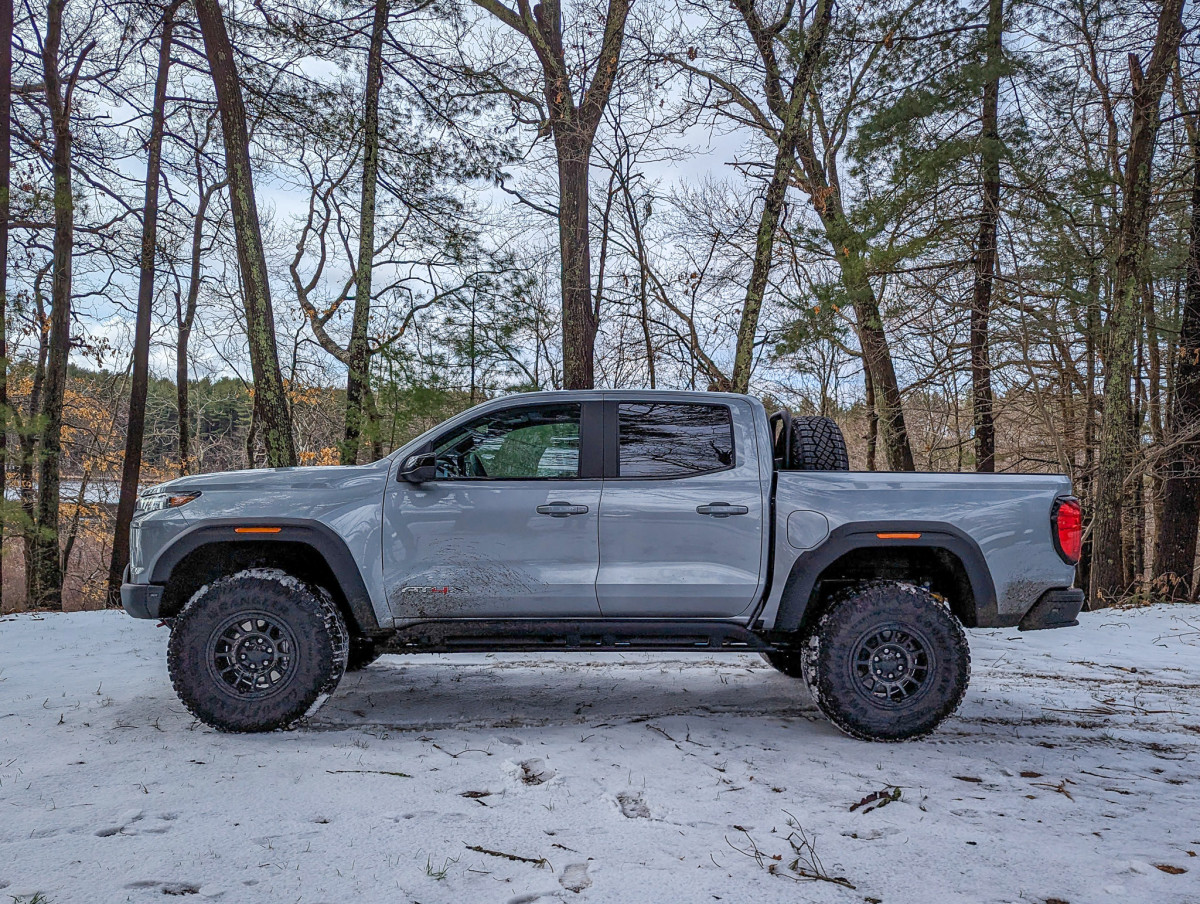
Immensely capable off-road with the AEV package
What to consider
Shorter bed length than competitors
Cramped back seat
Expensive
Expert review
The 2024 GMC Canyon is not for beginners.
Taller and wider than most midsize pickup trucks like the Ford Ranger or Toyota Tacoma, the GMC Canyon is designed to go farther and work harder than the rest of its class. GMC redesigned the Canyon for 2023, and a new AEV package arrives for the 2024 model year. With this off-road-specific kit, the rugged Canyon AT4X grows yet another 2.5 centimetres taller and adds 35-inch tires, steel skid plates, and a full-size spare tire.
Verdict: You don’t need to test drive an AT4X AEV trim to walk away impressed with the 2024 Canyon. Although pricey, this truck delivers a more impressive array of standard equipment than any other vehicle in its class, and its high-output turbocharged four-cylinder engine provides more than enough firepower for towing, hauling, and off-road driving.
out of 10 expert review
Look & feel
The GMC Canyon appears to be the biggest little truck on the market. Stretching 5,415 millimetres, it’s roughly the same length as a Toyota Tacoma, and only a touch longer than a 2024 Ford Ranger. Similarly, the Canyon is 1,389 mm wide without the side mirrors, which is in line with the competition. But the Canyon measures a startling 2,027 mm tall at a minimum, meaning the Canyon stands 15 centimetres taller than a Tacoma SR5 and 10 centimetres taller than a Tacoma TRD Pro. Even the 2024 Ford Ranger Raptor (at 1,927 mm) comes up short next to a GMC Canyon. For context, the GMC Canyon is very nearly the same height as LeBron James.
There’s a reason for the Canyon’s size. It rides on a wider track than most trucks, and every Canyon boasts at least 24.4 centimetres of ground clearance. The Canyon shares plenty of parts with the Chevrolet Colorado (also redesigned for the 2023 model year), but the base Colorado offers only 19.3 cm of ground clearance.
GMC sells the Canyon in four trims. The base Elevation trim comes closest to the classic understanding of a “work truck,” while the AT4 aims for a more off-road capable package, the Denali leans toward luxury, and the AT4X doubles down on the AT4’s dirt-focused intentions.
We tested a GMC Canyon AT4X with the all-new AEV package. AEV–short for American Expedition Vehicles–specializes in off-road and overlanding accessories, and it has partnered with other automakers in the past. With the AEV package, our Canyon came equipped with 35-inch all-terrain tires mounted on 17-inch beadlock-capable wheels (plus a fifth, bed-mounted spare tire), AEV-stamped front and rear bumpers, and multiple steel skidplates protecting its underside. The AEV package also adds an extra 3.8-centimetre lift kit, bringing our test truck’s ground clearance to an astonishing 31 centimetres.
Most automakers offer a base-trim truck with few amenities, cloth seats, and plenty of workmanlike attitude. With the Canyon, GMC keeps the attitude but skips the low-rent trims completely. The base-spec Elevation comes standard with cloth seats, keyless entry, and most notably, an 11-inch digital gauge cluster and an 11.3-inch touchscreen display. Dual-zone climate control and a tilting and telescoping steering wheel are available.
Our AT4X test vehicle had an even more impressive interior. GMC’s available Obsidian Rush upholstery has a distinctly “Air Jordan” vibe, but it’s also as high-quality as it is high-contrast. Fit and finish around the Canyon’s cabin are excellent, and the front seats feel impressively comfortable. GMC doesn’t really sell a stripped-down version of the Canyon, and the interiors of its higher-level trims look almost luxurious.
Performance
When General Motors redesigned the 2023 Chevrolet Colorado and 2023 GMC Canyon, it committed to a 2.7-litre four-cylinder engine. In the Chevy Colorado, this turbocharged engine has been tuned to three different power outputs, with the ZR2 trim level getting the top-level spec. In the Canyon, every trim level gets the most powerful iteration.
Fans of naturally aspirated engines may side-eye the Canyon’s turbo four-cylinder, but its output cannot be denied. With 310 horsepower and 430 pound-feet of torque, the little four-cylinder punches well above its weight class. In fact, the powertrain is robust enough that it also does duty as standard equipment in the larger Chevrolet Silverado 1500 and GMC Sierra 1500.
Towing capacity maxes out at 3,492 kilograms (7,700 pounds), and payload tops out at 785 kilograms (1,730 pounds). Both of those figures outgun the previous-generation Canyon, and while the payload figure is within spitting distance of the segment leaders, no midsize truck on sale today can tow more than the new Canyon.
The Canyon is nice to drive, too. Its eight-speed automatic transmission is well-suited to the turbo four-cylinder, and although its steering still showcases just enough vagueness and off-centre slop to keep it feeling like a truck, the Canyon doesn’t bounce over uneven pavement or feel top-heavy through corners. While not as tidy as a crossover, the Canyon doesn’t feel unsophisticated. That’s impressive for any pickup truck, but it’s even more so given the AT4X’s massive tires and elevated lift kit.
Road and tire noise is astonishingly well dampened, and the truck’s brakes do an admirable job, even in emergency situations. The key ingredient to our Canyon’s impressive road manners was a set of Multimatic spool-valve dampers. Designed to extend the suspension’s effective range, these trick dampers successfully smooth out bumpy terrain without causing the Canyon to feel too softly sprung when it comes back to the pavement.
In Canada, every trim level of the GMC Canyon comes standard with four-wheel drive (4WD). In a Canyon Elevation, you get a single-speed transfer case. Otherwise, a two-speed transfer case is standard. The AT4 and Denali come equipped with an auto-locking rear differential, while the AT4X adds driver-selectable front and rear lockers. Our AT4X test vehicle also included a Baja drive mode designed for high-speed off-road driving. It includes a launch control feature, which although thrilling, feels like the type of party trick best reserved for closed courses.
As impressive as the Canyon’s performance capabilities are, its fuel economy ratings remain a bit of a disaster. 13.2 litres per 100 kilometres in the city, 10.9 on the highway, and 12.2 combined are the best you can expect, and our AT4X AEV tester came with a Natural Resources Canada rating of 14.9 L/100 km combined. After roughly 200 kilometres of driving, we record 17.4 L/100 km.
Form & function
As noted earlier, the GMC Canyon offers best-in-class towing capacity. Given that the core function of a truck is tied to its ability to tow and haul, it’s safe to say that the Canyon deserves top marks in this regard.
These days, however, trucks are used for more than just work, and that’s where the Canyon begins to struggle. Yes, it’s a massively capable midsize truck, but on the inside, it doesn’t feel massive at all. Every Canyon comes configured with a four-door crew cab, but rear-seat legroom is preciously snug to the point that adults won’t be comfortable in the back seat for more than a short drive.
Further, the 1,567-millimetre (5.2-foot) bed offers less cargo capacity than the six-foot beds available with the Toyota Tacoma and Nissan Frontier. It is, however, larger than the new Ford Ranger’s. Of course, with the AEV package, much of our test vehicle’s usable space was eaten up by the spare tire.
That spare tire also makes reversing a bit trickier (although the Canyon does come with a very high-resolution backup camera). This feels like a great opportunity for GM’s digital rearview mirror, but unfortunately, that feature isn’t offered on the GMC Canyon.
Finally, the Canyon’s width and height may frustrate customers who spend any sort of time driving in urban areas. It may not be the size of a Silverado, but the Canyon doesn’t feel particularly tidy around town, and we weren’t able to find many parking garages in our city that could accommodate the Canyon’s height.
Technology
Not only does the 2024 GMC Canyon include a beautiful 11.3-inch touchscreen display as standard equipment, but the software also includes Google Built-in. This means that valuable apps like Google Maps and Google Assistant are available without needing to pair a phone for Android Auto or Apple CarPlay.
Of course, both Android Auto and Apple CarPlay are also included, and they’re wireless. Still, the native integration of Google puts the Canyon at the leading edge of modern infotainment technology. We expect to see Google Built-in on many (and possibly most) models in the future, so it’s great to see it arrive early in the Canyon.
There are a few quirks with GMC’s infotainment system setup, the most notable of which is the headlight controls. Typically, either the left steering-wheel stalk or a dedicated knob to the left of the wheel serves as the headlight switch. Rather than a physical control, however, the Canyon embeds the control into the infotainment software. This requires taking our eyes off the road, which we don’t like, but at least the controls are static icons that don’t move and are always available.
The Denali and AT4X trim levels benefit from a big, bright head-up display, and every trim level gets a set of off-road performance display pages with the standard infotainment software.
Safety
The NHTSA awarded the 2024 GMC Canyon an overall rating of four out of five stars in its crash-test evaluation. Frontal crash tests resulted in a four-star rating, while the side-impact test and rollover tests resulted in five and three stars, respectively.
The 2024 Canyon comes standard with automatic emergency braking with pedestrian and cyclist detection, lane-keeping assist and lane-departure warning, and a rear-seat reminder system. That’s the good news. The less-than-good news is that many other advanced driver assist systems are available only via options packages on lower trim levels.
For instance, if you want rear park assist, rear cross-traffic braking, and blind-zone steering assist on an Elevation-trim Canyon, you’ll need to fork over an extra $690 for the Canyon Safety Plus package. That’s not a ton of cash, but it feels a little like nickel-and-diming given the Canyon’s expensive starting price.
In addition to those features, our AT4X test truck also came standard with a brilliant HD surround-view camera, and its blind-spot avoidance system works with a trailer.
The Canyon can be equipped with impressive safety features but unless you opt for a high-spec trim, they’ll likely cost extra.
Cost-effectiveness
As noted earlier, the GMC Canyon gets pretty dreadful fuel economy, which means regular operating costs will be significant. Given many shoppers consider midsize trucks in place of full-size options because they want something more manageable, less expensive, and cheaper to run, this doesn’t bode well for the Canyon’s value proposition.
Further, GMC’s efforts to elevate the Canyon over its General Motors stablemate, the Chevrolet Colorado, result in a starting MSRP higher than most shoppers would expect. A Canyon Elevation starts at $50,133, including its $2,200 destination charge and other fees. The GMC Canyon AT4 trim starts at $54,833, the Denali at $64,433, and the AT4X carries a $69,733 sticker. However, it doesn’t stop there—not even close. The AEV package adds a whopping $11,895 to the AT4X’s starting price.
Admittedly, the AT4X AEV edition delivers significant off-roader capability and an extensive list of hardware. But north of $80,000 for a midsize pickup truck is steep no matter how you look at it, and that’s before you pick individual options.
Even skipping the off-road capability and accouterments of the AEV package, the Canyon is a pricey truck. Luckily, it looks and feels more upscale than many of its competitors. Consider it the MacBook Pro of the midsize truck market: yes, it’s a more capable machine than the typical MacBook, but it costs quite a bit more, too.
Note: Images show a US model.

What owners say
Nice truck. Awesome features, but weaker engine than I expected. My 2020 6 cylinder had more guts.
April 18, 2024Nice style but dont waste your money unless you want a 4 x 4 then spend. The lifted and mud tires are good but on 4wheel drive not on RWD.
September 23, 2024Trims & specs
Base MSRP $36,000 | Seating 5 |
Engine 2.7L 310 hp I4 | Cargo Capacity N/A |
Combined MPG 21 | Drivetrain 4X2 |
Base MSRP $51,000 | Seating 5 |
Engine 2.7L 310 hp I4 | Cargo Capacity N/A |
Combined MPG 20 | Drivetrain 4X4 |
Base MSRP $54,300 | Seating 5 |
Engine 2.7L 310 hp I4 | Cargo Capacity N/A |
Combined MPG 17 | Drivetrain 4X4 |
Base MSRP $43,000 | Seating 5 |
Engine 2.7L 310 hp I4 | Cargo Capacity N/A |
Combined MPG 20 | Drivetrain 4X4 |
Base MSRP $39,300 | Seating 5 |
Engine 2.7L 310 hp I4 | Cargo Capacity N/A |
Combined MPG 20 | Drivetrain 4X4 |


Pricing trends
MSRP range
$36,000 - $54,300
Current avg. market price
$51,245
Trending down by 0.8% this month
May 2026 - October 2026

