2024 Alfa Romeo Stelvio Reviews, Pricing & Specs


Pros & cons
What we like
Great handling
Stylish design
Fun to drive
What to consider
Outdated technology
Historically poor reliability
Very high depreciation
The CarGurus verdict
The Alfa Romeo Stelvio offers fashion and driving fun, with some sensibility as a compact SUV.
Since 2018, the Alfa Romeo Stelvio has tugged hearts with its sinewy design and serious performance. With gutsy turbocharged engines, the Stelvio delivers effortless speed, impeccable steering, and an immediacy to its handling that other luxury SUVs can't deliver. Unfortunately, the Stelvio suffers from poor resale value, which directly correlates to Alfa Romeo’s reputation for poor reliability. For 2024, the Stelvio receives a mild refresh and a new Competizione trim level. We tried one in Michigan to discover the subtle changes.
Verdict: With any Alfa, trying one is usually better than buying one. Service issues aside, the Stelvio is the only SUV that always feels connected to the driver, undoubtedly thanks to a lack of extemporaneous software blocking that sensation.
out of 10 expert review
Look & feel
Italians know how to design beautiful things. Whether they function or not is almost irrelevant. When parked or at speed, a Stelvio catches the eye. Any Alfa is an uncommon sight in public, all the more so since most people who buy a premium compact SUV choose to go German or Japanese. We last road tested a Stelvio in 2022 and wrote that "if a Lexus RX is a perfectly acceptable Nordstrom house brand, the Stelvio is straight out of Prada." Yet while they can look just as expensive as a Maserati Levante or other super SUVs like the Aston Martin DBX, most Stelvios are more affordable than they appear.
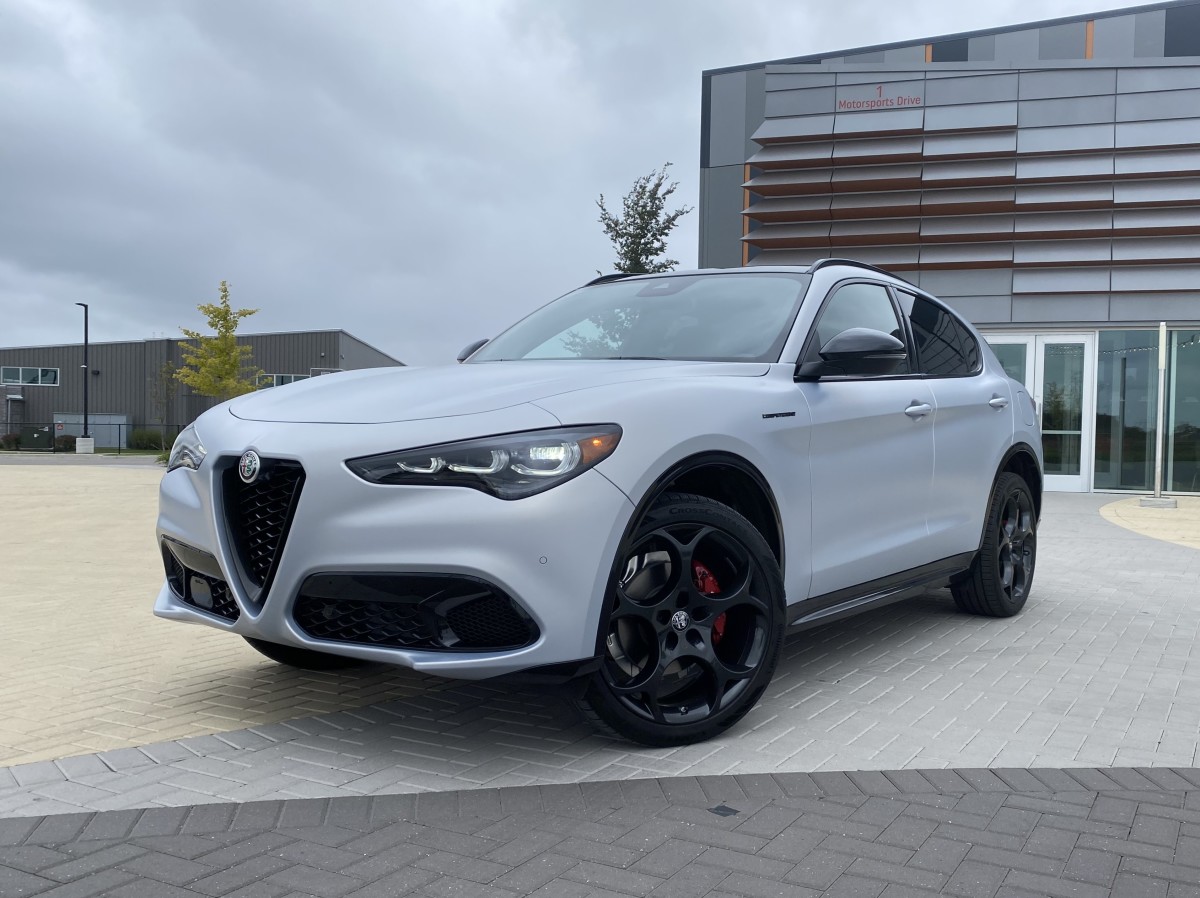
For 2024, the Stelvio incorporates "trilobe" LED headlights with three lighting elements separated by a series of three half-moon DRLs. This replaces the bi-xenon headlights and gives the fixtures a more modern, slicker appearance. The large headlamp housings, which like the taillamps are now tinted black, always looked menacing and unique. Paired with the downward triangle grille (which now has a reshaped insert), there is no SUV anywhere that looks this aggressive and tasteful at the same time. Note how the BMW XM can look aggressive but not tasteful, or how a Ferrari Purosangue can look no more tasteful than a Mazda CX-30. The Stelvio is boutique, high-end design on a budget. It's so fashionable that Alfa didn't designate a central spot for the front license plate. In perhaps the weirdest location ever, the Stelvio's factory mount is positioned off-centre between the lower intake and the bumper. Left or right side. Or no side, if your province allows it.
The Competizione, which is based on the Veloce, has black 21-inch wheels in the retro "phone dial" style, red brake calipers, black body and window trim, darker tints on the rear windows, and an exclusive matte paint called Moonlight Grey. Inside, red stitching adorns the seats, steering wheel, dash, and gear selector. In any trim, the Stelvio has perfect proportions. A short tail, a low shoulder and hood line, and simple, elegant curves all promise a sporty, performance-centred SUV. The interior, with its snug seats and thick metal shift paddles mounted on the steering column, is down to business but not so luxurious. Materials are generally good, as are fit and finish. But they're not top of the class and won't wow you like a loaded Jaguar F-Pace, Maserati Levante, or a BMW X5. As a modern car, the Stelvio feels most remarkable for its analog layout instead of dominating the dash with cold screens. The start button is on the steering wheel. An Italian tricolore marks the shifter housing, and it defines how this car drives.

Performance
You won't find off-road modes, skid plates, or anything related to dirt. Alfa is refreshingly honest about what the Stelvio can do. It sticks to pavement, in every sense of that phrase. On the M1 Concourse in Pontiac, Michigan, we lapped a Stelvio Quadrifoglio in the wet. It drives like a taller, slightly heavier Alfa Romeo Giulia, which is a very good thing.
Incredible balance through the turns, tingles and jitters transmitted through the steering wheel, strong brakes, finesse when getting back on the power, a raspy engine snarl—it is a masterly car. There are adaptive dampers and four driving modes that affect steering, shifting, and throttle, but that's it with the electronics. A mechanical limited-slip differential, huge tires, and a 505-horsepower twin-turbo V6 do the rest of the work. All-wheel drive (AWD) that transparently varies torque without any slippage, plus the ground clearance to hop curbs at high speed, makes the Stelvio even more secure when it’s busy being wild.
Most everything that makes the $100,000 Quadrifolgio so pleasurable trickles down to the four regular trims priced between $60,000 and $70,000. They’re just slower. The single-turbo 2.0-litre inline four-cylinder engine makes 280 horsepower and 306 pound-feet of torque sent through the same eight-speed automatic transmission—good specs, even if they don’t match the V6. The powertrain is eager, the sounds are pleasant but not too loud, and the same organic steering and brake-pedal feel are a constant reminder that you've purchased something special. The Competizione is the only regular trim to include adaptive dampers. Especially helpful on rougher roads is a soft suspension option, which the driver can select by pressing a button in the middle of the drive mode selector when it's in the Dynamic mode. On the terrible pavement that Canadians know so well, the Stelvio Competizione is stiff yet not unyielding to compression.
The Stelvio's handling prowess comes from a near 50/50 weight distribution and a unique suspension design. The front setup has an upper wishbone with two unequal length lower links that Alfa says "perform a scissors movement" that keeps the steering feel uniform and linear. Most SUVs use a simpler and more affordable MacPherson design. The rear has an extra "half" link to the usual four-link setup in most SUVs. This, says Alfa, improves comfort during normal driving and yet remains stiff during cornering. We'd agree with all of the above.
AWD, which Alfa dubs “Q4,” is standard on every trim in Canada. (A rear-wheel drive (RWD) version is available in the United States but not offered here.) Most trims are rated at fuel economy of 10.8 litres per 100 kilometres in city driving, 8.3 on the highway, and 9.6 combined. The Quadrifoglio is actually efficient next to most high-performance SUVs in this size, at 13.9 L/100 km city, 10.3 highway, and 12.3 combined. That's much better than the BMW X3 M and Jaguar F-Pace SVR.

Form & function
Where handling is maximized, interior space is limited. The back seats are firm and tight for average-size feet, with little legroom. The door openings are narrow at the bottom—that's the rear suspension intruding into the car—and should come with a low height warning at the top. You'll look great getting out of a Stelvio, so long as you don't sit back here for too long.
It's a similar situation in the front seats, with small footwells and a thin centre console that almost has driver and passenger locking arms. Alfa classifies the Stelvio as a midsize crossover, but it feels more like a compact. That's most evident in the cargo hold, which has just 525 litres behind the rear seats and 1,600 litres when folded. A Nissan Rogue feels like a Ford Expedition by comparison. Headroom is the one dimension that's generous.
Analog controls for the transmission, climate, drive modes, headlights, and other basic functions are very welcome in a digitizing world, though the infotainment system suffers from its small size and crammed menus. Using the steering-wheel controls and the new digital instrument panel is a breeze. We wish the infotainment was as up to speed. It's also kind of charming, in an Alfa Romeo way, that the huge shift paddles block the turn signal and wiper stalks. That charm wears off when you can't immediately use the turn signals or the wipers.

Technology
While Alfa Romeo is a Stellantis brand, it does not use the typical Stellantis infotainment system. This is great for brand distinction, but in terms of practicality, it's mostly a hindrance. The fact is, the Uconnect 5 software on every other model, including the latest Maseratis, is superior in terms of design and functionality.
The Stelvio’s 8.8-inch touchscreen is nicely integrated into the dash and isn't the centrepiece of the interior. That's good. But because it tries to put so much data on a smaller screen—and because Apple CarPlay and Android Auto can't take up the whole screen—the touchpoints are difficult to precisely select when driving.
The new 12.3-inch digital instrument panel, which still uses the deep circular housings of the older analog setup, is a real improvement. There are multiple displays, including a retro-looking layout with a thin typeface and red needles, plus full-screen maps and driver-assist layouts. Traffic Jam Assist with lane-keeping is available, though we were not able to test it fully. Assuming it works like other new Stellantis models, the Stelvio is good but doesn’t display class-leading accuracy in tracing lanes and curves.
Heated front and rear seats come standard, as do navigation, a wireless charger, and an auto-dimming rearview mirror. A 14-speaker Harman Kardon stereo and panoramic moonroof are optional. The headlights are now adaptive matrix LEDs, although the matrix portion of the technology that can actively light and shade individual pixels is disabled in North America due to headlight regulations. Options are rather limited, as is interior colour choice, which in Canada is restricted to black only.

Safety

Cost-effectiveness
The 2024 Stelvio starts at an MSRP of $59,995 for the base Sprint and $110,445 for the Quadrifoglio Carbon Edition. There are six trims in total. Our Competizione with optional Moonlight Grey paint and the Active Assist Plus package costs $72,385 including a destination estimate, though the exact charge varies from $2,095 to $2,795 across Canada. Frequent factory incentives will lower this price.
Alfa Romeo has a sterling reputation for unreliable cars with high maintenance costs. That explains why they don't crowd our roads and why it's easy to find nearly any late-model Alfa for cheap. A Stelvio after three years with a below-average odometer reading will lose more than half its value. The depreciation hit is similar to Jaguar, Maserati, and other low-volume brands and worse than Lexus, BMW, and other mainstream luxury brands. Take that into consideration when purchasing a new Stelvio.
Resale value is only one part of the equation. The Stelvio's older infotainment and its average material quality put it behind competitors. Get past all that, and the Stelvio leads the field in design and driving excitement. Alfa puts it like this: "On an Alfa Romeo, the driver is the one who always decides, and that is why Alfa Romeo continues to believe in cars and in the pleasure of those who drive them." If that doesn't tug at your heartstrings, then the Stelvio is not for you.
Note: Images show a US model.


What owners say
Love it!! Drives beautifully!! Features are great!! Bought it, yay!!
November 26, 2025Trims & specs
Base MSRP $57,150 | Seating 5 |
Engine 2.0L 280 hp I4 | Cargo Capacity 18.5 cu ft |
Combined MPG 25 | Drivetrain AWD |
Base MSRP $94,370 | Seating 5 |
Engine 2.9L 505 hp V6 | Cargo Capacity 18.5 cu ft |
Combined MPG 20 | Drivetrain AWD |
Base MSRP $52,850 | Seating 5 |
Engine 2.0L 280 hp I4 | Cargo Capacity 18.5 cu ft |
Combined MPG 25 | Drivetrain AWD |
Base MSRP $92,870 | Seating 5 |
Engine 2.9L 505 hp V6 | Cargo Capacity 18.5 cu ft |
Combined MPG 20 | Drivetrain AWD |
Base MSRP $87,370 | Seating 5 |
Engine 2.9L 505 hp V6 | Cargo Capacity 18.5 cu ft |
Combined MPG 20 | Drivetrain AWD |
Base MSRP $45,950 | Seating 5 |
Engine 2.0L 280 hp I4 | Cargo Capacity 18.5 cu ft |
Combined MPG 25 | Drivetrain RWD |
Base MSRP $51,050 | Seating 5 |
Engine 2.0L 280 hp I4 | Cargo Capacity 18.5 cu ft |
Combined MPG 25 | Drivetrain AWD |
Base MSRP $94,370 | Seating 5 |
Engine 2.9L 505 hp V6 | Cargo Capacity 18.5 cu ft |
Combined MPG 20 | Drivetrain AWD |
Base MSRP $47,950 | Seating 5 |
Engine 2.0L 280 hp I4 | Cargo Capacity 18.5 cu ft |
Combined MPG 25 | Drivetrain AWD |


Pricing trends
MSRP range
$45,950 - $94,370
Current avg. market price
$63,986
Trending up by 5.6% this month
May 2026 - July 2026

