2023 Volkswagen Taos Reviews, Pricing & Specs


Pros & cons
What we like
Stylish design
Spacious
Plenty of cargo space
What to consider
Irritating, underpowered drivetrain
Infotainment system user experience
Questionable value for the money
The CarGurus verdict
Small crossovers like the 2023 Volkswagen Taos have replaced compact cars, and for good reason.
Offering available all-wheel drive, a higher driving position, a roomy interior for four people, and plenty of utility, entry-level SUVs pay dividends in exchange for their higher price tags. Volkswagen introduced its new, most affordable crossover in 2022, and the 2023 Taos adds more standard safety features and equipment. Otherwise, aside from a lack of engine power and drivetrain refinement, it remains an appealing choice in the small SUV segment.
out of 10 expert review
Look & feel
Though the Taos nameplate is exclusive to North America, Volkswagen Group sells this SUV all around the world. Designed for appeal, engineered for affordability, and sized to succeed almost anywhere while maximizing passenger comfort and practical utility, the Taos and its derivatives are quite popular. In Canada, it’s intended to redirect sales that would have gone to the now-discontinued Volkswagen Golf.
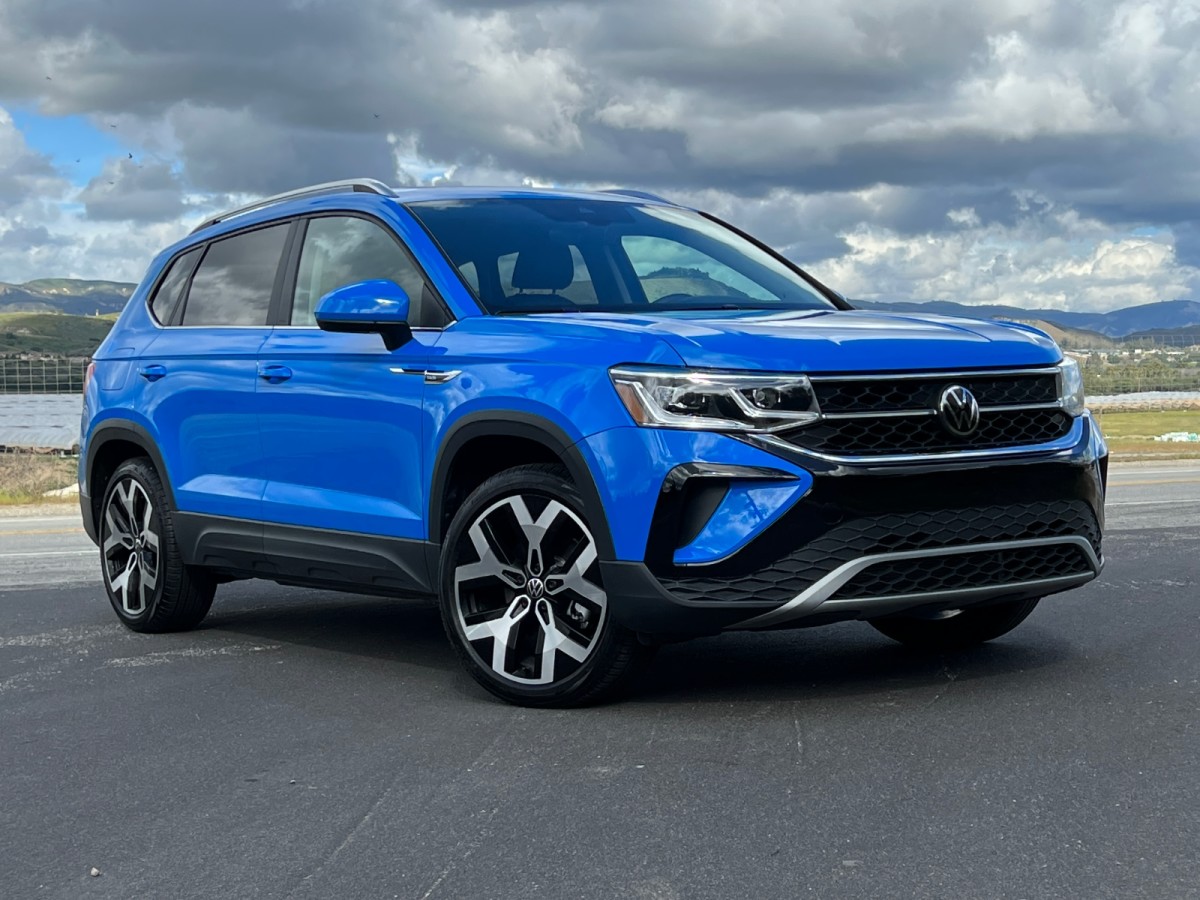
This year, 2023 VW Taos Canadian new vehicle prices range from $26,995 to $37,695, not including a destination charge of $2,050. In Canada, the SUV comes in Trendline, Comfortline, and Highline trim levels, with the lower two trims offering a choice between front-wheel drive (FWD) and 4Motion all-wheel drive (AWD). Our test vehicle arrived in the U.S. equivalent of Highline trim, which includes 4Motion. Dipped in Cornflower Blue paint and equipped with standard LED headlights, it had no options.
That’s pricey for the small SUV segment, but the Taos Highline is a stylish, sporty, and appealing vehicle. Bold 19-inch alloy wheels with a machined surface, the bright blue paint, creased and carved flanks, and proper proportions give the top-trim version an upscale look that eases some of the sticker shock.
The premium look and feel continues inside, where the test car’s light grey seat and dashboard accents, gloss black trim, metallic detailing, and leather seats make the Taos Highline resemble a cut-rate Audi. In addition, according to Volkswagen, the Taos is nearly as roomy inside as the larger Tiguan model, and that makes it one of the biggest subcompact SUVs you can buy.

Performance
Every 2023 Taos has a turbocharged (TSI) 1.5-litre four-cylinder engine making power specs of 158 horsepower and 184 lb-ft of torque. With front-wheel drive (FWD), the engine pairs with an eight-speed automatic transmission. With all-wheel drive (AWD), which is optional with Trendline and Comfortline trim and standard on the Taos Highline, a seven-speed dual-clutch automatic (DSG) is standard.
Depending on the model, a Taos can have up to five driving modes and four additional settings for the 4Motion AWD system. In addition, you can choose a Sport transmission mode. It is a bit much, so we stuck with Normal and Sport modes with 4Motion in its Onroad setting.
Driving a Taos Highline smoothly is a challenge because powertrain response is hard to predict. Sometimes, you get a surge of torque that you’re not expecting. Other times, an unexpected delay in response can cause a momentary panic when turning left across oncoming traffic. Frequently, the dual-clutch transmission exhibits its characteristic halting behaviour. A typical consumer is not going to put up with this, but if you can acclimate your driving style to the quirks, you’ll find your peace with this SUV when traveling in urban and suburban areas.
We evaluated the Taos on a mountainous driving loop. Here, we switched into Sport mode and put the transmission in Sport mode. That eliminates some of the inconsistency in the powertrain response, but also consumes more fuel. Still, over the entire route, the test vehicle averaged 8.8 litres per 100 kilometres, coming in just above the official Natural Resources Canada rating of 8.5 L/100 km for AWD models in combined driving. (In FWD models, the expected average is 7.6 L/100 km.)
Doubling up on Sport modes doesn’t solve the engine’s lack of power. At the Taos Highline’s sticker price, you could get a turbocharged Mazda CX-30 generating 250 hp and 320 lb-ft, or the thrilling Hyundai Kona N boasting 276 hp and 289 lb-ft. In comparison, the pricey Vee Dub’s paltry 158 hp and 184 lb-ft is almost an embarrassment. Volkswagen Group knows how to make powerful, efficient, and refined turbocharged four-cylinder engine drivetrains. It’s a shame the Taos doesn’t benefit from the automaker’s mastery.
When you upgrade to a Taos with 4Motion, VW swaps the standard torsion-beam rear suspension for an independent multi-link setup. However, since the Taos offers no more than 16.7 centimetres of ground clearance, depending on the configuration, you’re not going to travel very far off-road. If that’s a priority, consider the Ford Bronco Sport, Jeep Compass Trailhawk, or Subaru Crosstrek.
Circling back to our mountain run, the Taos Highline demonstrates a distinctly Germanic driving character. Sitting closer to the road than some rivals, and equipped with grippy P225/45R19 Pirelli Scorpion all-season tires, the Taos Highline feels firm, sure-footed, and stable. In addition, due to the excellent visibility, it is easy to place on a road.
Steering effort is light, but the wheel feels good in your hands and the response is sharp and accurate. This little SUV is nimble, toss-able, and easy to trust, so though it lacks power, its inherent athleticism makes for a rousing good time (especially traveling downhill).
Volkswagen equips the Taos with four-wheel-disc brakes, but brake pedal feel and response is occasionally hard to predict, making it difficult to know what you’re going to get when you press down on it. Sometimes, response is touchy and too aggressive. Other times, nothing much happens. This flaw calls attention to itself often enough to deserve mention here.
Also, at highway speeds, the Taos suffers from wind noise and plenty of road noise. But that is common in the small SUV segment.

Form & function
When you shop for a 2023 Taos, you’ll discover that Trendline trim has cloth seats, Comfortline trim has CloudTex artificial leatherette upholstery, and Highline trim features real leather.
In addition, cold-weather equipment is standard in Canada, including heated side mirrors, heated washer nozzles, heated front seats, and a heated steering wheel. Our Highline test vehicle also had rain-sensing wipers, dual-zone automatic climate control, and ventilated front seats.
An eight-way power driver’s seat is standard with Comfortline and Highline trim. It is exceptionally comfortable, and the Taos feels bigger inside than most competitors, like it should be selling one class up in size. However, it needs a sliding and height-adjustable centre armrest to ensure maximum comfort.
Small SUVs are notorious for their cramped back seats, but that isn’t the case in the VW Taos. Passengers will find plenty of room for their legs and feet, softly padded front seatbacks, air conditioning vents, and, in the Highline, a panoramic sunroof that extends all the way over their heads. The door panels are constructed of hard plastic, and the seat cushion feels a little bit low, but otherwise the Taos offers impressive rear-seat room and comfort.
Storage space is plentiful for all occupants, but most locations aren’t lined, so items placed there may cause noise and vibration. In the cargo area, deep wells exist on either side of the main load floor. Cargo space is generous, too, offering 790 litres behind the back seat and 1,866 litres with the rear seat folded down. With 4Motion, the figures are a little smaller, at 705 and 1,705 litres, respectively.

Technology
Volkswagen equips every 2023 Taos with standard digital instrumentation. With Trendline and Comfortline trim, the screen measures eight inches. The Highline gets a 10.25-inch display with more features, viewing options, and the ability to display the navigation map on the entire panel.
Infotainment systems range from basic to fully featured. With the Taos Trendline, the SUV has a standard 6.5-inch touchscreen and Bluetooth. With Comfortline and Highline trim, the infotainment system adds an 8-inch touchscreen equipping the Taos with Bluetooth support for multiple devices, wireless Apple CarPlay and Android Auto connectivity, SiriusXM 360L satellite radio service, Car-Net connected services, and an added USB port. Wireless smartphone charging is standard on these versions of the Taos.
A native navigation system is standard in the Highline, as is an eight-speaker Beats Audio premium sound system. It sounds good for the segment.
The Highline’s top-shelf infotainment system looks simple, clean, and logically laid out, but the user-experience is sketchy.
First, Volkswagen hides some of the virtual controls and doesn’t show them on the proximity-sensing screen until you raise your hand toward the glass. So, if you’ve forgotten what those hidden functions are and why they might not be visible, sometimes you stare blankly at the display trying to figure out how to do something.
Second, tuning the radio is a total pain in the you-know-what because you need to make sure the system is on the correct radio function before twisting the knob. So, raise your hand toward the screen, check the row of function tiles that magically appears at the bottom, and determine whether you need to make a change before twisting the tuning knob. But act fast, before the tiles disappear again.
Third, when you choose the menu granting access to the settings for the advanced driving assistance systems (ADAS), Volkswagen loads a fancy graphic instead of the expected list of functions and settings. If you don’t notice the small Settings icon in the lower right portion of the graphic, you won’t understand how to change things and will once again stare blankly at the screen.
Fourth, if you have the navigation map displayed within the digital instrumentation, but you select Nav on the centre touchscreen, a map doesn’t load. That’s because if the map is showing in the digital instrumentation, it won’t also show on the infotainment screen. Forget this detail, and you’ll be mystified and irritated.
Fifth, the voice-recognition technology is terrible. Even when carefully following the suggested voice prompts on the display, it’s not effective tech.
So, what the moral of this story? Pair your phone, run Apple CarPlay or Android Auto, and forget about this VW’s native system.

Safety
For the 2023 model year, Volkswagen improves the Taos regarding standard safety features and driver assistance technologies. Now, the Taos Trendline includes standard Front Assist (forward collision warning with pedestrian detection and automatic emergency braking), a blind-spot monitoring system, and rear cross-traffic alert.
The Taos Comfortline adds Lane Assist (lane-departure warning, lane-keeping assist); Travel Assist (adaptive cruise control with stop-and-go and lane-centring assist); Emergency Assist (automatic stopping when a driver becomes unresponsive); and an active version of blind-spot monitoring that will attempt to prevent an unsafe lane change.
In addition, the Taos features a standard post-collision automatic braking system (all trims), automatic high-beam headlights (Comfortline and Highline), parking sensors with automatic braking (Highline), and a road-sign recognition system (Highline).
Travel Assist is excellent. The technology easily navigated around curves and through construction zones. On a stretch of multi-lane highway, the system performed proper distance maintenance to traffic ahead without excessive or inconsistent braking. In addition, when slower vehicles exited the highway, the Taos was quick to accelerate back up to the set cruising speed. Overall, Travel Assist proved smooth, accurate, and refined.
While driving with only the Lane Assist system active, the tech reminded us it was operating but didn’t irritate us at all. The only false warning was its inaccurate perception of a crack in the road as a lane marker.
Crash-test ratings from the National Highway Traffic Safety Administration (NHTSA) and the Insurance Institute for Highway Safety (IIHS) are decent, but imperfect.

Cost-effectiveness
The Volkswagen Taos is not the most affordable small SUV you can buy. But it doesn’t look or feel as cheaply outfitted as some of its rivals, offers more interior room than competitors, is technologically sophisticated, and provides rewarding handling.
The problem with this SUV is the powertrain. At the Highline’s price, you can get significantly more power and performance out of a Hyundai Kona N or a Mazda CX-30 Turbo. And if fuel economy is the goal, the Toyota Corolla Cross Hybrid is unbeatable in the segment. The Taos lacks off-roading talent, too. For that, you would need a Ford Bronco Sport, Jeep Compass Trailhawk, or Subaru Crosstrek.
We like the Volkswagen Taos well enough. With more power, added drivetrain refinement, and a new infotainment system interface, we might love it.
Note: Images show a US model.

What owners say
The car overall value is a good, all 2023 Taos models do not have blind spot feature and yet every dealerships listed as available which is misleading. When shopping for a vehicle, one needs to be firm on the budget and know what you wants, it will make your purchase more enjoyable.
March 2, 2024Love my Taos. Drives smooth but you do feel the bumps. Very roomy and huge panorama sun roof.
September 3, 2023Trims & specs
Base MSRP N/A | Seating N/A |
Engine N/A | Cargo Capacity N/A |
Combined MPG N/A | Drivetrain N/A |
Base MSRP N/A | Seating N/A |
Engine N/A | Cargo Capacity N/A |
Combined MPG N/A | Drivetrain N/A |
Base MSRP N/A | Seating N/A |
Engine N/A | Cargo Capacity N/A |
Combined MPG N/A | Drivetrain N/A |
Base MSRP $26,495 | Seating 5 |
Engine 1.5L 158 hp I4 | Cargo Capacity 24.9 cu ft |
Combined MPG 28 | Drivetrain AWD |
Base MSRP $24,155 | Seating 5 |
Engine 1.5L 158 hp I4 | Cargo Capacity 27.9 cu ft |
Combined MPG 32 | Drivetrain FWD |
Base MSRP $34,535 | Seating 5 |
Engine 1.5L 158 hp I4 | Cargo Capacity 24.9 cu ft |
Combined MPG 28 | Drivetrain AWD |
Base MSRP $30,375 | Seating 5 |
Engine 1.5L 158 hp I4 | Cargo Capacity 24.9 cu ft |
Combined MPG 28 | Drivetrain AWD |
Base MSRP $28,925 | Seating 5 |
Engine 1.5L 158 hp I4 | Cargo Capacity 27.9 cu ft |
Combined MPG 32 | Drivetrain FWD |
Base MSRP N/A | Seating N/A |
Engine N/A | Cargo Capacity N/A |
Combined MPG N/A | Drivetrain N/A |
Base MSRP N/A | Seating N/A |
Engine N/A | Cargo Capacity N/A |
Combined MPG N/A | Drivetrain N/A |


