2023 Toyota Supra Reviews, Pricing & Specs


Pros & cons
What we like
Manual transmission available
Fun to drive
Great handling
What to consider
Advanced safety features not standard
Suffers from buffeting when windows are open
The CarGurus verdict
A manual transmission finally arrives, elevating the Toyota Supra to sports car nirvana.
Four years after the Toyota Supra’s revival, fanatics (and paying customers) finally get what they deserve. Although the Supra has been a performance standout thanks to its balanced weight distribution, precise steering, and available six-cylinder engine, the lack of a manual transmission has kept it off shopping lists for anyone looking for an engaging, involved driving experience. For 2023, Toyota has finally sourced a manual transmission worthy of the Supra. The automotive landscape is better for it.
out of 10 expert review
Look & feel
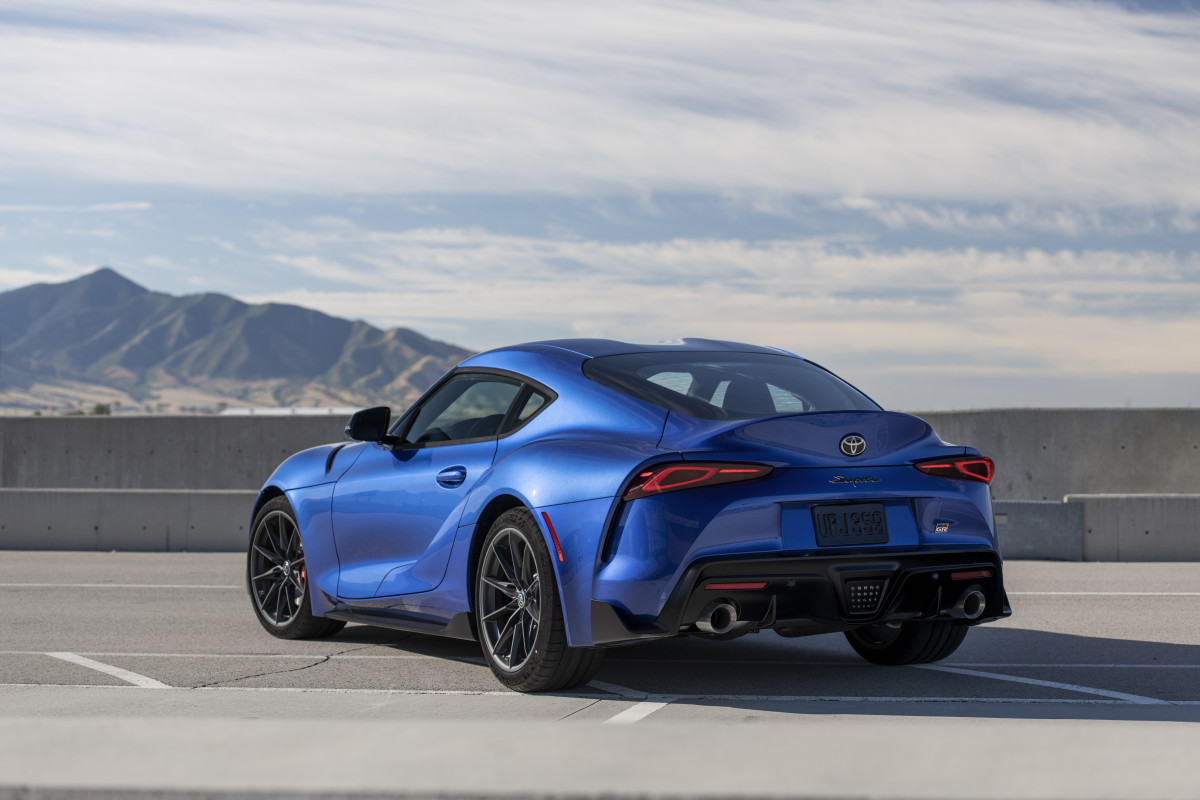
It doesn’t take a long look to recognize the Toyota Supra as what it is. Technically called the “GR Supra” for Gazoo Racing (GAH-ZOO), this vehicle, with its low-slung design, long hood, and cabin set way back toward the rear wheels, is clearly and obviously a sports car.
The beautifully proportioned two-door coupe doesn’t try to fake its way as a four-passenger. Unlike the Toyota GR 86, a 2+2 sports car with a rear seat just large enough for children, the Supra seats only two. Big, oversized fenders swallow the rear wheels right as the roofline slopes down toward the tail. Toyota couldn’t fit a back seat in the Supra if it tried.
And, although the Supra shares a platform with the BMW Z4 convertible, Toyota offers it only as a coupe. In fact, although the pedigree is at least one part Bavarian, the Supra shares very little, visually, with the Z4. The front fascia is much busier, with a big F1-style nose protruding like a swollen knuckle, and the profile is littered with cut-outs and vents. The Supra manages to look fast even before you step on the accelerator. While that will undoubtedly appeal to many sports-car enthusiasts, we can’t claim that this car is subtle.
Inside, a relatively small infotainment screen sits perched atop the dash, a row of buttons is arranged below the central air vents, and physical climate controls sit below those. The driver seat is comfortably separated from the passenger by a sizeable centre console and, while lower trims are still upholstered in black, black, black materials, the pinnacle Supra A91 trim can mercifully be outfitted with a lovely hazelnut leather. Both seats are heated as standard, but a heated steering wheel is not available.
Performance
Before this year, an eight-speed automatic transmission with paddle shifters was the Toyota Supra’s only available transmission, paired with rear-wheel drive (RWD). For the 2023 model year, however, a six-speed manual transmission will be offered. That manual transmission is the only powertrain change for 2023, but to many shoppers, it’s all that will matter.
Since 2020, Toyota has offered the Supra with two engines. In the base 2.0 trim, a four-cylinder engine delivers 255 horsepower and 295-pound feet of torque. Anyone who’s driven an entry-level BMW recently will be familiar with this powerplant. It delivers reasonable power. However, Toyota will not be fitting any 2.0-litre Supras with the aforementioned manual transmission.
But after driving the second engine option, it’s hard to go back to the little 2.0-litre four-cylinder, regardless of transmission. Both the 2.0 and the Supra’s upgrade engine, a 3.0-litre turbocharged inline six-cylinder, employ turbochargers, but while the 4-cylinder car is a touch lighter, it hardly compares with the experience provided by the six-cylinder. The 2.0-litre is a good engine while the 3.0-litre is one of the most enjoyable performance engines on the market.
The turbocharged straight-six produces 382 horsepower and 368 lb-ft of torque, figures that make the roughly 1,550 kilogram (3,400-pound) Supra 3.0 absolutely fly. Peak horsepower roars from 5,800 rpm to 6,500 rpm, while the torque finds its max point at an incredibly low 1,800 rpm and keeps pulling all the way up to 5,000 rpm.
At approximately 4.0 seconds, the Supra runs from zero to 100 km/h a little faster with the automatic than with the manual (approximately 4.3 seconds), and it burns a little less fuel, too. Natural Resources Canada estimates fuel economy at 10.2 litres per 100 kilometres in city driving, 7.7 on the highway, and 9.1 combined for automatic-equipped I6 Supras versus 12.7/8.8/10.9 for manuals. But, in the end, we don’t think these figures are enough to draw us away from the stick shift. Particularly for drivers that take their Supras on twisty backroads instead of race tracks, the manual will make driving the car much more enjoyable than the automatic can. Some of this back-roads enjoyment will come courtesy of a few tweaks to the differential and electronic control unit (ECU). Normal, Sport, and Individual drive modes return for 2023, but beyond those, Toyota has included a new Hairpin+ function. This system looks at the car’s steering and suspension behaviour, along with road conditions, and allows a little more tire spin when the car is cornering tightly on uphill gradients.
The shifter looks a little odd with such a small, round knob head, but it’s very well placed. The driver’s hand falls naturally to it, and the circular grip sits nicely in the hand. Throws are short, easy, and precise. If we have one criticism for the new, manual-transmission Supra, it’s that the car’s power band is a bit too wide in third gear. Although it certainly lessens the workload and makes driving fast on a track a bit easier, the fact remains that in most driving situations, once you shift up from second to third, there’s not much shifting left for you to do. Thanks to the Supra’s incredible torque over such a wide rpm range, the engine doesn’t lug or run out of steam in third gear, whether it’s poking along at 40 kilometres per hour or screaming up toward 130. Considering enthusiasts clamoured for a stick shift to make the Supra feel more engaging to drive, it’s a bit ironic to find that the car’s fat power band limits the level of engagement necessary.
The Supra’s BMW powertrain has been a double-edged sword since 2020. BMWs of recent years are brilliant performers, sure, but they’ve had a reputation for feeling almost surgically sanitized. Blisteringly fast with crisp, precise, less-than-a-blink-of-an-eye shifts, they’re hard to fault but hard to love, too, regardless of specs. Adding a manual gives the Supra just enough mess to make it feel emotive.
Form & function
Considering it’s a two-seater sports car, the Supra offers some semblance of practicality. Barely. The car’s liftback-style trunk reveals decent cargo space, measuring 288 litres. That’s more than you’ll get in a Nissan Z (241 litres) or a Toyota GR 86 (178 litres). Weirdly, it’s only marginally larger than the BMW Z4’s capacity, despite that vehicle having a traditional trunk and being a convertible.
Don’t confuse cargo volume with day-to-day practicality: this is not a daily driver. It’s a purpose-built sports car that simply won’t work for anyone looking to haul children, dogs, or anything purchased at a big-box store.
Further, the inside of the Supra is tight. Although the roof has been scalloped to provide a little extra headroom, it still feels a bit claustrophobic. This car has small windows and a high beltline. Kids will love how it looks from the outside, but we suspect they’d get carsick from its slim outward visibility (not to mention the g-forces you’d likely be pulling through corners).
The cupholders between the front seats are well placed, and there are two more bottle holders in the doors. There’s a bit (just a bit) of storage beneath the centre stack, and the centre-console cubby is decently sized for a car this small.
The Supra’s unacceptable failing, however, becomes evident when the windows—driver, passenger, or both—are rolled down. A violent buffeting makes it almost unbearable to drive at 30+ km/h with either window (or both!) cracked even the slightest bit. Owners have reportedly been able to solve this with inexpensive after-market wind-buffeting devices, but the fact that a modern car could be engineered and then shipped with this sort of basic fault is almost unthinkable.
Technology
The Toyota Supra’s headline might shout about performance, but that doesn’t mean it makes too many sacrifices in terms of technological conveniences.
In the GR Supra 2.0, drivers make do with a four-speaker stereo controlled via an 8.8-inch colour touchscreen display. Lightly garnished with simple tech features, it boasts AM, FM, and satellite radio, Bluetooth connectivity, and USB inputs. Admittedly, that’s not much, but we’d start our Supra search at the 3.0 trim level, anyway.
In base 3.0 guise, the Supra benefits from everything in the 2.0, but it swaps out the four-speaker audio system with a much more satisfying 12-speaker JBL sound system. Navigation, wireless Apple CarPlay, a head-up display, and voice recognition are also included as standard equipment, as is a Qi-compatible wireless charging pad.
The lack of CarPlay on the lower-level trims is a disappointment, and the Supra doesn’t exactly break new ground in terms of tech and entertainment. But if you’re shopping for a car like this—particularly if you’re looking at the manual transmission models, then you likely care more about how it scores in performance than technology, anyway.
Safety
Some companies see sports cars as an opportunity to skip out on advanced driver assistance safety (ADAS) features, whether that’s for cost-cutting or an attempt to keep things “visceral” or “authentic” or “unvarnished.” Refreshingly, Toyota says the hell with all that marking; we want to keep folks alive.
Automatic emergency braking with pedestrian detection, lane-departure warning with steering assist, automatic high beams, and of course stability control, traction control, and brake assist are all included as standard equipment on every Toyota Supra. Adaptive cruise control is standard with the automatic transmission, while manual cars get parking sensors.
Admittedly, we wish blind-spot monitoring and rear cross-traffic alert was an option in Canada; in a car this snug with windows this small, a feature like blind-spot monitoring becomes extra important. That said, we’re happy to see that Toyota is offering ADAS equipment on the Supra—even the manual transmission cars—as standard equipment.
Cost-effectiveness
Toyota includes a three-year, 60,000-kilometre basic warranty with roadside assistance, plus a 5-year, 100,000-kilometre powertrain warranty with every Supra.
Start scrolling through the new car MSRPs of each trim level, and the Toyota GR Supra’s cost looks justifiable, if not a killer bargain. The 2.0-litre, four-cylinder car (available, remember, with only an automatic) starts at $57,510, not including an $1,860 destination fee. We wouldn’t seriously consider any Supra without the six-cylinder engine though, and the GR Supra 3.0 starts at $70,630 before destination.
A $15,000 spread isn’t much in today’s market (a 2022 Ford Mustang’s price doubles from the base turbo four-cylinder trim to its top-level Mach 1 trim), and the range is even smaller once you equip a 3.0-litre engine. Normally, we’d look at a statistic like that and surmise that there’s lots of value in the higher trims. However, the Supra’s current competition makes things a little more complicated.
First, the new 2023 Nissan Z undercuts the Supra across the board. The Z provides a more powerful engine (even in base trim) and a terrific driving experience. But because it is built upon an older platform, Nissan did not incur the same development costs as Toyota. Happily, it appears that those savings have been passed on to the consumer.
On the other end, a mechanically similar BMW Z4 costs more than the Supra at every stop in the lineup. But, being a BMW, it provides a bit more luxury and, don’t forget, a convertible roof.
For many drivers, the thought of spending $60 to $70 grand on any car with the Supra’s level of practicality will be tough to justify. But in the world of sports coupes, the Supra does deliver plenty of high performance to match its price tag. And, with the new manual gearbox, it provides enough smiles to help you forget that price tag, too.
Note: Images show a US model.
What owners say
Trims & specs
Base MSRP N/A | Seating 2 |
Engine 3.0L 382 hp I6 | Cargo Capacity 289 L |
Combined MPG 27 | Drivetrain RWD |
Base MSRP N/A | Seating 2 |
Engine 3.0L 382 hp I6 | Cargo Capacity 289 L |
Combined MPG 27 | Drivetrain RWD |
Base MSRP N/A | Seating 2 |
Engine 2.0L 255 hp I4 | Cargo Capacity 289 L |
Combined MPG 28 | Drivetrain RWD |
Base MSRP N/A | Seating 2 |
Engine 3.0L 382 hp I6 | Cargo Capacity 289 L |
Combined MPG 23 | Drivetrain RWD |


Pricing trends
Current avg. market price
$65,057
Trending down by 0.7% this month
May 2026 - September 2026


