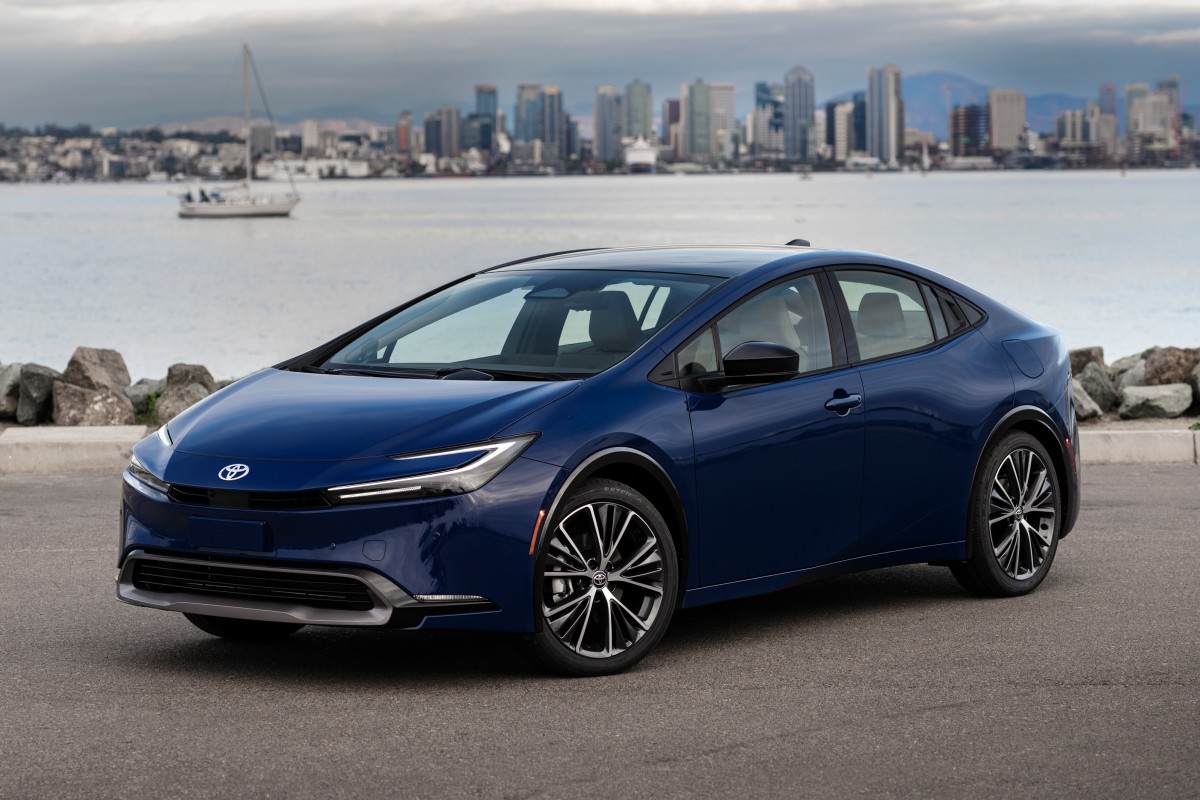
2023 Toyota Prius Reviews, Pricing & Specs


Pros & cons
What we like
More powerful than older Prius models
Sleek new styling
Excellent fuel efficiency
What to consider
Significant price bump over previous model
Engine can drone loudly when pushed hard
Interior space and cargo room have decreased
Expert review
The Toyota Prius finally looks better than it sips.
After decades of being the frumpy leader of the fuel-efficiency movement, the Prius emerges as one of the better-looking new cars to hit the market recently. This fifth-generation revelation in looks is then backed up by a huge jump in power without sacrificing any of the fuel-sipping ways of the earlier model. Add in impressive standard safety features and a reasonable suite of interior tech and comfort goodies, and you have a formidable hatchback that just now happens to be a hybrid.
out of 10 expert review
Look & feel
Toyota gave the 2023 Toyota Prius a complete makeover, finally giving the hybrid head-turning style that has long been missing from the lineup. After years of putting efficiency first and everything else second, new competition from cheaper electric vehicles and other hybrid cars has pushed the automaker to admit that the Prius needs to be both an efficient car and an appealing one.
The new Prius is undeniably sleeker on the outside. Its new look is a savvy blend of curves and edges that give the model a futuristic look without alienating more conservative shoppers. The wheels have been pushed further into the corners for better handling, which has the added benefit of making the new Prius look more planted and athletic. The car is also longer, lower, and wider than its predecessor. In Canada, 19-inch alloy wheels are standard on both the XLE and Limited models.
This model rides on the excellent platform that feels solid and stout when driven over rough surfaces. This isn’t a tinny or lightweight-feeling type of cheap hybrid. The doors close with a reassuring ‘thunk,;’ and inside, materials and the fit and finish are top notch. Nothing here feels like a cut-rate economy car.
A pair of screens is mounted beside the driver’s seat, along with an instrument panel in front of it plus the dashboard-mounted infotainment screen. This setup is a welcome departure from the previous Prius, which used a centre-mounted display for the instrument panel.
The cabin itself is more function over form, with few decorative trim pieces or forward-looking materials used to bring in some character or warmth.
Nevertheless, the new Prius is a comfortable place to spend some time.
Performance
The hybrid powertrain in the 2023 Prius uses a new 2.0-litre four-cylinder engine, a bump in size from the 1.8-litre unit in the older Prius. This engine, combined with a more powerful electric motor and lithium-ion battery, means that this latest powertrain iteration packs 196 total horsepower in all-wheel drive models (AWD), which is standard in Canada. (A 194 total horsepower front-wheel-drive (FWD) model is sold in the United States but not available here.) That’s a significant boost over the power specs of 121 total horsepower in the outgoing model. This engine is hooked up to a continuously variable automatic transmission.
For the new Prius, Natural Resources Canada fuel economy ratings measure up at 4.8 litres per 100 kilometres in city driving, 4.7 on the highway, and 4.8 combined. Those figures are among the best you’ll find for conventional hybrids on the entire automotive market. A plug-in hybrid version of the Prius, which continues with the nameplate Toyota Prius Prime, has been reviewed separately.
In everyday driving, the new Prius certainly feels more athletic and eager than before, with no lag to speak of, and it provides ample acceleration no matter the driving situation. The car scoots ahead on command and the power is welcomed but nowhere near excessive or even head-turning. It simply now feels appropriate; a sporty car this isn’t, but it’s also not the lifeless econobox earlier versions have felt like.
As one might imagine, given the newfound power, 0-100 km/h acceleration times—if that sort of thing is important to you as a hybrid shopper—have dropped significantly from the older model. Budget just over seven seconds now versus more than 10.5 seconds previously.
Road and wind noise are nicely isolated, save for when drivers push the Prius hard for acceleration. Then, too much of the engine’s loud droning flows into the cabin, but at least these intrusions are short-lived.
The Prius’s handling also feels agile and athletic thanks to the revised suspension and that longer wheelbase that tucks the wheels into the car’s corners. Harsh roads or unexpected bumps do little to upset the car or its passengers. The brakes do have a small bit of squishiness that is endemic to hybrids, but it’s minor.
All told, this new model will be more than enough of a comfortable, engaging daily driver for its audience.
Form & function
Despite growing on the outside, the interior of this new Prius is slightly smaller in some dimensions than the previous version. Headroom is the main victim here thanks to the sloping roofline, dropping in both the front and rear seats versus the previous model. But legroom is up throughout, and taller passengers do fit in the rear seats comfortably. SofTex leatherette upholstery is used in all Canadian models. Heated front seats and a heated steering wheel are standard in Canada, while heated rear seats are equipped on the Limited trim.
The fixed glass roof that’s standard on the Limited trim is a two-panel setup with one above the front passengers, one above the rear seats. This does a nice job of opening up what might otherwise be a slightly claustrophobic cabin, though we do wish the glass section themselves opened for airflow.
Out back, cargo space also takes a hit, dropping to 575 litres. Forward visibility is generally good, though the loss of the split rear window on this generation means rear visibility is hampered somewhat.
The rest of the cabin does have some nice touches to keep things organized and comfortable. There’s a smattering of cupholders throughout, plus a slick pocket in the centre console on the Limited trim that wirelessly charges your smartphone while also holding it snugly in place. A tray below the dashboard holds other various items and hides below it a hidden compartment for other goodies. USB-C charging ports are available in both front and rear seats.
The cargo section has small cubbies of underfloor storage that would be more helpful if they were just one big pocket, but it’s better than nothing. Notably, the Prius’s rear window does have a flexible cargo cover built in, to better hide your stuff when parked.
Technology
XLE models come with an 8-inch colour infotainment touchscreen multimedia system with wireless Apple CarPlay and Android Auto connectivity. A larger 12.3-inch touchscreen is standard on the top Limited trim. We recommend the upgrade, as the extra real estate on the screen is helpful and the screen itself is responsive and the menus intuitive. The navigation system uses cloud connectivity for real-time updates, but it requires a subscription to Toyota’s Drive Connect system to work, a frustrating requirement.
All models have a 7-inch digital instrument cluster in front of the driver, which we found too busy. Toyota simply crammed too much info into too small a screen, though it is an improvement over the centre-mounted display on the older Prius.
There are six USB-C charge ports throughout the cabin. Limited models come standard with wireless smartphone charging. In the Limited, an 8-speaker JBL audio system is included, as is a digital rearview mirror with a camera washer.
There’s also a trio of subscription-based connectivity bundles. Remote Connect allows you to connect to your Prius via the Toyota app to unlock/lock the car, turn it on and off, check the car’s parked location, and monitor young drivers. Safety Connect adds roadside assistance, collision notification, stolen vehicle locator, and an emergency assistance button. Finally, the aforementioned Drive Connect adds cloud navigation using Google’s points of interest, voice-activated features while inside the car, and 24/7 connectivity to a live person to help you find your destination.
Safety
The 2023 Prius has Toyota’s latest suite of active safety features bundled together as Toyota Safety Sense 3.0. This includes radar-based adaptive cruise control that works at any speed, pre-collision braking with pedestrian and cyclist detection, lane-departure alerts with steering assist, lane-tracing assist and Proactive Driving Assist, a feature that uses the car’s radar and cameras to detect curves in the road, or another car, pedestrian, or cyclist in front, and slows the Prius accordingly.
We tested the latter system during our review of the new Prius and came away impressed with its functionality. The intrusion is minimal. Instead, it feels like an EV with regenerative braking as you approach something in front of you, and we were quick to adapt to it. We also like that the system is disabled within the car’s menu screen, for drivers who instead prefer an analog experience.
All of these driver assistance features are standard on all 2023 Prius models, regardless of trim level.
Other non-active safety features include stability control, traction control, eight airbags including seat-mounted side airbags, and blind-spot monitoring with rear cross-traffic alerts. The top-end Limited trim can also be optioned with hands-free automatic parallel parking features called Advanced Park.
The Insurance Institute for Highway Safety (IIHS) rates the 2023 Toyota Prius as a Top Safety Pick+, its highest honour. A rating has not yet been issued by the National Highway Traffic Safety Administration (NHTSA) as of this writing.
Cost-effectiveness
With all the upgrades to this new generation of Prius, it should come as no surprise that it gets a significant price bump over the previous generation, too. The XLE AWD grade, where Canadian pricing starts, costs $36,650 before the $1,860 delivery charge and other fees. The top Prius Limited AWD trim is priced at $42,990 before fees. The 2022 Prius started at less than $30,000, though much of the difference can be attributed to Toyota Canada’s decision to make AWD standard, which also required the automaker to offer fewer, higher-priced trims.
This removes the Prius’s straight-up value, but after spending some time testing the new model, the higher price tag is more than justified. Just be aware of the higher ask as you’re headed to the dealer.
Note: Images show a US model.

What owners say
I got my XLE for 1000 under retail price. Right place right time I guess and so far I only have a few miles on it. So not to much to say other than it has remote start that is not listed on the window sticker and all the controls are easy to do. My biggest pet peeve is the antenna does not pick up my stations that my other Prius did in my driveway but they do come in down the road. Love the detail on the body lines that doesn’t look like the old ones. So far fuel mileage is way off on the estimate left for cruising range. Happy with Prius and will continue to buy them. Had the last one for almost 10 years so fingers crossed.
July 26, 2023Great purchase Love the 60 mpg! Great daily driver A toy also - not like my corvette or truck but a great car for long distance driving
April 29, 2024The information on the dash display might take some time to become familiar with. On my test drive I had trouble finding information that I wanted, partly because the graphics seem small compared to in my older Prius.
July 21, 2024Trims & specs
Base MSRP $27,450 | Seating 5 |
Engine 2.0L 194 hp I4 Hybrid | Cargo Capacity 23.8 cu ft |
Combined MPG 57 | Drivetrain FWD |
Base MSRP $28,850 | Seating 5 |
Engine 2.0L 196 hp I4 Hybrid | Cargo Capacity 23.8 cu ft |
Combined MPG 53 | Drivetrain AWD |
Base MSRP $35,865 | Seating 5 |
Engine 2.0L 196 hp I4 Hybrid | Cargo Capacity 20.3 cu ft |
Combined MPG 49 | Drivetrain AWD |
Base MSRP $34,465 | Seating 5 |
Engine 2.0L 194 hp I4 Hybrid | Cargo Capacity 20.3 cu ft |
Combined MPG 52 | Drivetrain FWD |
Base MSRP $30,895 | Seating 5 |
Engine 2.0L 194 hp I4 Hybrid | Cargo Capacity 20.3 cu ft |
Combined MPG 52 | Drivetrain FWD |
Base MSRP $32,295 | Seating 5 |
Engine 2.0L 196 hp I4 Hybrid | Cargo Capacity 20.3 cu ft |
Combined MPG 49 | Drivetrain AWD |


Pricing trends
MSRP range
$27,450 - $35,865
Current avg. market price
$29,572
Trending down by 3.7% this month
May 2026 - September 2026