2023 Subaru Solterra Reviews, Pricing & Specs


Pros & cons
What we like
Standard all-wheel drive
Standard advanced safety features
Comfortable
What to consider
Potentially polarizing design
Unimpressive electric range
Expert review
The 2023 Subaru Solterra is the first all-electric vehicle from Subaru, and allows EV drivers to go anywhere they need to.
In a market increasingly filled with overly futuristic and tech-focused electric vehicles, the 2023 Subaru Solterra approaches the space with a fresh but familiar style. Along with it being the first EV to provide symmetrical all-wheel drive, it offers a sensible interior and enough usable cargo space to keep crossover-hungry shoppers satisfied. But what makes the Solterra significant is that, more than being just another electric crossover, it feels and drives like an electric Subaru.
out of 10 expert review
Look & feel
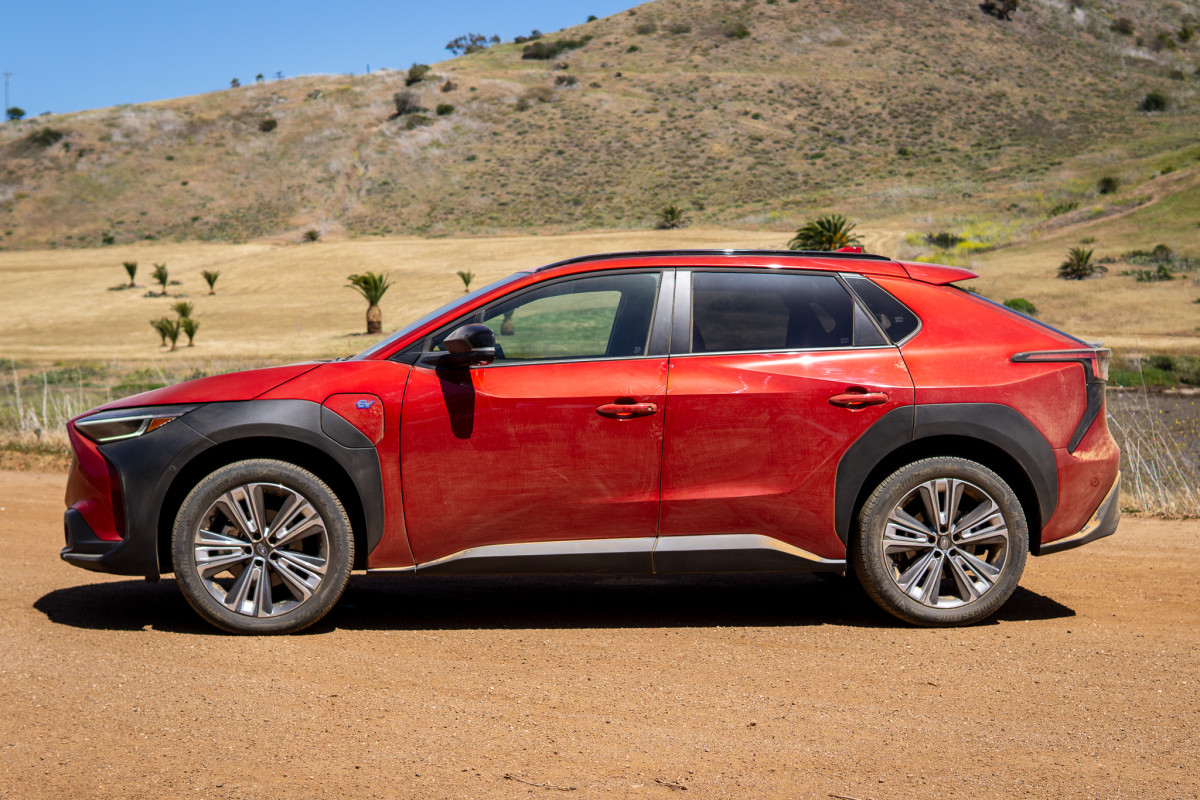
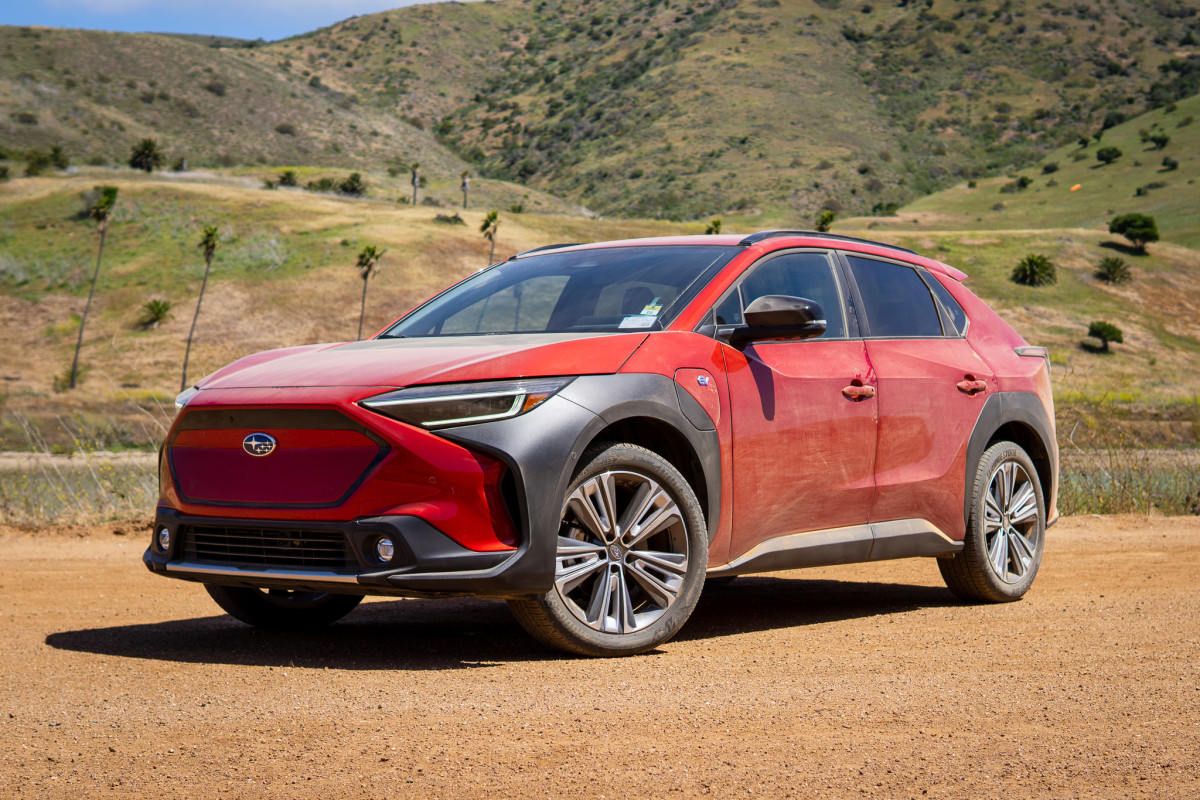
Having been co-developed with Toyota, it doesn’t come as much of a surprise to learn that the Solterra looks an awful lot like the also-all-new 2023 Toyota BZ4X. Both feature EV styling hallmarks like a flat front nose and hardly any grille. A large charging-port door sits just ahead of the driver’s side door, and at the back, the roof slopes down in a sharp rake before flattening at the top edge of the taillights for a duck-bill-style rear spoiler.
Both the BZ4X and the Solterra wear plenty of plastic cladding around their wheel wells. This, along with the overall shape and style of the vehicles’ front ends, leads to a very distinctive (and polarizing) exterior design. Alloy wheels are standard and measure 18 inches on the base trim and 20 inches with either of the available packages.
As they did with plenty of other Subaru models, the Solterra’s designers focused more on function than winning beauty pageants. This EV’s dimensions lend themselves to adventure: short overhangs, great ground clearance, and it was engineered with a roof rack in mind.
Despite being roughly the same length as a Forester, the Solterra sports a wheelbase length closer to the three-row Subaru Ascent’s. The EV platform allows Subaru to push the Solterra’s wheels farther to the front and back of the car, providing better approach and departure angles compared to what would be available on a gas-powered architecture.
Additionally, the Solterra sports a centre of gravity 8.9 centimetres lower than that of the Forester, thanks to its low-mounted battery and lack of an internal combustion engine. And while many EVs can claim similar advantages, the Solterra also displays multiple design elements specifically aimed at improving airflow and aiding aerodynamics. Notably, it features pass-throughs from the front bumper into the front wheel wells, the sides of the taillight elements act as air diffusers, and the distinctive roof spoiler is completely open in the middle, helping to funnel air down the backside of the car.
On the inside, drivers will find the Solterra handsome and comfortable, if a bit cramped. Some EVs like the Hyundai Ioniq 5 leverage their “skateboard” underpinnings to clear out interior space that would typically be filled with engine and transmission hardware on a gas car. In the Solterra, however, the driver and front passenger are firmly divided by a big centre console.
The airspace above that division, however, feels very open. Part of this is due to the low cowl housing the Solterra’s driver information display. The steering wheel sits even lower. The setup is designed so the driver can’t actually view the binnacle through the top-half opening of the steering wheel. Instead, position it so the wheel sits just below the display. It might not be how most drivers situate themselves, but it works.
The base Solterra receives cloth upholstery, while the mid-level Luxury Package and top-end Technology Package get the company’s StarTex synthetic leather. Subaru doesn’t offer a real leather interior on the Solterra.
The dash is deep and covered in a woven upholstery that looks and feels outstanding. Overall, the Solterra’s interior looks good, but where there’s no cloth or StarTex, there’s plastic. And many of those plastic parts—namely the steering column and the piano-black covering the centre console—look like they’ll accumulate lots of dust. That’s likely to be particularly problematic if you’re buying a Solterra to take on dusty, dirty, off-pavement trips.

Performance
Nonetheless, if you’re buying a Solterra, we hope you will be taking it on plenty of dusty, dirty roads. Compare Subaru’s EV on the selling points of its rivals, and it may not look overly competitive. Against the Chevrolet Bolt EUV, Ford Mustang Mach-E, Hyundai Ioniq 5, Kia EV6, and Volkswagen ID.4, the Solterra offers less driving range. It also takes longer to charge than those vehicles. And, when comparing all-wheel-drive (AWD) trims, its electric motors provide less horsepower and torque. But when we got off the glass-smooth highway pavement, the Solterra began to shine.
Subaru has built a strong reputation on the back of its symmetrical AWD technology, and for good reason. Anyone who’s been stuck in the snow on the side of a Canadian highway has undoubtedly seen plenty of Subarus pass them by, unperturbed.
Like the Outback, Forester, and other Subaru models, the Solterra’s symmetrical AWD sends power to all four wheels simultaneously, and in situations where one wheel begins to spin, it will route power to the wheels that have maintained traction. Aside from the mechanically identical Toyota BZ4X, no other EV offers this all-wheel-drive system. And, while the BZ4X offers 20.7 centimetres of ground clearance, the Solterra takes the crown with 21.1 centimetres.
We drove our top-trim Solterra test car on a few genuine off-road trails littered with rocks and carved out with deep troughs and tire tracks. Thanks to the Solterra’s always-on AWD, its X-Mode traction management system (fitted with Snow/Dirt and Deep Snow/Mud driving modes), and its downhill assist control feature, we failed to get our tester stuck.
On paved roads, the Solterra showed up with predictable, serviceable driving dynamics. It didn’t blow our hair back, but we didn’t particularly expect it to, either. While some dual-motor EVs boast massive horsepower and torque figures, the Solterra and BZ4X are more restrained.
A 72.8-kWh battery pack delivers enough juice to turn power specs of 215 hp and 249 pound-feet of torque from the Solterra’s electric powertrain. Regenerative braking comes in four settings, controlled via the car’s paddle shifters, plus an "S-Pedal" mode, but the Solterra’s not capable of full one-pedal driving. The total range comes in at an estimated 360 kilometres in all trims.
The MacPherson-style front struts and double wishbone rear suspension do a good job of keeping the Solterra smooth and level over bumps and through turns. EVs are naturally heavy cars, thanks to their batteries, but the Solterra’s a relative lightweight, tipping the scales at 4,365 pounds (1,980 kilograms) in the base configuration.
Finally, Subaru estimates that owners will be able to charge a Solterra in roughly 9 hours when using a level-two at-home charger, plugged into a 240-volt outlet running 32 amps. Plug a Solterra in for DC fast charging, and owners should see the battery climb from zero to 80% of battery capacity in about 56 minutes.

Form & function
Subaru has fitted the Solterra’s cargo area with a two-position floor. Move the deck board into its lower position, and the car swallows 820 litres of luggage. This eliminates the car’s nice and flat loading floor, however. Put the deck board in its higher position and the Solterra keeps its flat floor but gives out only 674 litres of trunk space. There is no frunk in the Solterra—open the hood, and you’ll see a bunch of electric car powertrain parts.
Total cargo space hasn’t been defined yet, which leads us to believe that it’s on the less impressive end of things. Certainly, with the rear seats folded down, the Solterra looks more spacious than a hatchback, but we don’t expect that it provides more room than a typical compact crossover. It definitely looks less spacious than gas-powered segment leaders like the Honda CR-V, Nissan Rogue, Volkswagen Tiguan, and Subaru’s own Forester.
The rear seat provides reasonable headroom and great legroom. With the front seat positioned for a six-foot two-inch driver, we could stretch out reasonably well in the back. In the front, Subaru adds decent cubby space. The centre console offers a deep well, and the space below the shifter controls is a wide-open shelf. Interestingly enough, the Solterra doesn’t provide a traditional glove compartment.
Our top-trim Solterra tester offered heated and ventilated front seats and heated rear seats. The Luxury package gets only heat for the front and rear, and the base trim gets heat only in the front. Dual-zone climate control with an eco mode is standard.
We were delighted to see that driving-related controls for features like X-Mode, traction control, parking assist, and parking cameras were all physical buttons rather than touch sensors with haptic feedback.

Technology
Unlike every other Subaru on sale, the Solterra doesn’t use the company’s regular Starlink infotainment software. Instead, it employs a Toyota-sourced system. On cars with the Luxury or Technology package, it operates on a beautiful, widescreen 12.3-inch touchscreen. Base trim vehicles get an 8-inch touchscreen.
The driving-related controls in the Solterra may be physical buttons, but the infotainment system still relies on plenty of touchscreen controls. The display, while sharp, does require some attention. The icons are lined up vertically on the driver’s side, and hitting the right button in the right spot definitely meant taking our eyes off the road.
Wireless Android Auto and wireless Apple Carplay come standard on all Solterra trims, and a wireless charging pad is available on the top two trims. Subaru provides plenty of USB ports, too, but only one is a USB-A input/charge port (located in the front centre console). The rest are USB-C. While that would annoy us a few years ago, USB-C is becoming more and more prevalent, and we expect it to become the standard sooner rather than later. Solterras with a package also get a premium Harman Kardon audio system.

Safety
Subaru advertises its EyeSight safety features as standard equipment on the Solterra, but it’s not the typical EyeSight suite that we’ve come to know and love. Instead of being the familiar camera-based system, this one’s sourced from Toyota. That’s OK, though, because Toyota is routinely a forerunner in the world of advanced safety technology.
Essentially all the expected driver assist technologies are included: automatic emergency braking with pedestrian detection, adaptive cruise control, blind-spot monitoring, rear cross-traffic alert, automatic high beams, and lane-keeping assist. Of note, the lane-keeping assist and related lane-tracing assist do a very good job. The former helps drivers stay between the lines without ping-ponging the Solterra between them, and lane-tracing assist follows the curves of the road, requiring limited interaction from the driver. A 360-degree camera system comes in with the Luxury package.
The Solterra also features some other advanced driver assistance systems (ADAS) that are worth noting. Intersection collision avoidance alerts the driver of dangerous situations in upcoming cross-traffic patterns. Road-sign assist pairs with a speed limit warning and is great for young drivers (or those of us who conveniently forget the last posted speed limit). Finally, lead-vehicle start provides a subtle beep when the car in front starts to pull away while you’re still stationary. If every vehicle had this last one, we expect traffic would get a lot more manageable.
The Insurance Institute for Highway Safety (IIHS) has rated the Solterra a Top Safety Pick+, its highest ranking. The National Highway Traffic Safety Administration (NHTSA) has not yet rated this new vehicle.

Cost-effectiveness
Subaru has announced new car pricing on the 2023 Solterra electric SUV, and while it’ll cost much more than a comparable Forester, it looks like a reasonable price next to other electric crossovers.
The base trim level starts at an MSRP of $54,295, which is more than most of its primary competitors' front-wheel-drive (FWD) base trims but still allows the Solterra to qualify for the Canadian federal government’s iZEV rebate program as well as provincial incentives where they exist. Add the Luxury package and your cost goes up to $59,095, and the Technology package brings the total price to $62,795. Each price is not including the manufacturer’s mandatory $1,995 destination charge.
Inventory for Canada has been limited from the start, but if you can find a 2023 Solterra in stock at your local dealership, it appears to be a decent value in the EV space, particularly because it comes standard with AWD.
The Subaru Solterra doesn’t compete on some benchmarks that other automakers are trumpeting, like range and charging speed, but it does offer items that the rest of the market can’t match. Symmetrical AWD and ground clearance are things Subaru has always done well, and they’re things that make the Solterra a true Subaru.
Note: Images show a US model.


What owners say
"Overall, owners appreciate the 2023 Subaru Solterra for its smooth ride and numerous features. Many drivers enjoy the look and feel of the car, along with its handling and power. However, a common concern is the lower range, with some feeling it could benefit from a faster charge option. The price point also raised eyebrows, as owners feel it may be a bit high for the range offered, especially on used models with higher mileage."
So far so good, no issues. Runs smooth, would like a longer charge, but otherwise no issues.
June 18, 2026For the price I paid it has more features than you can use. This car was a great value for what I paid for. This car is missing a fast charge mode but Subaru claimed it did. Love the ride and handling and power of this vehicle.
May 2, 2025Drives well, love the way it looks and feels. However, it is not a good vehicle for long distance drives.
March 30, 2026What owners say
So far so good, no issues. Runs smooth, would like a longer charge, but otherwise no issues.
June 18, 2026For the price I paid it has more features than you can use. This car was a great value for what I paid for. This car is missing a fast charge mode but Subaru claimed it did. Love the ride and handling and power of this vehicle.
May 2, 2025Drives well, love the way it looks and feels. However, it is not a good vehicle for long distance drives.
March 30, 2026The car itself is great for an all-electric vehicle. It has many features that I probably wouldn’t use, but overall, I think it would be a good option for someone who wants an extra car and doesn’t plan on taking long trips. The range is on the lower end, and for the price, I think it should be around $23k–$25k. Anything higher than that for a used 2023 model with over 10k miles would be overpriced, regardless of all the bells and whistles it comes with. If the range were better, I’d consider it a much stronger car.
August 21, 2025Good suspension , good interiors , I just wish they would come up with solution s to charge it faster .
April 10, 2025Trims & specs
Base MSRP N/A | Seating N/A |
Engine N/A | Cargo Capacity N/A |
Combined MPG N/A | Drivetrain N/A |
Base MSRP N/A | Seating N/A |
Engine N/A | Cargo Capacity N/A |
Combined MPG N/A | Drivetrain N/A |
Base MSRP N/A | Seating N/A |
Engine N/A | Cargo Capacity N/A |
Combined MPG N/A | Drivetrain N/A |
Base MSRP N/A | Seating N/A |
Engine N/A | Cargo Capacity 27.7 cu ft |
Combined MPG N/A | Drivetrain N/A |
Base MSRP $38,495 | Seating 5 |
Engine N/A | Cargo Capacity 27.7 cu ft |
Combined MPG N/A | Drivetrain N/A |
Base MSRP $41,395 | Seating 5 |
Engine N/A | Cargo Capacity 27.7 cu ft |
Combined MPG N/A | Drivetrain N/A |


Pricing trends
MSRP range
$44,995 - $51,995
Current avg. market price
$31,689
Trending down by 1.3% this month
May 2026 - October 2026

