2023 Nissan Versa Reviews, Pricing & Specs


Pros & cons
What we like
Stylish design
Fuel-efficient
Excellent value for money
What to consider
Fairly pedestrian performance
Outdated technology
Expert review
The Nissan Versa, Nissan's smallest sedan, proves “entry-level” doesn’t have to mean “bad.”
It’s getting hard to find a basic subcompact sedan, but Nissan is keeping the faith.
The Nissan Versa returned to the Canadian line-up in the 2021 model year after a six-year hiatus, slotting below the Sentra in the lineup. The most recent redesign was just a year earlier, for the 2020 model year. For 2023, the Versa gets a handful of updates, including freshened styling and more available tech features. In addition to the Versa S, the lineup includes SV and SR models; we tested the latter for this review.
Since the Versa has been on sale, the ranks of subcompact cars have thinned considerably. The Chevrolet Sonic, the Ford Fiesta, the Honda Fit, the Hyundai Accent, and the Toyota Yaris are no longer sold in North America. That leaves the Kia Rio and the Mitsubishi Mirage hatchback as the Versa’s main competitors, and the Rio is on its way out of Canada for 2024 as well. But, as is always the case in this market segment, shoppers must also consider whether to buy a new car like the Versa or a potentially better-equipped used car for similar money.
out of 10 expert review
Look & feel
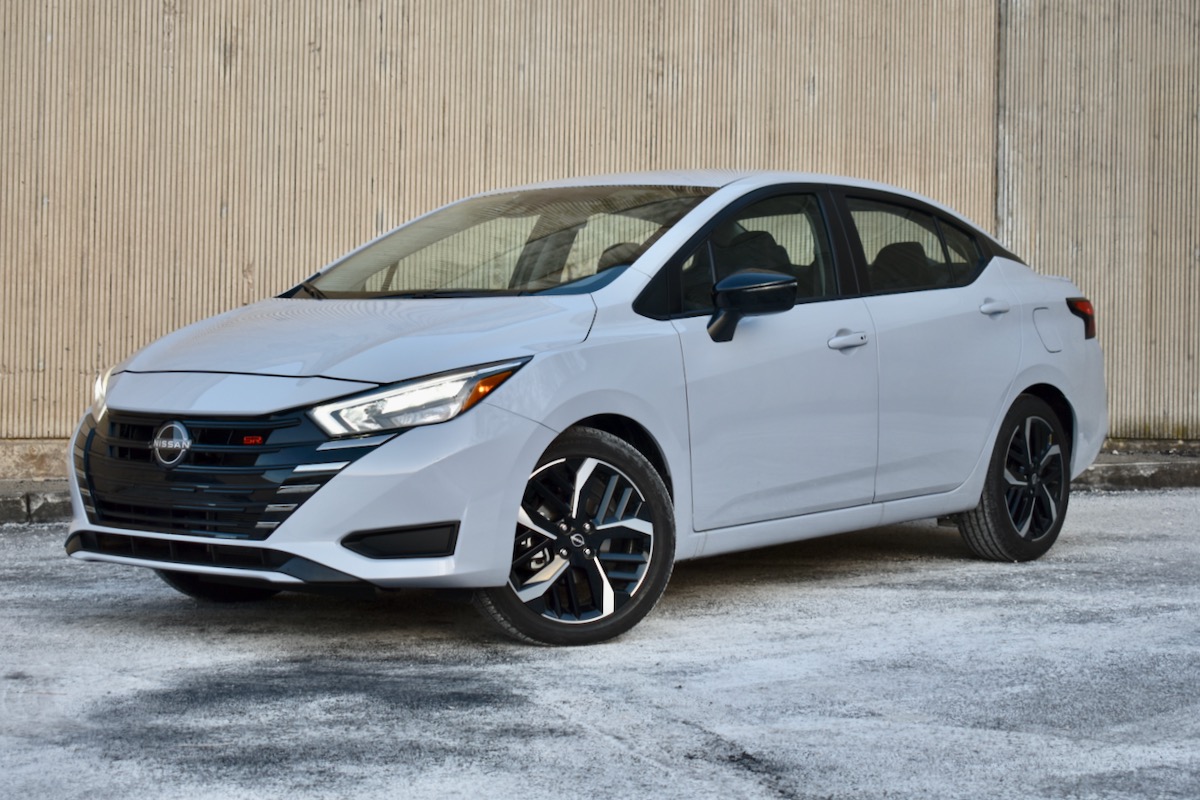
The Versa borrows the design language of Nissan’s larger Sentra and Altima sedans. From the strip of black trim on the rear roof pillar, intended to make the roof look like it’s “floating,” to the prominent V-Motion grille that gives the car a slightly jolly appearance, the Versa is instantly recognizable as a modern Nissan.
Whether you like the current Nissan look or not, copying the more senior sedans makes the Versa appear more upscale. It looks like a traditional sedan, not an econobox, with a sleek profile and fairly wide stance. Wheels and tires are also nicely sized, with standard 15-inch steel wheels on the base Versa S, 16-inch alloy wheels for the SV, and 17-inch alloy wheels for the Versa SR model.
For 2023, the Versa also gets some styling updates. A new front end incorporates a more elaborate version of the V-Motion grille, which has sprouted blade-like appendages, a new wheel design for the Versa SR, and our test car’s Grey Sky Pearl paint. This hue isn’t available on the Versa S, but it gave the SR a nice grown-up look.
The interior design shows a lot of creativity for a budget model. The large round air vents and elaborate dashboard, which seems to fold around the central touchscreen and climate controls, give the interior a lot of character. Most of what you see and touch is still plastic (this is an economy car, after all), but fit and finish were very good even on our pre-production test car, which wasn’t guaranteed to have the same assembly quality as vehicles being sold to customers.
SR models also get red stitching and upholstery inserts as part of that trim level. They remind us a bit of the early 2000s Nissan Sentra SE-R, and while the Versa SR doesn’t get any performance upgrades like that model, it’s nice to see Nissan trying to make an economy car less dull. The SV and SR also get a few more convenience features, including heated front seats, automatic climate control, and a centre console with armrest. A leather-wrapped steering wheel and LED headlights are standard on the SR model.
Performance
Nothing about the Versa’s spec sheet will get your heart racing, but that’s in keeping with its thrifty mission. All Versa models have a 1.6-litre four-cylinder engine and front-wheel drive (FWD). A continuously variable transmission (CVT) is standard, while the five-speed manual transmission has been discontinued.
The engine makes 122 horsepower and 114 pound-feet of torque, which is perfectly satisfactory. Our Versa SR test car never felt quick, but it didn’t feel like a liability in traffic either. It’s exactly what we’d expect of a basic sedan like this. The CVT was fairly responsive, as these transmissions go.
“Satisfactory” is also the best word to describe the Versa’s handling characteristics. The little sedan exhibited quite a lot of body roll in corners, but also remarkable grip for a car tuned with indifference to performance. No matter how dramatically the Versa tilted in corners, it always held on, providing a reassuring feel. Fairly responsive steering also highlighted the nimbleness of this pint-sized sedan. This is no performance car, but it makes daily commuting a little more pleasant.
The Versa also delivered an impressively comfortable ride for an entry-level model. The suspension cushioned impacts with bumps and potholes without too much bouncing or jiggling, and cabin noise levels were lower than expected.
Overall, the Versa felt more substantial than subcompact car stereotypes might suggest. It may be the entry-level model in the lineup, but the Versa’s handling and refinement felt a class above. Nissan could have easily slapped a Sentra badge on this car instead.
Form & function
The Versa is currently available only as a four-door sedan. Nissan sold the Versa Note hatchback in Canada up until it was discontinued to make room for this subcompact car. While marketed as an SUV, the Nissan Kicks with which the Versa shares a platform essentially fulfills the same role.
Even as a sedan, the Versa offers a respectable 416 litres of trunk space in base S form, and 425 litres in SV and SR trims. Either way, that’s more cargo space than you get in the similarly sized Kia Rio sedan. A 60/40 split-folding rear seat isn’t standard, however; you have to move up to the SV or SR trim levels.
Front-seat occupants also benefit from more headroom and legroom than the Kia, although the Nissan loses that advantage when it comes to rear-seat space as the Rio has more headroom. Still, our back-seat passengers didn’t complain.
Subjectively, the front row felt remarkably spacious, and outward visibility was aided by a relatively low dashboard and side glass. Power windows are standard. A reminder that this is still a small car came when trying to stow small items, as the centre console bin can’t hold much more than a bottle of hand sanitizer. The shifter is mounted on a raised platform that looks cool, but probably isn’t the best use of space. Nissan did tuck the optional wireless charging pad out of the way, though.
Technology
The base Nissan Versa S trim level gets a standard 7-inch touchscreen infotainment system, Bluetooth phone connectivity and streaming audio, Siri Eyes Free voice control for iPhone users, three USB ports, and keyless entry. However, to get Apple CarPlay and Android Auto, you need to move up to the Versa SV or SR trim levels.
In addition to Apple CarPlay and Android Auto and NissanConnect Services telematics, the Versa SV gets a 7-inch driver-information display for the instrument cluster and a wireless phone charging pad. The top Versa SR adds an 8-inch touchscreen, satellite radio, and a six-speaker audio system.
Even with all the tech bells and whistles, the Versa still offers a bargain basement experience. The touchscreens are somewhat small by current standards, although it’s hard to see how anything larger would fit into the neatly arranged dashboard. The graphics of the 8-inch screen in our Versa SR test car looked about a decade past their sell-by date, and it was difficult to find things on the crowded screen menus.
The optional digital instrument cluster display does make the Versa feel slightly more upscale. Positioned next to an analog speedometer, it can show a nicely rendered digital tachometer, as well as readouts for fuel economy, blind spot monitoring, and other vital information. This humble sedan also nails an important tech point many more expensive vehicles miss by providing a light to tell you if your phone is charging.
Safety
One area where the Versa exceeds expectations is standard driver-assist tech. Despite its entry-level status, the base Versa S comes standard with automatic emergency braking (with pedestrian detection), rear automatic braking, lane-departure warning, and high beam assist. The Versa SV adds blind-spot monitoring, rear cross-traffic alert, and a driver attention alert.
The Insurance Institute for Highway Safety (IIHS) hasn’t published updated safety ratings for the 2023 Versa. It received the highest “Good” ratings in older versions of the side-impact and moderate overlap front crash tests, but the IIHS hasn’t retested the Versa under its new protocols.
The National Highway Traffic Safety Administration (NHTSA) gave the 2023 Versa a five-star overall safety rating, with five stars in side-impact crash testing and four stars in the frontal and rollover categories.
Cost-effectiveness
Natural Resources Canada estimated fuel economy ratings for the 2023 Nissan Versa are 7.4 litres per 100 kilometres in city driving, 5.9 on the highway, and 6.7 combined. We averaged 7.4 L/100 km over a week of driving.
Like other new Nissans, the Versa’s standard warranty includes three years or 60,000 kilometres of basic coverage (whichever comes first) and five years or 100,000 kilometres of powertrain coverage.
2023 Nissan Versa sedan pricing starts at $24,103 for the Nissan Versa S base model, including a $1,750 destination charge. The Nissan Versa SR is priced at $27,103.
Even a loaded Versa SR like our test car is a fairly good value. The Versa also doesn’t feel cheap and tinny, as the price point might suggest. It looks and feels like a real car, which is far from a given in this market segment. The Mitsubishi Mirage, for example, forces drivers to make do with just 78 hp and 74 lb-ft of torque. The Kia Rio offers a similar level of refinement to the Versa, and a more reasonable 120 hp and 122 lb-ft, but can’t match the Versa’s standard safety features.
Just finding a car like this is becoming difficult as automakers continue pushing customers into more expensive crossover SUVs. If you doubt existence of the SUV premium, consider that the Nissan Kicks—which isn’t even available with all-wheel drive (AWD)—starts at $26,233 with destination. So, the cheapest Kicks nearly as expensive than the priciest Versa, and mainly so the driver can sit a little higher.
Cars like the Versa were once good only for a warranty and new-car smell. The 2023 Nissan Versa offers something more. While its price point shows in the dated infotainment system and just-adequate power, the Versa is honest basic transportation of the kind that’s becoming increasingly rare on new-car lots.
Note: Images show a US model.

What owners say
Trims & specs
Base MSRP $19,970 | Seating 5 |
Engine 1.6L 122 hp I4 | Cargo Capacity 15.0 cu ft |
Combined MPG 36 | Drivetrain FWD |
Base MSRP $15,980 | Seating 5 |
Engine 1.6L 122 hp I4 | Cargo Capacity 14.7 cu ft |
Combined MPG 36 | Drivetrain FWD |
Base MSRP $19,270 | Seating 5 |
Engine 1.6L 122 hp I4 | Cargo Capacity 15.0 cu ft |
Combined MPG 36 | Drivetrain FWD |


Pricing trends
MSRP range
$15,980 - $19,970
Current avg. market price
$18,571
Trending down by 5.7% this month
May 2026 - October 2026

