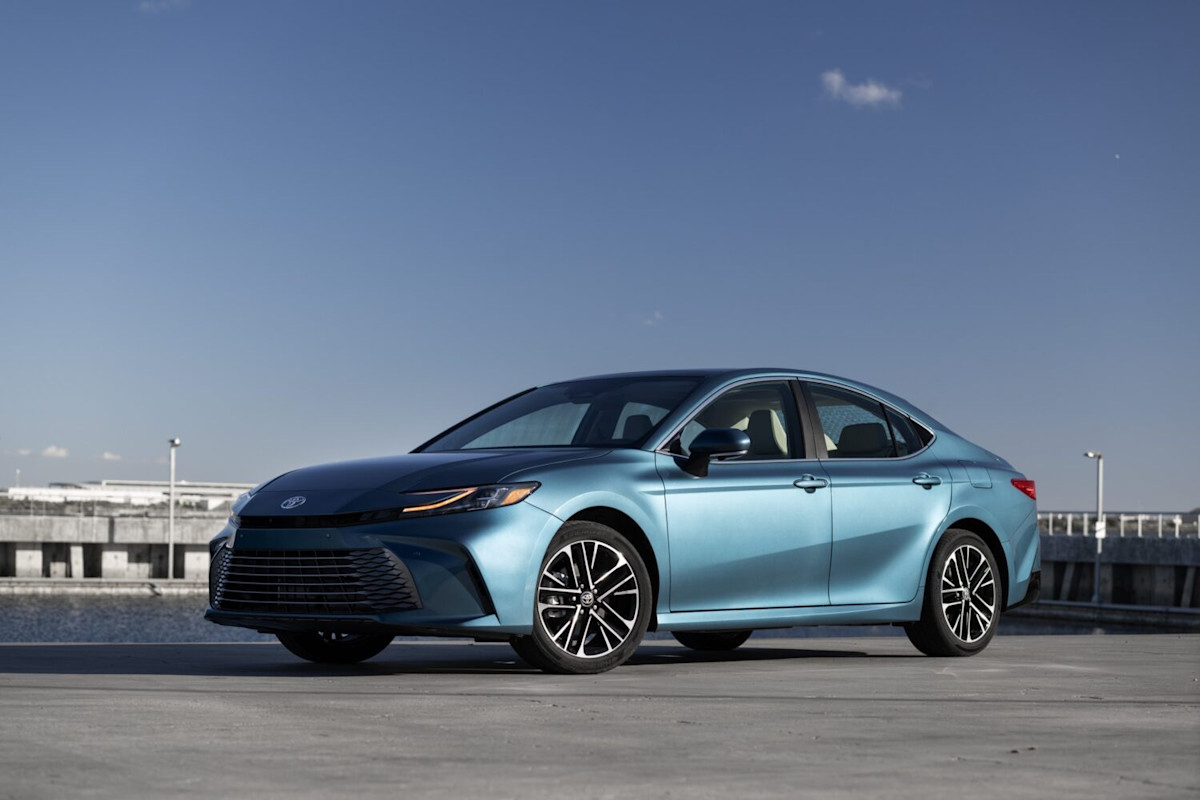
2022 Toyota Camry Reviews, Pricing & Specs

Expert review
If you like the way the 2022 Toyota Camry looks, then it's likely you’ll enjoy most other things about it.
Considering all of the headlines about how people don’t buy cars anymore, you might find it surprising to learn that there are plenty of consumers who still want a roomy, reliable, efficient, safe, and affordable car. The 2022 Toyota Camry is what they often choose.
out of 10 expert review
Look & feel
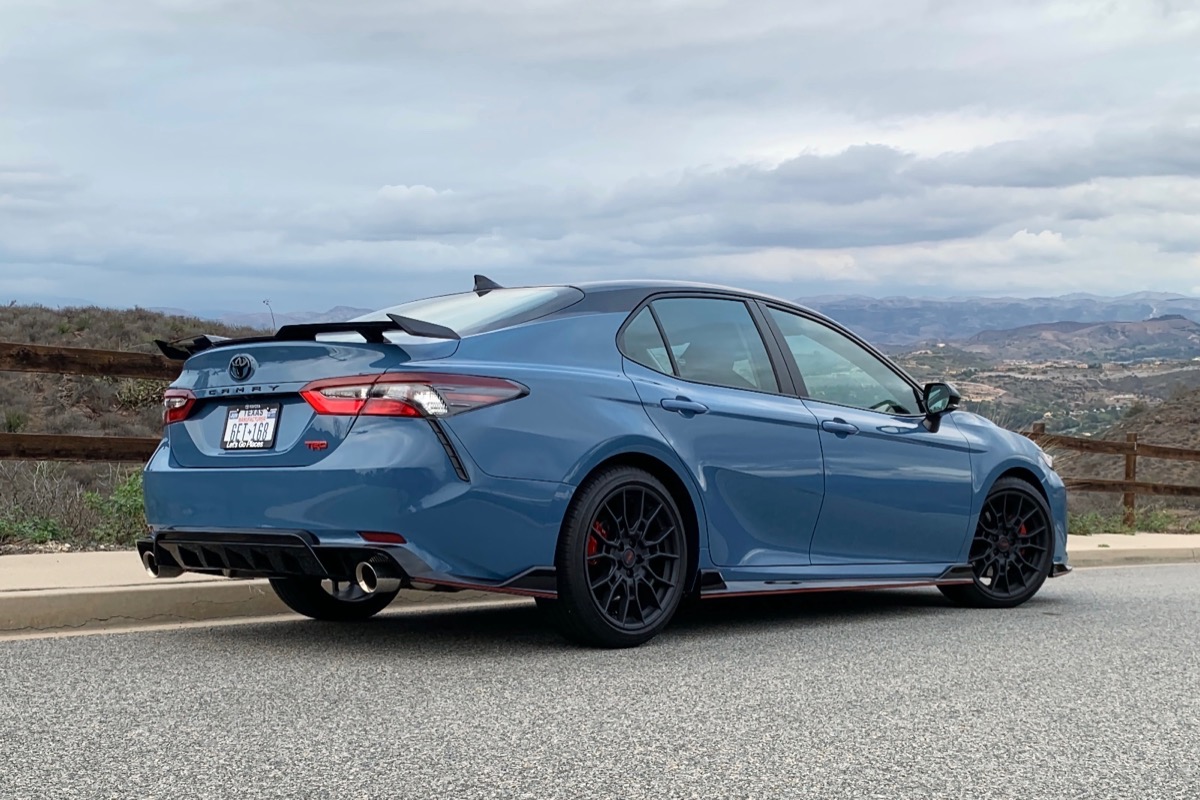
Three young guys took note of our Toyota Camry test car as we approached, one pointing and saying something to his gaggle of bros. In all of our years evaluating Camrys, this kind of thing has never happened. Credit the eye-catching Cavalry Blue paint, which is new for 2022 and exclusive to the performance-tuned Camry TRD (Toyota Racing Development) model.
That paint colour is one of a handful of changes to the Toyota Camry for the 2022 model year. Otherwise, updates include standard heated side mirrors for all trims. Additionally, the SE Hybrid trim level is now available with a new Nightshade Edition package that blacks out the car’s exterior trim and wheels (and was already available on other Camry models).
As long as you like the way this car looks, finding a satisfying Camry is easy because there are 13 different versions to choose from. Pricing starts at $27,750 Canadian for the base Toyota Camry LE and tops out at $41,390 for the sporty and slightly upscale Camry XSE V6. You can pick a four-cylinder engine, a V6 engine, or a fuel-efficient gas-electric hybrid powertrain (including the exclusively hybrid XLE variant) that will consume less than 5 litres of fuel per 100 kilometres in combined driving.
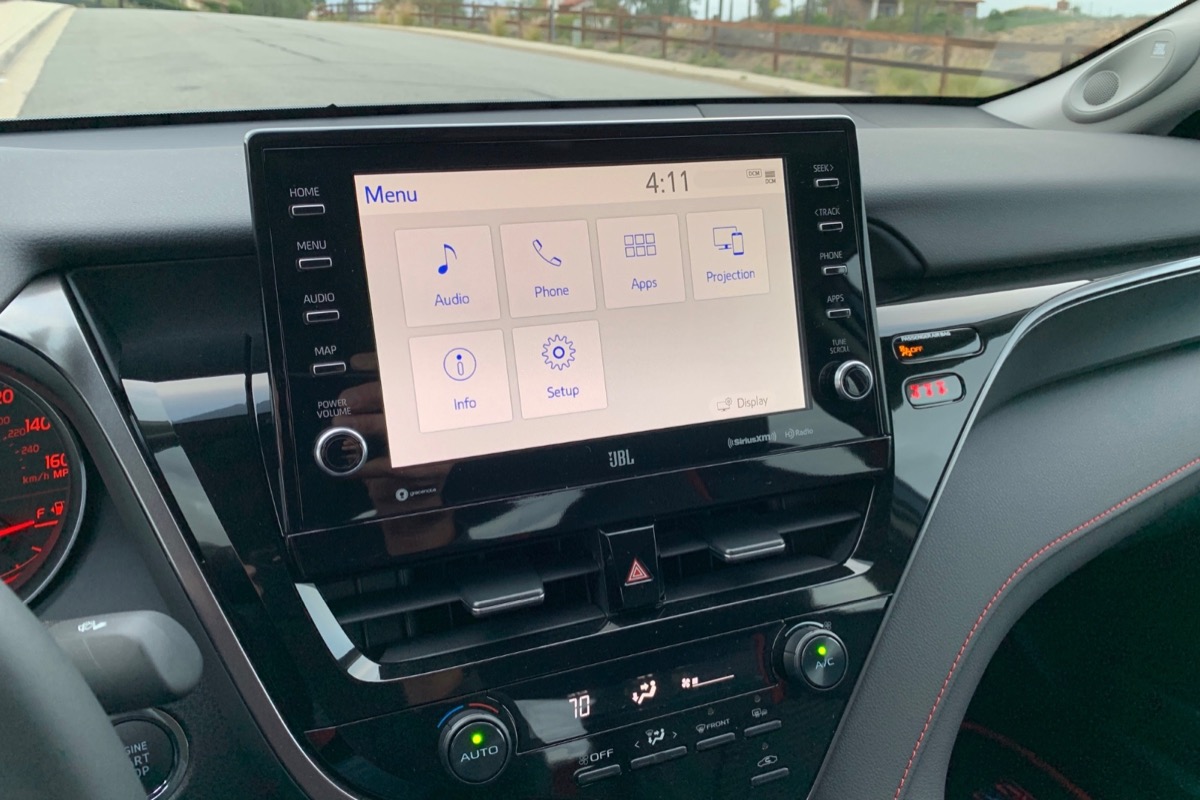
Our test car was not the fuel-sipping Toyota Camry Hybrid. Instead, Toyota supplied us with a Camry TRD with a JBL premium sound system and a 9-inch touchscreen infotainment system. The Canadian MSRP comes to $37,040, not including an $1,820 destination charge to ship it from the Camry factory in Kentucky to your local dealership.
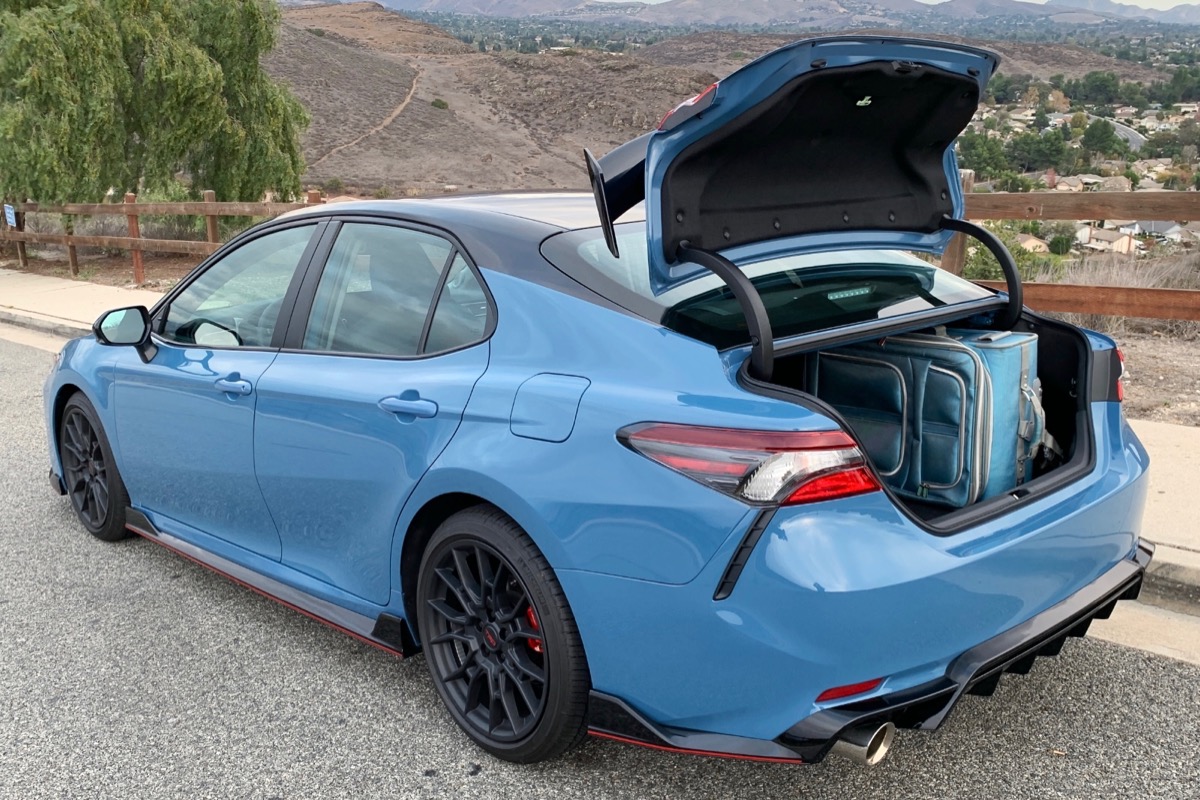
Even without the Cavalry Blue paint, there is no mistaking the Camry TRD for any other version of the car. It comes with an aerodynamic body kit, including a front splitter, side skirts, a pedestal-style rear spoiler, and a more aggressive rear diffuser panel. It also has matte-black 19-inch wheels, red brake calipers, red accent stripes and badges, and polished stainless steel exhaust outlets. A gloss black grille with a mesh insert leads the charge up front.
To some degree, the Camry is an acquired taste. Our excitable and youthful observers aside, the bright blue paint and go-fast bodywork don’t make the underlying styling easier to like. However, considering that Toyota endured decades of complaints about how boring previous versions of the Camry were, you certainly cannot say the same about the current design, even though it dates back to 2018.
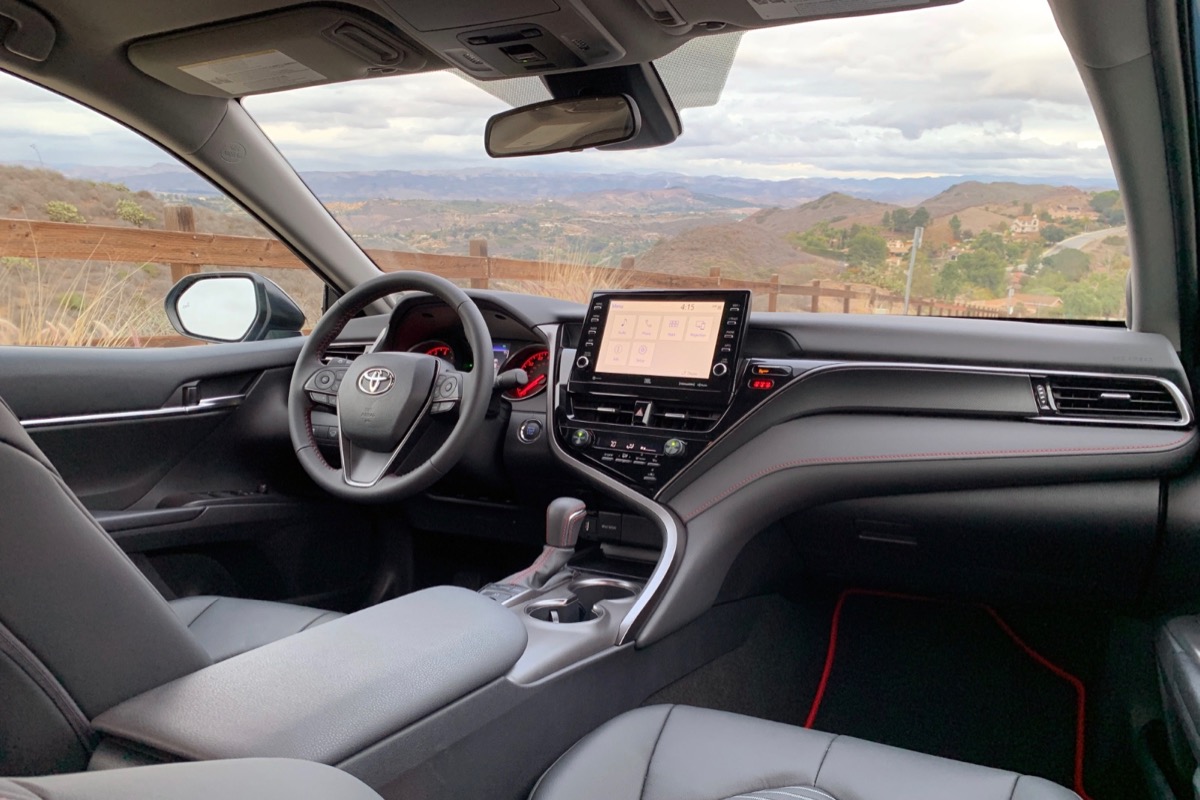
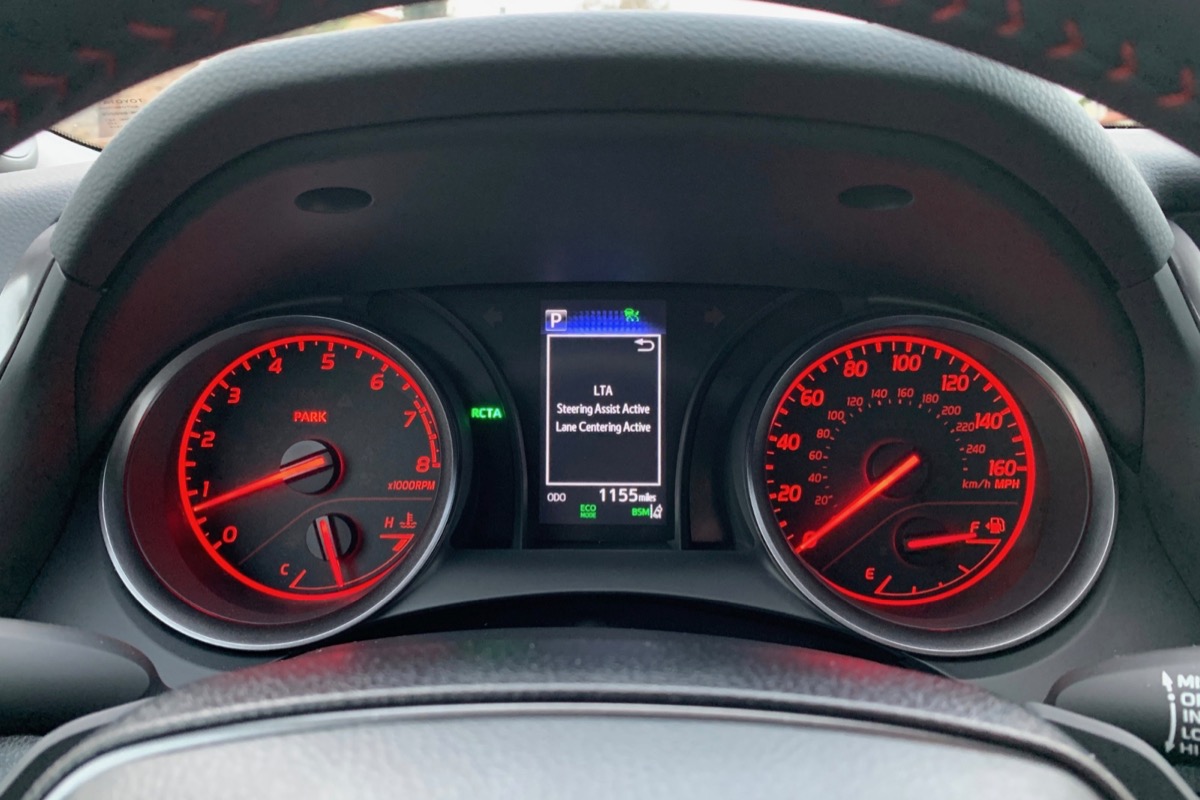
The interior is less polarizing but no less interesting, thanks to an unusual dashboard layout and driver-oriented centre console design. Unfortunately, the Camry TRD has red gauge illumination that was a terrible idea on 1990s-era Pontiacs and remains a terrible idea today—and not just because they don’t match the rest of the cabin’s illumination theme of white and blue. In addition, the red floor mat embroidery and red seatbelts are tacky.
Visually, the Camry TRD is trying too hard. The dynamic tuning described in the next section is welcome. The dramatic styling is not.
Performance
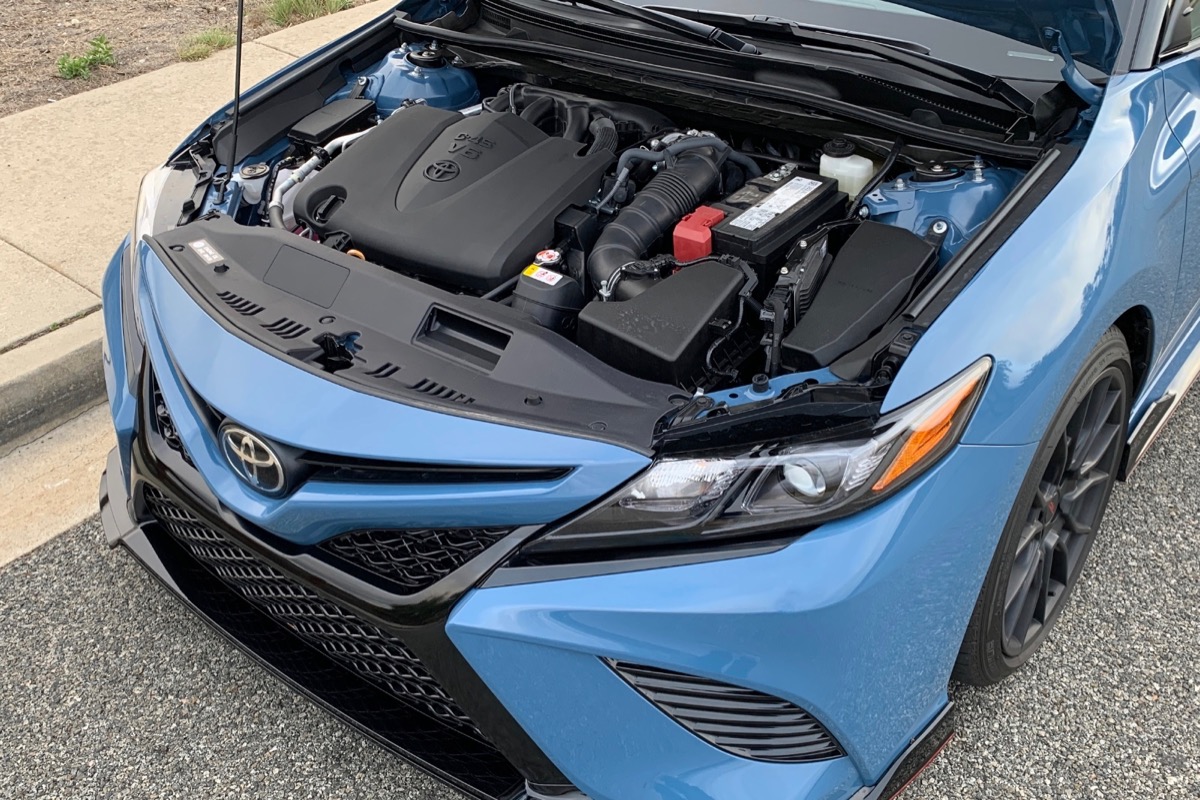
The 2022 Toyota Camry TRD has a 3.5-litre V6 engine making 301 horsepower and 267 pound-feet of torque, an eight-speed automatic transmission, and front-wheel drive (FWD). A Sport transmission mode and paddle shifters further quicken the car’s pulse, and a Sport driving mode also adjusts throttle response and steering effort levels. According to Natural Resources Canada fuel consumption ratings, the Camry TRD should use 9.4 L/100 km in combined driving. Despite hustling the car across a mountain range in Sport mode, we averaged 9.5 L/100 km, which is better than expected.
Beyond the robust V6 and racy design, the Camry TRD promises “track-tuned” driving dynamics. Toyota increases the car’s torsional rigidity with thicker underbody braces and reworks the suspension with stiffer sway bars, tauter springs, and TRD shocks. In addition, the Camry TRD boasts bigger and more responsive brakes, breathes through a sport dual exhaust system, and blasts down the road on 19-inch matte-black alloy wheels wrapped in 235/40 tires.
As you may have deduced from these specs, this is not your garden-variety Toyota Camry. Better yet, the Camry TRD delivers remarkable performance for the money. Toyota could have easily made the TRD the top-of-the-line version of the Camry. Instead, Toyota bases it on the Camry SE, which is why the interior can seem a little cheap and underwhelming.
In any case, this V6 is a terrific engine, and the eight-speed automatic transmission never gets a shift wrong. The Camry TRD quickly gathers speed, effortlessly passes slower vehicles, and emits a pleasing exhaust note that doesn’t resort to obnoxious snap, crackle, and pop in a seeming effort to underscore the car’s purpose. However, it sure would be nice to get a Camry TRD with all-wheel drive (AWD)—which is offered on other Camry models—because with FWD it is far too easy to break the front wheels loose and squeal the tires.
What’s better is how solid, secure, and planted the Camry TRD feels. The structural bracing pays dividends here, as does the TRD-tuned suspension and the performance rubber. Toyota says the Camry TRD sits lower for a reduced centre of gravity, and on winding mountain roads, the car is good fun to drive. Get into a hairpin curve too hot (or a city corner, for that matter), and the nose-heavy Camry TRD will push a little, but not much.
Better yet, the suspension proves communicative without beating you up. You can tell what’s going on at each tire contact patch, yet the ride is compliant enough for daily-driving comfort. Also, the brake pedal feel and modulation are excellent, and the system displayed no fade during a rousing run across a mountain range.
Although it resembles a life-size Hot Wheels car, the Camry TRD is well engineered. Looks-wise, it reminds us of Pontiacs from the 1990s, which were all dressed up to look speedy but offered nothing but a cold cup of disappointment when driven. However, the modern-day Camry TRD supplies the performance to back up the “Hey, look at me, I go fast” styling.
Form & function
Though they have the requisite red accent stripes, red stitching, and embroidered TRD logos on them, the Camry TRD’s front seats do not offer any added bolstering on the driver’s seat over what you’ll find in a bone-stock Camry SE. But, surprisingly, this wasn’t a problem for us.
This car has a low-slung, sporty driving position, and between the fabric seat inserts, the tall centre console, and the lack of body roll in corners, we simply didn’t get tossed around while exercising the Camry TRD. Plus, both front seats offer power height adjustment, making them comfortable over time.
The Camry is not the roomiest of midsize sedans, but the back seat holds two adults without any trouble. Unfortunately, the TRD model does not offer rear-seat air vents, and a casualty of the improved structural rigidity is the 60/40-split folding back seat. Instead, the TRD has a fixed rear seatback that doesn’t fold down.
That means you’ll need to be happy with the 428-litre trunk, one of the smallest ones in the Camry’s segment. For comparison, a Honda Civic sedan—which is a size class smaller than the Camry—offers 419 litres of cargo space.
Toyota makes up for this with generous in-cabin storage. The bin underneath the centre armrest is large for an SUV, let alone a car, and the Camry offers good stash space in other locations around the vehicle.
Technology
Toyota equips the Camry with a standard 7-inch touchscreen infotainment system, which is small by modern standards. However, the stereo volume and tuning knobs are a delightful throwback to a simpler time, and shortcut buttons flank each side of the screen to make the technology more accessible.
The screen might be small, but it includes Apple CarPlay and Android Auto compatibility, Bluetooth, and SiriusXM satellite radio. It also includes Safety Connect subscription services. In addition, Toyota provides complimentary trial periods for all subscription-based offerings.
Camry XSE and TRD buyers get a 9-inch touchscreen display that retains all of the buttons and knobs and adds additional Remote Connect and Service Connect subscription plans as well as a 9-speaker JBL premium audio system on the V6 offerings. As is typical of JBL components, sound quality is bass-heavy and sometimes brassy. But at this price point, it’s a decent system.
Toyota does not offer its dynamic connected navigation and voice recognition technology in the Camry TRD, so we could not evaluate its effectiveness. Connect via Apple CarPlay or Android Auto, and you can use the “talk” button on the steering wheel to use Siri or Google Assistant. That is probably the better solution, anyway.
Other Camry models are also available with a 10-inch head-up display and a 360-degree surround-view monitoring system, but not the TRD.
Safety
Every 2022 Camry has Toyota Safety Sense 2.5+, a package of driver assist and collision avoidance safety features that includes almost everything you really need, and then some. A highlight is the adaptive cruise control and available lane-centring assistance; when used together, they add a hands-on, semi-autonomous driving assistance function for highway driving.
Separately, Toyota offers a blind-spot monitoring system with rear cross-traffic alert. It comes standard on the Camry TRD and XSE but is an option with LE and SE trim.
As is generally typical with lane-maintenance technology, the Camry’s lane-departure warning system can misread pavement scars and get confused when travel lanes expand or contract, issuing false warnings. Also, the lane-centring assistance function can behave in too obvious or insistent a manner, especially when the road ahead is not straight. The adaptive cruise control system can automatically reduce vehicle speed in curves, too, and usually unnecessarily. This technological second-guessing, especially on the part of the lane-keeping assist features, contributes to a low level of irritation in the Camry’s driver.
Safety Connect is standard in every 2022 Camry. This technology is free to use for the first year you own the car but requires a paid subscription after that. Safety Connect equips the Camry with automatic collision notification, an emergency assistance button, and quick access to roadside assistance when you need help. A stolen vehicle locator is also a part of this connected services plan.
If the Camry’s driving aids cannot help you avoid a collision, rest assured the car will do its best to protect you and your passengers. It gets a “Top Safety Pick+” rating from the Insurance Institute for Highway Safety (IIHS) and nearly unheard of five-star ratings in every single evaluation the National Highway Traffic Safety Administration (NHTSA) performs.
Cost-effectiveness
On paper, Toyota checks every box on a consumer’s midsize sedan checklist. This is a comfortable, affordable, reliable, safe, and efficient family car, and is especially appealing in hybrid format. Don’t forget about free trial subscriptions to satellite ratio and connected services plans.
In TRD specification, Toyota addresses enthusiast drivers who enjoy the journey as much as the destination. The car looks immature, but the engineering underneath the spats and spoilers is legit. Better yet, Toyota makes the Camry TRD more affordable by basing it on the Toyota Camry SE trim level instead of the more expensive Toyota Camry XSE V6 trim.
In short, as a new car, the 2022 Toyota Camry is a cost-effective choice in a midsize family sedan. If you like the way it looks, you’ll like most other things about it.
Note: Images show a US model.

What owners say
"Overall, owners are very pleased with the 2022 Toyota Camry, noting its reliability, fuel efficiency, and stylish design. The majority appreciate its comfortable interior and value for money. However, some drivers find that the four-cylinder engine lacks power, and a few wish for more advanced features like wireless Apple CarPlay."
I absolutely love the features of my car. The push start, sunroof, heated seats, heated steering wheel, and Apple CarPlay are all fantastic. For the value, the car is a great choice. Being a Toyota, its built to last and is also very fuel-efficient. Both the exterior and interior are incredibly clean, which adds to its appeal. That said, there are a couple of things I wish were different. I’d love if the car had memory seats, and the display screen could be a bit more modern, especially compared to the ones in the Toyota Highlanders. Another small inconvenience is that, unlike the Highlanders where Apple CarPlay connects wirelessly through Bluetooth, my car requires the phone to be plugged in for CarPlay to work. While this isnt a huge issue, it would be more convenient if it were wireless like in the Highlanders. Overall, it’s a really cute car and an amazing choice for a first car. Im really happy with it!
November 12, 2024Smooth ride on the highway with great mpg. The shifting is a little hotter than I'm used to but you get used to it pretty quickly. The only thing it's missing is a physical pause/play button. Has all the controls except that one.
June 5, 2026Great car so far…clean inside and out. Rides great! I am still learning the features of the car.
April 14, 2026What owners say
I absolutely love the features of my car. The push start, sunroof, heated seats, heated steering wheel, and Apple CarPlay are all fantastic. For the value, the car is a great choice. Being a Toyota, its built to last and is also very fuel-efficient. Both the exterior and interior are incredibly clean, which adds to its appeal. That said, there are a couple of things I wish were different. I’d love if the car had memory seats, and the display screen could be a bit more modern, especially compared to the ones in the Toyota Highlanders. Another small inconvenience is that, unlike the Highlanders where Apple CarPlay connects wirelessly through Bluetooth, my car requires the phone to be plugged in for CarPlay to work. While this isnt a huge issue, it would be more convenient if it were wireless like in the Highlanders. Overall, it’s a really cute car and an amazing choice for a first car. Im really happy with it!
November 12, 2024Smooth ride on the highway with great mpg. The shifting is a little hotter than I'm used to but you get used to it pretty quickly. The only thing it's missing is a physical pause/play button. Has all the controls except that one.
June 5, 2026Great car so far…clean inside and out. Rides great! I am still learning the features of the car.
April 14, 2026Missing sensors and sunroof. But overall it’s great. If u want all the bells n whistles might wanna look into the XLE.
July 2, 2025The Camry does not have a lot of frills like a Navigation System but for the price it wasn't required for me
March 28, 2025Great model. Love this car. Really good value. No missing features. Just what I needed and wanted
July 14, 2023Reliable, fuel efficient, comfortable, and great looking. Comparable to the Accord.
March 28, 2023Reliable transportation! Toyota has dependable vehicles and so far no problems.
December 4, 2022Not your plain Jane sedan anymore. Very stylish and sporty. The four cylinder is a little sluggish for some. I would opt for a 300 hp V6.
November 30, 2022The car is solid safe , practical and looks good . It may be a little more expensive upfront but it is well worth it . Replaced older one with over 300 thousand miles It was a Rock Star!
July 19, 2024Trims & specs
Base MSRP $25,845 | Seating 5 |
Engine 2.5L 203 hp I4 | Cargo Capacity 15.1 cu ft |
Combined MPG 33 | Drivetrain FWD |
Base MSRP $27,245 | Seating 5 |
Engine 2.5L 202 hp I4 | Cargo Capacity 15.1 cu ft |
Combined MPG 29 | Drivetrain AWD |
Base MSRP $27,385 | Seating 5 |
Engine 2.5L 203 hp I4 | Cargo Capacity 15.1 cu ft |
Combined MPG 33 | Drivetrain FWD |
Base MSRP $28,785 | Seating 5 |
Engine 2.5L 202 hp I4 | Cargo Capacity 15.1 cu ft |
Combined MPG 29 | Drivetrain AWD |
Base MSRP $29,485 | Seating 5 |
Engine 2.5L 202 hp I4 | Cargo Capacity 15.1 cu ft |
Combined MPG 29 | Drivetrain AWD |
Base MSRP $28,085 | Seating 5 |
Engine 2.5L 203 hp I4 | Cargo Capacity 15.1 cu ft |
Combined MPG 33 | Drivetrain FWD |
Base MSRP $36,270 | Seating 5 |
Engine 3.5L 301 hp V6 | Cargo Capacity 15.1 cu ft |
Combined MPG 27 | Drivetrain FWD |
Base MSRP $32,910 | Seating 5 |
Engine 3.5L 301 hp V6 | Cargo Capacity 15.1 cu ft |
Combined MPG 26 | Drivetrain FWD |
Base MSRP $31,145 | Seating 5 |
Engine 2.5L 206 hp I4 | Cargo Capacity 15.1 cu ft |
Combined MPG 32 | Drivetrain FWD |
Base MSRP $32,545 | Seating 5 |
Engine 2.5L 205 hp I4 | Cargo Capacity 15.1 cu ft |
Combined MPG 29 | Drivetrain AWD |
Base MSRP $35,720 | Seating 5 |
Engine 3.5L 301 hp V6 | Cargo Capacity 15.1 cu ft |
Combined MPG 27 | Drivetrain FWD |
Base MSRP $30,595 | Seating 5 |
Engine 2.5L 203 hp I4 | Cargo Capacity 15.1 cu ft |
Combined MPG 32 | Drivetrain FWD |
Base MSRP $31,995 | Seating 5 |
Engine 2.5L 202 hp I4 | Cargo Capacity 15.1 cu ft |
Combined MPG 29 | Drivetrain AWD |


Pricing trends
MSRP range
$25,845 - $36,270
Current avg. market price
$26,758
Trending up by 1.9% this month
May 2026 - October 2026