2022 Lexus ES Reviews, Pricing & Specs



Pros & cons
What we like
Fuel-efficient
Quiet cabin
Multiple powertrain options
What to consider
Uninspired styling
Fairly pedestrian performance
Underwhelming base engine
Expert review
The 2022 Lexus ES is the best and worst entry to the luxury sedan class.
Auto manufacturers are always pursuing younger customers, but some cars appeal to a different clientele. The 2022 Lexus ES attracts the softest of buyers, mature adults seeking a mid-size luxury sedan without a giant price tag. Available with four cylinders, six cylinders, or a gasoline-electric hybrid powertrain, the 2022 Lexus ES starts in Canada at $46,200. In the age of the SUV and at the dawn of electrification, the ES does its best to capture any remaining new car buyers interested in a traditional sedan.
out of 10 expert review
Look & feel
The ES ("executive sedan" or "elegant sedan," depending on who you believe) has been a mainstay in the Lexus lineup since the start. The ES 250 debuted as a 1990 model alongside the LS 400 and has evolved over seven generations into its current form. While sales have slumped in recent years, a respectable number of ES sedans still leave dealer lots.
The challenge for Lexus is that the ES, like the LS, tends to be popular with an aging demographic, not a group any car company chases. Who knows? That 67-year-old might be buying their last car, and where would Lexus be then? But Lexus is stuck in the middle on this one. The company believes it must attract younger buyers but can't afford to alienate its loyal following. Whenever competing agendas rear their ugly heads, things get safe as the brand tries to satisfy everyone at once. They also get a little weird. The Lexus ES can't escape this.
The latest generation of the ES launched for the 2018 model year, moving to the Global Architecture-K (GA-K) platform underlying multiple mid-size models, including the Lexus RX, Toyota Camry, and Toyota Avalon (which is due to be discontinued). The platform supports a front-engine, front-wheel drive (FWD) layout, which can be upgraded to all-wheel drive (AWD) in most circumstances. The GA-K works with multiple engine options, too.
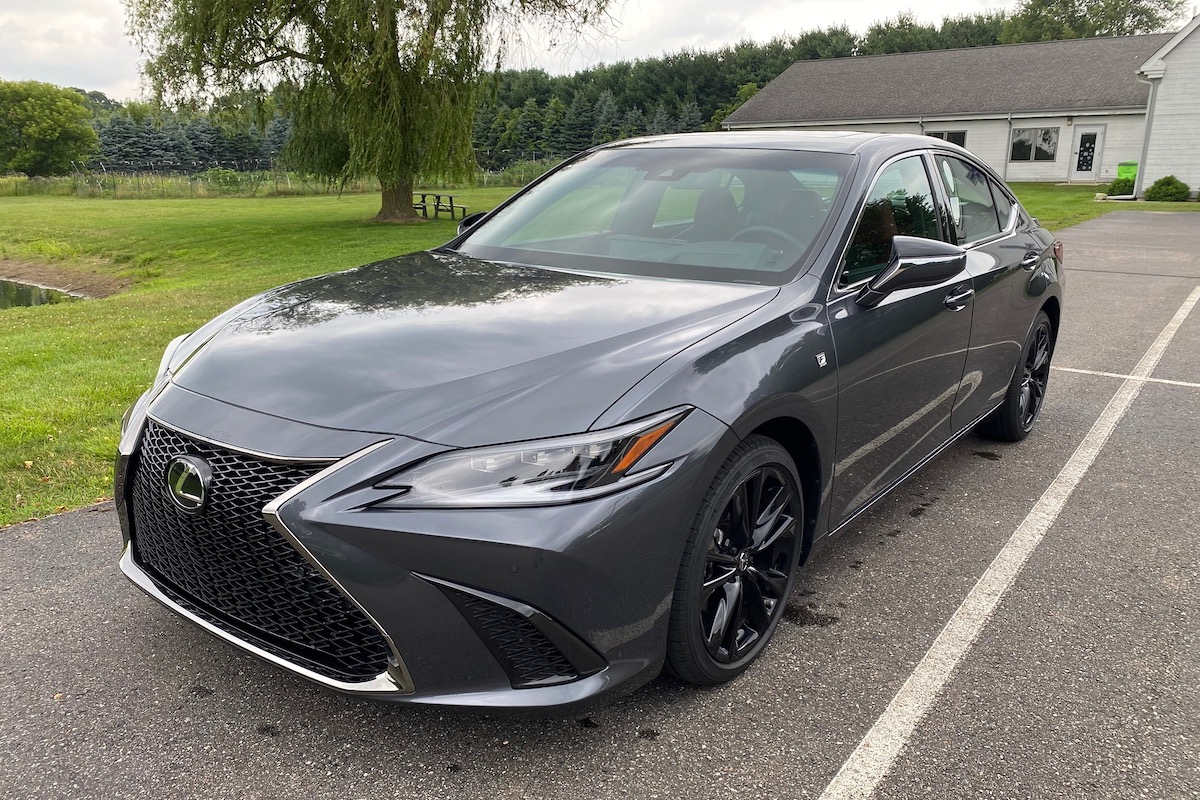
The ES is an attractive sedan, but not overly so. It has elegant proportions and a sleek, almost fastback roofline. The prominent Lexus "spindle" grille is a matter of taste, as are the very assertive headlamp shapes. The ES comes standard with 17-inch wheels, with 18-inch and 19-inch wheels available as you climb the trim ladder. The 18-inch hoops look the best, as the 19-inch ones verge on cartoonish.
Similarly, the interior is nice, but not overwhelmingly so. The dashboard is oddly asymmetrical, which gives the driver's side a cockpit feel but still looks jumbled. The dash is layered, and in typical Lexus fashion, precisely assembled with crisp, even gaps. Our test car came with F Sport packaging and thus had bold two-tone leather seating. The seats are attractive and sporty, maybe more than the rest of the car, which is a little weird. Lexus also inset a small analog chronometer into the touchscreen housing, perhaps to underline the ES's heritage. But it only succeeds in dating the dash and adding to the clutter.
Performance
The 2022 ES comes in three models, distinguished primarily by their powertrains.
The base model is the ES 250 AWD, which gets a 2.5-litre four-cylinder engine with an eight-speed automatic transmission and, as noted in the name, all-wheel drive (AWD). The ES 250 AWD puts out power specs of 203 horsepower and 184 pound-feet of torque, and Natural Resources Canada rates it at 9.5 litres per 100 kilometres in city driving, 7.0 on the highway, and 8.4 combined using regular gas. Lexus says the ES 250 AWD can go from 0-60 mph in 8.6 seconds (0 to 100 km/h figures are not provided) on the way to a top speed (electronically limited) of 210 kilometres per hour.
The Lexus ES 350 comes with a V6 engine displacing 3.5 litres, which also runs on regular gas, and also has an eight-speed automatic. However, this model is FWD only, with no option for AWD. Engine output is a robust 307 hp and 267 lb-ft of torque, good enough for a 6.6-second run from 0-60 mph, with the same electronically limited 210 km/h top speed as its four-cylinder sibling. The ratings for the ES 350 are 10.7 L/100 km city, 7.3 hwy, 9.2 combined. The ES 350 F Sport package brings these figures up slightly to 10.9 city, 7.5 hwy, 9.4 combined.
The ES 300h is the hybrid variant, equipped with a 176-hp four-cylinder engine working with a 39-hp electric motor for a net 215 hp. The powertrain is coupled to what Lexus calls an electronically controlled continuously variable transmission (CVT), sending power to the front wheels only. The hybrid is in the middle in terms of performance, a little quicker than the ES 250 AWD at 8.1 seconds from 0-60 mph and a little slower, but with a lower (still electronically limited) top speed of 180 kilometres per hour. The ES 300h excels in Natural Resources Canada testing, coming in at 5.5 L/100 km city, 5.2 hwy, 5.3 combined.
Our test car was an ES 250 AWD (note this is in U.S. specification; in Canada, F Sport packaging is offered on the ES 350 only). The naturally aspirated four-cylinder engine under the hood makes very un-Lexus-like sounds when you put your foot into the throttle, accusing you of bad manners with its strained engine note. Cruising at speed and tooling around works fine—just don't try to flog this ES. It's not going to do any good.
Lexus’ quoted 0-60 mph time is not slow for an economy car, but it's disappointing in a $45,000 luxury sedan. Thankfully, the Lexus handles well and drives smoothly and predictably. It just feels slow. The ES 350's V6 would undoubtedly be more fun for an engaged driver, and the ES 300h hybrid delivers excellent fuel economy to offset its modest performance. The ES 250's standard AWD doesn't make enough of a noticeable impact on driving to recommend settling for the four-cylinder engine, though some Canadian drivers may consider its extra winter-weather reassurance worth the trade.
Form & function
Sedans generally get less attention from shoppers these days with the soaring popularity of SUVs. But the luxury sedan form persists for both aesthetic and practical reasons. The obvious advantage of a sedan over an SUV is the separated, concealed storage made possible by a trunk. The ES has a generous 394 litres of cargo space, which carries over to the hybrid ES 300h, as the battery doesn't impact storage space. A pass-through behind the centre armrest allows long slim cargo, like a pair of skis, to intrude into the cabin. Further, the second row in the ES 250 and ES 350 folds flat, opening even more space for compatible packages, like a big-screen television in the box or flat-pack furniture from IKEA.
An additional practical and aesthetic advantage of the ES sedan over its luxury SUV match, the Lexus RX: the ES also has a lower centre of gravity and lower ground clearance, contributing to better handling. The ES also boasts superior fuel economy, is quicker from 0 – 100 km/h, and is sleeker in the wind. The ES carves a tighter turning circle as well, making it easier to maneuver in parking lots and other confined areas. So, don't scoff at the sedan.
Inside, the ES has ample storage and convenience features. Heated, ventilated, and power-adjustable front seats are standard along with dual-zone automatic climate control, while a heated steering wheel and semi-aniline leather upholstery are available. (Heated rear seats are not offered.) A moonroof comes standard, while a panoramic sunroof is available. Big bottle pockets in each door complement the hydration-friendly cupholders in the centre console and rear fold-down armrest. A tablet can fit in the centre console storage bin. The big glove compartment awaits stuffing with winter hand warmers. Though we can't praise the ES's dash for looks, its layout functions nicely. A volume knob for the audio system sits prominently on the centre
Technology
The base infotainment system in the ES includes an 8-inch touchscreen with Apple CarPlay and Android Auto compatibility. Also standard are a 10-speaker Pioneer sound system with USB audio input connections, Bluetooth hands-free phone and streaming audio, a CD player, HD radio, and SiriusXM satellite radio with a three-month trial subscription. Upper trim levels get an upgrade to a 12.3-inch touchscreen (available on the ES 250), Mark Levinson 17-speaker, 1,800-watt surround sound audio, and navigation. The ES still uses Lexus’s centre console touchpad interface for the infotainment system, much better than the previous fixed mouse setup, but still fidgety and challenging to use on rough roads.
Available on upper trim levels is a 10-inch head-up display. This clear, bright display can make driving safer by putting critical information in the driver's line of sight and reducing distraction while traveling. This luxury feature belongs in more cars and SUVs.
Beyond the government-mandated rearview camera, an available Panoramic View Monitor pairs with Intuitive Parking Assist with auto braking. Upper trim levels get this feature as standard equipment, but it's a worthwhile investment for the parking-challenged driver.
Lexus also has a suite of connected services branded as "Lexus Enform" and includes trial memberships of various lengths to its modules with the ES. Safety Connect automatically alerts emergency services for up to 10 years via trial. Service Connect notifies owners of impending and scheduled maintenance and service appointments for the first 10 years. Remote Connect lets you remotely control functions such as locking or unlocking your vehicle for three years. Cars with the navigation package get three years of Dynamic Navigation and Destination Assist and 10 years of voice command.
Safety
The 2022 Lexus ES ranks very well in safety. The Insurance Institute for Highway Safety (IIHS) awarded it the organization's highest rating—Top Safety Pick+. Similarly, the U.S. federal government’s National Highway Traffic Safety Administration (NHTSA) crash tests resulted in an overall five-star rating—the highest count.
Much of the equipment leading to these ratings is standard. Every ES comes with the Lexus Safety System+ 2.5. This suite of safety features and active driver assists includes a pre-collision system with pedestrian detection, which is tuned to detect pedestrians in low light and cyclists in the daytime, along with left-turn intersection support. Additional assists include lane-departure warning with steering assist, road-sign assist, Enhanced Lane-Tracing Assist, adaptive cruise control, and Intelligent High Beam Control (automatic high beams). Antilock brakes (ABS) are standard, while rain-sensing wipers are available.
Beyond the Lexus Safety System, each ES includes standard blind-spot monitoring with rear cross-traffic alert, 10 airbags (including front and rear side-curtain airbags and seat-mounted side airbags, driver and front passenger front airbags and knee airbags), and up to 10 years of Lexus Enform Safety Connect service.
Cost-effectiveness
The 2022 Lexus ES starts in Canada at $46,200 for the entry-level four-cylinder ES 250 AWD in base trim. A new Lexus ES 350 V6 and hybrid Lexus ES 300h models start at $49,900 and $51,900 respectively. Delivery is $2,145 extra. Our test car was an ES 250 AWD with plenty of options (some not available in Canada).
Though the mid-size luxury sedan is a shrinking class, there are still some vital competitors for the Lexus ES such as the Mercedes-Benz E-Class, BMW 5 Series, Audi A6, and Genesis G80. For some shoppers, the serious competition for the ES is the Toyota Camry. Toyota’s mid-size sedan shares a platform with the ES, can be optioned up to similar levels of luxury, with a bottom line thousands below the Lexus. Sure, the ownership experience with a Lexus is better, and the brand has more snob appeal. But is that enough?
Note: Images and video show a US model.

What owners say
"Overall, drivers are very satisfied with the 2022 Lexus ES. They love the smooth ride and reliable performance, noting it as a fantastic choice, especially for safety-conscious buyers. Many appreciate the innovative features and luxurious feel. However, a few mentioned that the interior space is a bit small, which was a minor downside for some."
Great car with the best innovation. Most reliable care with more bang for the buck.
March 9, 2025Great ultra luxury car. A bit small but good. Just made a road trip and the car behave very good. Like it too much.
July 15, 2025The lexus ES 350 rides really nice,7412miles so its practically a new car,really cool features safety is my #1 issue so this the car for me,and reliable is also a major factor thats why I chose this model
July 27, 2023What owners say
Great car with the best innovation. Most reliable care with more bang for the buck.
March 9, 2025Great ultra luxury car. A bit small but good. Just made a road trip and the car behave very good. Like it too much.
July 15, 2025The lexus ES 350 rides really nice,7412miles so its practically a new car,really cool features safety is my #1 issue so this the car for me,and reliable is also a major factor thats why I chose this model
July 27, 2023IS 350 with the space of an ES 350. CarPlay still needs to be connected to USB for connection (not very 2022 energy). Rides so smoothly!
October 31, 2024It was such a fantastic ride and car that I bought it. You can’t go wrong with a Lexus this is my fourth one.
August 27, 2023Trims & specs
Base MSRP $40,950 | Seating 5 |
Engine 2.5L 203 hp I4 | Cargo Capacity 13.9 cu ft |
Combined MPG 29 | Drivetrain AWD |
Base MSRP $45,600 | Seating 5 |
Engine 2.5L 203 hp I4 | Cargo Capacity 13.9 cu ft |
Combined MPG 29 | Drivetrain AWD |
Base MSRP $46,350 | Seating 5 |
Engine 2.5L 203 hp I4 | Cargo Capacity 13.9 cu ft |
Combined MPG 29 | Drivetrain AWD |
Base MSRP $45,600 | Seating 5 |
Engine 3.5L 302 hp V6 | Cargo Capacity 13.9 cu ft |
Combined MPG 26 | Drivetrain FWD |
Base MSRP $40,950 | Seating 5 |
Engine 3.5L 302 hp V6 | Cargo Capacity 13.9 cu ft |
Combined MPG 27 | Drivetrain FWD |
Base MSRP $46,350 | Seating 5 |
Engine 3.5L 302 hp V6 | Cargo Capacity 13.9 cu ft |
Combined MPG 27 | Drivetrain FWD |
Base MSRP $50,130 | Seating 5 |
Engine 3.5L 302 hp V6 | Cargo Capacity 13.9 cu ft |
Combined MPG 27 | Drivetrain FWD |
Base MSRP $50,130 | Seating 5 |
Engine 2.5L 203 hp I4 | Cargo Capacity 13.9 cu ft |
Combined MPG 29 | Drivetrain AWD |


Pricing trends
MSRP range
$40,950 - $50,130
Current avg. market price
$37,655
Trending up by 1.5% this month
May 2026 - October 2026

