2022 Jeep Wagoneer Reviews, Pricing & Specs


Expert review
Jeep’s original family SUV, the Wagoneer, returns for 2022 with a new focus on tech and design.
Jeep is digging deep into its back catalog for new models. The Stellantis brand (formerly Fiat Chrysler Automobiles) recently resurrected the Jeep Gladiator pickup truck, and now it’s bringing back another name from the past—the Wagoneer.
The Jeep Wagoneer was one of the original American SUVs and boasted a 28-year production run, spanning 1963 to 1991. It’s a tough act to follow, then, as demonstrated by Jeep’s last attempt at a full-size SUV, the ill-fated Commander.
The Wagoneer returns not just as a new SUV, but as a sub-brand that sits atop the rest of the Jeep lineup in size, price, and prestige. For the 2022 model year, Jeep is launching both the standard Wagoneer and a more luxurious Grand Wagoneer (covered in a separate review). As the lower-tier model, the standard Wagoneer targets full-size SUVs like the Chevrolet Tahoe, Ford Expedition, Nissan Armada, and Toyota Sequoia.
The 2022 Wagoneer launches in Series II and Series III trim levels, with a base Wagoneer Series I model scheduled to join the lineup at a later date. Our test vehicle was a Wagoneer Series II, which is the de facto base model until the Series I arrives.
out of 10 expert review
Look & feel
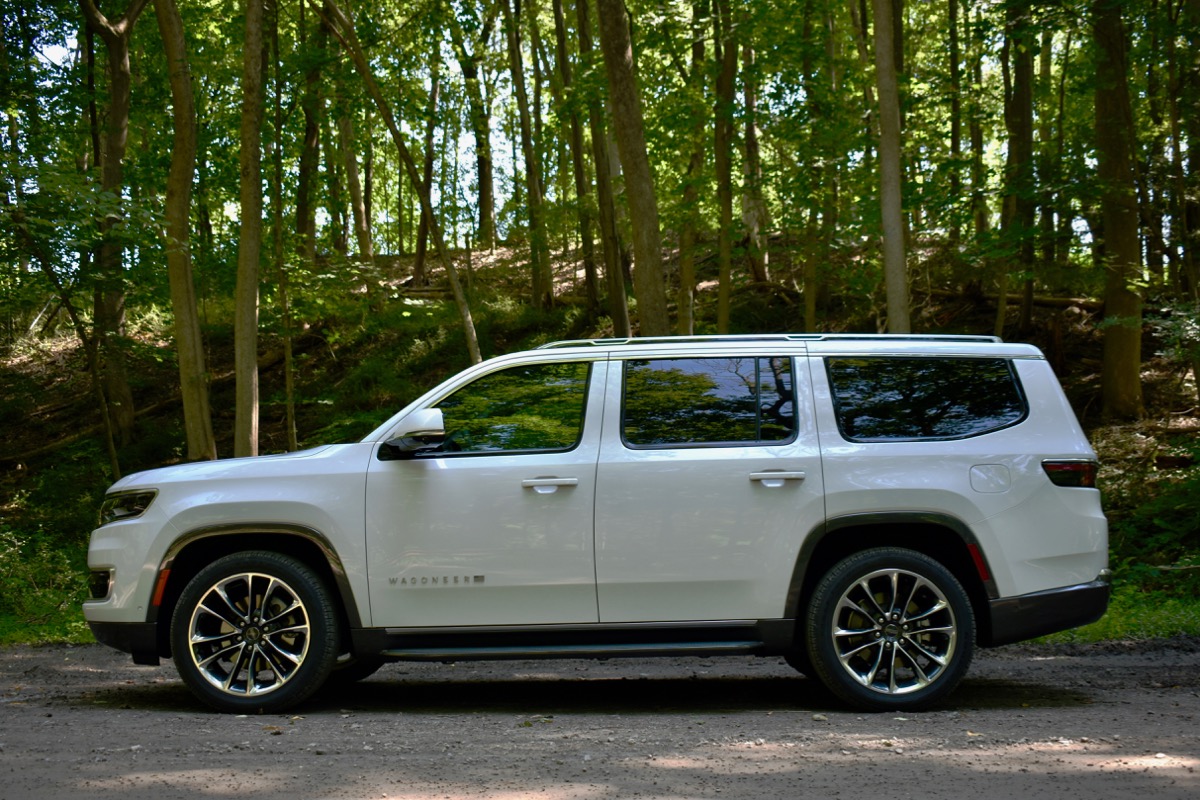
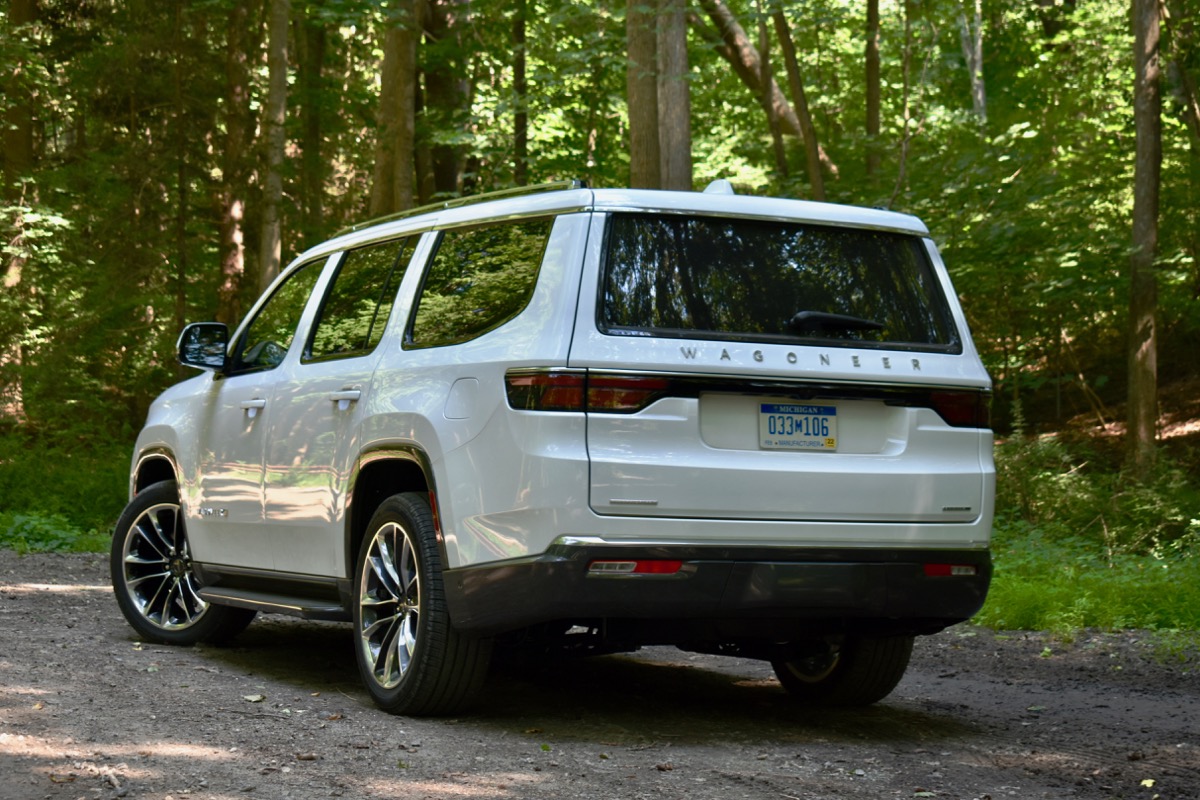
Jeep’s biggest SUV yet follows the same design theme as the smaller Grand Cherokee and Grand Cherokee L, with a high-mounted grille and LED headlights, a boxy profile, and trapezoidal wheel arches. If you’re looking for retro styling and callbacks to the original Wagoneer, you’ll be disappointed. You won’t find any wood paneling here, for example. Instead, the Wagoneer just looks like an enlarged Grand Cherokee
At launch, the Wagoneer will roll on standard 20-inch wheels, which actually look a bit small on this super-sized SUV with its 3,124 mm wheelbase. You’ll need to switch to 18-inch rims if you want the all-terrain tires that come with the off-road focused Advanced All-Terrain Group.
The Wagoneer rides on a new body-on-frame architecture designed to accommodate its independent front and rear suspension. Most cars and SUVs abandoned body-on-frame construction decades ago in favour of more efficient unibody designs, but it’s still the norm in this segment. While not a lightweight vehicle by any stretch of the imagination, the Wagoneer does save a few pounds with an aluminum hood and doors, as well as a composite tailgate.
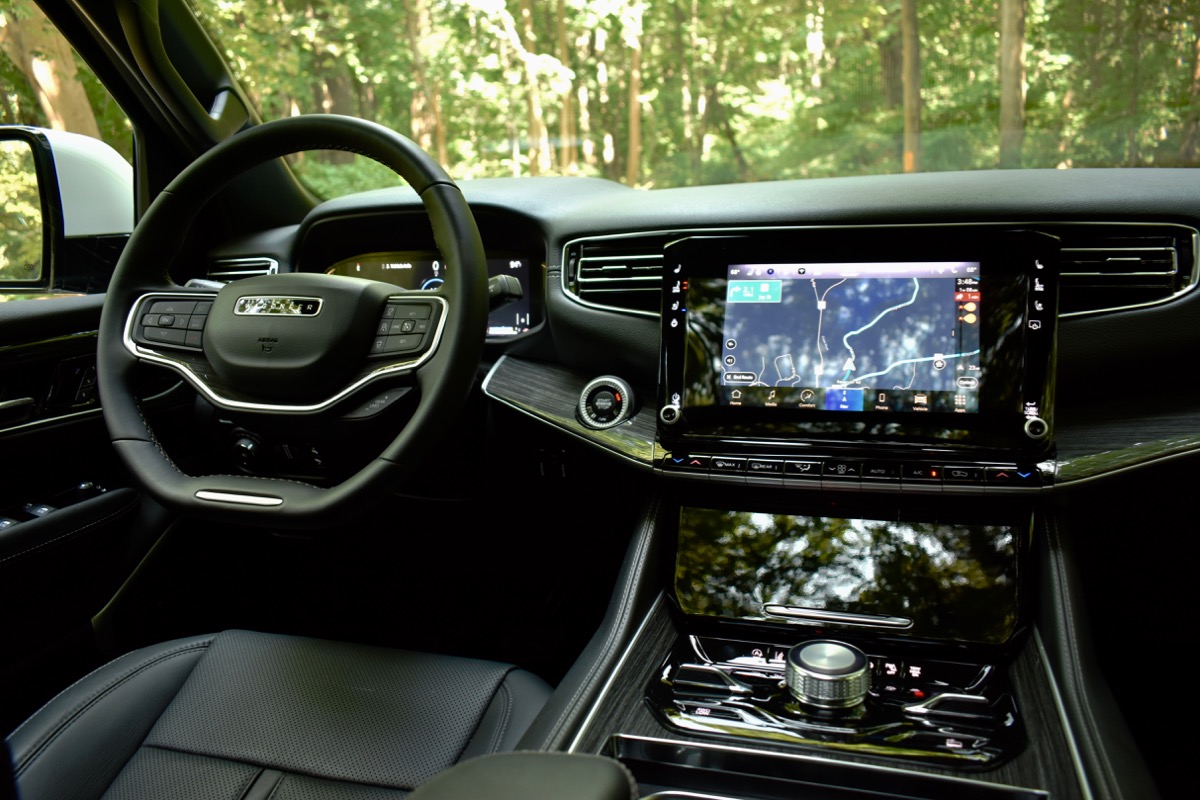
While the exterior is traditional SUV fare, the interior has a few interesting design details. The central touchscreen is nicely framed in the centre of the dashboard, with wing-like structures on either side of it. The engine start button stands proud of the dashboard, and features knurled detailing, giving it a high-quality appearance. Jeep also chose a two-spoke flat-bottom steering wheel, which was designed to be easy to hold comfortably during highway cruising, Dwayne Jackson, chief designer, Wagoneer and Grand Wagoneer interior, said.
However, overall material quality fell short of expectations for what is, ostensibly, a premium vehicle. While our test vehicle did have leather upholstery, we still saw plenty of glossy plastic that will likely scratch easily and show fingerprint smudges. The heavily lacquered wood trim also had an artificial feel. Overall, the Wagoneer felt like too big of a step down from the Grand Wagoneer, as if Jeep purposely cut corners to keep the Wagoneer from outshining its luxury SUV sibling.
Performance
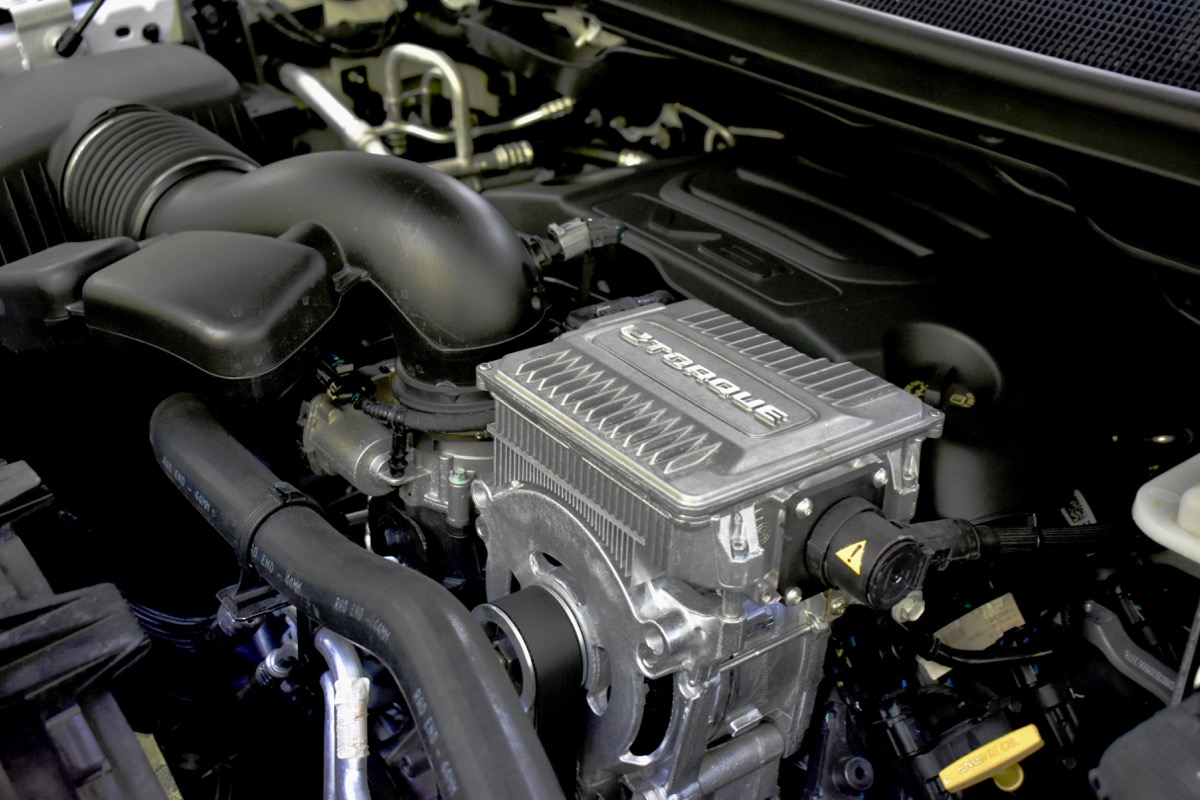
The Wagoneer is offered with a V8 mild-hybrid powertrain similar to the one used in the Ram 1500 pickup truck from Jeep’s sibling brand, Dodge. The 5.7-litre V8 produces power specs of 392 horsepower and 404 pound-feet of torque, while the eTorque mild-hybrid system uses 48-volt electrical architecture to increase fuel efficiency.
The key word here is “mild.” The eTorque system doesn’t allow the Wagoneer to drive on electric power alone, but it does enable a more robust engine start/stop system, which can shut off the engine for up to 10 minutes at a time while stationary, according to Jeep. The engine can also be shut off while coasting, and an integrated electric motor can provide up to 130 lb-ft of torque on initial throttle tip-in, Jeep claims. Electricity is accumulated through regenerative braking, and it's stored in a suitcase-sized battery pack located under the floor.
The Wagoneer has an eight-speed automatic transmission, with four-wheel drive (4WD) as standard in Canada (rear-wheel drive (RWD) is not offered), and an upgraded system as an available option. The entry-level Quadra-Trac I system found o the Series II uses a single-speed transfer case and is best suited to on-road driving. The Quadra-Trac II system on the Series III adds a two-speed transfer case for greater off-road capability.
Both systems get Jeep’s Selec-Terrain system, with five drive modes: Auto, Sport, Rock, Snow, and Sand/Mud. Also enhancing off-road capability is the optional Quadra-Lift air suspension system, which can raise the Wagoneer to provide up to 25.4 centimetres of ground clearance, lower it to reduce aerodynamic drag on highways, and even allow the big SUV to squat down for easier ingress and egress—like a city bus. With the air suspension raised to its maximum height, Jeep quotes a 25-degree approach angle, 24-degree departure angle, a 22-degree breakover angle, and the ability to ford 60 centimetres of water.
On the road, we were impressed by the quietness of the cabin and the responsiveness of the 5.7-litre Hemi V8 engine. The air suspension provided a comfortable ride, albeit with a lot of bounce and head toss over severe bumps. The Wagoneer’s body-on-frame construction created a notable shuddering sensation over bigger bumps, but that’s also the case with many competitor vehicles. The amount of body roll in corners was also typical of a big SUV, but we did wish for more precise steering, which can make some larger vehicles feel less intimidating. That wasn’t the case with the Wagoneer, which drives as big as it looks.
Due to its size, the Wagoneer doesn’t get Jeep’s “Trail Rated” badge, but it did pretty well on a short off-road course set up by the automaker during the launch drive. With Selec-Terrain in the appropriate mode, the Wagoneer clambered over piles of rocks, and drove through moguls with one wheel in the air. However, we did find the throttle a bit difficult to modulate (smooth throttle application is important for maintaining traction), and the Wagoneer’s sheer size will likely be a liability on tighter off-road trails.
Form & function
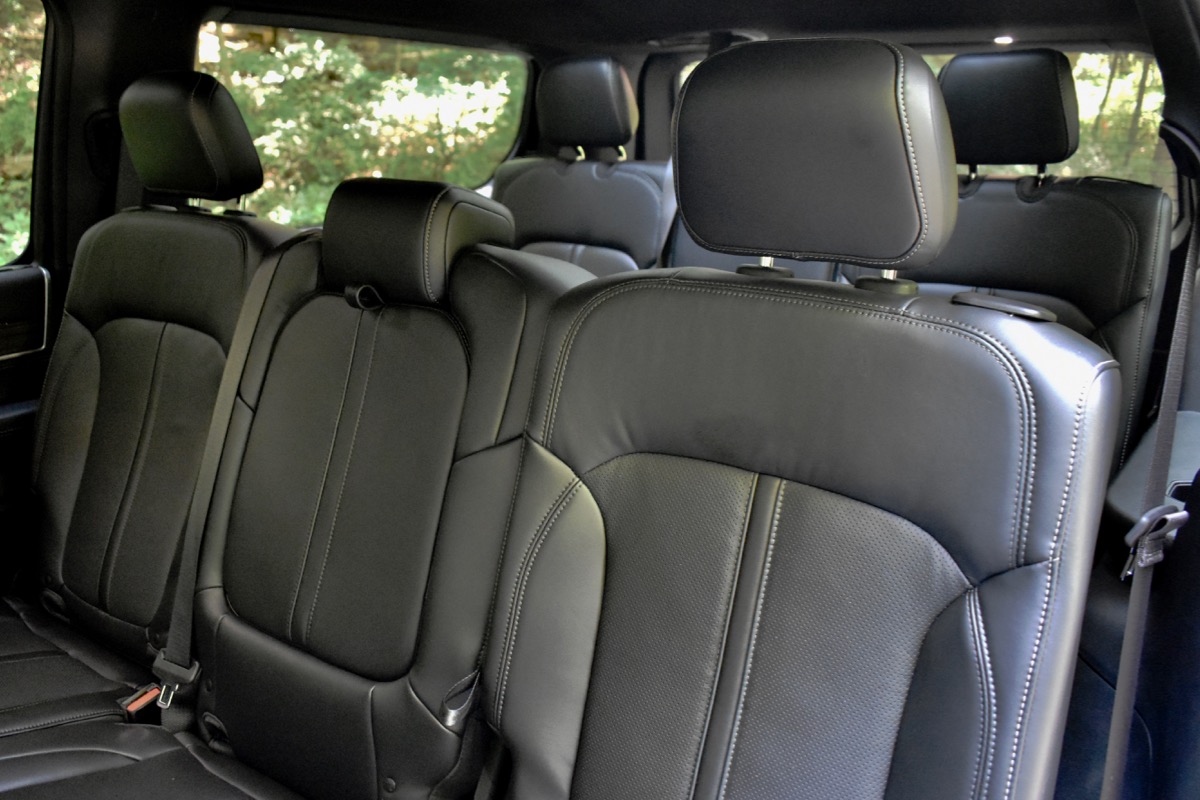
The three-row Wagoneer can seat up to eight people with the standard second-row bench, or seven with the optional second row captain’s chairs. Jeep seems to have prioritized second- and third-row space over space for the driver and front passenger.
Both of those rows offer more legroom than other full-size SUVs do, but the Wagoneer has the least front-seat legroom among its competitive set. It also has the most rear-seat headroom, and average second-row headroom, but less front-row headroom than the Chevy Tahoe or Ford Expedition.
Third-row seats typically eat into cargo space but, at 775 litres with the third row in place, the Wagoneer does better than other full-size SUVs. Fold the third row and you get 2,004 litres of cargo space, and the Wagoneer will swallow 3,304 litres of stuff with the second and third rows folded. Those are good numbers as well, but not enough to beat the Tahoe.
One area where Wagoneer owners will be able to unequivocally brag is towing. Jeep quotes a maximum towing capacity of 4,536 kilograms (10,000 pounds), which easily bests the Wagoneer’s competitors and also means this leather-lined Jeep can out-tow a base Ram 1500.
The first and second rows both get large storage bins, and our test vehicle also had a covered storage cubby below its touchscreen (this space is occupied by a second screen on Grand Wagoneer models). Forward visibility was hindered by the tall hood, but Jeep does at least offer a digital rearview mirror and 360-degree camera system to make maneuvering easier. Large mirrors helped as well, but we found they could create their own blind spots when turning.
Technology
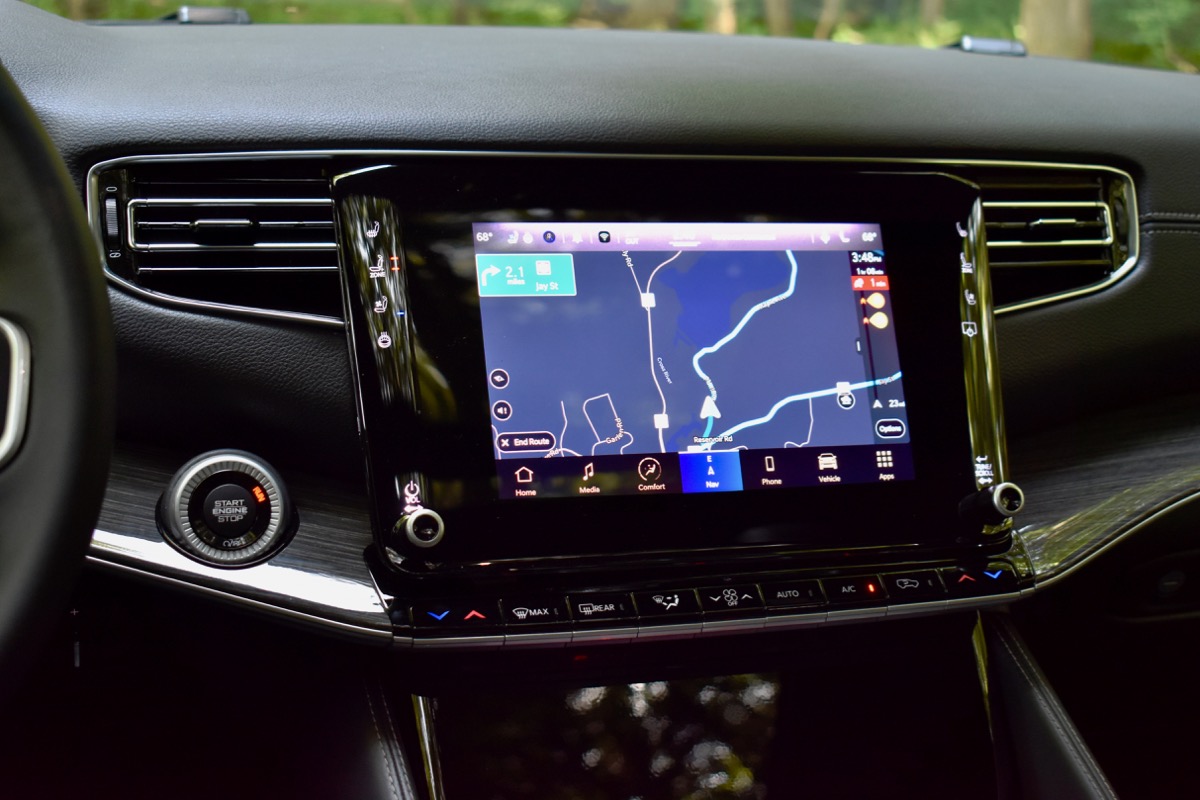
It may have a vintage name, but the Wagoneer is packed with tech. The standard infotainment system includes a 10.25-inch digital instrument cluster with 3D graphics, a 10.1-inch touchscreen, wireless Apple CarPlay/Android Auto, simultaneous pairing for two Bluetooth-enabled phones, and a 4G-LTE Wi-Fi hotspot that can support up to eight devices. A McIntosh audio system, standard on the Jeep Grand Wagoneer, is an optional upgrade for the Wagoneer Series III.
The Wagoneer can also be equipped with up to 11 USB ports and a separate 10.25-inch touchscreen that allows the front passenger to control things like navigation and the optional rear-seat entertainment system. As if that wasn’t enough, you can also get a 10-inch head-up display.
The Uconnect infotainment systems used by Jeep and other Stellantis brands have been some of the easiest to use in the business. The Wagoneer gets the latest Uconnect 5 version, with an Android-based operating system and over-the-air (OTA) software updates. We liked the layout of the touchscreen’s menus, but the screen in our test vehicle was a bit slow, and the graphics for the digital gauge cluster seemed a bit plain. The head-up display was easy to read even on a bright sunny day, however.
Safety
Crash-test ratings from the Insurance Institute for Highway Safety (IIHS) and National Highway Traffic Safety Administration (NHTSA) aren’t available yet, as the Wagoneer is a newly launched model.
Standard driver-assist tech includes automatic emergency braking (with pedestrian and cyclist detection), adaptive cruise control (with stop-and-go functionality), lane-keep assist, blind-spot monitoring, rear cross-traffic alert, and rear parking sensors.
Cost-effectiveness
Even with the mild-hybrid system, Natural Resources Canada fuel consumption ratings for the 2022 Jeep Wagoneer aren’t spectacular. The Wagoneer is rated at 13.8 litres per 100 kilometres combined (15.6 city, 11.7 highway) with 4WD.
Jeep offers a three-year, 60,000-kilometre, limited warranty and five-year, 100,000-kilometre, powertrain warranty.
Launch pricing starts at $80,495 for a Series II model (destination charges range from $1,895 to $2,795 and are extra). Pricing climbs to $86,495 for the range-topping Series III.
Our Series II test vehicle had a few options, including 22-inch wheels (available only with the $3,995 Premium Group), the Convenience Group, and a towing package, bringing the as-tested MSRP to $93,775 including destination fees. With pricing like that, the Wagoneer is a poor value compared to other full-size SUVs, most of which offer at least one lower-priced configuration.
While the original Jeep Wagoneer helped define the modern SUV, its 21st century successor is merely one good full-size SUV among many. The 2022 Jeep Wagoneer boasts impressive towing capability, lots of tech features, a solid powertrain, comfortable rides, and off-road capability worthy of the Jeep badge. But it’s not a game changer, nor does it live up to the premium aspirations Jeep has set for it.
Current owners who have outgrown their Jeep Grand Cherokees will not be disappointed, and new-car buyers who choose a Wagoneer over a Ford Expedition, Chevrolet Tahoe, Nissan Armada, or the aging Toyota Sequoia will still get a very capable SUV. But buyers who stick with those established rivals won’t be missing out on much, either.
Note: Images show a US model.

What owners say
"Overall, drivers are really impressed with the 2022 Jeep Wagoneer, often highlighting its spacious interior and comfort, especially for larger families. Many reviewers appreciate the advanced technology and luxurious feeling, particularly praising the comfort of the third row seats. However, some noted that trunk space could be a bit limited compared to competitors like the Yukon XL. Overall, many feel it's a fantastic choice for a comfortable and well-equipped SUV."
Everything I could’ve imagined and more! Impeccable inside and out and very smooth ride! Glad with the purchase!
March 9, 2026Probably my favorite car I’ve ever owned and I’ve had a lot of SUVs - Tahoe, Yukon, jeep grand Cherokee, explorer , now wagoneer!
December 24, 2022Great vehicle. All of the newest technologies. But the greatest of all is the 3rd row seat. Sitting in the 3rd row is like sitting in the second or even front row. A real seat.
August 26, 2022What owners say
Everything I could’ve imagined and more! Impeccable inside and out and very smooth ride! Glad with the purchase!
March 9, 2026Probably my favorite car I’ve ever owned and I’ve had a lot of SUVs - Tahoe, Yukon, jeep grand Cherokee, explorer , now wagoneer!
December 24, 2022Great vehicle. All of the newest technologies. But the greatest of all is the 3rd row seat. Sitting in the 3rd row is like sitting in the second or even front row. A real seat.
August 26, 2022The Wagoneer is a great hidden gem in this market. It offers almost every option available and drives like a dream.
November 2, 2024We have 5 children (14, 12, 11, 9 & 6) this car is great on leg space. Our oldest is 6’2” - this is the car for a tall family (we are 6’1” and 5’10”). There isn’t a lot of trunk space like a Yukon XL but we prefer our kids ride in comfort and scarified trunk space. We had a Yukon Denali XL and this by far is much nicer in our opinion. It’s well worth a test drive, you’ll love it!
July 16, 2022Trims & specs
Base MSRP $58,995 | Seating 8 |
Engine N/A | Cargo Capacity 27.4 cu ft |
Combined MPG N/A | Drivetrain N/A |
Base MSRP $76,190 | Seating 8 |
Engine 5.7L 392 hp V8 | Cargo Capacity 27.4 cu ft |
Combined MPG 17 | Drivetrain 4X4 |
Base MSRP $81,190 | Seating 8 |
Engine 5.7L 392 hp V8 | Cargo Capacity 27.4 cu ft |
Combined MPG 17 | Drivetrain 4X4 |
Base MSRP $67,490 | Seating 8 |
Engine 5.7L 392 hp V8 | Cargo Capacity 27.4 cu ft |
Combined MPG 17 | Drivetrain 4X4 |
Base MSRP $73,945 | Seating 8 |
Engine 3.0L 420 hp I6 | Cargo Capacity 27.4 cu ft |
Combined MPG 19 | Drivetrain 4X4 |
Base MSRP $64,490 | Seating 8 |
Engine 5.7L 392 hp V8 | Cargo Capacity 27.4 cu ft |
Combined MPG 19 | Drivetrain 4X2 |
Base MSRP $73,190 | Seating 8 |
Engine 5.7L 392 hp V8 | Cargo Capacity 27.4 cu ft |
Combined MPG 19 | Drivetrain 4X2 |
Base MSRP $78,190 | Seating 8 |
Engine 5.7L 392 hp V8 | Cargo Capacity 27.4 cu ft |
Combined MPG 19 | Drivetrain 4X2 |
Base MSRP $63,945 | Seating 8 |
Engine 3.0L 420 hp I6 | Cargo Capacity 27.4 cu ft |
Combined MPG 20 | Drivetrain 4X2 |
Base MSRP $61,995 | Seating 8 |
Engine 5.7L 392 hp V8 | Cargo Capacity 27.4 cu ft |
Combined MPG 17 | Drivetrain 4X4 |
Base MSRP $66,945 | Seating 8 |
Engine 3.0L 420 hp I6 | Cargo Capacity 27.4 cu ft |
Combined MPG 19 | Drivetrain 4X4 |
Base MSRP $71,810 | Seating 8 |
Engine 3.0L 420 hp I6 | Cargo Capacity 27.4 cu ft |
Combined MPG 20 | Drivetrain 4X2 |


Pricing trends
MSRP range
$58,995 - $81,190
Current avg. market price
$47,911
Trending down by 1.6% this month
May 2026 - October 2026

