2022 Jaguar F-PACE Reviews, Pricing & Specs

Expert review
The 2022 Jaguar F-Pace SUV is a stylish but flawed addition to this hugely popular class of vehicle.
There was a time when the notion of a Jaguar SUV would cause much harrumphing and the displacement of monocles. The stalwart British automaker has traditionally been known for sports cars and fast-yet-luxurious sedans, but market trends demanded an SUV. So, the 2022 Jaguar F-Pace tries to channel the spirit of previous Jags into a high-riding utility vehicle package.
The Jaguar F-Pace arrived for the 2016 model year as Jaguar’s first SUV (it’s since been joined by the smaller E-Pace and all-electric I-Pace). It thus introduced Jaguar’s “Pace” naming convention for SUVs, derived from the brand’s old marketing tagline “grace, pace, and space.” That’s fitting because, to succeed and keep star-crossed Jag alive, the F-Pace needs all three.
This crossover SUV has done wonders for Jaguar’s bottom line, but it still faces tough competition from rivals like the Audi Q5, BMW X3, Mercedes-Benz GLC-Class, and Volvo XC60, as well as the newcomer Genesis GV70. To help distinguish it from the wares of sibling brand Land Rover, the F-Pace focuses more on sporty driving dynamics than off-road capability.
Following a major update for the 2021 model year, the F-Pace rolls into 2022 essentially unchanged. The F-Pace lineup includes a base four-cylinder powertrain (in P250 S configuration), a V6 mild-hybrid powertrain, (available in the F-Pace P340 S and P400 R-Dynamic S variants) and the V8-powered Jaguar F-Pace SVR performance model. We tested a mid-level F-Pace P340 S.
out of 10 expert review
Look & feel
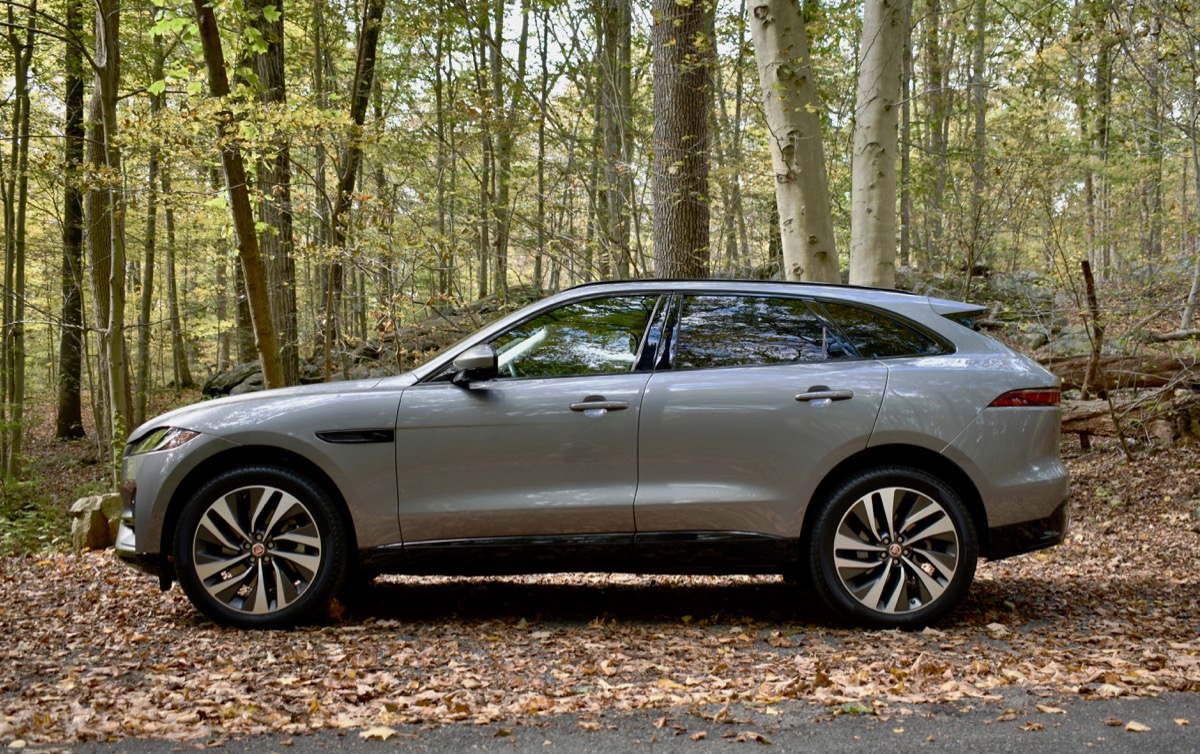
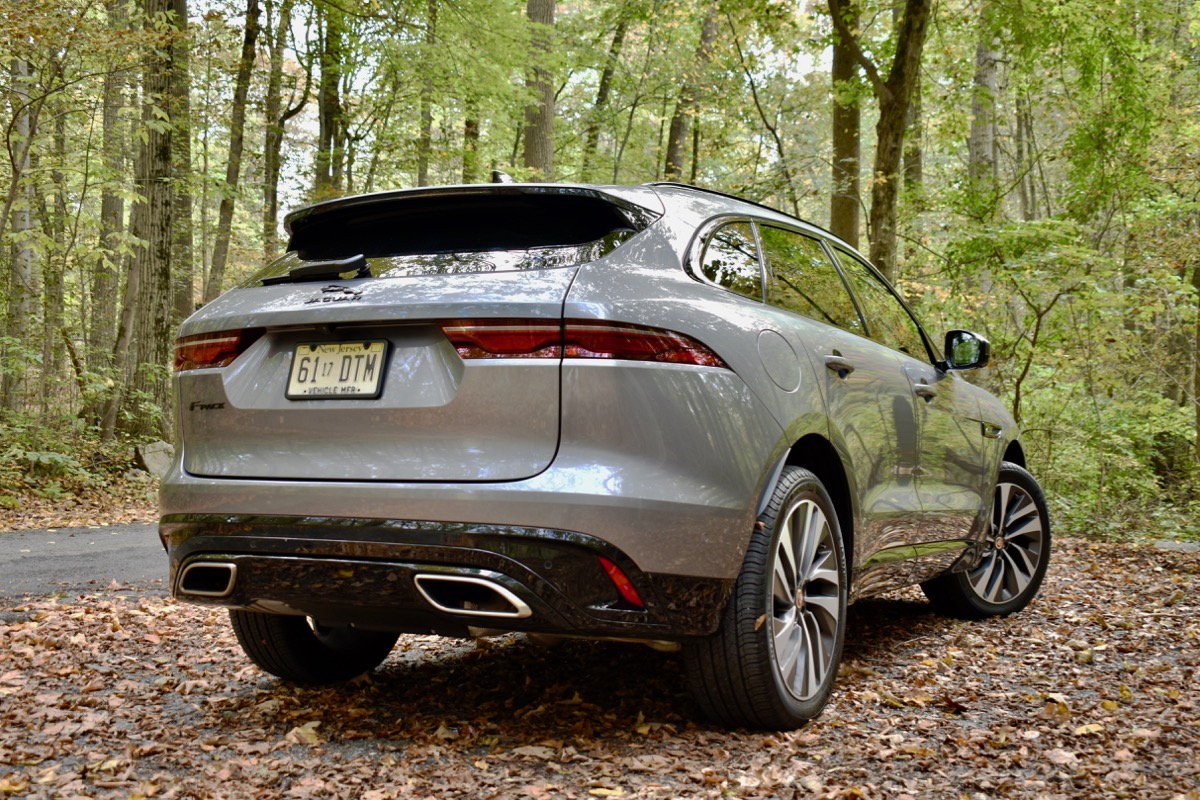
The exterior styling works very to hard to communicate that this is a Jaguar. Despite the very different body style, the familial resemblance with the Jaguar XF sedan and F-Type sports car is strong. The front fascia is a puffed-up version of the XF’s, as if the sedan was experiencing an allergic reaction. The taillights look they were taken straight off the F-Type and grafted onto the F-Pace’s liftgate.
The styling emphasizes that the F-Pace is a Jaguar first and an SUV second, which makes sense given Jaguar’s need to attract SUV-hungry new customers without diluting its brand identity. It also makes for a handsome SUV. The F-Pace looks sporty without resorting to the oversized grille and overwrought bodywork of some competitors. However, since the F-Pace’s launch some automakers have copied the Jag’s sharply tilted rear window and low rooflines, making it look less distinctive today.
The F-Pace gets 19-inch wheels as standard equipment, but 21-inch wheels are available. They filled out the wheel wells of our F-Pace P340 S test car nicely. The F-Pace SVR also gets some model-specific styling features, mostly related to the needs of its larger engine. Larger front air intakes and SVR-specific hood vents aid in cooling, while providing real aerodynamic benefits, according to Jaguar. Changes made for the 2021 model year reduce lift by 35%, and give the SVR a drag coefficient of 0.36, according to the automaker.
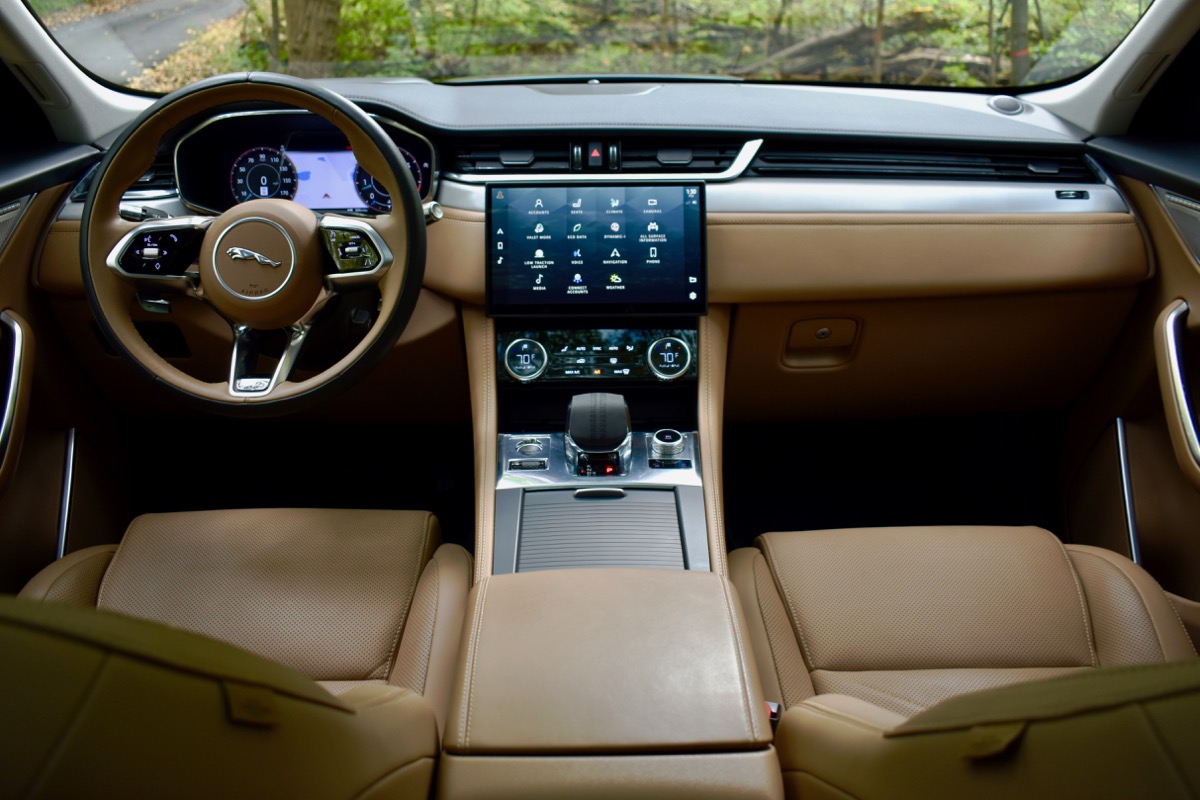
Like the exterior, the interior seems designed to make you think you’re in one of Jaguar’s other models. The high window line, angled dashboard, and tall centre console create a more enclosed feeling than you typically get in SUVs. It seemed like Jaguar was trying to make the F-Pace’s driving position more like that of a sports car, but it made for an odd combination with the F-Pace’s tall ride height. The setup also hindered outward visibility, which wasn’t helped by small (but admittedly stylish) exterior mirrors.
Other design touches stood out, including the clean touchscreen integration and available ambient lighting. However, the lighting elements don’t go all the way across the dashboard, which was noticeable at night when everything else was lit up. And while overall material quality was satisfactory, the strips of grained metallic plastic in our midlevel test car looked a bit cheap.
Performance
The F-Pace gets standard all-wheel drive (AWD) and all models use an eight-speed automatic transmission, but the drivetrain can be coupled to three very different engines.
Base models get a 2.0-litre turbo four-cylinder engine, which produces power specs of 246 horsepower and 269 pound-feet of torque. That’s enough for zero to 100 kilometres per hour in 7.3 seconds, and a top speed of 217 km/h, according to Jaguar.
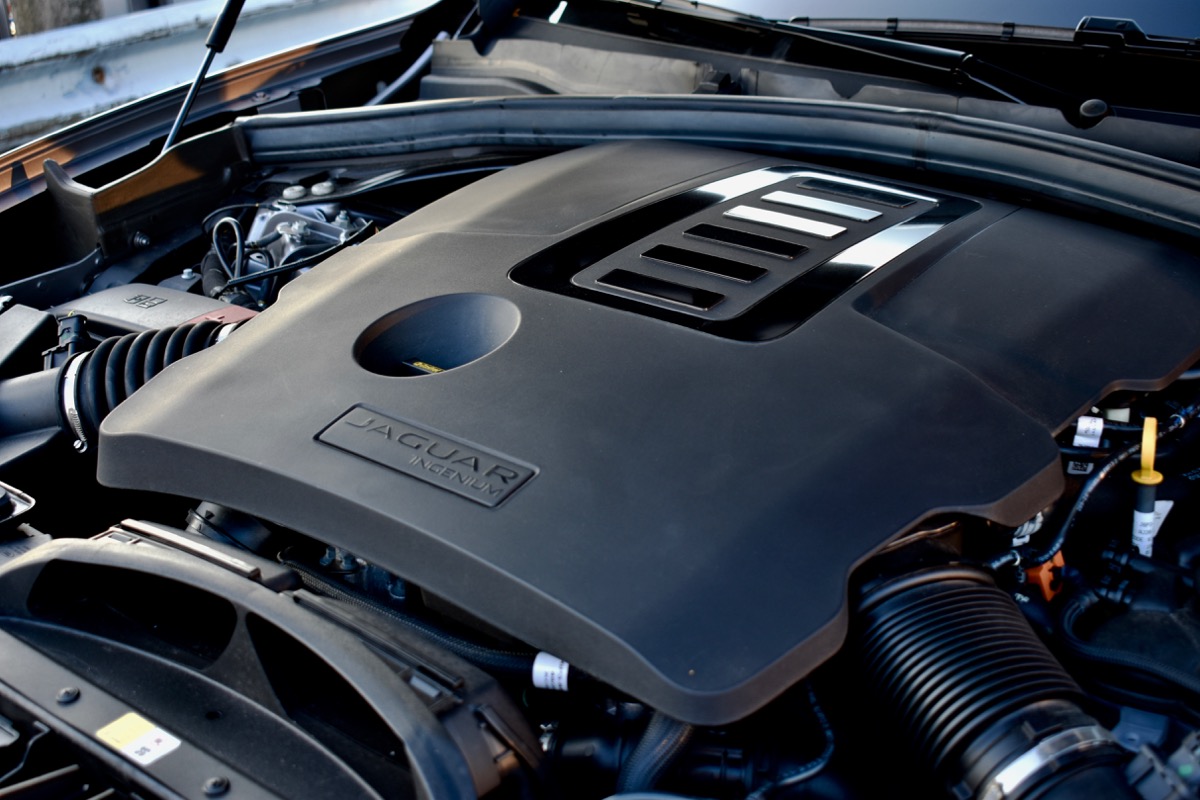
The P340 S and P400 R-Dynamic S models use a mild-hybrid powertrain, consisting of a 3.0-litre turbocharged and electric supercharged V6, plus a small electric motor that provides a brief burst of extra power when setting off, and enables a more aggressive engine start/stop system. The P340 S is tuned for 340 hp and 354 lb-ft of torque, does zero to 100 km/h in 6.1 seconds, and has a 240 km/h top speed, per Jaguar. The F-Pace R-Dynamic S gets a power bump to 400 hp and 405 lb-ft, allowing for a 5.4-second zero to 100 km/h time and 250 km/h top speed.
Finally, the high-performance F-Pace SVR has a 5.0-litre supercharged V8 producing 550 hp and 516 lb-ft of torque. That will get it from zero to 100 km/h in 4.0 seconds and on to a top speed of 286 km/h, Jaguar boasts. That's not bad for something with a 2,133-kilogram (roughly 4,700-pound) curb weight, and means the F-Pace SVR can outrun a Porsche Macan GTS. The Jag is a fraction of a second behind the Alfa Romeo Stelvio Quadrifoglio in the zero to 100 km/h sprint, but has a slight advantage in top speed.
We didn’t get to test out the SVR, which is a low-volume model that most F-Pace buyers won’t opt for. That’s a shame, because our more mainstream F-Pace P340 S test car didn’t offer the satisfaction its rakish bodywork suggested.
While mild-hybrid systems are primarily about improving fuel efficiency, they often provide a nice kick of electric-motor torque when accelerating away from stops. That wasn’t the case here, however, as the F-Pace didn’t really seem to make up until its gasoline engine built up some revs. The throttle was also difficult to modulate, as it had a lot of extra travel. The brake pedal had the same problem; the first bit of pedal travel didn’t seem to do anything.
We felt a similar lack of precision in the steering and suspension. It was unusually difficult to make small steering corrections, making it difficult to corner smoothly. While the suspension did a good job of soaking up bumps, the F-Pace never seemed settled. Even slight road imperfections set off suspension wobbles, and every steering input seemed to cause a bit of body roll.
The F-Pace’s quiet cabin and well-damped ride made our first few minutes of driving enjoyable, but these issues eroded that good feeling. Some luxury SUVs struggle to be both sporty and comfortable, but the F-Pace P340 S seemed unable to do either. The F-Pace SVR at least throws out some impressive specifications for an SUV but, again, it’s not representative of most of the F-Pace lineup.
Form & function
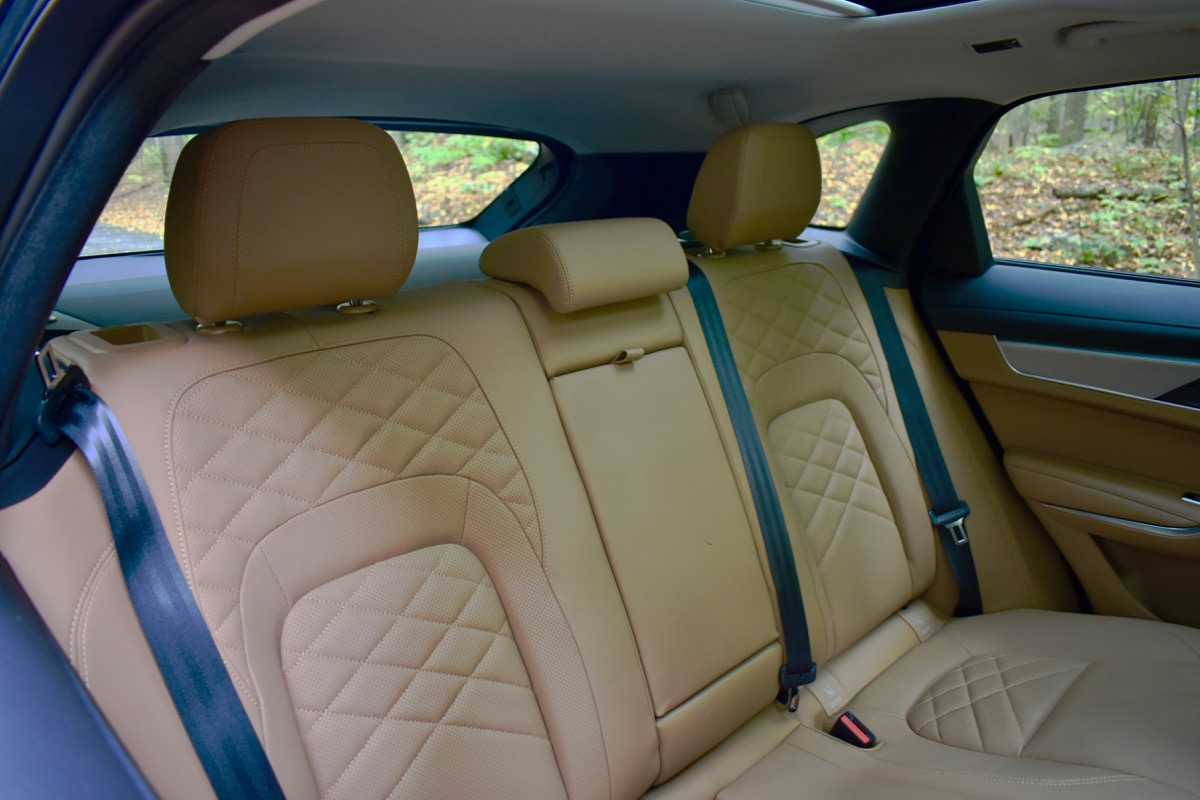
The F-Pace has below average headroom for its market segment, which isn’t surprising considering the low roofline and Jaguar’s decision to fit a panoramic sunroof in many trim levels. The F-Pace has the same front legroom as a BMW X3, but that means drivers get less room than in an Audi Q5 or Mercedes-Benz GLC-Class. Rear-seat legroom is about average.
The numbers don’t convey how cramped the front seats felt, even for occupants of average height. The low roof, bulky centre console, and thick door cards are likely to blame for this, although they do at least provide plenty of potential armrest space.
Given the size of the centre console, and Jaguar’s use of a small electronic shifter for the 8-speed automatic, we also expected more interior storage space. The console bin is fairly small, and there isn’t much space to put things elsewhere. The console is quite high, and some automakers with similar designs have found space for storage underneath. Jaguar only provided a small pocket where items will be easily forgotten.
Jaguar quotes 613 litres of cargo space with the rear seats in place, which is more than a Q5, GLC, or Volvo XC60, but less than an X3, Acura RDX, or Genesis GV70. Jaguar lists a 1,440-litre capacity with the rear seats folded. The cargo area seemed a bit narrow, and the lift-over height might make loading and unloading heavy objects difficult. A power liftgate is available, though.
Jaguar quotes a maximum towing capacity of 2,400 kilograms (5,291 pounds) for all F-Pace models. That’s more than reasonable for a crossover of this size.
Technology
The base F-Pace P250 S comes standard with an 11.4-inch touchscreen, Apple CarPlay/Android Auto connectivity, SiriusXM satellite radio, Bluetooth, wireless phone charging and a 14-speaker Meridian sound system. However, the P250 runs the more basic Pivi infotainment system. Higher trim levels get Jaguar Land Rover's latest Pivi Pro system, which adds simultaneous Bluetooth pairing for two phones and what Jaguar claims is a simplified menu structure.
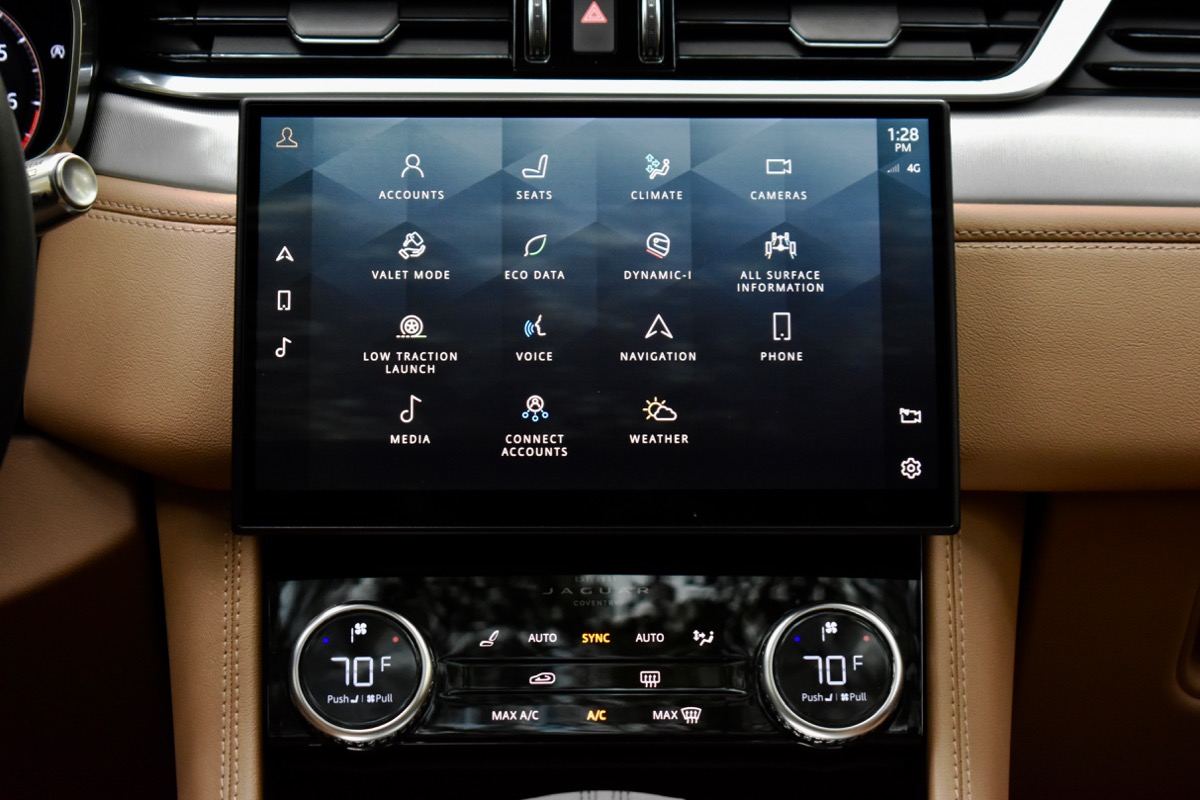
Our test car had the Pivi Pro system, as well as the optional 12.3-inch digital instrument cluster and head-up display. We were impressed by the graphics of both the instrument cluster and touchscreen but found menus unnecessarily difficult to navigate.
While most tasks didn’t require many steps, finding the right menu or icon took some trial and error. This was especially true of the climate-control interface, which requires using both the touchscreen and a set of knobs on a panel below. That panel also had labels that looked like buttons, but actually denote features that need to be accessed through the screen. The whole setup looked pretty cool when turned on, but all of that black plastic will likely smudge and scratch easily.
The voice recognition system was also a bit clunky. It required more specific prompts than comparable systems from BMW or Mercedes. Using it also pulled up an on-screen menu, which seems to defeat the purpose of voice control.
Safety
Crash-test ratings from the Insurance Institute for Highway Safety (IIHS) and National Highway Traffic Safety Administration (NHTSA) weren’t available at the time of publication.
Like most luxury brands, Jaguar isn’t particularly generous when it comes to standard driver assistance features. The F-Pace gets standard lane-keep assist, blind-spot monitoring, rear cross-traffic alert, safe exit monitor, and traffic sign recognition, but you’ll have to upgrade from the base model to get adaptive cruise control—a feature that’s standard on a Toyota RAV4.
Cost-effectiveness
Natural Resources Canada fuel consumption ratings for the F-Pace weren’t available at the time of publication.
Jaguar offers a four-year, 80,000-kilometre, new-vehicle warranty.
The 2022 F-Pace starts at an MSRP of $61,600 base price (not including a mandatory $2,876 destination charge). The V8-powered 2022 F-Pace SVR starts at $98,400, with the V6 P340 S and P400 R-Dynamic S models priced in between.
As with most other luxury vehicles, you will have to pay extra to get the features that really set the F-Pace apart from non-luxury SUVs.
Most of the F-Pace’s competitors are poor value propositions as well (the Genesis GV70 being a notable exception). The Jaguar’s styling helps it stand out, but rivals offer more substance. The Acura RDX and BMW X3 are nicer to drive, the Mercedes-Benz GLC-Class and Volvo XC60 do traditional luxury better, and the Audi Q5 offers a better tech interface.
Nothing about the F-Pace is catastrophically bad, but its many small flaws add up to an underwhelming whole. A luxury vehicle needs to do better.
Note: Images show a US model.

What owners say
The vehicle features are amazing im still trying to figure it out ,that's because I haven't read the owners manual yet lol. Exceptional vehicle
December 10, 2025The ride is great . the computer with the nav, radio,phone is a bit complicated. The doors do not lock by themselves. The air cool seats are great. THE seats are comfortable. I compare it to my old cadi.
September 11, 2022Trims & specs
Base MSRP N/A | Seating N/A |
Engine N/A | Cargo Capacity N/A |
Combined MPG N/A | Drivetrain N/A |
Base MSRP $54,000 | Seating 5 |
Engine 2.0L 246 hp I4 | Cargo Capacity 31.5 cu ft |
Combined MPG 24 | Drivetrain AWD |
Base MSRP $50,900 | Seating 5 |
Engine 2.0L 246 hp I4 | Cargo Capacity 31.5 cu ft |
Combined MPG 24 | Drivetrain AWD |
Base MSRP $59,600 | Seating 5 |
Engine 3.0L 335 hp I6 | Cargo Capacity 31.5 cu ft |
Combined MPG 23 | Drivetrain AWD |
Base MSRP $86,600 | Seating 5 |
Engine 5.0L 550 hp V8 | Cargo Capacity 31.5 cu ft |
Combined MPG 18 | Drivetrain AWD |
Base MSRP $65,500 | Seating 5 |
Engine 3.0L 395 hp I6 | Cargo Capacity 31.5 cu ft |
Combined MPG 22 | Drivetrain AWD |


Pricing trends
MSRP range
$50,900 - $86,600
Current avg. market price
$44,737
Trending up by 1.6% this month
May 2026 - November 2026

