2022 Chevrolet Blazer Reviews, Pricing & Specs
Write a review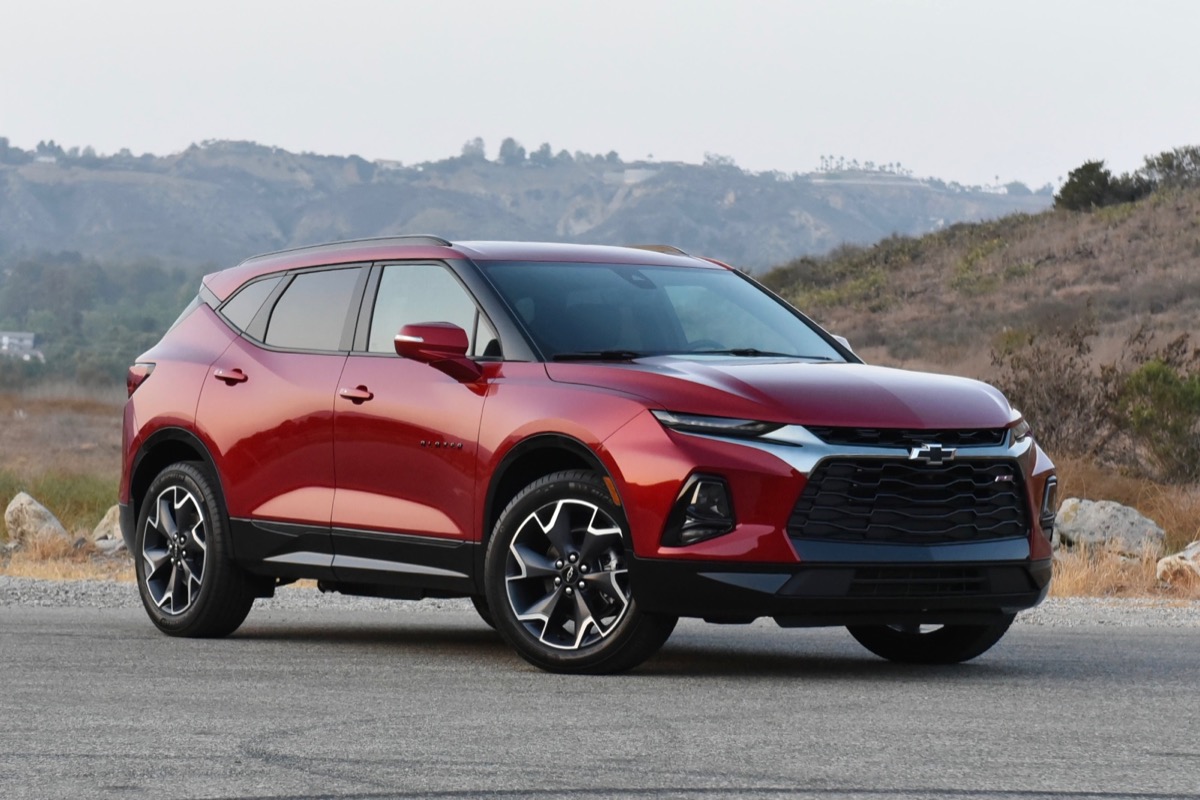
There isn’t much that’s wrong with the 2022 Chevrolet Blazer. But aside from its styling and approachable tech, there isn’t much compelling about it, either.
In Canada, Chevrolet offers the 2022 Blazer in LT, True North, Premier, and RS trim levels. The LT has a standard turbocharged four-cylinder engine and front-wheel drive (FWD) or available all-wheel drive (AWD). Other Blazer grades includes a standard V6 engine and AWD. The RS grade’s AWD system uses a more sophisticated twin-clutch design for improved responsiveness on low-traction surfaces.
For the 2022 model year, the Chevy Blazer sees few changes. Blazer Premier versions look a little different thanks to revised bumper and bodyside trim and redesigned standard wheels. Two-tone paint is now available for the LT and RS trim levels.
Blazer MSRPs range from $37,498 to $47,598, not including the $1,900 destination charge to ship it north from Ramos Arizpe, Mexico, where it is built. Our Chevrolet Blazer RS test vehicle arrived with extra-cost paint and several packages. The price tallied up to $53,358, including the destination charge (Canadian, estimated).
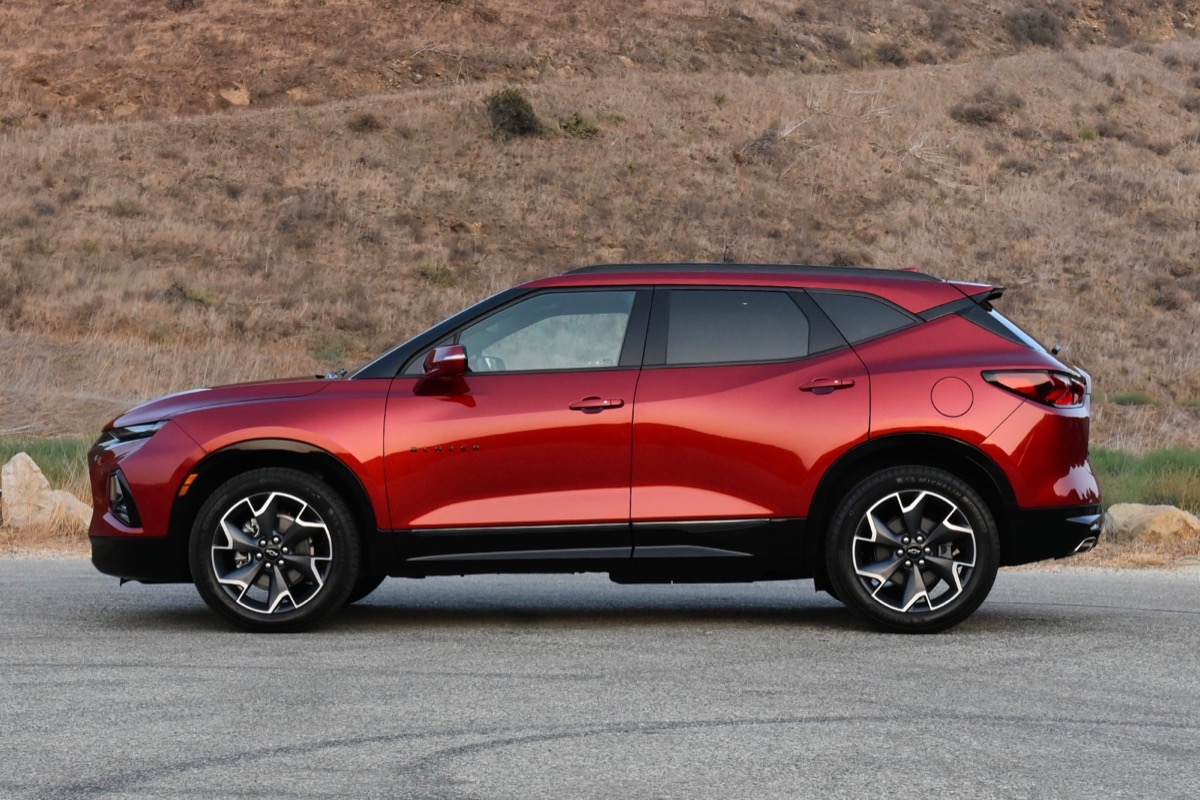
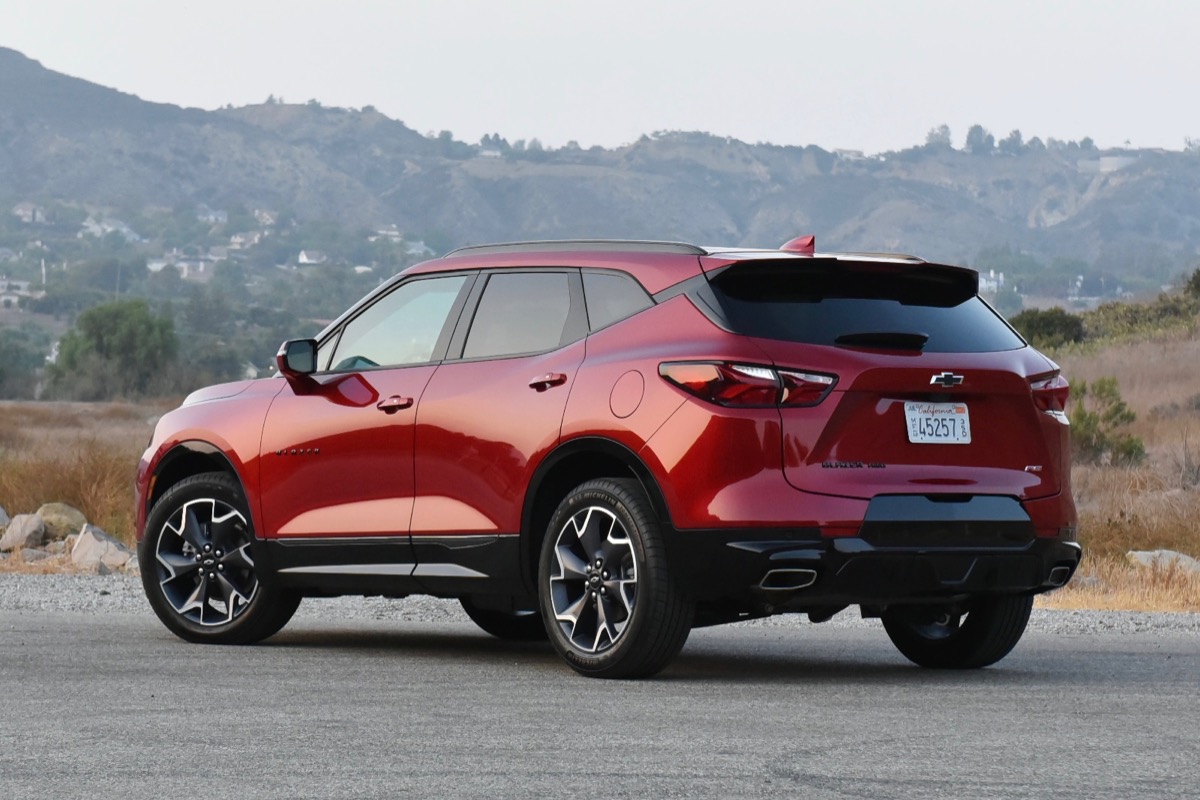
Featuring Camaro inspired design inside and out, the 2022 Blazer is appealing to our eyes. The key is to get one with 20-inch wheels, which is easy enough to do. The one bit of weirdness to the Blazer’s styling is the black trim that rises from the lower rear bumper and into the bottom of the liftgate. It looks like a big plastic tongue licking the bottom of the liftgate, or the automotive equivalent of a fat lip after taking a punch. Either way, it gives the SUV an unfinished appearance.
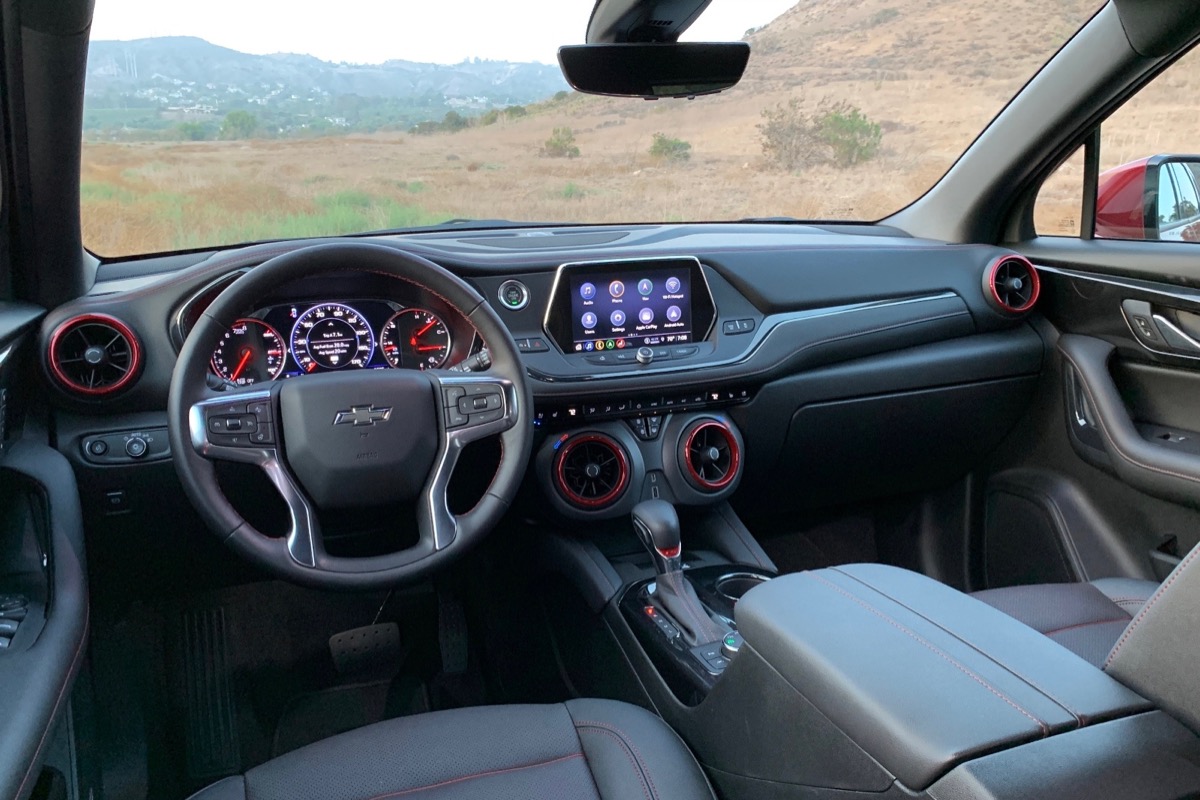
Inside, hints of the Camaro manifest themselves in the infotainment and climate control systems. The 8-inch touchscreen display has simple physical controls beneath it, while large round centre air vents feature innovative temperature adjustment rings. A strip of climate buttons resides over the air vents. Everything is easy to find and use.
There is plenty of hard plastic inside of the Blazer, another reminder of the Camaro. In fact, in our test vehicle, the upper door panel trim was egregiously hard instead of soft. At least it had a low-gloss coating on it.
One appealing thing about the Blazer RS, especially if the outside is painted Cherry Red Tintcoat like the test car, is that the red interior accents match the exterior paint. That includes the exposed stitching, air vent trim, and piping on the perforated leather seats. Overall, the test vehicle’s colour scheme added a layer of sophistication to the Blazer.
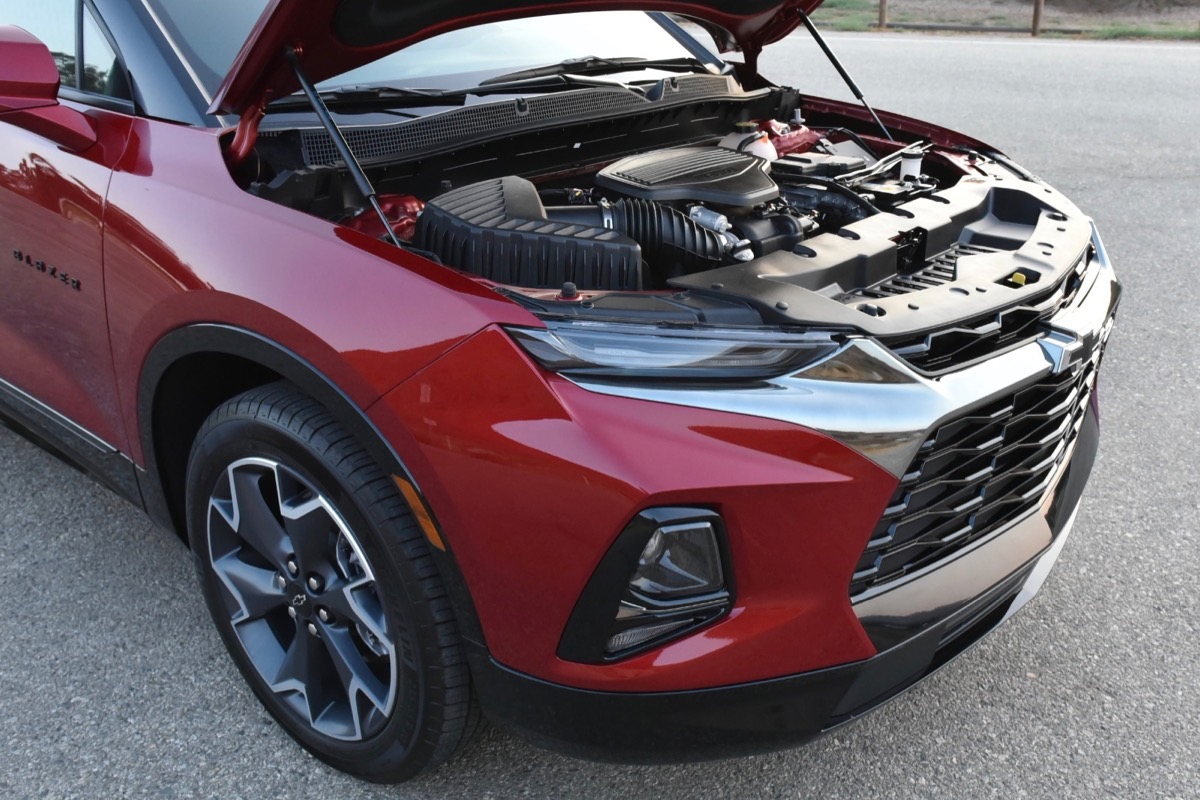
The 2022 Blazer LT has a standard 2.0-litre turbocharged four-cylinder engine generating 228 horsepower and 258 pound-feet of torque. A nine-speed automatic transmission powers the front or all four wheels, and drivers can choose between Tour, Sport, Slippery, and Tow/Haul driving modes. Remote engine starting is available.
Higher grades come with a standard 3.6-litre V6 engine, which is also available on the LT. It whips up 308 hp and 270 lb-ft of torque, fed to all four wheels through a nine-speed automatic transmission. Only the RS trim pairs it with a more sophisticated dual-clutch AWD system. The V6 offers the same driving modes and remote engine starting as the turbo-four, and it can tow up to 2,040 kilograms (4,500 pounds). That’s over 450 kilograms (1,000 pounds) more than the base engine.
When driven in the city and suburbs or on highways, the Blazer RS feels firm and sporty. The V6 engine supplies satisfying acceleration, though it frequently sounds loud and unrefined. Grip is decent thanks to the 20-inch wheels and tires, and as long as you’re not in Sport mode, the steering feels good in your hands without any unnecessary weight. The brakes are capable, too.
The Blazer RS’s styling and power might inspire you to drive it with some enthusiasm on a favourite back road. Here, the SUV is less pleasing. It bounds around too much on its suspension, and even in Sport mode, the nine-speed automatic is too slow to downshift when powering out of a curve. This is especially true when you’re heading up a hill after exiting the curve.
Furthermore, in Sport mode, the steering takes on an obnoxiously artificial sense of heft, and in higher-speed constant radius curves, it fights against the driver in a bid to return to centre.
Though it is perfectly agreeable to drive in the areas where most people spend most of their time, the Blazer’s styling promises a level of driving dynamism that simply doesn’t exist. Approach the SUV with low expectations and you’ll probably be happiest behind its steering wheel.
According to official Natural Resources Canada fuel consumption ratings, our Blazer RS AWD should’ve burned 11.0 litres per 100 kilometres in combined driving. We averaged 11.5 L/100 km on the testing loop while using FWD mode. However, heavy pre-holiday traffic likely suppressed the Blazer’s efficiency.
Just as the Blazer is agreeable to drive in typical situations, it’s reasonably comfortable and useful. Our RS test vehicle’s black leather upholstery with red perforations wouldn’t win any awards for quality, but it looked good and lent the Blazer’s cabin a sporty appearance.
The steering wheel is pleasing to grip, and the test vehicle had power tilt and telescopic adjustment as well as heating for chilly weather. Both front seats supplied power adjustment including for height and featured heating and optional ventilation for improved comfort on cold and hot days. Flat and lacking side bolsters, they’re also accommodating of larger people. However, we found the bottom cushions to be too short and lacking in thigh support.
Dual-zone automatic climate control is standard for the Blazer, and like most General Motors products the air conditioning proves exceptionally effective at dealing with a hot and sunny day. Rear air vents help passengers to keep their cool, and beneath them, there are USB ports and a household-style power outlet.
As is true with the front seats, the Blazer’s back seat is wide and flat with plenty of room for legs, knees, and feet. It also slides forward and back on tracks so that owners can add cargo space or passenger space as is desirable.
Storage space impresses. The glove compartment is large and accommodating, and the bin underneath the centre armrest offers lots of stash space. The front door panels have shelves and bins, too. Rear passengers get seatback pockets, small trays in the armrests, bottle holders in the door bins, and a centre armrest with cupholders.
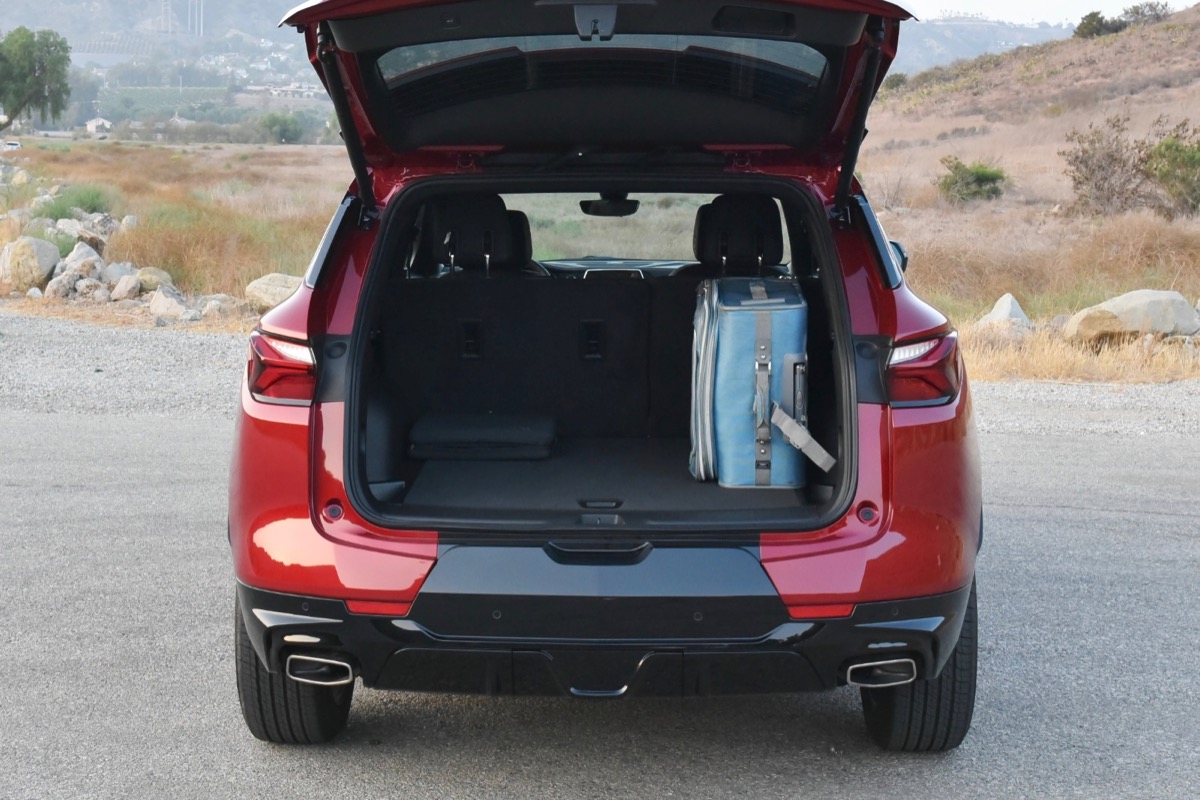
Most Blazers have a power rear liftgate, and the RS and Premier trims offer hands-free operation by swiping a foot underneath the back bumper. The success rate is best described as hit-and-miss. When the liftgate rises, it reveals a 864-litre cargo area. Fold the 60/40-split back seat down, and maximum volume measures 1,818 litres. Both numbers are small for a midsize crossover SUV.
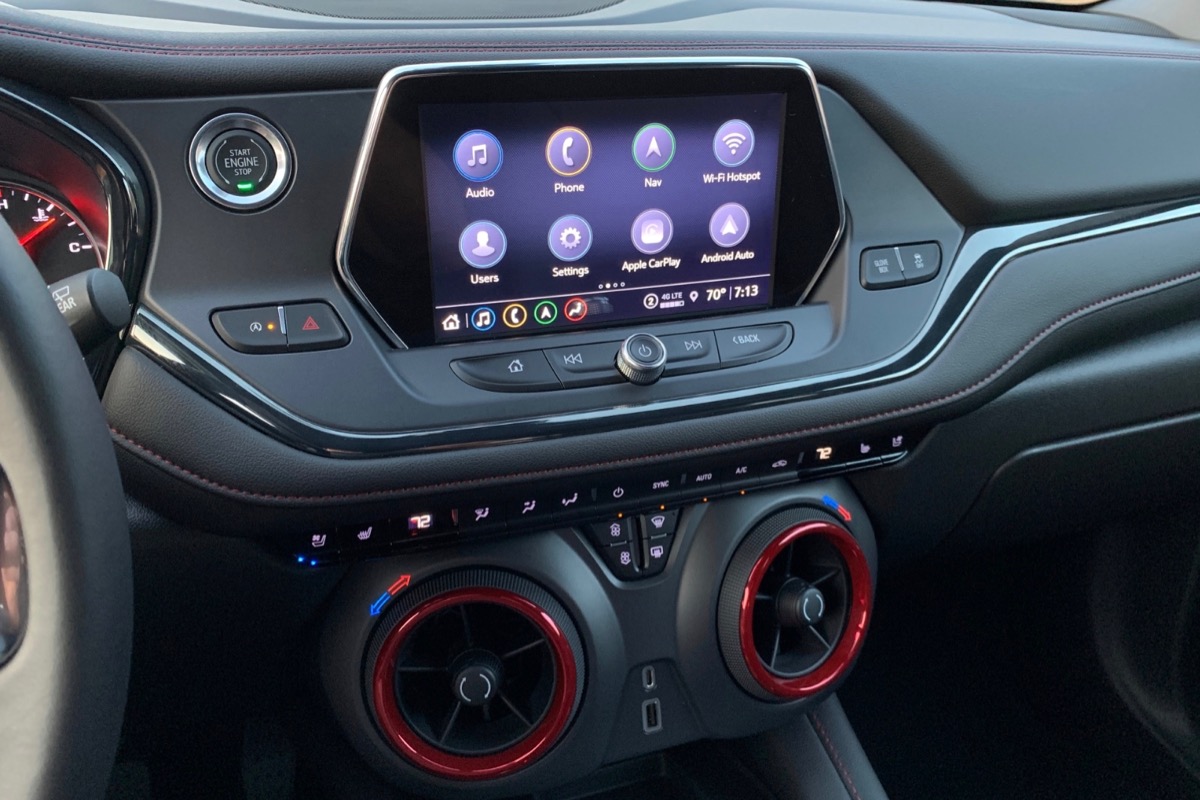
Just as the Blazer is agreeable to drive in typical situations, it’s reasonably comfortable and useful. Our RS test vehicle’s black leather upholstery with red perforations wouldn’t win any awards for quality, but it looked good and lent the Blazer’s cabin a sporty appearance.
The steering wheel is pleasing to grip, and the test vehicle had power tilt and telescopic adjustment as well as heating for chilly weather. Both front seats supplied power adjustment including for height and featured heating and optional ventilation for improved comfort on cold and hot days. Flat and lacking side bolsters, they’re also accommodating of larger people. However, we found the bottom cushions to be too short and lacking in thigh support.
Dual-zone automatic climate control is standard for the Blazer, and like most General Motors products the air conditioning proves exceptionally effective at dealing with a hot and sunny day. Rear air vents help passengers to keep their cool, and beneath them, there are USB ports and a household-style power outlet.
As is true with the front seats, the Blazer’s back seat is wide and flat with plenty of room for legs, knees, and feet. It also slides forward and back on tracks so that owners can add cargo space or passenger space as is desirable.
Storage space impresses. The glove compartment is large and accommodating, and the bin underneath the centre armrest offers lots of stash space. The front door panels have shelves and bins, too. Rear passengers get seatback pockets, small trays in the armrests, bottle holders in the door bins, and a centre armrest with cupholders.
Most Blazers have a power rear liftgate, and the RS and Premier trims offer hands-free operation by swiping a foot underneath the back bumper. The success rate is best described as hit-and-miss. When the liftgate rises, it reveals a 864-litre cargo area. Fold the 60/40-split back seat down, and maximum volume measures 1,818 litres. Both numbers are small for a midsize crossover SUV.
The Chevy Safety Assist suite of driver assistance technologies is standard on every 2022 Blazer, equipping the SUV with forward-collision alert, pedestrian detection, low-speed automatic emergency braking, lane-departure warning, lane-keep assist, and automatic high-beam headlights.
The Blazer also comes with a rear-seat reminder system to remind drivers to check the back seat before locking and leaving the SUV. Teen Driver technology is also standard, monitoring how your teenaged driver uses the Blazer and producing a report card for parents to review.
Among the available safety-related upgrades, Chevy’s vibrating Safety Alert Seat can warn you of threats and even tell you from which side of the Blazer they’re approaching. For example, if you’re backing out of a parking spot and a car or pedestrian is coming, the driver's seat vibrates on the side of the cushion corresponding to the direction of their approach.
An adaptive cruise control system with enhanced automatic emergency braking is also available, along with blind-spot monitoring and rear cross-traffic alert. You can also outfit the Blazer with LED headlights, but they don’t appear to help much. The Insurance Institute for Highway Safety (IIHS) doesn’t give the Blazer a “Top Safety Pick” rating because neither version of the Blazer’s peepers supplies high-ranking illumination.
Our test vehicle had all of the Blazer’s available driving aids, and the technology works exceptionally well – even in thick traffic. The adaptive cruise control recognizes early when vehicles cut into the gap ahead, allowing it to respond smoothly instead of suddenly. Likewise, the lane-keeping assistance is effective.
Overall, nothing about the Blazer’s advanced driving assistance systems proves aggravating, and the driver never feels as though the technology is picking a fight. As a result, you’re more likely to use the safety features and keep them turned on rather than shutting them off.
The 2022 Chevrolet Blazer looks good, is roomy and practical, features useful and intuitive technology, and is reasonably priced unless you load it up with every option. Most of the time, it's decent to drive, too.
However, it struggles to deliver value for the money. For example, driving enthusiasts can find plenty to love about a Ford Edge ST. For sheer comfort and cargo volume, the Honda Passport leads the 5-passenger SUV segment. A Jeep Cherokee or Grand Cherokee is more adept off-road. And the Kia Sportage blends modern style and technology with impressive performance and efficiency.
But, when it comes to value, the Blazer cannot touch the Hyundai Santa Fe, which looks and feels like an entry-level luxury vehicle, and it offers a robust turbocharged engine or an efficient gas-electric hybrid powertrain.
To summarize, there isn’t much that’s wrong with the 2022 Chevy Blazer. But aside from its styling and approachable tech, there isn’t much compelling about it, either.
Note: Images show a US model.

User reviews for 2022 Chevrolet Blazer
Write a review2022 Chevrolet Blazer Pricing
Trims & specs
Air Conditioning
Automatic climate control front air conditioning · Dual front air conditioning zones
Airbags
Dual front airbags · Driver knee airbags · Passenger airbag deactivation: occupant sensing deactivation · Front side airbags · Front side curtain airbags
Audio System
Antenna Type: diversity · Voice recognition audio system · USB auxiliary audio input · Stitcher internet radio · Touch screen display radio · Satellite Radio: SiriusXM · Total Number of Speakers: 6
Brakes
ABS: 4-wheel · Braking assist: hill start assist · Electronic parking brake: auto off · Front brake diameter: 12.6 · Front brakes: ventilated disc · Rear brake diameter: 12.4 · Rear brakes: disc
Comfort Features
Armrests: rear center with cupholders · Floor Mat Material: carpet · Floor Material: carpet · Floor Mats: front · Steering wheel trim: urethane
Convenience Features
Assist handle: rear · Cargo area power outlet: 12V · Center console: front console with armrest and storage · Cupholders: rear · Multi-function remote: proximity entry system · One-touch windows: 4 · Power outlet(s): 12V front · Power steering: speed-proportional · Power windows: lockout button · Reading lights: front · Steering wheel: tilt and telescopic · Steering wheel mounted controls: voice recognition controls · Storage: front seatback · Vanity mirrors: dual illuminating
Driver Seat
Power adjustments: 8
Drivetrain
Axle ratio: 3.47
Engine
Alternator: 170 amps · Battery: maintenance-free
Exterior Features
Body side moldings: black · Door handle color: body-color · Exhaust: dual exhaust tips · Exhaust tip color: chrome · Fender lip moldings: black · Front bumper color: body-color · Grille color: black with chrome accents · Mirror color: body-color · Rear bumper color: body-color · Rear spoiler: roofline spoiler · Rear spoiler color: body-color · Rear trunk/liftgate: liftgate · Rocker panel color: black · Window trim: black
Headrests
Front headrests: adjustable · Number of front headrests: 2 · Number of rear headrests: 2
In Car Entertainment
Connected in-car apps: app marketplace integration · Infotainment: Android Auto ready · Infotainment screen size: 8 in.
Instrumentation
Fuel economy display: range · Instrument cluster screen size: 4.2 in. · Warnings and reminders: coolant temperature warning
Lights
Daytime running lights: LED · Headlights: wiper activated · Tail and brake lights: LED
Mirrors
Exterior mirrors: heated · Inside rearview mirror: manual day/night
Passenger Seat
Manual Adjustments: 4
Rear Seats
Type: 60-40 split bench
Safety
Automatic emergency braking: front · Camera system: rearview · Child seat anchors: LATCH system · Pre-Collision Warning System: audible warning · Pre-collision warning system: pedestrian detection · Programmable safety key: MyKey · Rearview monitor: in dash
Seatbelts
Emergency locking retractors: front · Front seatbelts: 3-point · Seatbelt force limiters: front · Seatbelt pretensioners: front · Seatbelt warning sensor: driver and passenger · Second row seatbelts: 3-point
Seats
Driver seat power adjustments: height · Front seat type: bucket · Passenger seat manual adjustments: reclining · Rear headrests: adjustable · Rear seat folding: split · Upholstery: premium cloth
Security
Power door locks: anti-lockout
Spare Tire
Mount Location: inside · Size: temporary
Spare Wheel
Rim Type: steel
Stability and Traction
Traction control: with trailer stability control
Suspension
Front Arm Type: lower control arms · Front Shock Type: gas shock absorbers · Front Spring Type: coil springs · Front Suspension Classification: independent · Front Suspension Type: MacPherson struts · Rear Shock Type: gas shock absorbers · Rear Spring Type: coil springs · Rear Suspension Classification: independent · Rear Suspension Type: multi-link · Stabilizer bar(s): rear
Telematics
Driver assistance app: roadside assistance · Electronic messaging assistance: with voice recognition · Phone: voice activated · Phone wireless data link: Bluetooth · Satellite communications: OnStar · Smart device app compatibility: myChevrolet with Connected Access · Smart device app function: maintenance status · Wifi: hotspot
Tires
Type: all season
Tires and Rims
Wheel type: aluminum alloy
Windows
Front wipers: variable intermittent · Liftgate window: fixed · Power windows: with safety reverse · Rear wiper: intermittent
Air Conditioning
Automatic climate control front air conditioning · Dual front air conditioning zones
Airbags
Dual front airbags · Driver knee airbags · Passenger airbag deactivation: occupant sensing deactivation · Front side airbags · Front side curtain airbags
Audio System
Antenna Type: diversity · Voice recognition audio system · Bluetooth auxiliary audio input · Stitcher internet radio · Touch screen display radio · Satellite Radio: SiriusXM · Total Number of Speakers: 6
Brakes
ABS: 4-wheel · Braking assist: hill start assist · Electronic parking brake: auto off · Front brake diameter: 12.6 · Front brakes: ventilated disc · Rear brake diameter: 12.4 · Rear brakes: disc
Comfort Features
Armrests: rear center with cupholders · Floor Mat Material: carpet · Floor Material: carpet · Floor Mats: front · Steering wheel trim: urethane
Convenience Features
Assist handle: rear · Cargo area power outlet: 12V · Center console: with lighting · Cupholders: 4 · Multi-function remote: keyless entry with panic alarm · One-touch windows: 4 · Power outlet(s): USB rear · Power steering: electric · Power windows: lockout button · Reading lights: front · Steering wheel: tilt and telescopic · Steering wheel mounted controls: voice recognition controls · Storage: front seatback · Vanity mirrors: dual illuminating
Driver Seat
Power adjustments: 8
Drivetrain
4WD Type: part time · Axle ratio: 3.47 · Transfer Case: electronic
Engine
Alternator: 170 amps · Battery: maintenance-free
Exterior Features
Body side moldings: black · Door handle color: body-color · Exhaust: dual exhaust tips · Exhaust tip color: chrome · Fender lip moldings: black · Front bumper color: body-color · Grille color: black with chrome accents · Mirror color: body-color · Rear bumper color: body-color · Rear spoiler: roofline spoiler · Rear spoiler color: body-color · Rear trunk/liftgate: liftgate · Rocker panel color: black · Window trim: black
Headrests
Front headrests: adjustable · Number of front headrests: 2 · Number of rear headrests: 2
In Car Entertainment
Connected in-car apps: app marketplace integration · Infotainment: Android Auto ready · Infotainment screen size: 8 in.
Instrumentation
Fuel economy display: range · Instrument cluster screen size: 4.2 in. · Warnings and reminders: low oil pressure
Lights
Daytime running lights: LED · Headlights: Auto on/off · Tail and brake lights: LED
Mirrors
Exterior mirrors: manual folding · Inside rearview mirror: manual day/night
Passenger Seat
Manual Adjustments: 4
Rear Seats
Type: 60-40 split bench
Safety
Automatic emergency braking: front pedestrian · Camera system: rearview · Child seat anchors: LATCH system · Pre-Collision Warning System: audible warning · Pre-collision warning system: pedestrian detection · Programmable safety key: MyKey · Rearview monitor: in dash
Seatbelts
Emergency locking retractors: front · Front seatbelts: 3-point · Seatbelt force limiters: front · Seatbelt pretensioners: front · Seatbelt warning sensor: driver and passenger · Second row seatbelts: 3-point
Seats
Driver seat power adjustments: height · Front seat type: bucket · Passenger seat manual adjustments: reclining · Rear headrests: adjustable · Rear seat folding: split · Upholstery: premium cloth
Security
Power door locks: anti-lockout
Spare Tire
Mount Location: inside · Size: temporary
Spare Wheel
Rim Type: steel
Stability and Traction
Traction control: with trailer stability control
Suspension
Front Arm Type: lower control arms · Front Shock Type: gas shock absorbers · Front Spring Type: coil springs · Front Suspension Classification: independent · Front Suspension Type: MacPherson struts · Rear Shock Type: gas shock absorbers · Rear Spring Type: coil springs · Rear Suspension Classification: independent · Rear Suspension Type: multi-link · Stabilizer bar(s): front
Telematics
Driver assistance app: roadside assistance · Electronic messaging assistance: with voice recognition · Phone: voice activated · Phone wireless data link: Bluetooth · Satellite communications: OnStar · Smart device app compatibility: myChevrolet with Connected Access · Smart device app function: maintenance status · Wifi: hotspot
Tires
Type: all season
Tires and Rims
Wheel type: aluminum alloy
Towing and Hauling
Trailer hitch: Class III · Trailer wiring: 7-pin
Windows
Front wipers: variable intermittent · Liftgate window: fixed · Power windows: with safety reverse · Rear wiper: intermittent
Air Conditioning
Automatic climate control front air conditioning · Dual front air conditioning zones
Airbags
Dual front airbags · Driver knee airbags · Passenger airbag deactivation: occupant sensing deactivation · Front side airbags · Front side curtain airbags
Audio System
Antenna Type: diversity · Voice recognition audio system · USB auxiliary audio input · Stitcher internet radio · AM/FM radio · Satellite Radio: SiriusXM · Total Number of Speakers: 6
Brakes
ABS: 4-wheel · Braking assist: hill start assist · Electronic parking brake: auto off · Front brake diameter: 12.6 · Front brakes: ventilated disc · Rear brake diameter: 12.4 · Rear brakes: disc
Comfort Features
Armrests: rear center with cupholders · Floor Mat Material: carpet · Floor Material: carpet · Floor Mats: front · Steering wheel trim: leather
Convenience Features
Assist handle: passenger side · Cargo area power outlet: 12V · Center console: with lighting · Cupholders: rear · Dimming rearview mirror: auto-dimming · Memorized settings: liftgate · Multi-function remote: proximity entry system · One-touch windows: 4 · Power outlet(s): 12V front · Power steering: electric · Power windows: lockout button · Reading lights: rear · Steering wheel: tilt and telescopic · Steering wheel mounted controls: cruise controls · Storage: door pockets · Universal garage door opener: Homelink · Vanity mirrors: dual illuminating
Driver Seat
Power adjustments: 8
Drivetrain
Axle ratio: 3.47
Engine
Alternator: 170 amps · Battery: AGM
Exterior Features
Body side moldings: black · Door handle color: body-color · Exhaust: dual exhaust tips · Exhaust tip color: chrome · Fender lip moldings: black · Front bumper color: body-color · Grille color: black with chrome accents · Mirror color: body-color · Rear bumper color: body-color · Rear spoiler: roofline spoiler · Rear spoiler color: body-color · Rear trunk/liftgate: liftgate · Rocker panel color: black · Window trim: black
Headrests
Front headrests: adjustable · Number of front headrests: 2 · Number of rear headrests: 2
In Car Entertainment
Connected in-car apps: app marketplace integration · Infotainment: Chevrolet Infotainment System · Infotainment screen size: 8 in.
Instrumentation
Fuel economy display: range · Instrument cluster screen size: 4.2 in. · Warnings and reminders: low fuel level
Lights
Daytime running lights: LED · Headlights: Auto on/off · Tail and brake lights: LED
Mirrors
Exterior mirrors: power
Passenger Seat
Power adjustments: 6
Rear Seats
Type: 60-40 split bench
Roof
Roof rails: black
Safety
Automatic emergency braking: front pedestrian · Camera system: rearview · Child seat anchors: LATCH system · Cross Traffic Alert: rear · Parking sensors: rear · Pre-Collision Warning System: visual warning · Pre-collision warning system: pedestrian detection · Programmable safety key: MyKey · Rearview monitor: in dash
Seatbelts
Emergency locking retractors: front · Front seatbelts: 3-point · Seatbelt force limiters: front · Seatbelt pretensioners: front · Seatbelt warning sensor: driver and passenger · Second row seatbelts: 3-point
Seats
Driver seat power adjustments: height · Front seat type: bucket · Passenger seat power adjustments: height · Rear headrests: adjustable · Rear seat folding: split · Upholstery: leather-trimmed
Security
Power door locks: anti-lockout
Spare Tire
Mount Location: inside · Size: temporary
Spare Wheel
Rim Type: steel
Stability and Traction
Traction control: with trailer stability control
Suspension
Front Arm Type: lower control arms · Front Shock Type: gas shock absorbers · Front Spring Type: coil springs · Front Suspension Classification: independent · Front Suspension Type: MacPherson struts · Rear Shock Type: gas shock absorbers · Rear Spring Type: coil springs · Rear Suspension Classification: independent · Rear Suspension Type: multi-link · Stabilizer bar(s): rear
Telematics
Driver assistance app: roadside assistance · Electronic messaging assistance: with read function · Phone: voice activated · Phone wireless data link: Bluetooth · Satellite communications: Turn-by-Turn Navigation · Smart device app compatibility: myChevrolet with Connected Access · Smart device app function: maintenance status · Wifi: hotspot
Tires
Type: all season
Tires and Rims
Wheel type: aluminum alloy
Windows
Front wipers: variable intermittent · Liftgate window: fixed · Power windows: with safety reverse · Rear wiper: intermittent
Air Conditioning
Automatic climate control front air conditioning · Dual front air conditioning zones
Airbags
Dual front airbags · Driver knee airbags · Passenger airbag deactivation: occupant sensing deactivation · Front side airbags · Front side curtain airbags
Audio System
Antenna Type: mast · Voice recognition audio system · USB auxiliary audio input · Stitcher internet radio · AM/FM radio · Satellite Radio: SiriusXM · Total Number of Speakers: 6
Brakes
ABS: 4-wheel · Braking assist: hill start assist · Electronic parking brake: auto off · Front brake diameter: 12.6 · Front brakes: ventilated disc · Rear brake diameter: 12.4 · Rear brakes: disc
Comfort Features
Armrests: rear center with cupholders · Floor Mat Material: carpet · Floor Material: carpet · Floor Mats: front · Steering wheel trim: leather
Convenience Features
Assist handle: rear · Cargo area power outlet: 12V · Center console: with lighting · Cupholders: 4 · Dimming rearview mirror: auto-dimming · Memorized settings: liftgate · Multi-function remote: trunk release · One-touch windows: 4 · Power outlet(s): 12V front · Power steering: electric · Power windows: lockout button · Reading lights: front · Steering wheel: tilt and telescopic · Steering wheel mounted controls: multi-function screen controls · Storage: accessory hook · Universal garage door opener: Homelink · Vanity mirrors: dual illuminating
Driver Seat
Power adjustments: 8
Drivetrain
4WD Type: part time · Axle ratio: 3.47 · Transfer Case: electronic
Engine
Alternator: 170 amps · Battery: AGM
Exterior Features
Body side moldings: black · Door handle color: body-color · Exhaust: dual exhaust tips · Exhaust tip color: chrome · Fender lip moldings: black · Front bumper color: body-color · Grille color: black with chrome accents · Mirror color: body-color · Rear bumper color: body-color · Rear spoiler: roofline spoiler · Rear spoiler color: body-color · Rear trunk/liftgate: power operated · Rocker panel color: black · Window trim: black
Headrests
Front headrests: adjustable · Number of front headrests: 2 · Number of rear headrests: 2
In Car Entertainment
Connected in-car apps: app marketplace integration · Infotainment: Chevrolet Infotainment System · Infotainment screen size: 8 in.
Instrumentation
Fuel economy display: range · Instrument cluster screen size: 4.2 in. · Warnings and reminders: low fuel level
Lights
Daytime running lights: LED · Headlights: automatic high beam dimmer · Tail and brake lights: LED
Mirrors
Exterior mirrors: power
Passenger Seat
Power adjustments: 6
Rear Seats
Type: 60-40 split bench
Roof
Roof rails: black
Safety
Automatic emergency braking: front pedestrian · Camera system: rearview · Child seat anchors: LATCH system · Cross Traffic Alert: rear · Parking sensors: rear · Pre-Collision Warning System: visual warning · Pre-collision warning system: pedestrian detection · Programmable safety key: MyKey · Rearview monitor: in dash
Seatbelts
Emergency locking retractors: front · Front seatbelts: 3-point · Seatbelt force limiters: front · Seatbelt pretensioners: front · Seatbelt warning sensor: driver and passenger · Second row seatbelts: 3-point
Seats
Driver seat power adjustments: height · Front seat type: bucket · Passenger seat power adjustments: height · Rear headrests: adjustable · Rear seat folding: split · Upholstery: leather-trimmed
Security
Power door locks: anti-lockout
Spare Tire
Mount Location: inside · Size: temporary
Spare Wheel
Rim Type: steel
Stability and Traction
Traction control: with trailer stability control
Suspension
Front Arm Type: lower control arms · Front Shock Type: gas shock absorbers · Front Spring Type: coil springs · Front Suspension Classification: independent · Front Suspension Type: MacPherson struts · Rear Shock Type: gas shock absorbers · Rear Spring Type: coil springs · Rear Suspension Classification: independent · Rear Suspension Type: multi-link · Stabilizer bar(s): front
Telematics
Driver assistance app: roadside assistance · Electronic messaging assistance: with voice recognition · Phone: voice activated · Phone wireless data link: Bluetooth · Satellite communications: Turn-by-Turn Navigation · Smart device app compatibility: myChevrolet with Connected Access · Smart device app function: maintenance status · Wifi: hotspot
Tires
Type: all season
Tires and Rims
Wheel type: aluminum alloy
Towing and Hauling
Trailer hitch: Class III · Trailer wiring: 7-pin
Windows
Front wipers: variable intermittent · Liftgate window: fixed · Power windows: with safety reverse · Rear wiper: intermittent
Air Conditioning
Automatic climate control front air conditioning · Dual front air conditioning zones
Airbags
Dual front airbags · Driver knee airbags · Passenger airbag deactivation: occupant sensing deactivation · Front side airbags · Front side curtain airbags
Audio System
Antenna Type: diversity · Voice recognition audio system · Bluetooth auxiliary audio input · Stitcher internet radio · AM/FM radio · Satellite Radio: SiriusXM · Total Number of Speakers: 6
Brakes
ABS: 4-wheel · Braking assist: hill start assist · Electronic parking brake: auto off · Front brake diameter: 12.6 · Front brakes: ventilated disc · Rear brake diameter: 12.4 · Rear brakes: disc
Comfort Features
Armrests: rear center with cupholders · Floor Mat Material: carpet · Floor Material: carpet · Floor Mats: front · Steering wheel trim: leather
Convenience Features
Assist handle: rear · Cargo area power outlet: 12V · Center console: with lighting · Cupholders: 4 · Dimming rearview mirror: auto-dimming · Memorized settings: liftgate · Multi-function remote: proximity entry system · One-touch windows: 4 · Power outlet(s): USB rear · Power steering: electric · Power windows: lockout button · Reading lights: rear · Rear power outlet: 115V · Steering wheel: tilt and telescopic · Steering wheel mounted controls: cruise controls · Storage: accessory hook · Universal garage door opener: Homelink · Vanity mirrors: dual illuminating
Driver Seat
Power adjustments: 8
Drivetrain
Axle ratio: 3.49
Engine
Alternator: 155 amps · Battery: maintenance-free
Exterior Features
Body side moldings: black · Door handle color: body-color · Exhaust: dual exhaust tips · Exhaust tip color: chrome · Fender lip moldings: black · Front bumper color: body-color · Grille color: black · Mirror color: body-color · Rear bumper color: body-color · Rear spoiler: roofline spoiler · Rear spoiler color: body-color · Rear trunk/liftgate: power operated · Rocker panel color: black · Window trim: black
Headrests
Front headrests: adjustable · Number of front headrests: 2 · Number of rear headrests: 2
In Car Entertainment
Connected in-car apps: app marketplace integration · Infotainment: Apply CarPlay ready · Infotainment screen size: 8 in.
Instrumentation
Fuel economy display: range · Instrument cluster screen size: 8 in. · Warnings and reminders: low fuel level
Lights
Daytime running lights: LED · Headlights: auto delay off · Tail and brake lights: LED
Mirrors
Exterior mirrors: manual folding
Passenger Seat
Power adjustments: 6
Rear Seats
Type: 60-40 split bench
Roof
Roof rails: black
Safety
Automatic emergency braking: front pedestrian · Camera system: rearview · Child seat anchors: LATCH system · Cross Traffic Alert: rear · Parking sensors: rear · Pre-Collision Warning System: audible warning · Pre-collision warning system: pedestrian detection · Programmable safety key: MyKey · Rearview monitor: in dash
Seatbelts
Emergency locking retractors: front · Front seatbelts: 3-point · Seatbelt force limiters: front · Seatbelt pretensioners: front · Seatbelt warning sensor: driver and passenger · Second row seatbelts: 3-point
Seats
Driver seat power adjustments: height · Front seat type: bucket · Passenger seat power adjustments: height · Rear headrests: adjustable · Rear seat folding: split · Upholstery: contrast stitching
Security
Power door locks: anti-lockout
Spare Tire
Mount Location: inside · Size: temporary
Spare Wheel
Rim Type: steel
Stability and Traction
Traction control: with trailer stability control
Suspension
Front Arm Type: lower control arms · Front Shock Type: gas shock absorbers · Front Spring Type: coil springs · Front Suspension Classification: independent · Front Suspension Type: MacPherson struts · Rear Shock Type: gas shock absorbers · Rear Spring Type: coil springs · Rear Suspension Classification: independent · Rear Suspension Type: multi-link · Stabilizer bar(s): front
Telematics
Driver assistance app: roadside assistance · Electronic messaging assistance: with voice recognition · Navigation system: with voice recognition · Phone: voice activated · Phone wireless data link: Bluetooth · Satellite communications: OnStar · Smart device app compatibility: myChevrolet with Connected Access · Smart device app function: maintenance status · Wifi: hotspot
Tires
Type: all season
Tires and Rims
Wheels: painted aluminum
Windows
Front wipers: variable intermittent · Liftgate window: fixed · Power windows: with safety reverse · Rear wiper: with washer
Air Conditioning
Automatic climate control front air conditioning · Dual front air conditioning zones
Airbags
Dual front airbags · Driver knee airbags · Passenger airbag deactivation: occupant sensing deactivation · Front side airbags · Front side curtain airbags
Audio System
Antenna Type: diversity · Voice recognition audio system · Bluetooth auxiliary audio input · Stitcher internet radio · Touch screen display radio · Satellite Radio: SiriusXM · Total Number of Speakers: 6
Brakes
ABS: 4-wheel · Braking assist: hill start assist · Electronic parking brake: auto off · Front brake diameter: 12.6 · Front brakes: ventilated disc · Rear brake diameter: 12.4 · Rear brakes: disc
Comfort Features
Armrests: rear center with cupholders · Door sill trim: aluminum · Floor Mat Material: carpet · Floor Material: carpet · Floor Mats: front · Steering wheel trim: leather
Convenience Features
Assist handle: passenger side · Cargo area power outlet: 12V · Center console: front console with armrest and storage · Cupholders: 4 · Dimming rearview mirror: auto-dimming · Memorized settings: liftgate · Multi-function remote: keyless entry with panic alarm · One-touch windows: 4 · Power outlet(s): USB rear · Power steering: electric · Power windows: lockout button · Reading lights: front · Rear power outlet: 115V · Steering wheel: tilt and telescopic · Steering wheel mounted controls: phone · Storage: front seatback · Universal garage door opener: Homelink · Vanity mirrors: dual illuminating
Driver Seat
Power adjustments: 8
Drivetrain
Axle ratio: 3.47
Engine
Alternator: 170 amps · Battery: AGM
Exterior Features
Body side moldings: chrome · Door handle color: body-color with chrome accents · Exhaust: dual exhaust tips · Exhaust tip color: chrome · Fender lip moldings: black · Front bumper color: body-color · Grille color: black with chrome accents · Mirror color: body-color · Rear bumper color: body-color · Rear spoiler: roofline spoiler · Rear spoiler color: body-color · Rear trunk/liftgate: sensor-activated · Rocker panel color: black · Window trim: black
Headrests
Front headrests: adjustable · Number of front headrests: 2 · Number of rear headrests: 2
In Car Entertainment
Connected in-car apps: app marketplace integration · Infotainment: Apply CarPlay ready · Infotainment screen size: 8 in.
Instrumentation
Fuel economy display: range · Instrument cluster screen size: 8 in. · Warnings and reminders: low oil pressure
Lights
Daytime running lights: LED · Headlights: HID · Tail and brake lights: LED
Mirrors
Exterior mirrors: reverse gear tilt
Passenger Seat
Power adjustments: 6
Rear Seats
Type: 60-40 split bench
Roof
Roof rails: silver
Safety
Automatic emergency braking: front · Camera system: rearview · Child seat anchors: LATCH system · Cross Traffic Alert: rear · Parking sensors: rear · Pre-Collision Warning System: audible warning · Pre-collision warning system: pedestrian detection · Programmable safety key: MyKey · Rearview monitor: in dash
Seatbelts
Emergency locking retractors: front · Front seatbelts: 3-point · Seatbelt force limiters: front · Seatbelt pretensioners: front · Seatbelt warning sensor: driver and passenger · Second row seatbelts: 3-point
Seats
Driver seat power adjustments: reclining · Front seat type: bucket · Passenger seat power adjustments: reclining · Rear headrests: adjustable · Rear seat folding: split · Upholstery: perforated · Upholstery accents: faux suede
Security
Power door locks: anti-lockout
Spare Tire
Mount Location: inside · Size: temporary
Spare Wheel
Rim Type: steel
Stability and Traction
Traction control: with trailer stability control
Suspension
Front Arm Type: lower control arms · Front Shock Type: gas shock absorbers · Front Spring Type: coil springs · Front Suspension Classification: independent · Front Suspension Type: MacPherson struts · Rear Shock Type: gas shock absorbers · Rear Spring Type: coil springs · Rear Suspension Classification: independent · Rear Suspension Type: multi-link · Stabilizer bar(s): rear
Telematics
Driver assistance app: roadside assistance · Electronic messaging assistance: with read function · Navigation system: hard drive navigation system · Phone: voice activated · Phone wireless data link: Bluetooth · Satellite communications: Turn-by-Turn Navigation · Smart device app compatibility: myChevrolet with Connected Access · Smart device app function: maintenance status · Wifi: hotspot
Tires
Type: all season
Tires and Rims
Wheel type: aluminum alloy
Windows
Front wipers: variable intermittent · Liftgate window: fixed · Power windows: with safety reverse · Rear wiper: intermittent
Air Conditioning
Automatic climate control front air conditioning · Dual front air conditioning zones
Airbags
Dual front airbags · Driver knee airbags · Passenger airbag deactivation: occupant sensing deactivation · Front side airbags · Rear side curtain airbags
Audio System
Antenna Type: mast · Voice recognition audio system · Memory card slot auxiliary audio input · Stitcher internet radio · AM/FM radio · Satellite Radio: SiriusXM · Total Number of Speakers: 6
Brakes
ABS: 4-wheel · Braking assist: hill start assist · Electronic parking brake: auto off · Front brake diameter: 12.6 · Front brakes: ventilated disc · Rear brake diameter: 12.4 · Rear brakes: disc
Comfort Features
Armrests: rear center with cupholders · Floor Mat Material: carpet · Floor Material: carpet · Floor Mats: front · Steering wheel trim: leather
Convenience Features
Assist handle: rear · Cargo area power outlet: 12V · Center console: front console with armrest and storage · Cupholders: illuminated · Dimming rearview mirror: auto-dimming · Memorized settings: liftgate · Multi-function remote: trunk release · One-touch windows: 4 · Power outlet(s): 12V front · Power steering: electric · Power windows: lockout button · Reading lights: front · Rear power outlet: 115V · Steering wheel: tilt and telescopic · Steering wheel mounted controls: multi-function screen controls · Storage: door pockets · Universal garage door opener: Homelink · Vanity mirrors: dual illuminating
Driver Seat
Power adjustments: 8
Drivetrain
4WD Type: part time · Axle ratio: 3.49 · Transfer Case: electronic
Engine
Alternator: 170 amps · Battery: maintenance-free
Exterior Features
Body side moldings: black · Door handle color: body-color · Exhaust: dual exhaust tips · Exhaust tip color: chrome · Fender lip moldings: black · Front bumper color: body-color · Grille color: black · Mirror color: body-color · Rear bumper color: body-color · Rear spoiler: roofline spoiler · Rear spoiler color: body-color · Rear trunk/liftgate: power operated · Rocker panel color: black · Window trim: black
Headrests
Front headrests: adjustable · Number of front headrests: 2 · Number of rear headrests: 2
In Car Entertainment
Connected in-car apps: app marketplace integration · Infotainment: Chevrolet Infotainment System · Infotainment screen size: 8 in.
Instrumentation
Fuel economy display: range · Instrument cluster screen size: 8 in. · Warnings and reminders: low oil level
Lights
Daytime running lights: LED · Headlights: automatic high beam dimmer · Tail and brake lights: LED
Mirrors
Exterior mirrors: power
Passenger Seat
Power adjustments: 6
Rear Seats
Type: 60-40 split bench
Roof
Roof rails: black
Safety
Automatic emergency braking: front · Camera system: rearview · Child seat anchors: LATCH system · Cross Traffic Alert: rear · Parking sensors: rear · Pre-Collision Warning System: visual warning · Pre-collision warning system: pedestrian detection · Programmable safety key: MyKey · Rearview monitor: in dash
Seatbelts
Emergency locking retractors: front · Front seatbelts: 3-point · Seatbelt force limiters: front · Seatbelt pretensioners: front · Seatbelt warning sensor: driver and passenger · Second row seatbelts: 3-point
Seats
Driver seat power adjustments: reclining · Front seat type: bucket · Passenger seat power adjustments: reclining · Rear headrests: adjustable · Rear seat folding: split · Upholstery: leather-trimmed
Security
Power door locks: anti-lockout
Spare Tire
Mount Location: inside · Size: temporary
Spare Wheel
Rim Type: steel
Stability and Traction
Traction control: with trailer stability control
Suspension
Front Arm Type: lower control arms · Front Shock Type: gas shock absorbers · Front Spring Type: coil springs · Front Suspension Classification: independent · Front Suspension Type: MacPherson struts · Rear Shock Type: gas shock absorbers · Rear Spring Type: coil springs · Rear Suspension Classification: independent · Rear Suspension Type: multi-link · Stabilizer bar(s): front
Telematics
Driver assistance app: roadside assistance · Electronic messaging assistance: with voice recognition · Navigation system: hard drive navigation system · Phone: voice activated · Phone wireless data link: Bluetooth · Satellite communications: Turn-by-Turn Navigation · Smart device app compatibility: myChevrolet with Connected Access · Smart device app function: maintenance status · Wifi: hotspot
Tires
Type: all season
Tires and Rims
Wheels: painted aluminum
Towing and Hauling
Trailer hitch: Class III · Trailer wiring: 7-pin
Windows
Front wipers: variable intermittent · Liftgate window: fixed · Power windows: with safety reverse · Rear wiper: intermittent
Air Conditioning
Automatic climate control front air conditioning · Dual front air conditioning zones
Airbags
Dual front airbags · Driver knee airbags · Passenger airbag deactivation: occupant sensing deactivation · Front side airbags · Front side curtain airbags
Audio System
Antenna Type: diversity · Voice recognition audio system · USB auxiliary audio input · Stitcher internet radio · Touch screen display radio · Satellite Radio: SiriusXM · Total Number of Speakers: 6
Brakes
ABS: 4-wheel · Braking assist: hill start assist · Electronic parking brake: auto off · Front brake diameter: 12.6 · Front brakes: ventilated disc · Rear brake diameter: 12.4 · Rear brakes: disc
Comfort Features
Armrests: rear center with cupholders · Door sill trim: aluminum · Floor Mat Material: carpet · Floor Material: carpet · Floor Mats: front · Steering wheel trim: leather
Convenience Features
Assist handle: rear · Cargo area power outlet: 12V · Center console: front console with armrest and storage · Cupholders: illuminated · Dimming rearview mirror: auto-dimming · Memorized settings: liftgate · Multi-function remote: trunk release · One-touch windows: 4 · Power outlet(s): USB front · Power steering: speed-proportional · Power windows: lockout button · Reading lights: rear · Rear power outlet: 115V · Steering wheel: tilt and telescopic · Steering wheel mounted controls: voice recognition controls · Storage: door pockets · Universal garage door opener: Homelink · Vanity mirrors: dual illuminating
Driver Seat
Power adjustments: 8
Drivetrain
4WD Type: part time · Axle ratio: 3.47 · Transfer Case: electronic
Engine
Battery: AGM
Exterior Features
Body side moldings: chrome · Door handle color: body-color with chrome accents · Exhaust: dual exhaust tips · Exhaust tip color: chrome · Fender lip moldings: black · Front bumper color: body-color · Grille color: black with chrome accents · Mirror color: body-color · Rear bumper color: body-color · Rear spoiler: roofline spoiler · Rear spoiler color: body-color · Rear trunk/liftgate: power operated · Rocker panel color: black · Window trim: black
Headrests
Front headrests: adjustable · Number of front headrests: 2 · Number of rear headrests: 2
In Car Entertainment
Connected in-car apps: app marketplace integration · Infotainment: Android Auto ready · Infotainment screen size: 8 in.
Instrumentation
Fuel economy display: range · Instrument cluster screen size: 8 in. · Warnings and reminders: maintenance reminder
Lights
Daytime running lights: LED · Headlights: HID · Tail and brake lights: LED
Mirrors
Exterior mirrors: manual folding
Passenger Seat
Power adjustments: 6
Rear Seats
Type: 60-40 split bench
Roof
Roof rails: silver
Safety
Automatic emergency braking: front · Camera system: rearview · Child seat anchors: LATCH system · Cross Traffic Alert: rear · Parking sensors: rear · Pre-Collision Warning System: audible warning · Pre-collision warning system: pedestrian detection · Programmable safety key: MyKey · Rearview monitor: in dash
Seatbelts
Emergency locking retractors: front · Front seatbelts: 3-point · Seatbelt force limiters: front · Seatbelt pretensioners: front · Seatbelt warning sensor: driver and passenger · Second row seatbelts: 3-point
Seats
Driver seat power adjustments: reclining · Front seat type: bucket · Passenger seat power adjustments: reclining · Rear headrests: adjustable · Rear seat folding: split · Upholstery: leather-trimmed · Upholstery accents: faux suede
Security
Power door locks: anti-lockout
Spare Tire
Mount Location: inside · Size: temporary
Spare Wheel
Rim Type: steel
Stability and Traction
Traction control: with trailer stability control
Suspension
Front Arm Type: lower control arms · Front Shock Type: gas shock absorbers · Front Spring Type: coil springs · Front Suspension Classification: independent · Front Suspension Type: MacPherson struts · Rear Shock Type: gas shock absorbers · Rear Spring Type: coil springs · Rear Suspension Classification: independent · Rear Suspension Type: multi-link · Stabilizer bar(s): rear
Telematics
Driver assistance app: roadside assistance · Electronic messaging assistance: with read function · Navigation system: touch screen display · Phone: voice activated · Phone wireless data link: Bluetooth · Satellite communications: Turn-by-Turn Navigation · Smart device app compatibility: myChevrolet with Connected Access · Smart device app function: maintenance status · Wifi: hotspot
Tires
Type: all season
Tires and Rims
Wheel type: aluminum alloy
Towing and Hauling
Trailer hitch: Class III · Trailer wiring: 7-pin
Windows
Front wipers: variable intermittent · Liftgate window: fixed · Power windows: with safety reverse · Rear wiper: intermittent

