2022 BMW M4 Reviews, Pricing & Specs


The CarGurus verdict
Simply put, the 2022 BMW M4 is one of the most engaging driver's cars on the market today, regardless of price.
No other model in BMW's lineup better epitomizes the brand's "Ultimate Driving Machine" tagline than the M4. Possessing a nearly perfect blend of power and handling, the M4 provides a high-performance driving experience like no other. For 2022, the top-spec M4 Competition is now available for the first time with BMW's xDrive all-wheel-drive (AWD) system, allowing drivers to fully harness the car's 479 pound-feet of torque. The new BMW M4 Competition is also now available as a soft-top convertible.
out of 10 expert review
Look & feel
Even casual observers have likely noticed that car, truck, and SUV grilles (and the badges affixed to them) have gotten more prominent over the past decade or so. While we can certainly appreciate a big badge as much as the next automotive journalist ("I like big badges and I cannot lie…"), it seems that things have gotten a little out of hand in recent years, especially among the luxury ranks. Brands like Mercedes, Lexus, and Infiniti have upped their badge game, and we're pretty sure the Cadillac logo on the new Escalade can be seen from the International Space Station.
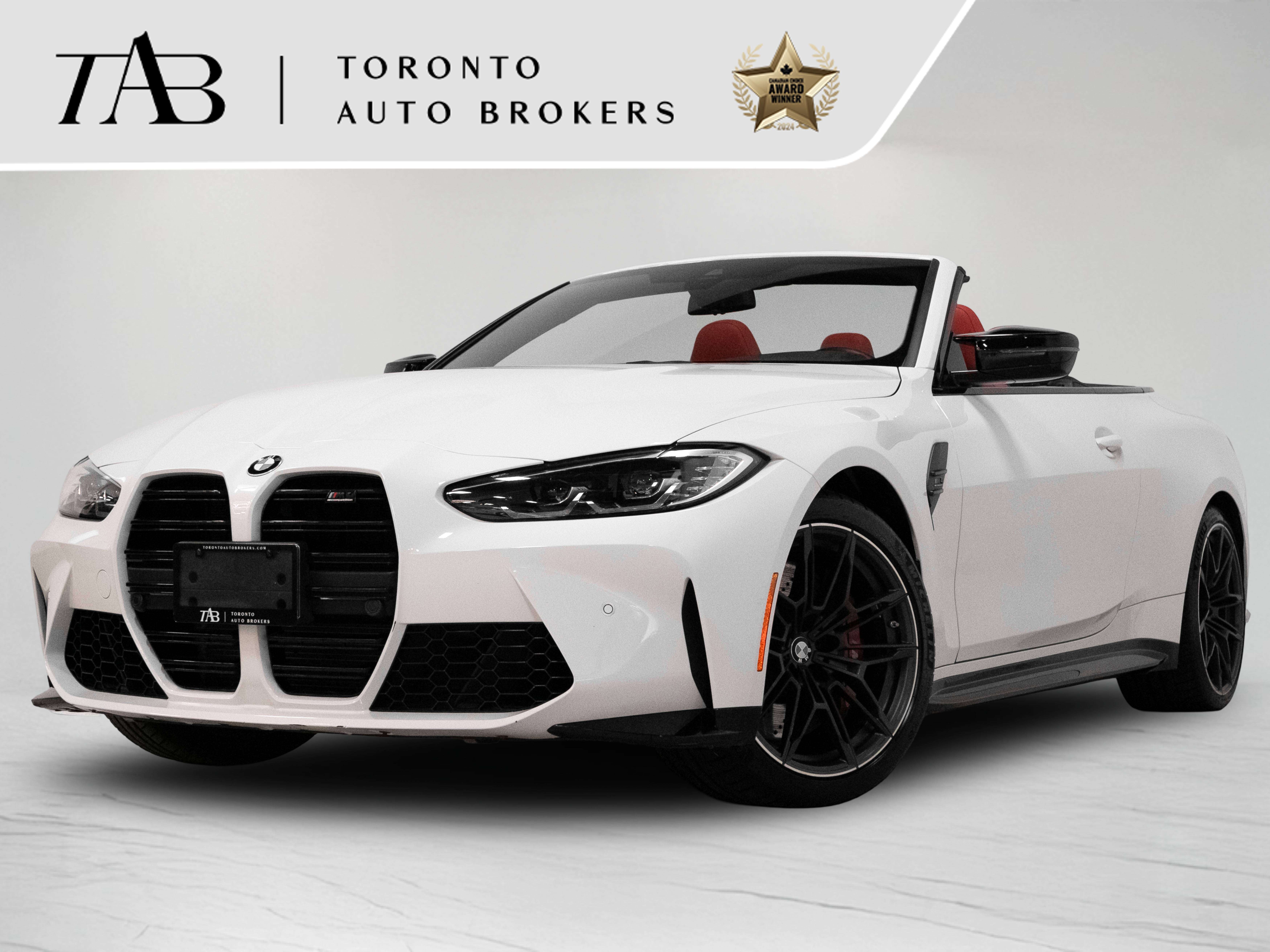
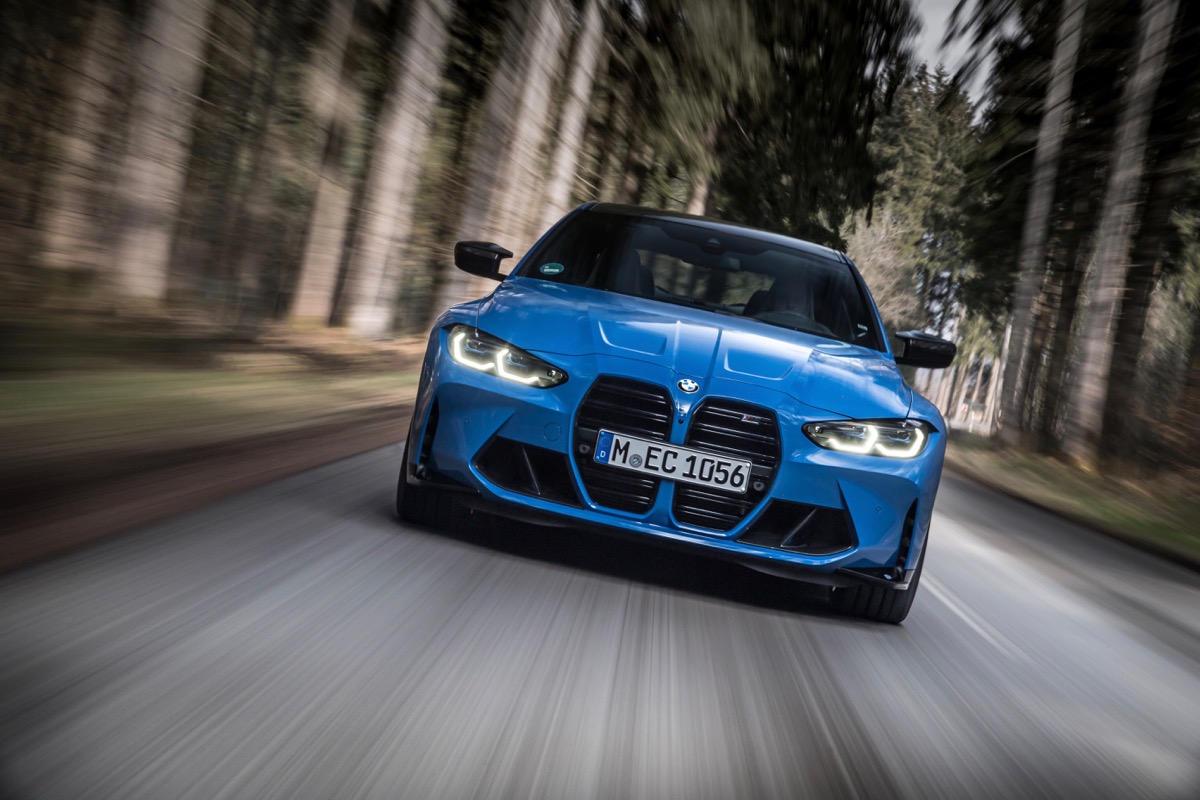
While BMW has managed to exercise some restraint and chosen not to participate in this badge madness (badness?), the automaker has instead focused its design energy on supersizing the M4's twin-kidney grille. While the new grille's look may be polarizing, it's undoubtedly distinctive, making the M4 instantly recognizable, even from long distances. Oversized grille notwithstanding, the M4 is an otherwise sleek, sexy coupe (or the BMW M4 convertible) with gorgeous proportions. It's particularly attractive when viewed from the side, where its flowing roofline trails off perfectly to meet the rear of the car. To use a cliché, it looks fast standing still.
Nice as they are, BMW interiors have a reputation for being a notch below German competitors Audi and Mercedes-Benz. We think this is a bit unfair. Overall, material quality and fit and finish in the M4 are well executed. It may not precisely match its rivals, but the M4's cabin is definitively luxurious and well put together, if not what one might consider "premium." The carbon-fibre trim in our test car added a dose of sportiness, too. While not a luxury feature, we also appreciated the adjustable ambient interior lighting, always adding a friendly, welcoming touch.
Inside, the M4 features a sporty, driver-oriented cockpit with soft-touch materials up to the standards you'd expect from a car with a base price exceeding $87,000. Our test car, an M4 Competition xDrive coupe, had the optional carbon fibre trim package and race-inspired BMW M Carbon bucket seats, upping the sport quotient. The M Carbon seats, with their lower seating position, lighter weight, and ability to accommodate multi-point seat belts, would be our choice for track days. However, we'd go with the standard M sport seats for daily commuting, as they have better bolstering and are more suitable for long drives. Other cool interior touches include red accents for the M buttons on the M leather steering wheel and the start/stop button on the centre console.

Performance
To drive the BMW M4 is to love the BMW M4. Nothing else matters—not the styling, the interior, the technology, or safety scores, though the M4 does well in all of those areas. No, as any driving enthusiast with gasoline flowing through their veins will tell you, get the driving part right, and everything else is forgiven. And the drive is where the BMW M4 sets itself apart.
The heart and soul of the BMW M4 is its direct-injected, twin-turbocharged, 3.0-litre inline-6-cylinder engine, which it shares with the M3 sedan. The standard M4 engine produces 473 horsepower at 6,250 rpm and 406 lb-ft of torque between 2,650 and 6,130 rpm. The engine in the M4 Competition is further tuned to deliver 503 hp at 6,250 rpm and 479 lb-ft between 2,750 and 5,500 rpm. Redline for both engines is 7,200 rpm.
Both versions of the M4's twin-turbo engine work with either a six-speed manual transmission or an eight-speed M Steptronic automatic transmission as part of the powertrain, the latter standard on Competition models to handle the extra engine torque. BMW M4 Competition models also feature a separate transmission oil cooler. The Steptronic features both automatic and manual modes, controlled by the Drivelogic switch on the gear shift lever for those who like a little more control over gear selection. Additionally, three drive modes are available: comfort, sport, and track.
According to BMW, the standard rear-wheel drive (RWD) M4 can accelerate from zero-to-100 kilometres per hour in 4.2 seconds, while the M4 Competition can do the deed in 3.9 seconds. The M4 Competition xDrive is quicker still, taking just 3.7 seconds to reach 100 kilometres per hour thanks to the AWD system's extra grip.
While we can't (and, even if we could, we wouldn't) verify BMW's top-speed claims, we can vouch for the M4 Competition's brisk acceleration from a standing start. If we didn't know we were driving a vehicle powered by an internal combustion engine, we'd swear we were piloting an electric vehicle with its instant torque and accelerative forces that press your head and shoulders to the seatback. It was such a hoot performing zero-to-100 runs that we found ourselves seeking out victims, er, passengers to demonstrate the M4 Competition's astounding off-the-line performance. It was that much fun, and we didn't want it to end.
While the initial acceleration was EV-like, the sound emanating from the engine/dual-branch exhaust system was anything but and only served to enhance the experience. For those that prefer a quieter exhaust, the M4 is outfitted with an M Sound button, which allows the driver to reduce the engine note when desired and works in any drive mode.
Once at speed, the M4 Competition handled like a boss. Part of this was due to the M4's chassis and suspension tuning. The newly available xDrive AWD drivetrain also kept the BMW composed by distributing torque between the front and rear axles via an electronically controlled multi-plate clutch. The M xDrive system is unique because it offers three different modes to allow drivers to custom-tailor their drive. The default setting, 4WD is rear-wheel-biased and emphasizes traction and handling. The 4WD Sport mode sends more torque to the rear wheels during spirited driving and is best suited to a track environment. Meanwhile, 2WD mode requires the car's stability control and traction control systems to be turned off and provides the purest, most electronic nanny-free driving experience.
The M4 Competition's standard forged light-alloy M double-spoke 19-inch front and 20-inch rear wheels wear grippy Z-rated tires that enabled the car to handle like it was on rails. Testing the car's cornering ability on decreasing-radius on- and off-ramps was particularly fun. The standard M Compound brakes worked incredibly well, quickly bringing the M4 down from speed with no drama or fade during our repeated runs.
Bottom line, if there were a way to give the M4 extra credit for performance on our 10-point scale, we'd most certainly go all Spinal Tap and "turn it up to eleven."

Form & function
Unlike the four-door, five-passenger BMW M3 sedan with which it shares a platform, the M4 coupe/M4 convertible has two doors and seats four. While the two cars share many of the same measurements, including wheelbase, length, width, ground clearance, and turning radius, the M4 is not as tall as the M3, and the rear-seat area is smaller.
There's plenty of space up front in the M4, with headroom being the lone exception. Surprisingly for a two-door sports coupe, the rear seat isn't a bad place to be, even for adults (those over 5'9" will have to tilt their heads sideways). Of course, buying the convertible would be a quick, albeit expensive, solution to the rear-seat headroom issue.
While it may be short on headroom, the M4's back seat features a handy trunk pass-through for carrying long, skinny items, and rear-seat passengers enjoy their own climate controls and two USB chargers built into the back of the centre console. Still, if you intend to carry passengers in the back with regularity, the M3 offers similar performance and the ability to carry an extra rider.
The M4's trunk holds 340 litres of cargo, enough for a couple of average-sized suitcases or two sets of golf clubs. The M3's trunk is slightly larger at 368 litres.

Technology
The foundation of the M4's in-vehicle technology platform is BMW Live Cockpit Professional and the integrated iDrive operating system. Much maligned in its early days for its somewhat obtuse operation and overly complicated menus, iDrive has come a long way. Now in its seventh generation, iDrive is the gateway to interacting with the M4's onboard infotainment and communication systems, including navigation via cloud-based BMW Maps, Bluetooth, wireless Apple CarPlay and Android Auto smartphone mirroring, and BMW Intelligent Personal Assistant. Drivers can access the M4's iDrive 7 system through voice commands, using the infotainment system's touchscreen nestled atop the centre stack, or via the rotary controller on the centre console.
iDrive is also how you customize the instrument cluster display and the optional head-up display. Speaking of the instrument cluster, rather than a traditional analog setup, the M4 features a fully digital 12.3-inch instrument display. While some commentators have griped about the digital display gauges being difficult to decipher, we didn't have any problems in this regard and think the setup is clean and attractive.
Optional tech features include a Parking Assistance Package feature, drive recorder, adaptive LED headlights with Laserlight, head-up display, wireless device charging, and gesture control. The standard Harman Kardon surround-sound audio system sounded great.

Safety
Having as much performance capability as the M4 does, it's essential that the car can protect occupants in the event of a collision or, better yet, help to avoid one altogether.
In terms of driving assistance systems, the 2022 BMW M4 comes standard with adaptive cruise control, park distance control, automatic high-beam headlights, an Active Protection package (includes automatic front seat belt tensioning, automatic closing of windows and moonroof, fatigue and focus alert, and post-collision braking), and an Driving Assistant package (includes lane-departure warning, speed-limit recognition, active blind-spot monitoring, rear cross-traffic alert, and rear-collision preparation).
Optional tech includes adaptive cruise with stop-and-go capability, front cross-traffic alert, extended traffic jam assist, lane-keeping assistance, evasive-steering assistance, parking assistance, and automatic emergency braking with full-stop capability.
As it is a low-volume car, neither the National Highway Traffic Safety Administration (NHTSA) nor the Insurance Institute for Highway Safety (IIHS) has tested the 2022 BMW M4 for crashworthiness.
While the M4 does offer a comprehensive selection of safety features, many of them are optional on the base model. Considering the M4's price, we think more of that tech should be standard. Additionally, BMW does not offer any form of pedestrian detection on the M4.

Cost-effectiveness
With a base MSRP of $87,700, not including the $2,480 destination charge, the BMW M4 Coupe isn't cheap. Still, when you consider the level of performance you get in return, it passes the value test. Stepping up to the M4 Competition coupe variant will set you back $91,800 before fees, and further adding xDrive AWD brings the total to $94,300. In our opinion, the extra horsepower and grip that contribute to the breathtaking performance on the BMW M4 Competition xDrive is well worth the additional outlay over and above the base model.
Outfitted with the upgrades in the Ultimate package ($18,950), which covers the most desirable options, a well-equipped example of even a base M4 quickly exceeds six figures.
As stated earlier, to achieve the best balance of performance and value, we'd splurge for the M4 Competition xDrive, but pass on the more expensive options such as the M Carbon seats and the $1,000 carbon fibre trim to save more money for gas.
According to Natural Resources Canada, both the 2022 BMW M4 and M4 Competition are rated to consume 12.6 litres per 100 kilometres in combined city/highway driving. The xDrive-equipped M4s are slightly less fuel-efficient at 12.7 L/100 km combined. Compared to its main competitors, the Audi RS 5 and Mercedes-AMG C63, these figures are slightly lower. That said, the M4 returned 11.3 L/100 km during our week of testing, somewhat surprising considering the amount of our "demonstrations." However, a 225-kilometre roundtrip highway jaunt certainly aided our overall fuel efficiency. With a 70-litre fuel tank, our 11.3 L/100 km average translates into a maximum driving range of 619 kilometres.
Luxury sports cars are notorious for their high operating and ownership costs. Expect to pay a premium for maintaining and servicing your new car. Leasing a car like the M4 might be a good option if you generally take good care of your vehicle(s), drive fewer than 20,000 or so kilometres per year, and like to drive the latest models. Otherwise, once you hit four years of ownership or 80,000 kilometres (when the standard warranty expires) and you start replacing components on your own dime, things can escalate quickly.
Note: Images show a US model.

What owners say
Perfect car, if you don’t have a second car, a M3 might be a better option, but having a SUV, the M4 is a perfect second car
May 3, 2025Trims & specs
Base MSRP $86,500 | Seating 4 |
Engine 3.0L 503 hp I6 | Cargo Capacity 13.6 cu ft |
Combined MPG 19 | Drivetrain AWD |
Base MSRP $79,000 | Seating 4 |
Engine 3.0L 503 hp I6 | Cargo Capacity 15.5 cu ft |
Combined MPG 19 | Drivetrain AWD |
Base MSRP $72,000 | Seating 4 |
Engine 3.0L 503 hp I6 | Cargo Capacity 15.5 cu ft |
Combined MPG 19 | Drivetrain RWD |
Base MSRP $72,000 | Seating 4 |
Engine 3.0L 503 hp I6 | Cargo Capacity 15.5 cu ft |
Combined MPG 19 | Drivetrain RWD |