2021 Toyota Camry Reviews, Pricing & Specs


Expert review
The popular Toyota Camry didn't receive many updates for the 2021 model year, but this midsize sedan remains a good all-rounder.
The Toyota Camry has long been many new-car buyers’ default choice—but not because it’s interesting. Reliability and practicality have traditionally been the Camry’s strengths, not sportiness or style.
Toyota tried to change that for the 2018 model year, when the Camry was last redesigned. The current-generation Camry adopted more extroverted styling, and engineers tried to make the driving experience more exciting, too. While Toyota’s approach has changed, the Camry still competes against the same array of midsize sedans, including the Honda Accord, Hyundai Sonata, Mazda 6, Nissan Altima, Subaru Legacy, and Volkswagen Passat.
Changes for the 2021 model year include subtle styling tweaks, new infotainment displays, an upgrade to the Toyota Safety Sense 2.5+ (TSS 2.5+) package of driver aids, and some changes to the dashboard trim.
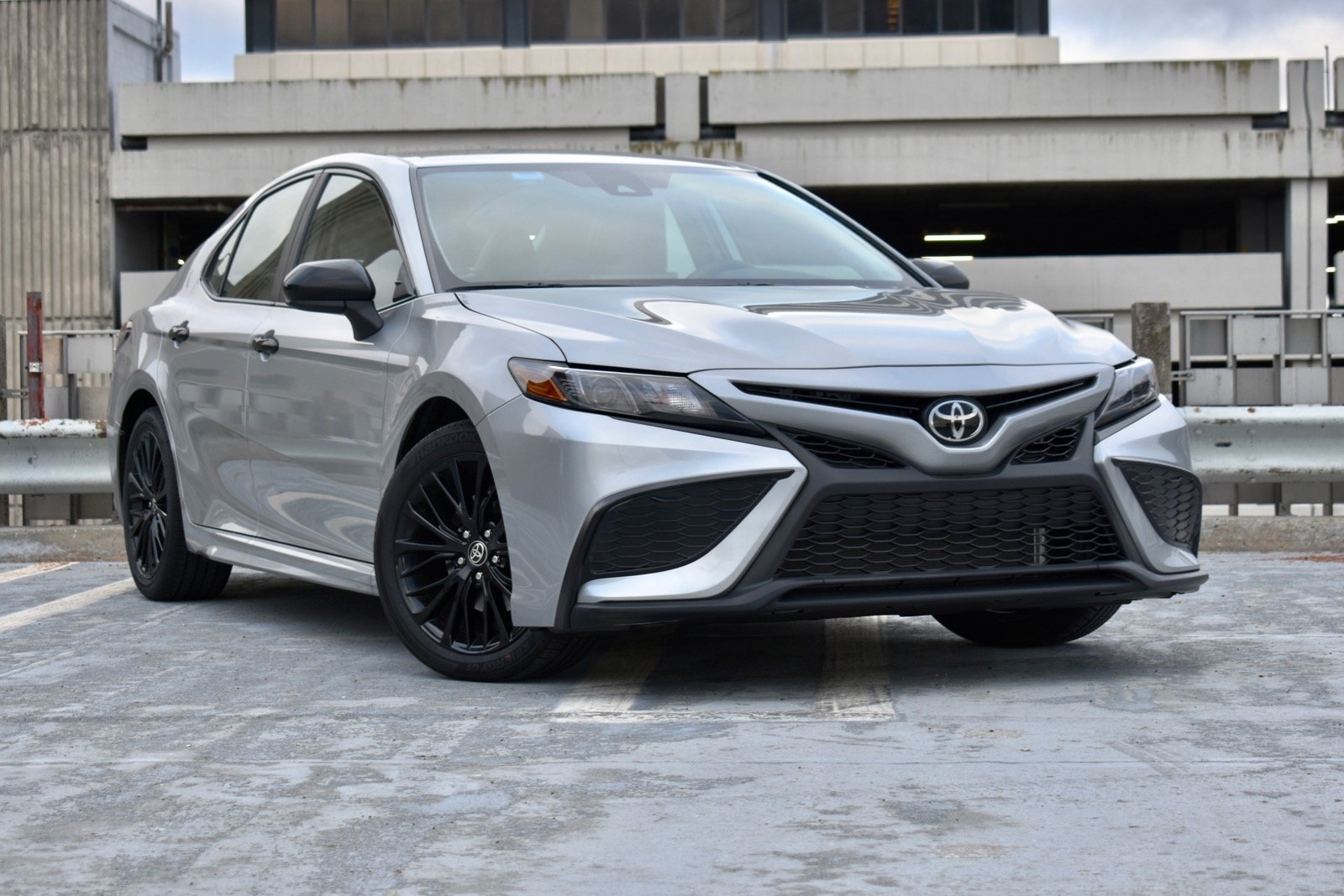
The Camry offers buyers more choices than many rivals, encompassing three powertrains (inline-four, V6, and hybrid), four trim levels (LE, SE, XSE, XLE), three packages available on select models (Upgrade, Nightshade Edition, and TRD) and the choice of front-wheel drive (FWD) or all-wheel drive (AWD). Our test car was an AWD Camry SE Nightshade Edition, positioned close to the middle of the lineup.
out of 10 expert review
Look & feel
The 2021 Toyota Camry works hard to distance itself from past Camry models, which often looked like the generic cars from driver’s ed textbooks. Like other recent Toyota models, designers tried to make the Camry exciting by piling on styling details.
Some of the styling elements work, such as the flared wheel arches and thin headlights and taillights, which visually widen the car. However, if you opt for the SE or XSE trim levels, the Camry is festooned with fake vents that add a lot of visual clutter. LE and XLE models get a different grille that’s somewhat cleaner, but still massive. Under the skin is the ubiquitous TNGA-K platform shared with many other Toyota models, including the larger Avalon sedan and the RAV4 SUV.
Toyota changed the front-fascia styling on most trim levels for the 2021 model year, but the differences aren’t too dramatic. As before, the TRD performance package gets some unique styling elements like a larger rear spoiler.
The Nightshade Edition also carries over from the 2020 model year. It’s based on the SE trim level, but it features blacked-out exterior trim and wheels. Speaking of wheels, 16-inch steel wheels are standard on the base LE trim level, with 17-inch, 18-inch, and 19-inch alloy wheels available on other models.
The interior has the same chaotic styling as the exterior. The dashboard of our SE Nightshade Edition tester looked like it was made from the parts of two separate cars. Toyota threw a lot of different trim elements at the interior—including contrast stitching, piano black plastic, and plastic trim that looked vaguely like carbon fibre (XLE and XSE models get leather upholstery)—but there doesn’t seem to have been an overall design theme. The materials also looked and felt low-rent.

Performance
The base powertrain for the 2021 Toyota Camry is a 2.5-litre four-cylinder engine. It delivers above-average output for a naturally-aspirated four-banger. In most trim levels, it’s rated at 203 horsepower and 184 pound-feet of torque with FWD, and 202 hp and 182 lb-ft with AWD. Camry XSE models get a dual-exhaust system, bumping output to 206 hp and 186 lb-ft with FWD, and 205 hp and 185 lb-ft with AWD. Whether you choose FWD or AWD, you get an eight-speed automatic transmission.
While most other automakers have opted for downsized turbo-four engines, Toyota still offers a naturally-aspirated 3.5-litre V6 in the Camry, with 301 hp and 267 lb-ft of torque, and the same eight-speed automatic as the four-cylinder engine. Finally, the 2021 Toyota Camry Hybrid combines a 2.5-litre four-cylinder engine with electric assist, for a total system output of 208 hp. The V6 and hybrid powertrains are only available with FWD.
Our SE Nightshade Edition test car had the base four-cylinder and AWD. That might not sound like the most exciting setup, but that’s where the Camry surprises. Besides offering a decent amount of grunt, the engine offered a bubbly, eager-to-rev nature worthy of a sports car or hot hatchback, let alone a family sedan. It even had a nice sound.
Chassis tuning struck a good balance between handling and ride quality. The Camry was surprisingly fun to toss into corners but didn’t punish the driver with a stiff ride. Steering lacked feel, but was very responsive and precise, making it easy to set up for corners. Overall, this Camry wasn’t as sharp as a Honda Accord or Mazda 6, but still above average for this segment. In stark contrast to previous generations of Camry, it actually rewards people who enjoy driving.
The driving experience was also impressive because we didn’t even have the sporty Camry TRD package. Introduced for the 2020 model year, the TRD (short Toyota Racing Development) pairs the stock V6 powertrain with a handful of chassis upgrades, including lowered suspension with stiffer coil springs and sway bars, and TRD shocks, bigger brakes, and available Bridgestone Potenza summer tires.
Toyota brought back AWD for the 2020 model year (it was previously offered on the Camry from 1988 to 1991), and the setup remains the same for 2021. Derived from the RAV4 AWD system, it can send up to 50% of torque to the rear wheels but reverts to FWD when extra traction isn’t needed. Toyota says the added hardware doesn’t impact passenger or cargo space.

Form & function
Compared to other midsize sedans, the Camry has a generous amount of rear headroom and legroom, but that seems to come at the expense of front headroom and legroom, which are below average. That wasn’t too much of an issue for us, however, as the front seats offered enough adjustability to find a suitable position. The driver and passenger seats themselves were also comfortable and supportive, and outward visibility was excellent.
At 428 litres, cargo space is about average for a midsize sedan, but far behind the 473 litres of the Honda Accord. In-cabin storage space was fairly limited, but that’s typical of a sedan. The cupholders and door bottle holders were on the small side, and items tended to get stuck in the crevices of the door storage bins.
Helpfully, Toyota included analog controls for important functions, so drivers don’t have to rely on the touchscreen. The large knobs for audio volume and tuning (with rubberized grips), and shortcut buttons for touchscreen menus improved ease of use, but the locations of these controls could be improved. The angle and size of the centre stack meant some controls—such as the audio tuning knob—were a long reach from the driver’s seat. Dual-zone automatic climate control is available on higher trim levels.

Technology
The standard infotainment system includes a 7-inch touchscreen, Apple CarPlay and Android Auto compatibility, and Bluetooth. SiriusXM satellite radio with a three-month free trial is available on higher trims along with a 9-inch touchscreen, navigation, and a nine-speaker JBL audio system. A 10-inch head-up display (HUD) is also available on the XSE and XLE trim levels.
A single USB media port and two USB charge ports are both standard, along with a 12-volt outlet (all are located in the cubby hole ahead of the shifter). You don’t get any more places to plug in on higher trim levels.
As with other recent Toyota models, the touchscreen’s menus were easy to navigate, but the graphics were somewhat plain. Toyota’s infotainment system is very functional; it’s just not a standout feature.

Safety
The 2021 Toyota Camry earned a “Top Safety Pick+” rating from the Insurance Institute for Highway Safety (IIHS)—the organization’s highest safety rating. The Camry also earned the highest five-star overall rating from the National Highway Traffic Safety Administration (NHTSA), with five-star ratings in front, side, and rollover crash tests.
For the 2021 model year, the Camry gets the new TSS 2.5+ package of safety features as standard equipment. The list of standard features—including adaptive cruise control, automatic emergency braking, forward-collision warning (with pedestrian detection), lane-departure warning, automatic high beams, and traffic-sign recognition—is largely unchanged, but many of the safety systems get enhanced capabilities, according to Toyota.
For example, when the adaptive cruise control is active, the car will automatically provide a burst of acceleration when the driver engages the turn signal and begins to steer, to assist with lane changes. Forward-collision warning can now detect not only the vehicle ahead, but also a preceding cyclist (in daytime only), as well as detect oncoming vehicles or pedestrians while making a left-hand turn, according to Toyota.
Also new for the 2021 model year is Toyota’s Rear Seat Reminder. Standard on all trim levels, it’s designed to prevent children or pets from being left unattended in the back seats, using beeps and a message on the dashboard. Similar features have been available on Chevrolet and Nissan vehicles for a few years and, as with those versions, it’s unclear if a person too distracted to remember that the back seat is occupied will be reminded this way. That’s especially true in the Camry, where the Rear Seat Reminder beep could easily get lost amid the various other audio warnings issuing from the speakers.
Blind-spot monitoring and rear cross-traffic alert are also available as standalone options. They're standard on the XLE and XSE trim levels, and optional on the LE and SE grades.

Cost-effectiveness
Fuel consumption ratings depend on both the drivetrain and trim level. The four-cylinder LE and SE models are rated at 7.4 litres per 100 kilometres combined (8.5 city, 6.1 highway) with FWD, and 8.2 combined (9.3 city, 6.8 highway) with AWD. The higher-level Camry XLE and XSE trim levels come with slight efficiency penalties.
Similarly, the V6 engine is rated at 9.0 L/100 km combined (10.5 city, 7.1 highway), but only in XLE trim; the XSE and TRD models get slightly higher ratings across the board. Overall, fuel consumption figures are competitive but not class-leading. However, Toyota also offers the Camry Hybrid, with the lowest available combined average of 4.9 L/100 km—not far off a base Prius.
Toyota offers a three-year, 60,000 km basic warranty and a five-year, 100,000 km powertrain warranty. Those are average terms for this segment, although the Hyundai Sonata and Kia K5 get a five-year, 100,000 km limited warranty. Toyota retains an excellent reputation for reliability, which has traditionally been one of the most attractive things about the Camry.
Pricing starts at $27,250 Canadian before fees for a base four-cylinder FWD LE model, while the range-topping XLE V6 has a $41,990 starting MSRP (destination charge is $1,790 more in Canada). Our AWD SE Nightshade Edition tester had a $36,250 base price. Those prices are about average for a midsize sedan these days, but the Camry is undercut by the Hyundai Sonata and Subaru Legacy—the latter offering standard AWD.
Where it was previously a boring appliance that sold mostly on a good reputation for reliability, the Camry is now a well-rounded product. Toyota’s midsize sedan remains competitive on interior space, fuel efficiency, and standard driver aids, but now adds a great driving experience to its resume—even with the base four-cylinder engine. The availability of AWD should also help retain some customers who might otherwise defect to SUVs.
Toyota rested on its laurels for a long time, knowing buyers would habitually buy its cars on name recognition alone. That’s no longer the case. The 2021 Camry is a good car that legitimately deserves its loyal following.
Note: Images show a US model.


What owners say
"Overall, drivers love the 2021 Toyota Camry for its smooth ride, great handling, and stylish design. They particularly appreciate the fuel efficiency and reliable performance. However, some express disappointment with the interior quality, specifically the infotainment system and noise levels at higher speeds."
I absolutely love my 2021 Toyota Camry. From the moment I got it, I honestly fell in love with it. The car looks sporty and modern, but at the same time it’s very comfortable and smooth to drive. It feels reliable and safe, which gives me a lot of confidence, especially as someone still getting used to driving more often. The fuel efficiency is great, and the interior is clean and well-designed. Everything feels solid and easy to use. It’s definitely a great value for the price. If I had to mention something, I wish it had push-button start, but overall I’m extremely happy with my purchase. I would definitely recommend this car to anyone looking for something reliable, stylish, and comfortable.
April 3, 2026The Camry SE AWD is stylish and classy in looks. It has a well appointed interior, is comfortable and easy to drive and efficient on gas.
July 29, 2026Love the vehicle. Great gasoline mileage. Comfortable ride. Very stylish.
April 26, 2022What owners say
I absolutely love my 2021 Toyota Camry. From the moment I got it, I honestly fell in love with it. The car looks sporty and modern, but at the same time it’s very comfortable and smooth to drive. It feels reliable and safe, which gives me a lot of confidence, especially as someone still getting used to driving more often. The fuel efficiency is great, and the interior is clean and well-designed. Everything feels solid and easy to use. It’s definitely a great value for the price. If I had to mention something, I wish it had push-button start, but overall I’m extremely happy with my purchase. I would definitely recommend this car to anyone looking for something reliable, stylish, and comfortable.
April 3, 2026The Camry SE AWD is stylish and classy in looks. It has a well appointed interior, is comfortable and easy to drive and efficient on gas.
July 29, 2026Love the vehicle. Great gasoline mileage. Comfortable ride. Very stylish.
April 26, 2022There are many Camry variations. I drove the TRD version. Fun, fast and practical. Because if you’re going to drive the kids to soccer practice, why not look a little cool doing it? Then have a little fun yourself after. Great car.
March 24, 2022Toyota makes Camry a highly reliable trustworthy and solid comfortable ride. With 20,500 miles, this model was a good value. The additional safety features and added condole amenities built in since my last purchase(2011) sealed the deal. I am a dedicated driver of this brand.
December 5, 2022The interior is very comfortable and firm with plenty of space. The ride is very smooth and controlled with excellent handling. The best part is 40 mpg on secondary roads without being a hybrid, yet it has plenty of power.
September 4, 2022100% satisfied. The car was just as described on the CarGurus website. It is EXACTLY the vehicle my wife has been wanting for for so long!!!
September 28, 2023Great reliability and great mpgs. Love the style as well.
July 2, 2022The 2021 Camry SE Nightshade AWD is a great car. Plenty of get and go for a 4 cylinder and the handling is on point. The only complaint I have is some SE have garage door opener on mirrors and mine did not.
January 19, 2021Smooth riding and handles great. Bigger engine than most of its competitors with a 8 speed transmission not a sluggish CVT Trans. All Wheel Drive, sporty looking and has the latest safety and technology features. Definitely recommend this vehicle to everyone!
December 31, 2020Trims & specs
Base MSRP $26,560 | Seating 5 |
Engine 2.5L 203 hp I4 | Cargo Capacity 15.1 cu ft |
Combined MPG 33 | Drivetrain FWD |
Base MSRP $25,045 | Seating 5 |
Engine 2.5L 203 hp I4 | Cargo Capacity 15.1 cu ft |
Combined MPG 33 | Drivetrain FWD |
Base MSRP $35,620 | Seating 5 |
Engine 3.5L 301 hp V6 | Cargo Capacity 15.1 cu ft |
Combined MPG 27 | Drivetrain FWD |
Base MSRP $27,960 | Seating 5 |
Engine 2.5L 202 hp I4 | Cargo Capacity 15.1 cu ft |
Combined MPG 29 | Drivetrain AWD |
Base MSRP $31,895 | Seating 5 |
Engine 2.5L 205 hp I4 | Cargo Capacity 15.1 cu ft |
Combined MPG 29 | Drivetrain AWD |
Base MSRP $26,445 | Seating 5 |
Engine 2.5L 202 hp I4 | Cargo Capacity 15.1 cu ft |
Combined MPG 29 | Drivetrain AWD |
Base MSRP $30,495 | Seating 5 |
Engine 2.5L 206 hp I4 | Cargo Capacity 15.1 cu ft |
Combined MPG 32 | Drivetrain FWD |
Base MSRP $29,945 | Seating 5 |
Engine 2.5L 203 hp I4 | Cargo Capacity 15.1 cu ft |
Combined MPG 32 | Drivetrain FWD |
Base MSRP $35,070 | Seating 5 |
Engine 3.5L 301 hp V6 | Cargo Capacity 15.1 cu ft |
Combined MPG 27 | Drivetrain FWD |
Base MSRP $32,260 | Seating 5 |
Engine 3.5L 301 hp V6 | Cargo Capacity 15.1 cu ft |
Combined MPG 26 | Drivetrain FWD |
Base MSRP $31,345 | Seating 5 |
Engine 2.5L 202 hp I4 | Cargo Capacity 15.1 cu ft |
Combined MPG 29 | Drivetrain AWD |
Base MSRP $28,660 | Seating 5 |
Engine 2.5L 202 hp I4 | Cargo Capacity 15.1 cu ft |
Combined MPG 29 | Drivetrain AWD |
Base MSRP $27,260 | Seating 5 |
Engine 2.5L 203 hp I4 | Cargo Capacity 15.1 cu ft |
Combined MPG 33 | Drivetrain FWD |


Pricing trends
MSRP range
$25,045 - $35,620
Current avg. market price
$24,048
Trending down by 0.2% this month
May 2026 - October 2026


