2021 Subaru Outback Reviews, Pricing & Specs


Expert review
The 2021 Subaru Outback is tough, economical, and slow, not to mention the ultimate non-luxury wagon.
The Outback, like any Subaru, is an old soul in a young person’s body. It embraces a rosier past of automotive history, back when cars were just cars and drivers were concerned only with driving. It’s conservative, unhip to fashion, and slow. Yet the 2021 Outback—a raised, all-wheel drive (AWD) station wagon like the first 1995 model—has all of today’s essentials and extra technology. Subaru just skips the fripperies and focuses on what people really need: Generous space, go-anywhere capability, reliability, low cost, high resale, and safety. It’s not all that innovative or stylish, but a Subaru Outback tackles the everyday banalities of life as few other cars can.
out of 10 expert review
Look & feel
The Outback was redesigned for the 2020 model year. Not that you’d have noticed—a modern Subaru feels as familiar and comfortable as a 10-year-old Subaru. The analog gauges have the same typefaces, colours, and spacing. The steering wheel has its spokes—now with more buttons—in the same shapes and angles. The seats have a similar form. But unlike the smaller 2021 Subaru Crosstrek, which has a stale dashboard from the 2009 recession, the Outback’s interior is fresher. That’s if you skip the base trim, which sets two 7-inch touchscreens in the centre stack in matte plastic and splits them with a row of buttons. They’re ugly placeholders for the 11.6-inch portrait display that’s meant to be here. Standard on Premium and above trim levels, this display is bright, sharp, and sits flush against polished black plastic and a handful of physical buttons. Chrome trim flows around the screen, and on upper trims, contrasting leatherette wraps around the chrome. It floats neatly above a couple of USB ports and a parking brake switch. Behind that are a thick PRNDL shifter and two cupholders. Nothing more, nothing less.
Quality is evident, which cannot be said of pre-2015 Outback models. Window switches, padding on the dash, and surface materials all feel substantial. Limited and Premier trims with two-tone brown or beige leather upholstery and contrast stitching do a decent impression of a luxury car. Our test car, an Outdoor XT, swapped the leather for gray and black soft-touch upholstery, a water-resistant synthetic that promises easier cleaning and greater durability. This, combined with lime green contrast stitching on the seats and lower dash, is Subaru gone wild. It’s like a dad letting loose on weekends, when his pressed, collared shirt goes untucked. But he’s still wearing a belt.
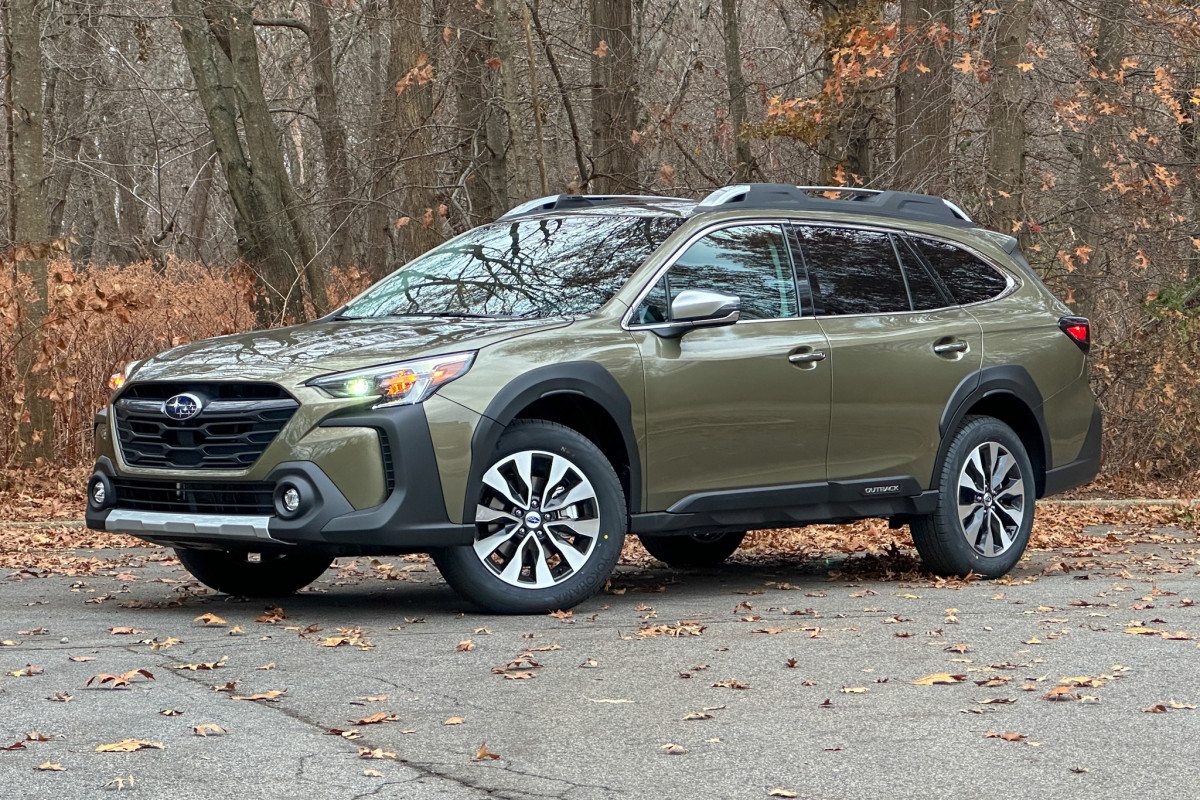
On the outside, the Outback wears its gray cladding high on its wheel arches, sills, and bumpers, because it's better to scratch plastic than paint. The styling remains smooth and plain, tall but not towering, with enough length to give the impression of balance and stability. There are a few chrome flourishes on the window trim and bracket-shaped LED running lights. Changes are few for 2021. A new brown paint, Brilliant Bronze Metallic, is available on the Touring and Premium trims. Adaptive LED headlights are now standard. The biggest standout feature is something Subaru and its buyers will no longer admit: This is a lifted wagon. That’s why it’s a great alternative to a typical crossover or SUV. It’s also why the Outback hasn’t changed appearance since Paul Hogan was in the Subaru commercials.
Performance
As cars have become larger and heavier, Subaru has refused to adjust the Outback’s engine output for inflation. In 2021, this 2.5-litre Subaru boxer flat-four is making nearly the same power as it did in the 1990s, but with direct injection and without the quicker gearing of a manual or conventional automatic transmission. The Outback in base trim weighs a minimum of 1,656 kilograms (3,650 pounds). Now add four adults, luggage, bikes on the back, more cargo on the roof, and a few more options. Now ask a four-cylinder engine with 182 horsepower to move 4,500 pounds in a reasonable amount of time. The results are as predictable as they are pathetic. With 176 pound-feet of torque and a continuously variable transmission (CVT) that cannot adjust to this engine’s thin power band, the Outback is brutally slow and noisy as it tackles the highway, hills, and normal life on the road.
The only saving grace for this antiquated powertrain is throwing it out, which Subaru does if you order the XT, available on the Outdoor, Limited, and Premier trims. This 2.4-litre flat-four is turbocharged, with up to 14.5 psi of boost on regular-grade gas. The results are night and day: 260 hp, 277 lb-ft of torque at a low 2,000 rpm, and a newfound capability to keep up with traffic. This engine is quieter and smoother than the 2.5-litre and even more powerful and refined than the older 3.6-litre flat-six it replaced.
The Outback was never about speed, nor should it be. But safety and capability go hand in hand. The Outback is too large a vehicle to use an underpowered engine. While the XT is restricted to the top trim levels and adds thousands of dollars to the price, the returns are worth the money. Fuel efficiency on the turbo XT suffers mildly to the base engine, at a Natural Resources Canada-estimated 10.1 litres per 100 kilometres city and 7.9 highway compared to 9.0 city and 7.1 highway. When weighed down, expect the 2.5 will burn at least as much fuel, if not more, than the turbo XT.
The Outback’s squishy handling and imprecise steering are forgiven since it’s built to be a long-distance cruiser. Under these circumstances, the Outback’s ride comfort and tranquil behaviour are fantastic with either engine. Long-travel springs and high 22 centimetres of ground clearance let the Outback charge through rough roads, especially when there are no roads left.
Subaru’s electronically-variable AWD is legendary. Unlike many competitors that primarily drive the front wheels and then drive the rear wheels after the vehicle is already slipping, the Outback is more proactive. It always drives all four wheels and reacts quicker to vary the torque split. Activating X-Mode engages hill descent control and optimizes the throttle, CVT ratio, stability control, and torque split for tougher road conditions, while the Outdoor trim adds two more driving modes for snow and mud. Regardless, when equipped with the proper seasonal tires, an Outback is basically unstoppable and more proficient off-road than most wannabe crossovers and SUVs. Subaru is a long-time rally car champion and its continuing success in that grueling motorsport shows up on the road, in the Outback.
Form & function
Reconsider the Outback’s ground clearance: Its underside is further off the ground than a Chevrolet Tahoe and any number of real trucks. That means an Outback can go anywhere they do, and possibly further, without the drawbacks of being a huge, oversized vehicle. But the Outback is plenty big inside, where it can hold 2,144 litres of cargo with the rear seats folded and has a substantial 920 litres of cargo space with them raised. The cargo area is wide, flat, and free of any oddly-shaped cutouts or intrusive wheel arches.
Headroom and legroom are ample in all four outboard seating positions, and those seats are comfortable and supportive. Outward visibility is superb in every direction, thanks to thin pillars, a low shoulder height, and lots of glass. Many modern cars with sloped roofs and slinky silhouettes choose, on purpose, to sacrifice the driver’s vision for style. The Outback has blind-spot radar and ultrasonic parking sensors, but they’re a supplement rather than a necessity.
Storage is another plus. In addition to large map pockets and bottle holders in each door, the front centre console has a handy pocket on either side plus a small shelf on the passenger-side dash. They’re perfect for stashing loose items you’ll want to retrieve quickly, like toll transponders.
Downsides: Push-button start and rear console climate vents are not standard, starting at the Touring and Limited trims respectively. In this way, Subaru is more like BMW—charging extra for essential features that should be standard. Subaru’s little moonroof is also included from the Outback Touring grade.
A power driver’s seat and rear USB ports are standard, and dual-zone climate and a hands-free power liftgate are included from Touring. Only the Outdoor XT comes with a full-size spare alloy wheel and tire; others have a steel wheel on a doughnut.
But the Outback’s best feature has to be the standard roof rails and integrated crossbars. On any other SUV, you have to buy the crossbars separately and install them when needed. On the Outback, they sit flush within the rails and can be swiveled and locked in place within seconds for easy installation of a roof rack or other items. Not only is this a money-saver, but it’s also just brilliant engineering.
The oversized 11.6-inch touchscreen does complicate the climate controls, as only driver and passenger temperature are outside the screen as buttons. Controls for the heated seats are also within the screen, which hampers usability. The icons are large and the screen is generally responsive. Plus, the big screen makes it easier to adjust vehicle settings and scroll through stereo presets.
Technology
Like all Subaru models, the Outback’s infotainment system looks about a decade old—think graphics and typefaces similar to the Nintendo Wii instead of the PlayStation 5. The central screen in the instrument panel is worse. Unfortunately, this user interface masks the modern tech underneath and brings the Outback down a few notches. For example, the Outback’s adaptive cruise control has four settings that change how the car responds to changes in traffic speed. This is fantastic—but finding it and changing it is a bear. However, SiriusXM satellite radio and Apple CarPlay and Android Auto come standard, and the optional navigation is more modern-looking than the rest of the system. But do yourself a favour and do not order the base model with the dual-screen setup. The single large screen, for all its flaws, is more cohesive, useful, and attractive.
Subaru EyeSight is standard on all trims. That includes adaptive cruise, lane-keep assist, and forward automatic emergency braking. The system offers good semi-automated control on marked highways. However, it relies on two forward-looking cameras and does not supplement them with forward-facing radar. When their view is blocked or impeded, such as around tighter curves, EyeSight’s impressive functionality is degraded compared to other systems that use both camera and radar.
Safety
The 2021 Outback rides on a chassis that is stronger and stiffer than previous models. A driver’s knee airbag and passenger seat-cushion airbag are standard. More driver assist technology and safety features are also available on most trims. Blind-spot monitoring with rear cross-traffic alert is standard from the Touring trim, as is reverse automatic braking. A driver-attention monitor is included only with the Premier and Premier XT.
The Outback was a 2020 Insurance Institute for Highway Safety (IIHS) "Top Safety Pick+," an award that is tougher for automakers to earn than in years past. The 2020 Outback, which is identical to the 2021 Outback, earned the top “Good” ratings in all six crash tests and for headlights, plus the top “Superior” rating for its forward emergency braking, activated by vehicles and pedestrians.
The National Highway Traffic Safety Administration (NHTSA) evaluated the 2021 Outback in three crash tests and a rollover test. The car scored an overall five stars, but with four stars for the front passenger in a frontal crash and four stars for the rollover test.
Cost-effectiveness

What owners say
"Overall, owners are very happy with the 2021 Subaru Outback, praising its comfortable ride, impressive safety features, and modern technology. Many drivers are excited about the upgrades and performance, especially the turbocharged engine option. However, some have mentioned that storage space in the cabin could be improved, and there are concerns about the accessibility of climate controls on the touchscreen, which can be distracting while driving."
Upgraded to 2021 Limited from a 2016 Outback. Like the improvements for the seat positioning options, mirror adjustment integration to driver choice, and of course the touch panel in the middle. Will be integrating Android Auto as well once I stop driving. It has a better ride then 2016 - kudos to Subaru for making those minor adjustments. Looking forward to better gas mileage, engine now shuts down when at a stop. Heated steering wheel a nice touch. Map and driving direction work very nicely with improved notifications. Traffic jams are now very apparent. Look forward to longer road trips given the comfort that is now there.
December 9, 2021Not fast but fun to drive, enough space for anything I need. Safe and capable of going anywhere and everywhere.
February 18, 2024We were searching for a safe and reliable car for our teenage son to commute back and forth to school. The Outback checks so many of the boxes for what we were looking for... with one very big exception. The climate controls on the 2020+ models being very low on the touch screen(s) and not directly responsive caused my son to take his eyes off of the road for much too long of a time just to adjust the fan speed. Were now considering models up to and including the 2019 builds as the climate controls are more easily accessible.
August 24, 2023What owners say
Upgraded to 2021 Limited from a 2016 Outback. Like the improvements for the seat positioning options, mirror adjustment integration to driver choice, and of course the touch panel in the middle. Will be integrating Android Auto as well once I stop driving. It has a better ride then 2016 - kudos to Subaru for making those minor adjustments. Looking forward to better gas mileage, engine now shuts down when at a stop. Heated steering wheel a nice touch. Map and driving direction work very nicely with improved notifications. Traffic jams are now very apparent. Look forward to longer road trips given the comfort that is now there.
December 9, 2021Not fast but fun to drive, enough space for anything I need. Safe and capable of going anywhere and everywhere.
February 18, 2024We were searching for a safe and reliable car for our teenage son to commute back and forth to school. The Outback checks so many of the boxes for what we were looking for... with one very big exception. The climate controls on the 2020+ models being very low on the touch screen(s) and not directly responsive caused my son to take his eyes off of the road for much too long of a time just to adjust the fan speed. Were now considering models up to and including the 2019 builds as the climate controls are more easily accessible.
August 24, 2023Im not sure if its due to riding higher or what it could be but for some reason this outback xt feels quicker than my previous 2015 wrx. I drove a impreza in-between the two so its hard to say. But the crazy lag I remember with my wrx is not present in my xt. Its awesome and more than I expected.
May 2, 2023Great ride. So far it’s living up to its mileage boast. Wicked comfortable. Awesome amount of little bells and whistles and at only 26K and I got the zero percent interest it’s worth every penny.
April 8, 2021This is my second Outback. I am selling my 2012 Limited edition to my daughter. It has 187,000 miles on it and still drive and looks new. I just wanted a little more get up and go that the new Outback Onyx edition has with the 2.4L turbo-charged engine. Also, I wanted the newest bells and whistles in the media/electronic compatibility area. And to say I am excited about it would be an understatement. This car is amazing! I love the way it looks, feels, and drives. If I had to say anything negative, it would be the lack of storage space in the driving section. My old model had lots of nooks and crannies to put whatever “stuff” I felt I need at the ready. This new Outback has extra airbags that I’m sure take up some of the space. Also, the iPad-sized control panel negates my dash cubby. They did include a small recess above the glove compartment that is handy. All in all, I would recommend this car whole-heartedly! And seriously, Subaru has the best customer service.
March 13, 2021Well overpriced but a great car. Been driving Subies for years and have 2 now
August 14, 2023Trims & specs
Base MSRP $33,595 | Seating 5 |
Engine 2.5L 182 hp H4 | Cargo Capacity 32.5 cu ft |
Combined MPG 29 | Drivetrain AWD |
Base MSRP $27,645 | Seating 5 |
Engine 2.5L 182 hp H4 | Cargo Capacity 32.5 cu ft |
Combined MPG 29 | Drivetrain AWD |
Base MSRP $38,695 | Seating 5 |
Engine 2.4L 260 hp H4 | Cargo Capacity 32.5 cu ft |
Combined MPG 26 | Drivetrain AWD |
Base MSRP $29,045 | Seating 5 |
Engine 2.5L 182 hp H4 | Cargo Capacity 32.5 cu ft |
Combined MPG 29 | Drivetrain AWD |
Base MSRP $35,845 | Seating 5 |
Engine 2.4L 260 hp H4 | Cargo Capacity 32.5 cu ft |
Combined MPG 26 | Drivetrain AWD |
Base MSRP $40,645 | Seating 5 |
Engine 2.4L 260 hp H4 | Cargo Capacity 32.5 cu ft |
Combined MPG 26 | Drivetrain AWD |
Base MSRP $27,695 | Seating N/A |
Engine N/A | Cargo Capacity N/A |
Combined MPG N/A | Drivetrain N/A |
Base MSRP $38,195 | Seating 5 |
Engine 2.5L 182 hp H4 | Cargo Capacity 32.5 cu ft |
Combined MPG 29 | Drivetrain AWD |
Base MSRP N/A | Seating N/A |
Engine N/A | Cargo Capacity N/A |
Combined MPG N/A | Drivetrain N/A |
Base MSRP N/A | Seating N/A |
Engine N/A | Cargo Capacity N/A |
Combined MPG N/A | Drivetrain N/A |
Base MSRP N/A | Seating N/A |
Engine N/A | Cargo Capacity N/A |
Combined MPG N/A | Drivetrain N/A |
Base MSRP N/A | Seating N/A |
Engine N/A | Cargo Capacity N/A |
Combined MPG N/A | Drivetrain N/A |
Base MSRP N/A | Seating N/A |
Engine N/A | Cargo Capacity N/A |
Combined MPG N/A | Drivetrain N/A |
Base MSRP N/A | Seating N/A |
Engine N/A | Cargo Capacity N/A |
Combined MPG N/A | Drivetrain N/A |
Base MSRP N/A | Seating N/A |
Engine N/A | Cargo Capacity N/A |
Combined MPG N/A | Drivetrain N/A |


Pricing trends
MSRP range
$26,795 - $39,945
Current avg. market price
$26,124
Trending down by 2.6% this month
May 2026 - October 2026