2021 BMW M3 Reviews, Pricing & Specs





The CarGurus verdict
The new BMW M3’s best angle is from the driver’s seat – and that’s just fine by us.
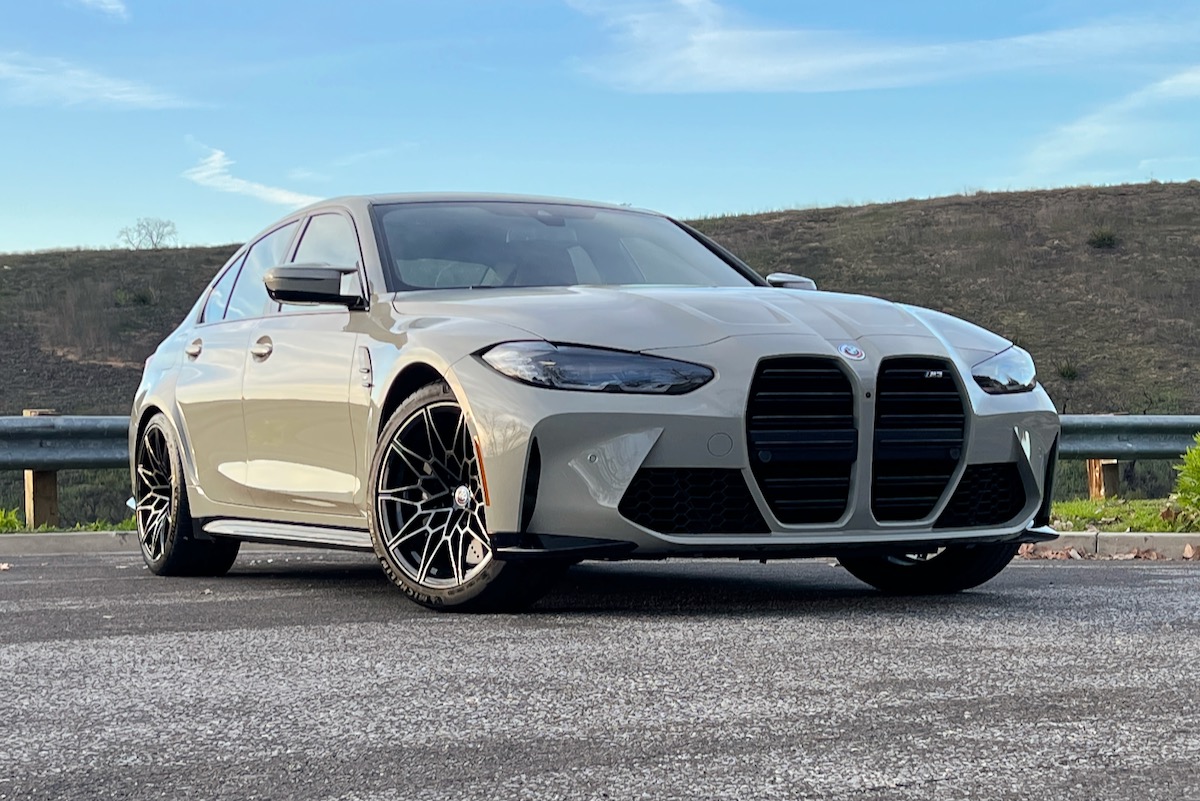
People sure do love expressing their opinions about the latest 2021 BMW M3 sedan and its BMW M4 coupe sibling, most notably regarding the dramatic new grille. Some say BMW’s oversized grilles are getting out of hand, while others observe that increasingly ostentatious automotive design is simply the order of the day. We say you don’t have to look at the grille while you’re behind the wheel, and as with every M car that has come before it, the experience from the driver’s seat is what sets these vehicles apart.
out of 10 expert review
Look & feel
Yes, that grille is divisive. For our part, we’re not fans. One of the best things about modern BMW M cars has traditionally been that they’ve flown below the radar—like a wolf in sheep’s clothing, as the saying goes—and the new M3 runs completely counter to that ethos. Everyone sees this thing coming, even in the most sedate exterior colours. Some owners may revel in the added attention, given the amount of their investment: the standard M3 starts at $86,780 including a $2,480 destination charge, and with options the model we tested rings up at $96,150. But we’re concerned the distinctive grille and styling may attract more of the unwanted sort of attention, namely of the fines-and-demerit-points variety.
On the other hand, the grille is the only thing about the exterior of this car that’s questionable. Every single other line and detail is perfect, from the blue accents in the optional upgraded LED cornering headlights to the gloss black side skirts and window trim, M painted brake calipers, and the matching quad exhaust tips. Even this test unit’s oxide grey metallic paint seems to somehow deepen the effect of the subtle shadows cast by the tasteful door stamping. From every angle but the front, this car is the sedan perfected.
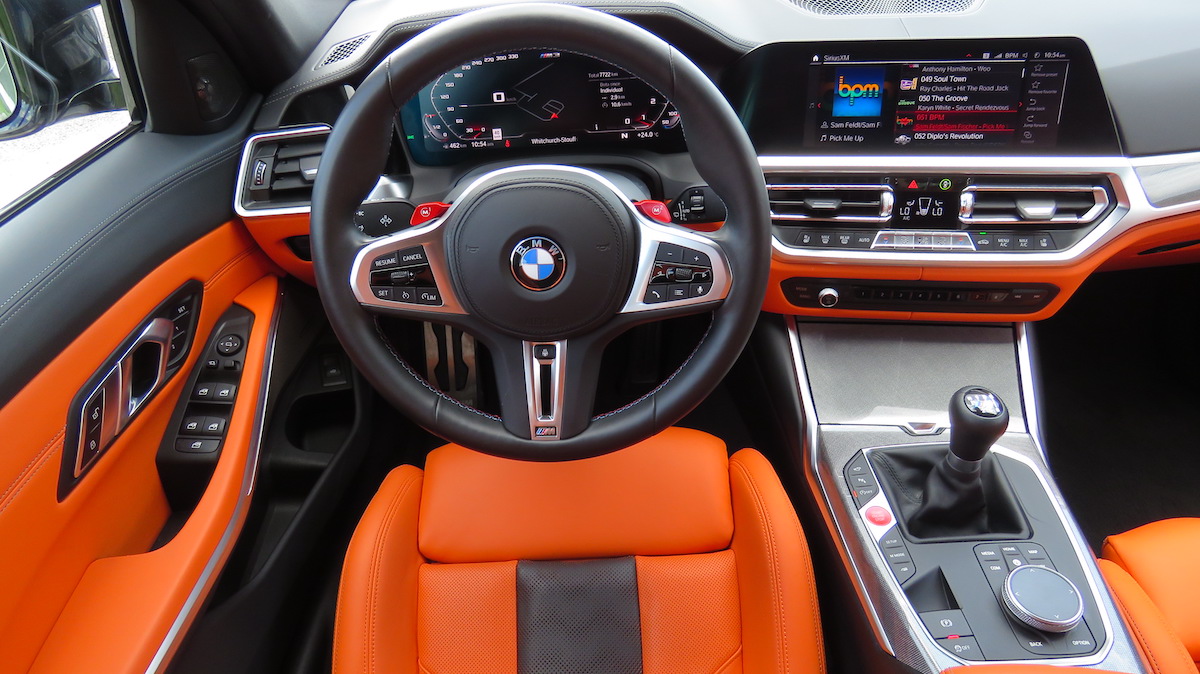
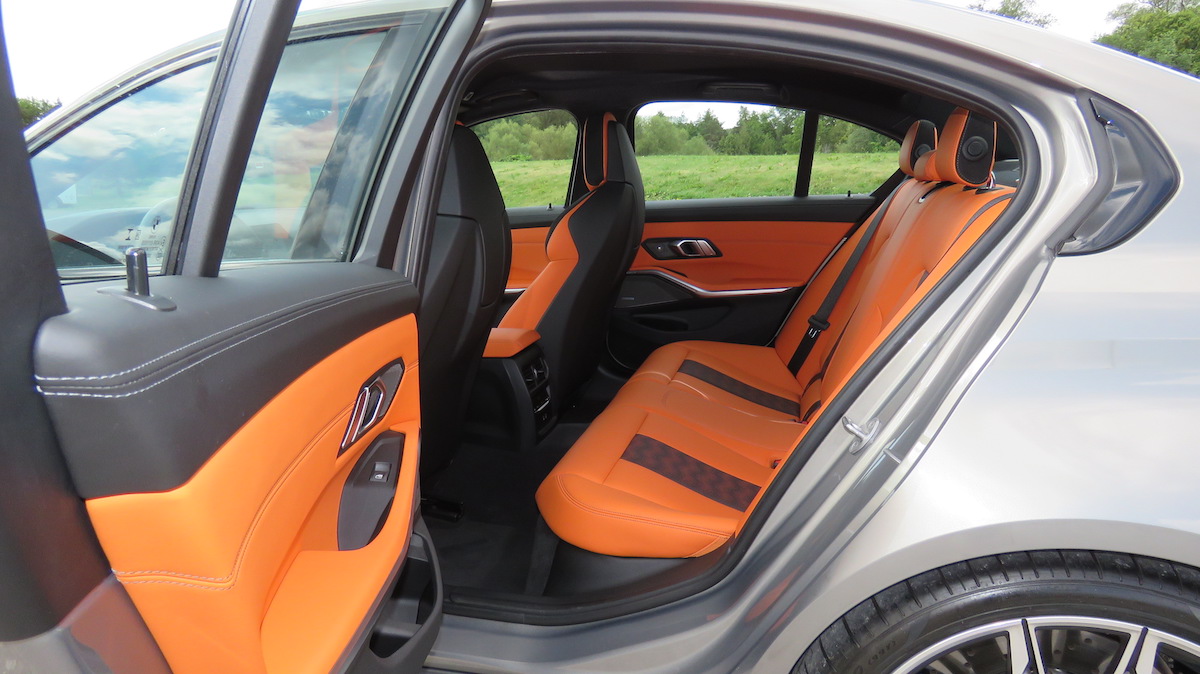
And that’s even before we get to the interior. Now, to be fair, our test car was equipped with orange merino leather, a $4,000 option that will win us over every darned time. Grey, blue-green, and black interiors are also offered with each configuration available in either the standard partial merino leather finishes or the upgraded full merino treatment. The aluminum “fabric” inserts employed here, a $500 option that looks like a gloss-covered metal mesh, complement this interior perfectly; open-pore wood and carbon fibre are also available. The layering of materials and colours, along with the standard illuminated M3 logo in the front seats and subtle ambient lighting, are tastefully executed while acting as a constant reminder of the calibre of the machine you’re driving.
Performance
The toughest part about buying a 2021 M3 is choosing your preferred method of putting the power down.
There are two versions to choose from: the standard M3, and the BMW M3 Competition. Each comes fitted with the same 3.0-litre, twin-turbocharged inline-six-cylinder engine. In the M3, it produces 473 bhp and 406 lb-ft of torque. In the M3 Competition, this output is increased to 503 bhp and 479 lb-ft.
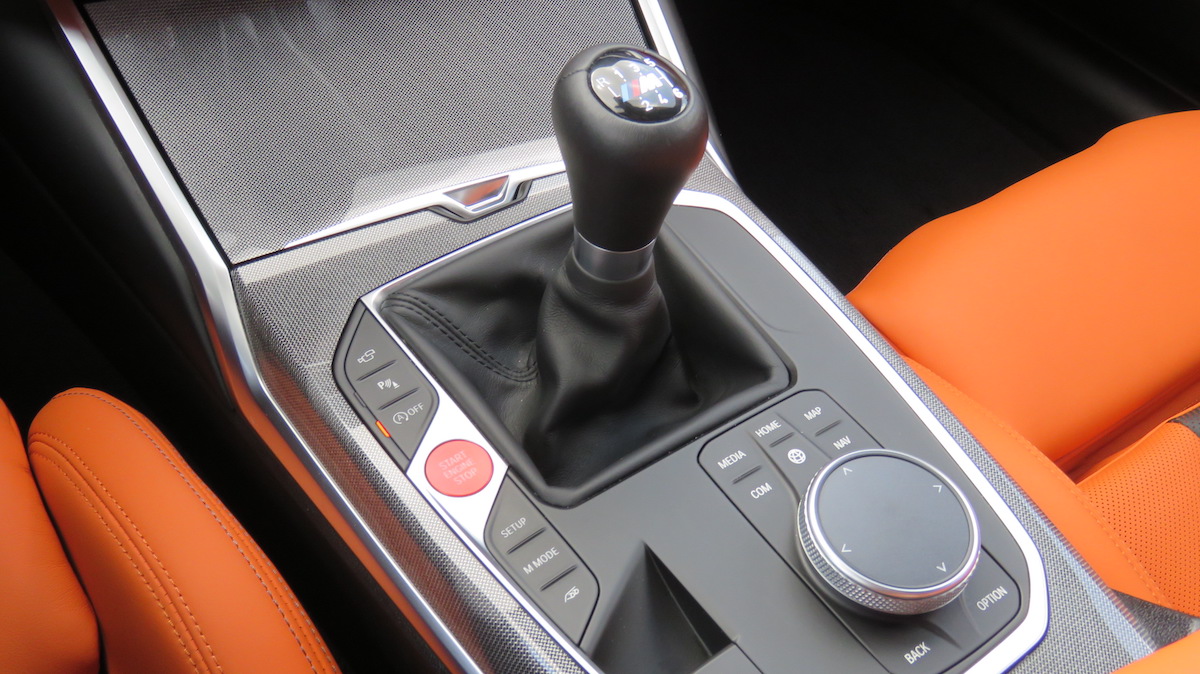
But here’s where things get interesting: the lower-horsepower M3 comes only with a six-speed manual transmission. This is the model we tested for this first drive review, and this transmission is eminently satisfying with snappy action on the shifter, though it takes some skill to achieve smooth shifts when accelerating through the lower gears. It’s also possible that very aggressive shifters could inadvertently shift into reverse instead of into first gear since there’s no additional action needed to get into the former except an extra push to the left. A rev-matching system is installed to assist with downshifting, and it’s one of the better and more natural-feeling ones we’ve encountered. With this transmission, the M3 is 22.5 kilograms (50 pounds) lighter than the M3 Competition, and its front-to-rear weight distribution is closer to even.
On the other hand, due to the higher torque output in the M3 Competition and M4 Competition, these models are available only with BMW’s high-performance eight-speed M automatic transmission. We haven’t tested it in this specific vehicle but we have in others, and it does the job much more quickly than even the most skilled self-shifter ever could. A manual mode can be activated and controlled using the shift lever, and an interesting feature allows the driver to downshift to the lowest possible gear by pulling the left steering wheel mounted shift lever and simultaneously pressing the throttle. Three drive modes are included – comfort mode, sport mode, and a track-oriented setting – and each progressive mode increases the speed of shifts and the length of time that gears are held.
This makes the decision of which M3 to choose a complex one. Which makes you the more talented driver: the ability to row your own gears, or the ability to successfully wrangle more power and torque? That’s for each individual owner to determine.
The standard M3 is exclusively available in rear-wheel drive. Starting in the summer of 2021, the Competition models come with a new M-tuned xDrive all-wheel-drive system for the first time. Every M3 comes equipped with BMW’s adaptive M suspension. In this context, the comfort mode doesn’t seem to be quite as smooth over typically winter-ravaged Canadian roads as it is in larger M vehicles, though this can perhaps be forgiven given the M3’s performance intent and relatively lower cost.
The M button on the centre console enables switching between road and sport modes, and a track mode is unlocked when the newly available M Drive Professional feature is equipped. (On our test car, this feature comes as part of the Premium Package that also includes an automatic trunk release, ventilated front seats and rear seat heating, upgraded headlights, a surround-view camera, head-up display, drive recorder, wireless charging pad, and a Wi-Fi hotspot for $6,000.) The M Drive Professional feature allows the driver to fully disable the car’s comfort and safety assistance features for optimal on-track performance, and it also equips a lap timer and the M Drift Analyzer that records the duration, distance, and angle of a drift and gives each one a rating. As with other M models, the M3 has two red buttons mounted on the steering wheel that allow for quick access to customized performance settings for traction control, suspension, steering response, and other features.

Form & function
Let’s start with the bad news: if you opt for the M3 with the 6-speed manual transmission, you’ll want to skip the beverages more often than not. The cupholders in the centre console sit just ahead of the shifter, which means you’ll rap your knuckles on anything that’s in them whenever you shift into third or fifth gear. This is a surprising usability oversight from such a detail-oriented automaker as BMW. Unfortunately, the door-mounted cupholders don’t mitigate the problem. They’re positioned at an angle, which makes them effective at holding capped bottles but not at all useful for your morning venti. Of course, opting for the M3 Competition and its automatic transmission solves this problem, but that does nothing to preserve the beauty of doing one’s own gear selection.
Everything else about the M3’s interior ergonomics is excellent. The front seats are power-adjusting and are very comfortable with excellent bolstering, and the back seats are contoured nicely but not excessively into a bucket shape. Of course, opting for the M3 sedan rather than the M4 coupe makes these rear seats easy to reach thanks to its four-door body style.
Heated front seats and a heated steering wheel are standard. Heated rear seats and ventilated front seats are available as part of the Premium Package. With the front seats both heated and ventilated, the car can predict your preference based on the exterior temperature: we saw it go from heating on a chilly morning to ventilation on a hot and sunny afternoon.
According to BMW, the M3’s trunk measures 13 cubic feet, which more of less matches other compact sedans.
Technology
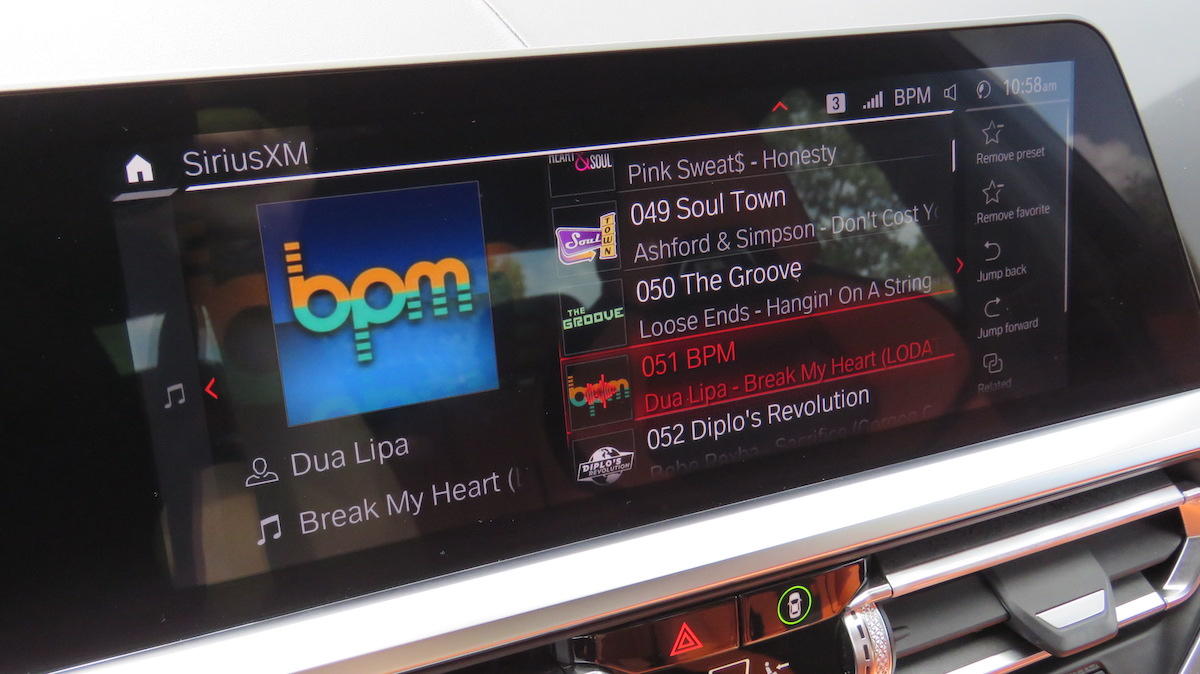
The new M3 and M4 include both a fully digital 12.3-inch instrument cluster and a 12.25-inch high-resolution touchscreen infotainment display as standard equipment. The updated iDrive 7 operating system is excellent with much more intuitive functions for previewing what’s playing on your favourite radio stations, cloud-based maps, and standard compatibility with Apple CarPlay and Android Auto. Interaction with the system can be done by touch, through the rotary controller on the centre console, or via voice commands.
The digital instrument cluster is a mixed bag; some hate the way it looks compared with BMW's simple analogue dials, while others will enjoy the clear and easy-to-read graphics and custom M-specific displays. The optional head-up display has a 70 percent larger surface than the previous version and can project a multi-colour tachometer, shift lights, and an M View mode. Do note, however, that if you wear polarized sunglasses it is nearly invisible.
One tech-related concern is that the optional wireless charging pad is positioned inside the already-small centre console bin, and it’s side-mounted with a clip, which makes it awkward to use with many types of phone cases. That said, there aren’t many other places the designers could have put it, and it is a smart idea to put smartphones out of sight and, ideally, out of mind for the driver.
Our test team in the US meanwhile remarked that the optional Harman Kardon surround sound system lacked depth and resonance and simply didn’t do the car’s price tag justice.
Safety
Given that the standard M3 comes with a manual gearbox and is intended to be within the driver’s control at all times, standard safety and driver assistance features are respectable. The standard Driving Assistant feature includes forward collision warning with city braking, rear cross-traffic alert and collision mitigation, lane departure warning, and speed limit information. Adaptive cruise control, automatic high beams, and blind spot monitoring are also standard.
The M3 Competition’s automatic transmission makes the Advanced Driving Assistant Package available, which includes active cruise control with stop and go functionality, a traffic jam assistant, lane keep assist, lane change assist, front cross-traffic warning, crossroads warning, evasion aid, and emergency stop assistant.
The Insurance Institute for Highway Safety (IIHS) and National Highway Traffic Safety Administration (NHSTA) have not rated the M3 on its own. The IIHS gives the BMW 3 Series a Top Safety Pick designation when equipped with specific headlights. Crashworthiness is rated Good in all categories. The NHTSA gives the 3 Series a five-star safety rating.
Cost-effectiveness
Unlike the BMWs of yesteryear, the 2021 M3 and its related models are reasonably well-equipped given the price point, and selecting from the options list doesn’t feel like nickeling and diming. That said, it doesn’t take long to approach six-digit pricing once you do start looking at options, though that likely won’t take potential buyers by surprise.
It also won’t surprise anyone to find out that the M3 isn’t the most fuel-efficient car on the road. With the manual transmission, the engine holds just shy of 3,000 revolutions per minute at typical Ontario highway speeds, which is ideal for keeping it ready to pounce in a performance context but could get expensive when using this car as a daily driver. This no doubt contributed to our final as-tested fuel consumption rating of 12.5 litres per 100 kilometres. At time of publication, official fuel consumption ratings from Natural Resources Canada have not yet been released.
BMW Canada offers a four-year, 80,000-kilometre warranty on all its vehicles.
The standard M3’s major competition includes the Mercedes-AMG C 63 (from $89,700 before destination charges, which vary) and the Audi RS5 Sportback (from $89,950 including a $2,550 destination charge). Pricing and power output is comparable on each, but neither of those offerings can claim the design and character edginess BMW offers. There’s no other sports car on the road quite like an M3, and as far as its desirability goes, quibbles over practical concerns won’t change a thing.

What owners say
Overpriced for what you get. Car needs to be $10k-$12k cheaper. It’s being over hyped.
August 3, 2025Recently purchased one, and am loving it. Great to have the six-speed manual for the base trim. :)
May 19, 2021Manual transmission; great stye; may change color. Interior looks good
August 25, 2022Trims & specs
Base MSRP $79,300 | Seating 5 |
Engine 3.0L 473 hp I6 | Cargo Capacity 13.0 cu ft |
Combined MPG 19 | Drivetrain RWD |
Base MSRP $83,500 | Seating 5 |
Engine 3.0L 503 hp I6 | Cargo Capacity 13.0 cu ft |
Combined MPG 19 | Drivetrain RWD |