2020 Dodge Charger Reviews, Pricing & Specs
Write a reviewPros
Multiple powertrain options
Spacious
Cons
Poor fuel economy
Advanced safety features are not standard
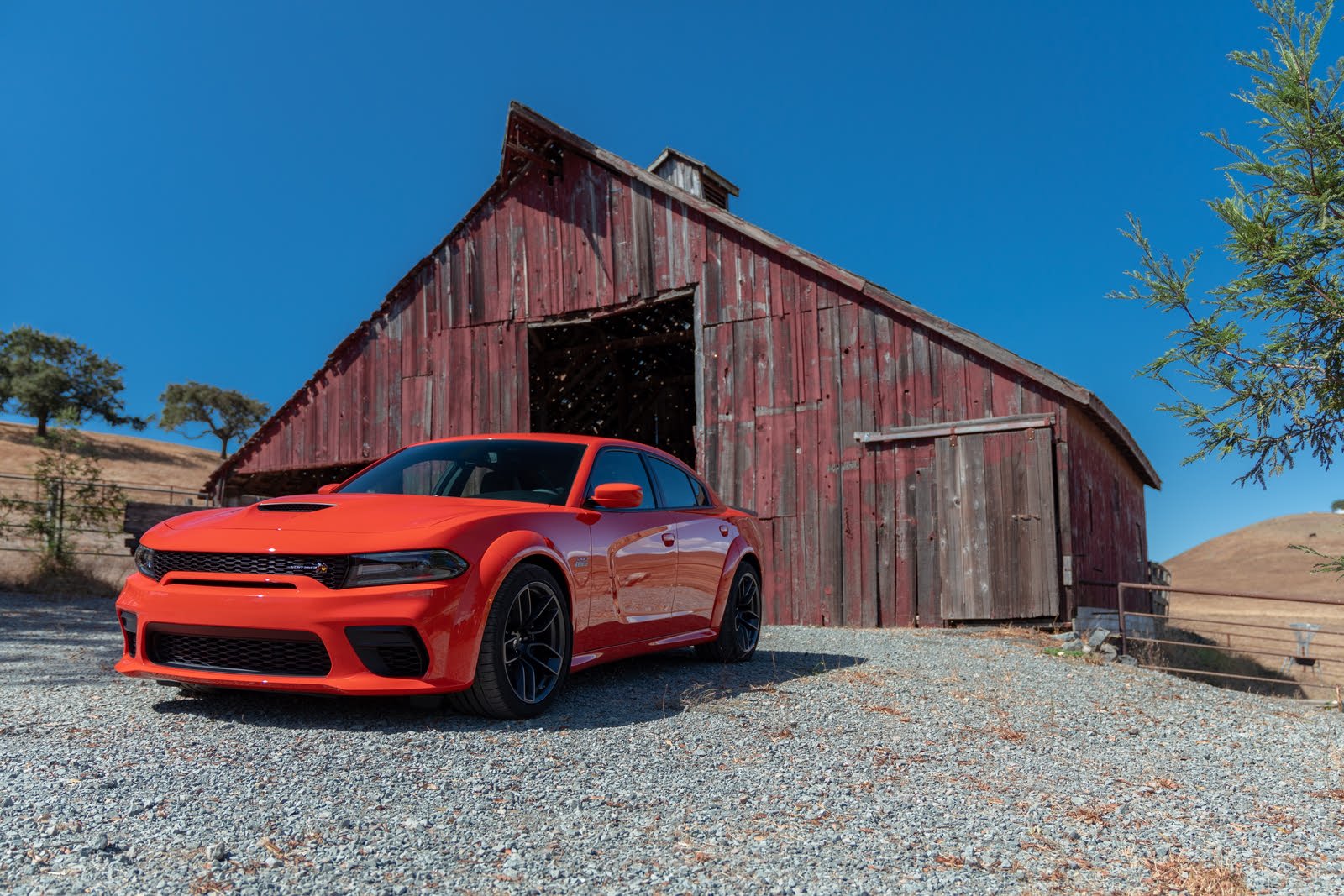
The 2020 Dodge Charger proves that sedans can be supremely fun and still offer a spacious cabin and large trunk.
The Dodge Charger represents an all-in-one approach to modern performance. Unlike its Dodge Challenger coupe counterpart, the Charger is a sedan, providing the usability of four full doors and five-passenger seating. It offers a wide variety of potent powertrains, as well as the availability of all-wheel drive (AWD). The Charger also provides the latest tech and infotainment features. It may be a classic nameplate, but it is a very different approach to the family sedan. This also makes it a breath of fresh air in the modern sedan market.
Thanks to its wide variety of performance models, the Charger's exact competition is hard to pin down. V6-powered versions like the SXT and GT compete with the likes of the Toyota Avalon, Nissan Maxima, and Chevrolet Impala. But the available performance on tap with R/T and Hellcat models opens it up to a world of sports cars and muscle cars. Which model you select determines its rivals.
No matter the trim selected, the Charger provides a baseline of athleticism paired with a spacious cabin, large rear seats, and a large trunk. Together, these make the Charger a fun and functional new car, with styling that helps it stand out in a crowd.

Dodge resurrected the Charger name in 2006 with a modern take on the muscle car silhouette. The menacing headlights and gaping grille that were key to this car also found their way to the current-generation car, which arrived in 2011. Then, in 2015, the Charger underwent a major facelift, while maintaining the same underpinnings and interior. 2015 was a major departure from the previous 10 years of design, but it fits perfectly with Dodge's identity as a purveyor of modern American performance (notwithstanding that it’s assembled in Brampton, Ontario, Canada).
This 2015 update replaced the large grille with a thin inlet, opening up the lower front grille area below the bumper. Just as significant were the changes to the headlights, taking the "menacing" theme to new places.
The Dodge Charger's cabin still honours that retro theme, while blending old and new. The large vintage-looking bezels house modern digital displays. The Charger's rear-wheel-drive (RWD) platform requires a raised transmission tunnel, lending to the tall centre console. This creates a cockpit-like feel for the driver and front passenger.
Trim levels for the 2020 Charger are SXT, GT, R/T, Scat Pack, and SRT Hellcat. The Charger SXT comes standard with 17-inch alloy wheels, remote start, push-button start, power-adjustable front seats, dual-zone climate control, rear parking sensors, a Wi-Fi hot spot, and a 8.4-inch infotainment screen with HD Radio plus safety features like blind-spot monitoring and the mandated back-up camera.
Moving to the Dodge Charger GT trim adds several visual touches, including 20-inch wheels, a more pronounced lower front spoiler, rear trunk lip spoiler, and a hood scoop. The GT also provides a fantastic houndstooth pattern in the fabric seats, offering an attractive alternative to leather.
The R/T and GT share a good amount of the visual cues and cabin features, but the R/T has the added benefit of a V8 engine. A Charger Scat Pack variant of the R/T is available, covered in performance.
The Charger SRT Hellcat features the largest engine in the lineup, as well as leather upholstery, heated and ventilated front seats, and heated rear seats. The Hellcat also comes with the widebody kit, which is available for the R/T Scat Pack, too. It features more pronounced fenders and wider wheels and tires.

The Dodge Charger offers a number of different ways to enjoy the drive, and trim levels correspond with powertrain selection. The SXT and GT come equipped with Chrysler's 3.6-litre Pentastar V6 engine. In the SXT RWD, it makes power specs of 292 horsepower, while the SXT with AWD and the GT bump that output to an even 300 horsepower. The V6 and all other engines route power to the rear wheels through an eight-speed automatic transmission with manual tap-shift function. AWD is available as an option on the Dodge Charger SXT and GT.
The R/T comes with a 5.7-litre Hemi V8 putting out 370 hp and 395 lb-ft of torque. The R/T also features an upgraded performance suspension and an active exhaust. It can un-muffle the sound of the V8 either manually or automatically to unleash the full, raw sound of the engine.
The Dodge Charger Scat Pack comes with a 6.4-litre (392 cubic inch) Hemi V8 making 485 hp and 475 lb-ft of torque. It also features Brembo high-performance disc brakes and launch assist, which holds the revs at the ideal point for perfect acceleration from a standstill. Given its $52K price tag, CarGurus recommends the R/T Scat Pack as the ultimate high-horsepower bargain.
There is also a Scat Pack Widebody variant. It features unique bodywork and the aforementioned wider track, wheels, and tires. This setup is also found on the range-topping Dodge Charger SRT Hellcat Widebody, which boasts a supercharged 6.2-litre V8, making 707 horsepower and 650 pound-feet of torque.
The Charger lineup represents the ultimate example of "Good/Better/Best" as the base V6 allows the Charger to accelerate quite well compared to the Toyota Avalon or Nissan Maxima. The 5.7-litre V8 is heaps of fun, and the 6.4-litre Hemi in the Scat Pack is a serious performance powerplant. Then there is the Hellcat V8. Its 707 horsepower will rocket you back in your seat, be it from a standstill or climbing to another level when already at highway speeds.
You certainly do feel the weight of the Charger at times. Though never sluggish, some body roll is noticeable in turns. The upgraded suspension in some models levels that out, but it is still present.
Both widebody models have Bilstein adaptive suspension, each with their own unique tuning. The combination of wider track and a clever high-tech suspension turn the Charger into a surprisingly precise corner-carver. Perhaps the suspension is necessary to manage the weight of the big V8, but it pays huge dividends on winding back roads. The Brembo brakes are absolutely necessary for the weight, but also contribute to the fantastically dialed-in approach to the Charger's cornering.
Dodge provides an incredible amount of information and chassis customizing through the Performance Pages. Located in the centre touchscreen, it allows you to record lap times, acceleration runs (0-100 kph, quarter mile, etc.), and monitor engine performance with incredible detail. Just as crucially, Performance Pages provides a number of drive modes and the ability to toggle your own preference for throttle response, transmission mapping, steering feel, suspension feel, and traction control.

There are other high-horsepower sedans out there, like the Alfa Romeo Giulia Quadrifoglio, BMW M5, Audi RS6, and others. Few offer as much space as the Dodge Charger. In many performance sedans, the rear seats are an afterthought. But with the Charger, there is plenty of legroom, even with the seats slid back.
The driver and front passenger are treated to well-bolstered front bucket seats as well as tons of head- and legroom. The doors feature helpful trays and cup holders and the centre console provides a number of quick and easy storage solutions. The Charger also boasts a large trunk, displacing 467 litres. Not only is this better than many performance sedans, but it is also above average even for the large family sedan set. It comes standard with a 60/40 split-fold rear bench that opens up for even more storage space.
In Canada, all trims of the Charger feature an 8.4-inch touchscreen. This runs FCA's outstanding Uconnect infotainment system. It features Bluetooth and USB connectivity, available satellite radio, available HD radio, standard Apple CarPlay, and standard Android Auto.
More than anything, this system shines thanks to its simplicity. The main screen features a lower dock of icons for media, climate, controls, phone, and settings. No matter which menu you end up on, those docked icons are always there. This ensures you can quickly jump to another function without the added step of backing out of menus. When using Apple CarPlay, other rival systems require going to CarPlay's home screen, finding the automaker's icon, and pressing that to get back into the native infotainment system. In Uconnect, the dock icons are always present, even when you are in CarPlay, and they include a CarPlay or Android Auto dock icon. This ensures you can jump between Uconnect and your preferred mobile device infotainment system with ease.
This logical menu layout carries over to the standard digital display screen at the centre of the instrument panel. It is operated via a directional pad on the steering wheel and allows for easy cycling through functions like a trip computer, digital speedometer, vehicle settings, radio station, and phone call information. This screen also presents turn-by-turn directions for the available navigation system.

Standard safety features on the 2020 Dodge Charger include a full array of front- and side-impact airbags, traction control, and rear parking sensors. Forward-collision warning with automatic emergency braking, adaptive cruise control, blind spot monitoring and rear cross-traffic alert, and automatic high-beams are also standard features. Lane-departure warning and lane-keeping assist, as well as rain-sensing wipers, are optional.
During Insurance Institute for Highway Safety (IIHS) crash tests, the Charger's crash prevention technology earned the highest score of Superior.

Thanks to its powerful engines and heavier platform, the Charger falls behind other sedans on fuel efficiency. According to Natural Resources Canada, the most efficient of the 2020 Dodge Charger models is the 3.6-litre V6 with rear-wheel drive, returning 12.4 litre per 100 kilometres in the city, 7.8 on the highway, and 10.3 combined. Adding AWD to the mix brings fuel consumption up to 12.8 L/100 km city, 8.7 hwy, 11.0 combined.
The Charger R/T and its 5.7-litre V8 return fuel consumption of 14.7 L/100 km city, 9.4 hwy, 12.3 combined. The least efficient version of the Charger is the Hellcat Widebody, returning 19.0 L/100 km city, 11.5 hwy, 15.6 combined.
Base MSRP for the 2020 Dodge Charger SXT trim is $37,345. The GT starts at $40,445, and adding AWD brings the GT price to $44,195. The R/T starts at $43,345, and the Scat Pack starts at $51,945, representing a serious value for the performance. The SRT Hellcat Widebody has a starting price of $83,495. All prices exclude an $1,895 destination charge, or $2,595 on the SRT Hellcat Widebody.
It's hard to consider the cost-effectiveness of a product with so few peers. Sure, the base sedan has its conventional rivals, but a Toyota Avalon customer is likely not the same as a Dodge Charger customer. Furthermore, no car in the large family sedan segment has the performance ceiling of the Charger. Conversely, few cars with 707 horsepower offer four doors, a comfortable second row, and a large trunk. If the marriage of practicality and performance is what you seek, the Charger delivers in its many forms.
Note: Images show a US model.


