Eighth Generation (2016-present)
After showing a sporty-looking concept version at the 2014 L.A. Auto Show, Nissan redesigned the Maxima for the 2016 model year into its eighth (possibly final) generation. It also revived the “four-door sports car” label for this sleek new machine. Though much sportier looking and a little more fun to drive, this new Maxima was again not much different, size-wise, from the Altima (less than 5 centimetres longer, overall) and used that less expensive car’s platform.
In this generation, the Maxima was offered in five trims in Canada: S, SV, and the new SL, SR, and Platinum. All versions used a 3.5-litre V6 engine, making 300 horsepower and 261 pound-feet of torque. Power went down to the front wheels through a continuously variable transmission (CVT), and handling was improved by larger sway bars. The CVT wasn’t as droney or listless as older versions in some other Nissan cars, but it blunts the Maxima’s responses, undermining its sporty intent.
An 8-inch colour display boasts navigation across all trims. Advanced driver-assistance features like adaptive cruise control, blind-spot monitoring, forward-collision warning, and rear cross-traffic alert were standard on the top three trims. At the same time, the range-topping Nissan Maxima Platinum got a surround-view camera. Apple CarPlay was made standard for the 2017 model year, as were forward-collision warning and automatic emergency braking. In 2018, Nissan made Android Auto standard as well.
2019 brought a refresh to the Maxima with revised front and rear fascias, LED lighting, and new wheel designs. Nissan’s Safety Shield 360 suite of advanced driver-assistance and safety features became standard on the top trim. Nissan also added rear exit alert, traffic sign recognition, and USB-C ports. For 2020, Nissan’s Safety Shield 360 suite was made standard for all trim levels, as were some handling goodies from the SR.
After that, the slow-selling Maxima got few updates before being discontinued at the end of 2023. The name will likely return in 2026 as a new EV, but the exact details are scant.
Despite its voluptuous styling and genuinely fun handling, this Maxima is a relaxed driver overall. It’ll scoot to 100 km/h in just under six seconds and corners well, but it doesn’t feel all that exciting. It does have lots of standard safety features though, and it earned “Top Safety Pick” or “Top Safety Pick+” designations from the Insurance Institute for Highway Safety (IIHS) every year it was on sale.
While the newest and best-equipped ones still cost more than $40,000, 2021 and earlier models are a bargain. It’s possible to find plenty of eighth-gen Maximas with fewer than 100,000 kilometres for under $30,000 and even lots under $25,000. Our search revealed a few on sale for as little as $20,000, and the Maxima is a lot of car for that amount, even if the CVT isn’t super fun. Reliability data is scarce on this vehicle, but all indications point to an average record.
Seventh Generation (2009-2014)
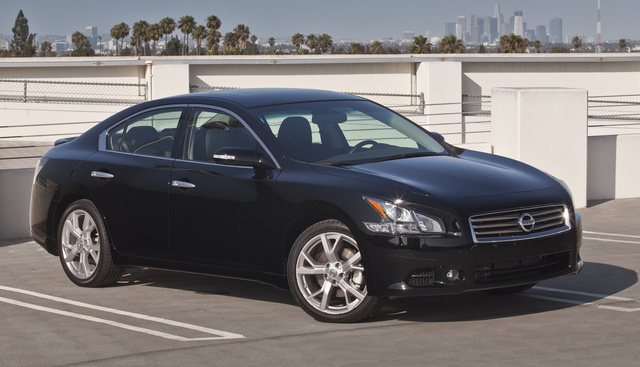
After the enlarged Altima stole much of the Maxima’s thunder in the mid-2000s, Nissan sought a reset with the seventh-generation model. Unfortunately, it was once again a little too close to its smaller sibling in size to justify its larger price. But this Maxima had lots of things going for it. It came in base S or luxurious SV trims (though in Canada the S trim was not offered during the entire run). The 3.5-litre V6 got a bump from 2008 with 290 horsepower and 261 lb-ft of torque.
Those 290 horses under the hood are amicably tamed by a CVT with unprecedented performance, bringing the Maxima to 100 km/h in roughly 6.5 seconds. The capable handling was still there, even without the Sport option package, at least in part because of the car’s smaller but wider stance and improved technology.
In its Nissan Maxima SV trim, integrated turn signals on heated side mirrors are included, as are fog lights, more seat comforts like heated front seats, a heated steering wheel, full leather upholstery, and a nine-speaker Bose premium audio system with Sirius XM satellite radio. This can be further boosted with either the Premium or Sport package, adding features like driver memory functions and paddle shifters for some manual functionality with the continuously variable transmission (CVT). The CVT may not be the sportiest idea for such a car, but it also delivered decent fuel economy, as low as 10.8 litres per 100 kilometres combined.
The seventh-generation Maxima rivaled luxury cars of the time with options like a hard-drive navigation system, voice recognition, real-time traffic, rear-view camera, digital music storage, and iPod interface. The Sport package added a sport-tuned suspension with 19-inch wheels. What the Maxima did not offer was true full-size sedan room, with a back seat no larger than a BMW 3 Series.
2010 and 2011 saw no significant changes to the Maxima, but the sedan got a refresh in 2012 with revised grille, taillights, and interior trim. The Maxima remained unchanged for 2013, but xenon headlights, a USB port, a 7-inch touchscreen, and a rearview camera became standard equipment in 2014.
As with the eighth-generation Maxima, this seventh-generation model doesn’t have the space to truly rival full-size models like the Toyota Avalon or Chrysler 300. For all its handling goodness, it also isn’t as responsive a driver as a V8 Dodge Charger or a Cadillac CTS. But it is a good value. The seventh-gen Maxima has a solid reliability record but low resale values, and even the very nicest ones shouldn’t cost more than $13,000. Very nice examples with under 150,000 kilometres sometimes sell for as little as $9,000.
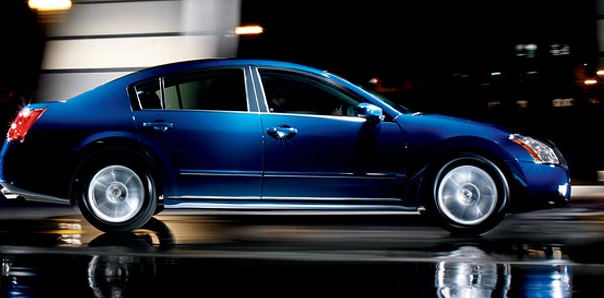
Sixth Generation (2004-2008)
Taking cues from Toyota, Nissan moved Maxima production to a North American plant for the sixth generation, borrowing the Nissan Altima platform and again expanding the interior room. The move meant the end for the baseline model in favour of just two trims—the sporty SE and the high-end SL. In 2004, the Maxima had a 3.5-litre V6 under the hood, pushing out 265 horsepower and 255 pound-feet of torque, besting the 2003 model. The SE was paired with a five-speed automatic transmission as standard, but a six-speed manual was on tap as well. SLs came only with automatic transmissions.
While the SE had a sport-tuned suspension, 18-inch wheels, an eight-speaker CD stereo, keyless entry, and power accessories, the SL offered a softer ride with 17-inch wheels, heated leather seats, a 320-watt Bose stereo, wooden interior accents, and plenty of other surprisingly standard accessories that would rival those found in even a modern luxury car. The 2005 and 2006 models saw few changes, but in 2007, Nissan brought in the Xtronic CVT, leaving all other shifting options behind. For 2008, the Maxima didn’t get any significant upgrades.
While all this sounds really good, and the sixth-gen Maxima was also a good-looking car, Nissan also chose to enlarge the Altima in 2003 to nearly the same dimensions as the Maxima. The Altima ended up just 2.5 centimetres shorter overall than the Maxima, and it was also very visually similar. Since the Maxima seemed very much like an Altima but more expensive, the result was a huge spike in Altima sales and a big drop for the Maxima.
At the same time, the transition to the new factory coincided with a steep drop in build quality. 2004 to 2006 Maximas generated more consumer gripes than any earlier version by orders of magnitude. This generation seems prone to transmission fragility, engine trouble, build quality issues, and body and paint problems.
Though they have plenty of nice features and drive well, it’s hard to recommend one. They’re also very hard to find in Canada now. We found fewer than 10 cars for sale nationwide in our searches. The good news is they’re very cheap, with not one priced at more than $5,000. Newer Maximas aren’t much pricier, though, and they seem like a better long-term bet.
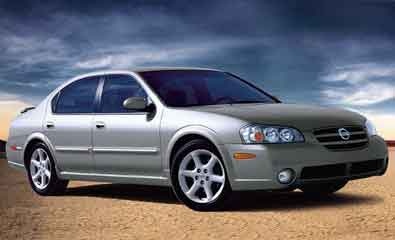
Fifth Generation (2000-2003)
The last of the old-school Maximas, and the last one made in Japan, the fifth-generation version was a heavy update of the circa-1994 fourth-generation model. It retained the same balanced chassis and comfy interior as its predecessor but was clothed in updated styling and its standard V6 offered even more power.
Fifth-generation Maxima trims included the GXE, SE, and GLE, and the 3.0-litre V6 now made 222 horsepower and 217 pound-feet of torque, making it one of the most powerful cars in the midsize sedan class. A five-speed manual transmission was standard on lower trims, but a four-speed automatic was also available and was standard on the top model. Manuals are rarer today, but sought after and sell for more than automatics.
In 2001, Nissan added an SE 20th Anniversary Edition with five more ponies under the hood and a viscous limited-slip differential. In 2002, the Maxima upped its performance ante once again with a new 3.5-litre V6 with 255 horsepower and 246 pound-feet of torque. A six-speed manual transmission was standard on the SE trim, while others got a four-speed automatic. Small tweaks to the headlights and taillights were made for this year, and navigation was available as well. There were no major changes in 2003.
The fifth-generation Maxima also formed the basis of the Infiniti i30 (2000-2001) and i35 (2002-2004). Those versions had more luxurious interiors and a few extra features, but weren’t available with the manual transmission.
Like the Maxima, they also make good used buys now despite their age. Both the fifth-gen Maxima and the two Infinitis have a solid reliability record and they’re plenty of fun to drive, and they have none of the transmission woes of later Maximas. They also have slightly more room in their back seats than some later versions, though they have fewer modern safety features. You’re unlikely to come across any of these cars now in Canada, but if you do, a well-kept one should be priced around $5,000, a good deal despite the age.

Fourth Generation (1995-1999)
The fourth-generation Nissan Maxima was entirely redesigned into a sleek, aerodynamic machine for the 1990s, with more interior room and a nicer interior with more creature comforts and luxuries, including a really nice optional Clarion stereo. It shed none of its sporty feel in the process, either. Offers in GXE, sporty SE, or GLE trims, this generation outperformed its predecessor in every regard, with a wholly new engine and driving dynamics to match.
Introduced as a 1995 model in the spring of 1994, the fourth-gen Maxima didn’t change the car’s format but it did get a new heart. While the previous version had used an earlier 3.0-litre V6, this one got a new engine of the same size, with 190 horsepower and 205 pound-feet of torque, mated to a five-speed manual transmission or a four-speed automatic. That engine made it one of the fastest and most satisfying to drive cars in the midsize class, and it earned many critical accolades in 1995 and 1996, including repeated spots on Car and Driver’s 10 Best list.
Reliable and roomy, it was much more fun to drive than a Honda Accord or Toyota Camry, and it looked more contemporary than a Ford Taurus. The Maxima remained unchanged in 1996, but in the following year, buyers were treated to revised front and rear fascias. 1998 was an unchanged year, and traction control was added in 1999. In 1996, the Maxima also got an Infiniti variation, the i30, which would continue into the fifth-generation car’s era. The i30 is much the same under the skin as the Maxima, but has frillier styling and a nicer interior. It was not, however, available with the manual transmission.
Reliable, fun to drive, and good looking, these Maximas still make nice drivers, but they’re very rare in Canada now thanks to their age. Collectors are also beginning to notice them, and manual versions, which appeal to enthusiasts, tend to sell for a little more than the more common automatics. These aren’t bad cars, but as usual, for something this old, inspect carefully for rust and signs of past damage. If you come across one, you shouldn’t have to pay more than $8,000 for it.
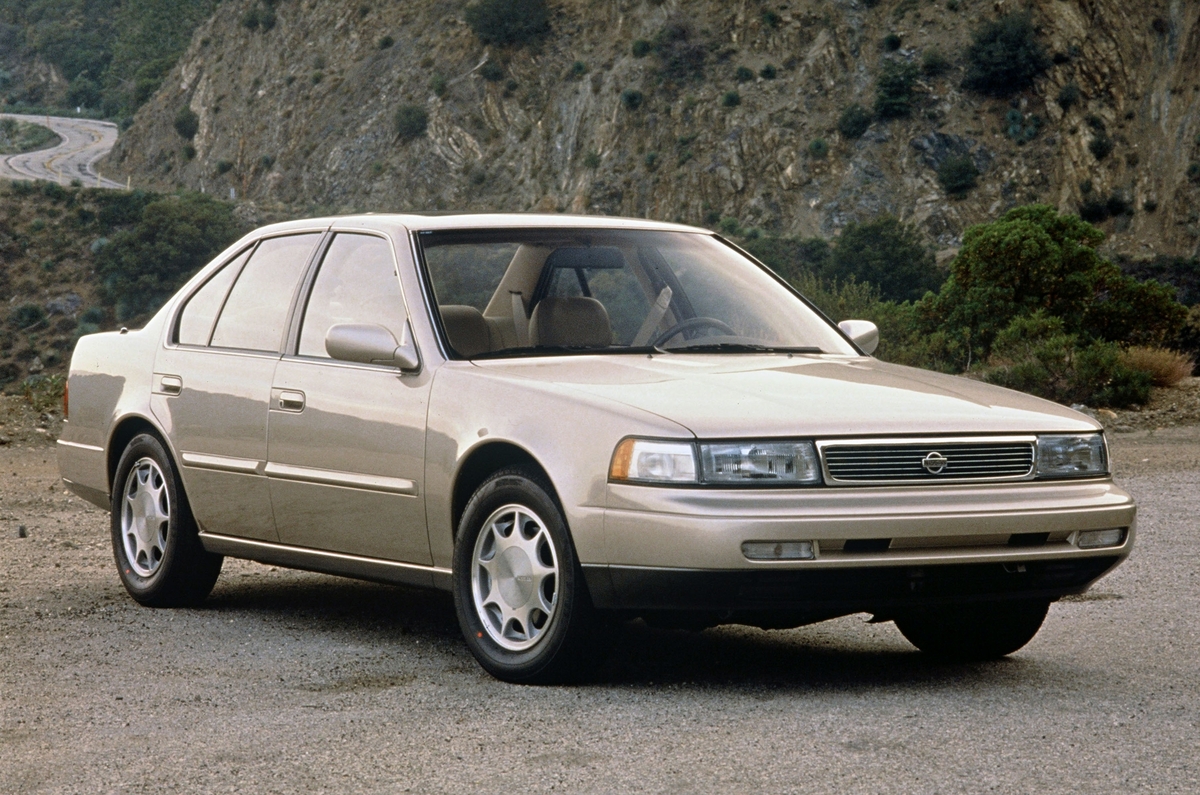
Third Generation (1989-1994)
Undoubtedly the best-remembered Maxima of all, the third-gen model dropped the wagon altogether, gained even more power, and shed its boxy form for a slinky sports sedan shape. It was just as good to drive as it was to look at, too, thanks to a capable, sharp-handling chassis. The “four-door sports car” branding was born in this era, but it seemed like an accurate description rather than marketing hyperbole.
While the standard Maxima used a 160-horsepower 3.0-litre V6, the sporty SE gained a 190-hp 3.0-litre V6 in '92 and a retuned suspension to match, reaching 100 km/h in just seven seconds. This combination made it seriously fast for that time and often drew comparisons to much more expensive sports sedans from Audi and BMW. The Maxima’s style elements were also functional, with much-improved aerodynamics and bright, highly legible white-faced gauges in its ergonomic interior.
The car was also very comfy, though the back seat was fairly small for a midsize car of that time. The focus, again, was on performance, even to the extent that automatic-transmission models had primitive drive modes, “sport” and comfort,” which remapped the shift points. Nissan also offered a wild digital dashboard and a very early head-up display on these models, though you are extremely unlikely to find one of these rarely ordered units today.
Though a reliable car overall, this Maxima tended to have more problems than earlier versions, mainly because they were driven enthusiastically and used up. Survivors aren’t common today, particularly in Canada due to rust issues, and collectors are already interested in them. You’ll likely need to shop south of the border if you’re interested, where you can expect to pay $6,000 to $12,000 U.S. for a good example. You can find worn examples for much less, but restorations aren’t easy.

Second Generation (1985-1988)
Perhaps the biggest change of any Maxima generation was when the second-generation model switched from the original’s rear-wheel drive setup and inline-six engines to a front-wheel drive layout with V6 engines. This was still the default setup on the 2023 Maxima, and Nissan never again revisited rear-wheel drive for the model. Visually, however, the second-gen Maxima wasn’t so different than what came before, with slightly better aerodynamics but still very boxy eighties styling, but the switch to front-drive was just one of many major changes.
Power now came with a 154-hp 3.0-litre V6—a full 34 horses more than its predecessor. The GL sedans and wagons came with the four-speed automatic standard, and the SE sedan came only with the five-speed manual. Overall, the new car offered superior improvements to its comfort, capacity, braking, suspension, and overall driving dynamics meant that the Maxima quickly went from an also-ran in the midsize sedan pack to a leader, despite losing its rear-drive layout, traditionally a favourite with enthusiasts.
The Maxima went through a modest facelift late in this generation, renaming the baseline trim to GXE and allowing the choice of an automatic transmission in the sportier SE. Nissan also added in an early adaptive suspension and a keyless entry system, foreshadowing the striking innovations to come for the Maxima’s next incarnation. This model also offered many aerodynamics and graphics packages, sometimes getting monochromatic schemes that were trendy then and have returned in the 2020s. You could, in 1988, get a Maxima in blackout trim.
Though staid in appearance and not quick by today’s standards, the second-generation Maxima is roomy, reliable, and fun to drive. Little wonder then, that in the late 1980s, outlets like Consumer Guide called it an excellent used car value. It also offers a handy station wagon body, though none of these cars are common today after almost four decades on the road. It’s also a classic car bargain, though you’ll almost certainly need to look to the U.S. to find it. There, you can pick up nice ones for anywhere from $3,500 to $7,000 U.S., and very few of them sell for more than that.
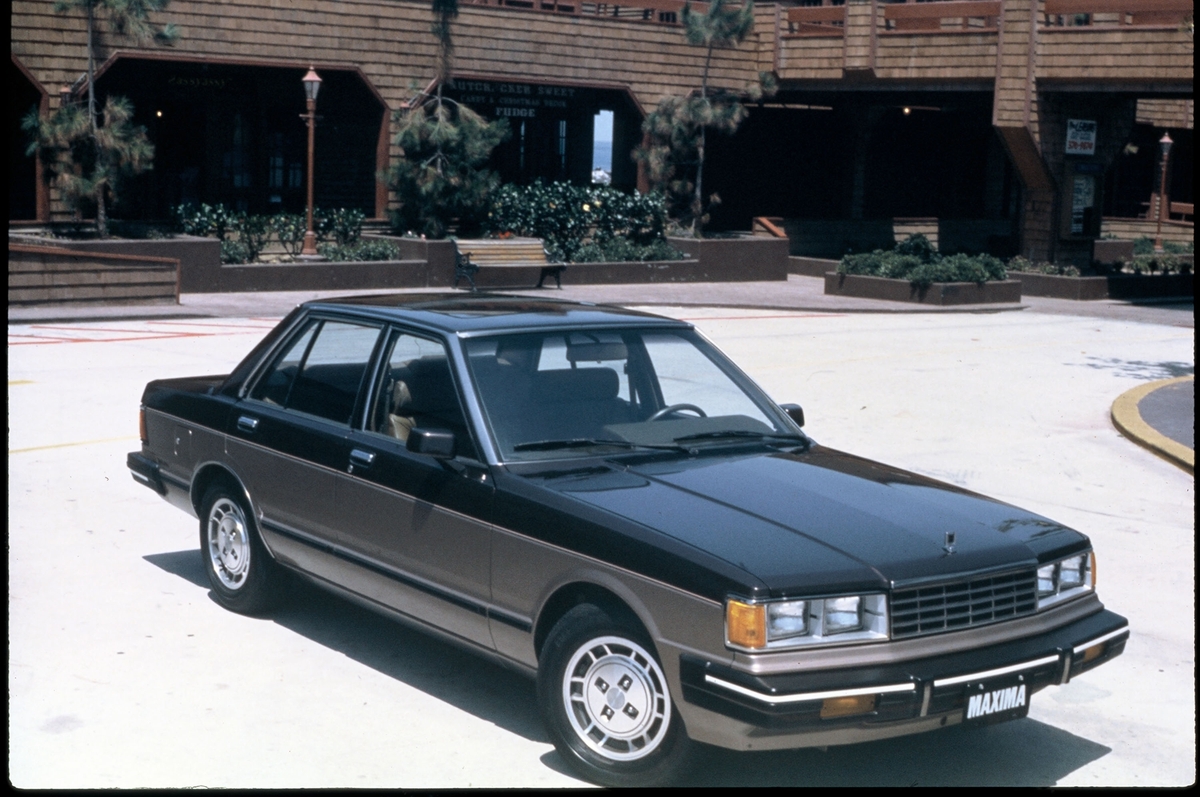
First Generation (1981-1984)
Here, we get the original Maxima, although it was technically the second generation of a Datsun 810. There was actually a considerable amount of name shuffling going on during this car’s lifetime. It first debuted as the Datsun 810 in the fall of 1980, then became the 810 Maxima in 1981, and then finally just “Maxima” after 1982. That was just in time for the fateful decision to rebrand Datsun as Nissan in 1983, reflecting the automaker’s actual name in Japan.
As with the 1970s 810, the Maxima was based on the Japanese Nissan Bluebird but had a wheelbase stretch ahead of the A-pillar to accommodate a long inline-six engine. Buyers could choose from two: a 2.4-litre, 120-horsepower gas six or and 80-horsepower 2.8-litre diesel. This was right after the second OPEC crisis, and fuel economy was top of mind for many consumers, but the diesel proved too slow even by the era's standards and was dropped after 1983.
This first Maxima was rear-wheel drive and used a five-speed manual (borrowed from the 280ZX) or three- (1981-82) or four-speed (1983-84) automatic transmissions. That sounds like a recipe for enthusiast driving, but this car had a sedate personality. It was also marketed as a more premium machine than the 1990s Maximas were, aimed at cars as diverse as the Peugeot 505, Mercury Marquis, and Toyota Cressida. Its ultra-conservative styling, very much in the mold of its opposite number at Toyota, telegraphed its upmarket intent.
Nissan offered this first Maxima, as with the prior 810, as a sedan or a station wagon, but the sedan is the more common survivor today. All are rare, though, especially in Canada, and while collectors have started to take notice, they’re still not worth very much. $5,000 U.S. will buy you a really nice one south of the border if you can find one, but these are too old and rare to really be of much use as daily drivers. Notably, they’re very reliable, and even as far back as the late 1980s, they were well regarded by Used Car data outlets like J.D. Power for their quality.
Related Topics: