The Chrysler 300 name goes all the way back to 1955, when it debuted as the tailfinned, hemi-powered C-300 coupe. It returned in 1956 as the “300B,” setting up a line of famous “letter cars” that continued until 1965. There were also 300s in the late 1960s, a brief reappearance in 1979, and the front-drive 300M built from 1999 to 2004. But it’s the modern 300 that today’s car shoppers are most familiar with.
And they should be familiar with it, because even though it got a major refresh in 2011 and a variety of subsequent updates, it was with us for 18 years all told. It only went out of production at the end of 2023, with North American versions of the entire modern run originating at Chrysler’s assembly plant in Brampton, Ontario. These two closely related series, the 2005 to 2010 “LX” and the 2011 to 2023 “LD,” are the cars we’re talking about here. They made a blockbuster debut in 2005, and they’ve generally enjoyed a reputation for longevity. Today they make fairly affordable, and very roomy, used cars.
As Chrysler’s first rear-wheel drive sedan since 1989, the 300 was developed during the DaimlerChrysler era with help from then-partner Mercedes-Benz. It uses some German engineering ideas, but it isn’t directly based on a Mercedes as is sometimes thought. It was designed with rear-wheel drive in mind, but like Mercedes-Benz’s big sedans, the limits of rear-drive for some drivers meant all-wheel drive (AWD) versions were planned from the start.
Power came only from tough, durable V6 and V8 engines, most notably Chrysler’s 3.6-litre Pentastar V6 in later years and the 5.7-litre “Hemi” V8, for which the 300 was the launch vehicle. All used automatic transmissions. The lower-powered versions are durable and long lived, though early ones tend to have more problems than second-generation cars. The high-performance SRT models, with up to 470 horsepower from a 6.4-litre V8, tend to lead hard lives but aren’t necessarily any less durable than the standard versions.
As these cars got older, their main competitors, the Ford Crown Victoria, Lincoln Town Car, and Mercury Grand Marquis were all discontinued, as were their smaller replacements, the Ford Taurus and Lincoln MKX. The Toyota Avalon large sedan was discontinued in Canada after the 2022 run. The 300 even survived the revived full-sized Lincoln Continental, offered from 2017 to 2020. Only the related Dodge Charger is truly similar, which ended production at the same time as the 300.
Early 300s are cheap now, and they're near the bottom of their depreciation curve. It’s also still possible to buy certified pre-owned and possibly even new-build 300s in 2024.
Chrysler 300: Cost, Reliability, and the Best Years to Buy
Frequently Asked Questions
Which Chrysler 300 years are the best?
Without a doubt, the newer the better. Because sales of the 300 began to slow after 2018, there’s less reliable data on newer examples. But what data there is suggests that these cars have fewer problems than older 300s. Among early LX models, 2007 to 2010 models have a much better repair record than the early years, according to outlets like CarComplaints. Among LD models, post-2013 vehicles are the best choice. Mid-2010s examples offer the best mix of available features, solid reliability, and affordable pricing.
What are the worst Chrysler 300 years?
The first year or two of any totally new design is always a risky period, and 2005 and 2006 Chrysler 300s have by far the highest number of user complaints and reliability issues. They’re also the oldest models on the road, so they have the most wear. According to sources like RepairPal and CarComplaints, owner gripes rose again in 2011 after the 300’s first major refresh. In most cases, the issues seem to centre around electrical and transmission problems, some of which are software related, which might require dealer intervention.
First generation 300s are also known for HVAC, sunroof track, navigation unit, and EGR valve issues. Second generation 300s tend to have more software problems, but window regulators are also an issue.
Is a used Chrysler 300 a good deal?
Yes. You should be able to find clean, low-kilometre late-model 300s (2015 to 2020) for under $28,000 so long as you’re willing to take a V6. V8s cost more, but you can also find them for good prices if you’re okay with buying a slightly older model. This is a huge car compared to most sedans you can buy in 2024 that don’t cost six figures, and it’s comfy, reliable if not neglected, and has room for a family of five. It’s old, but a lot of car for the money.
Chrysler 300 Pros and Cons
Pros:
- Classic American luxury sedan styling
- A range of powerful, durable engines
- Full-sized but not enormous
Cons:
- Very early models don't have the greatest reliability record
- Not as performance focused as Dodge Charger sibling, fewer performance versions
- Big size, big appetite for fuel
Chrysler 300 Generations
Second Generation (2011-Present)
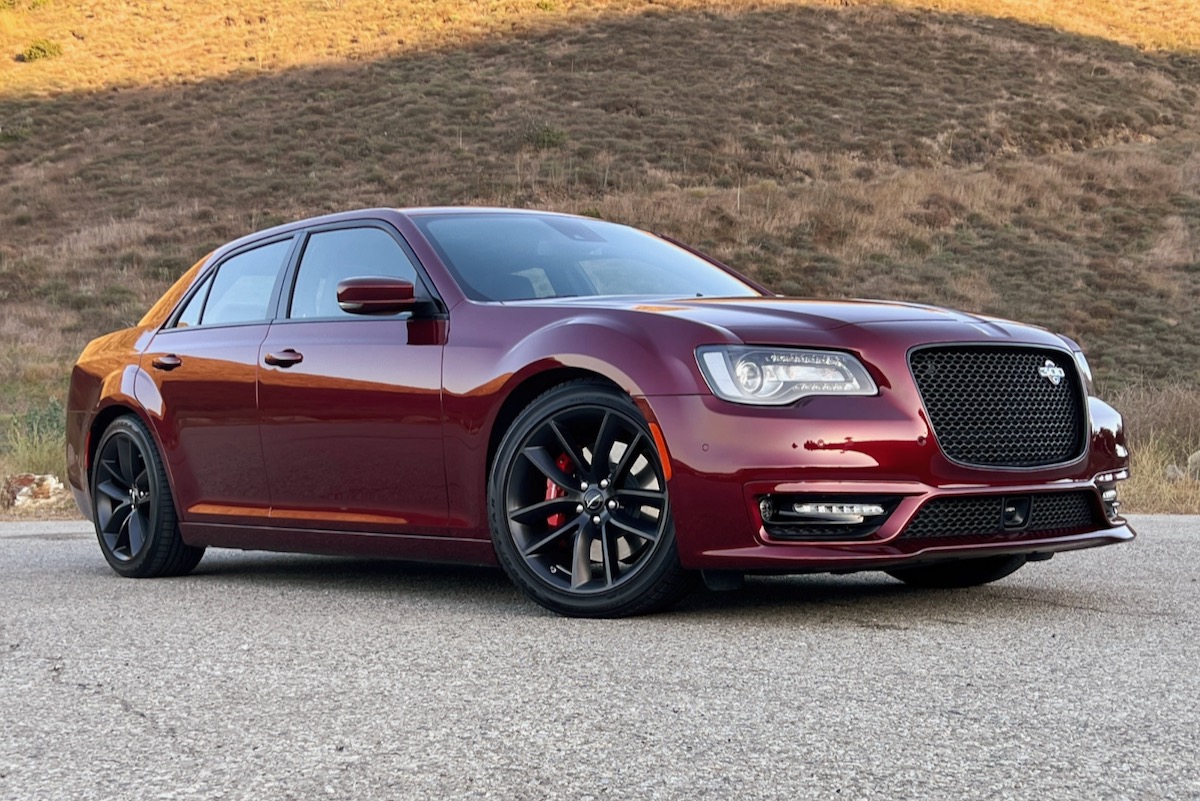
After six years on the market, Chrysler gave the 300 a huge refresh, but not quite a redesign, for the 2011 model year. The styling was softened and made less self-consciously retro, and the interior and V6 engine’s electrical systems got major upgrades. The basic chassis remained much the same, complete with its Mercedes-derived suspension bits, even though Daimler and Chrysler had long since parted ways and Fiat would soon take over. Nobody could have predicted that the car would still be in production in 2023.
Because the “LD” 300 received many updates in its 12-year run, two basic eras easily categorize it for shoppers looking to saddle up.
From 2011 to 2014, the lineup continued much as in the first generation, but with the 3.6-litre Pentastar V6 (292 horsepower in Touring and Limited models, 300 in the 300S) replacing the earlier V6s. The 5.7-litre Hemi V8 (363 horsepower) continued while the SRT-8’s original 6.1-litre engine gave way to an even more powerful 6.4-litre Hemi with 470 horsepower, a really big number in 2011 and capable of hurling the 300 to 96 km/h in 4.5 seconds. Starting in 2012, all 300s got a more durable eight-speed automatic transmission supplied by ZF, which they kept until production ended.
The second era began in 2015. Performance buyers preferred the closely related Dodge Charger and Challenger to the 300, so when it was refreshed that year, the SRT-8 was temporarily dropped. But the 300 also gained lots of new features in that refresh and an updated more upscale cabin design. For the first time buyers could order adaptive cruise control, automatic emergency braking and lane-keep assist, plus there were major improvements to the UConnect infotainment system that had debuted on the earlier LDs.
Chrysler continued to periodically upgrade the UConnect system, adding Apple CarPlay and Android Auto in 2017, but after 2019 the 300 was essentially frozen in time. AWD, as in the first generation, was confined to V6 models. Sales gently fell until 2023, when the automaker, now Stellantis and not (FCA) Fiat Chrysler Automobiles or DaimlerChrysler, decided to end production of its big rear-drive cars after 18 years. To mark the occasion, the SRT-8 returned for 2023 only as the 300C, the Hemi version’s original name in 2005.
As in the first generation, the earliest years of the LD series have the worst reliability record, but Consumer Reports lists the 2011 300 as having a basically average record. Complaints are higher on the 2011 and 2012 300s than in subsequent years, however. Most centre on worn suspension components or electrical and infotainment issues, but many other reports seem to be common aging car or neglect problems. Most sources suggest 2014 and later 300s are generally reliable.
As in the first generation, SRT-8 models are much more expensive than the “regular” 300s. Even 10-—or 11-year-old SRT-8s in good condition are $30,000 cars, and a 2023 300C Hemi will cost you a minimum of $67,000. Since the V6 and 5.7-litre V8 models ran so long, prices really run the gamut, but in searching for clean examples with less than 120,000 kilometres on the odometer, we found a handful of V8s priced at around $20,000 and a fistful of V6s, some as new as 2018 or 2019.
Later models will have more safety and infotainment features, and they’re usually in better shape, so buy as new as your budget will allow.
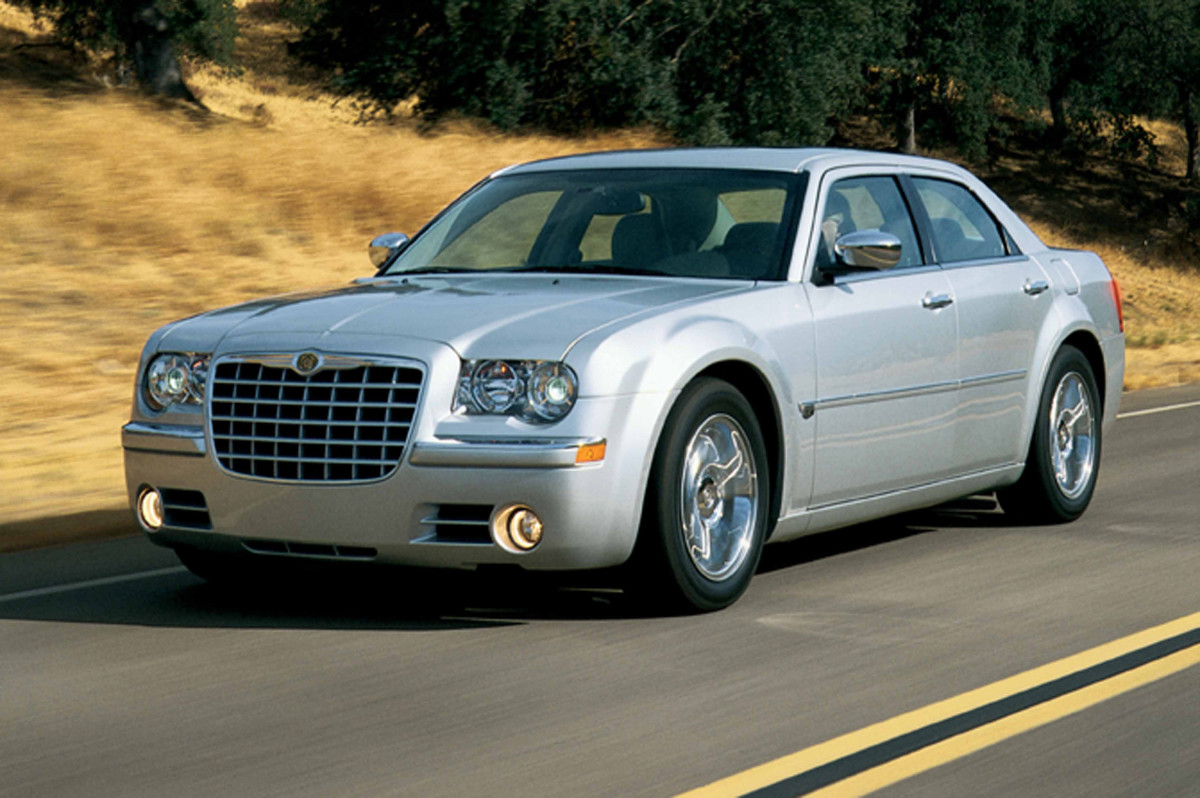
First Generation (2005 to 2010)
Drawing styling cues from the classic 1957 300C and the 1998 Chrysler Chronos concept car, the modern Chrysler 300 was introduced as a concept car at the 2003 New York International Auto Show. It entered production almost unchanged just eight months later, in January 2004. At the time, Detroit’s automakers had been gradually abandoning traditional full-size, rear-drive sedans for years and Chrysler had ditched its last 1970s sedan holdover, the Fifth Avenue, in 1989.
The 300 suddenly made big cars relevant again, and it didn’t hurt that it looked like a cut-price Bentley crossed with classic Chryslers. Under the skin, Chrysler’s engineers had borrowed liberally from the Mercedes-Benz parts and engineering department, so many of the 300’s systems were based on hardware from the E-Class and S-Class, including the suspension and electrical systems, the rear differential and a variety of other bits. This made them durable and capable, but sometimes expensive to repair.
First-gen 300s were powered by a wide range of engines. Base 300s originally used a 2.7-litre, 190 horsepower V6, while the 300 Touring and 300 Limited used a 3.5-litre, 250 horsepower V6. The 300C was introduced with a 5.7-litre Hemi V8, with a multi-displacement system that allowed the engine to run on as few as four cylinders, going as low as a Natural Resources Canada-estimated 9.5 litres per 100 kilometres on the highway. Finally, the SRT-8 model introduced the 6.1-litre Hemi V8 with a stunning (for the time) 425 horsepower.
Early V6s used a four-speed automatic transmission, while the V8s and, later, all of the LX cars were equipped with a W5A580 “5G-Tronic” five-speed automatic transmission from the Mercedes-Benz parts bin. These cars were big and tough, but they had little in the way of modern active safety features as those were still cutting-edge tech in the 2000s and very expensive. However, the requisite airbags, seat belts, anti-lock brakes and crumple zones were all there.
The first three model years were ones of real excitement, but later on, these early cars came to be known as the most troublesome of the lot. Valve seals, head gaskets, transmission issues, sunroof problems, and the ever-present electrical gremlins in the complex wiring are all the most common foibles. Deals on early cars might be tempting, but many of these issues were resolved by 2009, so late-in-the-run examples are the best buys.
As always, the lowest-kilometre and cleanest example will have the best chance of being a reliable driver. If you shop around, you can find LX-series V6 models with under 125,000 kilometres on the dial and in good shape for $9,000 to $15,000. V8 models in similar condition will cost about 10-20% more, but SRT-8 models are an entirely different story. These early SRT hot rods are already appreciating as potential collector’s items, and they’ll cost you a minimum of $25,000 in good shape.
The first-gen 300 isn’t a bad buy, but given the number of later cars on the market and their visual and dynamic similarity, it’s best to search very broadly.
Related Topics: