Though it doesn’t sell as well as it used to, the Altima is still a good consumer choice and arguably nicer than it has ever been. The current generation model, introduced in 2019, is one of the prettiest models in its class. It offers plenty of room, many driver safety features, good fuel economy, and currently offers standard all-wheel drive (AWD) in Canada in a class where some rivals don’t offer it at all.
Unfortunately, the model doesn’t have the best reliability record or resale values. Those issues have led to a pop culture reputation for neglected maintenance and inattentive owners, but there’s still plenty of value to be had here. Two- or three-year-old Altimas can be had at steep discounts, and they still have most of the virtues of a brand new one.
Here, we’ve outlined each of the Altima’s generations in detail and provided some pricing and buying advice for each one.
Nissan Altima: Cost, Reliability, and the Best Years to Buy
Frequently Asked Questions
Which Nissan Altima years are the best?
The first two 1990s Altimas, the 2008 to 2012 fourth-generation model, and the current sixth-generation version (2019 to present) version have the best records in terms of reliability and durability. But even within those generations, not every reliability tracking outlet agrees on which years are best. J.D. Power gives the current Altima “Average” ratings in most years, while Consumer Reports gives it average or below average ratings and finds more problems in 2019 and 2020 models than in other years. Among fourth-generation models, 2008 and 2009 have poorer reliability ratings than other years.
What are the worst Nissan Altima years?
The third-generation Altima (2002 to 2006) and fifth-generation (2013 to 2018) have the worst reliability ratings overall, but again, not every source agrees on every year or every problem. CarComplaints has logged a huge number of owner issues with 2013 to 2015 Altimas, with that first year having more problems than any other. It also shows a large number of complaints about the 2002, 2003, and 2009 Altimas. Consumer Reports doesn’t have data for the oldest Altimas anymore, but the fifth-generation models consistently earn below-average reliability ratings from them.
Is a used Nissan Altima a good deal?
It can be. The Altima has always offered plenty of value in terms of design, performance, or features, and it generally sells for a lower price than an equivalent Honda Accord or Toyota Camry. However, it doesn’t hold its value as well as those models, so while the cost of entry is low, it makes the most sense if you’re going to keep the car long-term. It’s also worth inspecting carefully because some Altimas have been neglected, and former fleet cars may have been used hard.
Nissan Altima Pros and Cons
Pros:
- Relatively affordable for a well-equipped mid-sized sedan
- Shares a family resemblance with the upscale Maxima
- All-wheel drive available
Cons:
- CVT transmissions blunt performance, enjoyment
- So-so long-term reliability record
- Poor resale values
Nissan Altima Generations
Sixth Generation (2019–present)
For the 2019 model year, the sixth-generation Nissan Altima donned a sleek, sporty-looking and angular new shape and got fractionally larger overall than the previous Altima. Surprisingly, the back seat got slightly smaller, with less legroom overall than in the previous generation, but it’s still competitive with rivals like the Hyundai Sonata.
The current generation sticks with a continuously variable transmission (CVT), which dulls the driving experience, but the Altima is more about quiet transportation than excitement. In Canada, Nissan offers a 2.5-litre four-cylinder engine for the Altima, which makes 182 horsepower and 178 pound-feet of torque. All-wheel drive (AWD) has been standard on the Nissan Altima in Canada since the sixth generation launched for the 2019 model year.
In the U.S., a 2.0-litre turbocharged variable compression (VC) four-cylinder engine is offered on this generation of Altima, producing 236 horsepower and 267 pound-feet of torque. Since it can’t be paired with AWD, this engine has never been offered in the Altima in Canada.
Part of the Altima’s appeal is that in addition to its pretty styling, you get lots of equipment, or at least it’s available. All Altima trims in this generation come standard with automatic emergency braking with pedestrian detection, forward-collision warning, rear automatic braking, lane-departure warning, radar-based blind-spot monitoring, rear cross-traffic alert, and high-beam assist.
The only major omission is adaptive cruise control, which Honda, Hyundai, and Toyota include but which is optional here. ProPILOT Assist driver assistance is a long name for “adaptive cruise control,” comprising a forward-facing camera, forward-facing radar, sensors, and an electronic control module to help the driver stay in the centre of the driving lane and to maintain vehicle speed. It also maintains a preset distance to the car in front. ProPILOT Assist is not available on the base S trim but is standard on all other versions of the Nissan Altima in Canada.
This helped the Nissan Altima achieve “Top Safety Pick” ratings from the Insurance Institute for Highway Safety (IIHS) in 2019 and 2020, and “Top Safety Pick+” ratings from 2021 to 2023.
Also making up for the lack of performance is a good array of infotainment and connectivity. The touchscreen is accompanied by physical knobs and buttons, plus Bluetooth, USB ports, and Apple CarPlay/Android Auto are all included (though wireless versions of CarPlay and Android Auto require an upgrade). Navigation and a Bose premium audio system are available on higher trims.
These are well-equipped cars even at the base S trim level, with standard features like a push-button ignition and the previously mentioned blind spot monitoring and AWD. The Nissan Altima SR is one of the most popular trims, offering upgrades such as 19-inch wheels, paddle shifters, and a leather-wrapped shifter. Altimas get good fuel economy, too. Combined Natural Resources Canada fuel consumption for the Nissan Altima runs between 7.9 and 8.1 litres per 100 kilometres combined.
Altimas don’t have great resale value, and these newer models are no exception. All but the very newest and highest-trim used sixth-gen Altimas can be had for less than $30,000, and most fall in the $18,000 to $25,000 range. It’s possible to buy very low kilometre and clean ones for even less if you shop long enough and are willing to take a low-trim version. This is a lot of car for the cost, and prices may come down further as Nissan incentivizes new models.
Fifth Generation (2013-2018)
The fifth-generation Nissan Altima was priced more competitively than the Honda Accord, and Nissan offered many upgrades that increased its value proposition against the Toyota Camry. It was also characterfully styled, though the looks haven’t aged very well. Until crossover SUVs began to dominate the market, if you were looking for a solid family vehicle with decent fuel efficiency, the Altima was a great choice. When new, it often compared well with or even bested vehicles like the Mazda6, Volkswagen Passat, Chevrolet Malibu, and even the Camry.
Today, this design is less of an all-star. Its “Coke Bottle” styling looks a little overwrought, its repair record is below average (but not awful), and many competitors eventually introduced superior designs, but it still packs plenty of value as a used car.
Like its predecessor, the fifth-gen Altima continued to offer a 2.5-litre four-cylinder base engine (179 horsepower and 177 pound-feet of torque) and an optional 3.5-litre V6 (270 horsepower and 251 pound-feet), both mated to continuously variable automatic transmissions (CVTs). Manual transmissions and hybrids, offered in earlier generations, were dropped from this one, and this Altima offered only front-wheel drive. Four-cylinder models returned around 7.5 to 7.8 litres per 100 kilometres combined, while V6s averaged 9.0 to 9.3 L/100 km combined.
Early on, the interior was dominated by a very conventional centre stack of buttons for audio and HVAC controls, with a 7-inch display for navigation optional. The gauge cluster also had a driver assist screen, though not all trims got all the advanced driver assistance features. Blind spot warning, moving object detection, and lane departure warnings were all optional.
The 2016 model year introduced a facelift that dramatically improved its looks, and a lot of effort went into making the passenger cabin as quiet as possible, including new sound deadening and a windshield designed to reduce exterior noise, but it didn’t bring huge tech advancements. Nissan cut several trims for 2018, and features like Apple CarPlay and Android Auto became standard along with a backup camera.
As with the newer sixth-generation model, resale values are only so-so. You can pick up a clean, sub-150,000-kilometre fifth-generation Altima for anywhere between $8,000 and $20,000. If you don’t mind a higher odometer reading, you could buy one for even less. V6 versions offer better performance but are relatively rare, though they don’t seem to command much of a price premium. 2013 through 2015 models have more problems than later versions, with complaints primarily centring on the transmissions and electrical systems.
Early on in the fifth-generation Altima’s life, the fourth-generation Altima Coupe remained on sale. 2013 Coupes are all part of the previous generation.
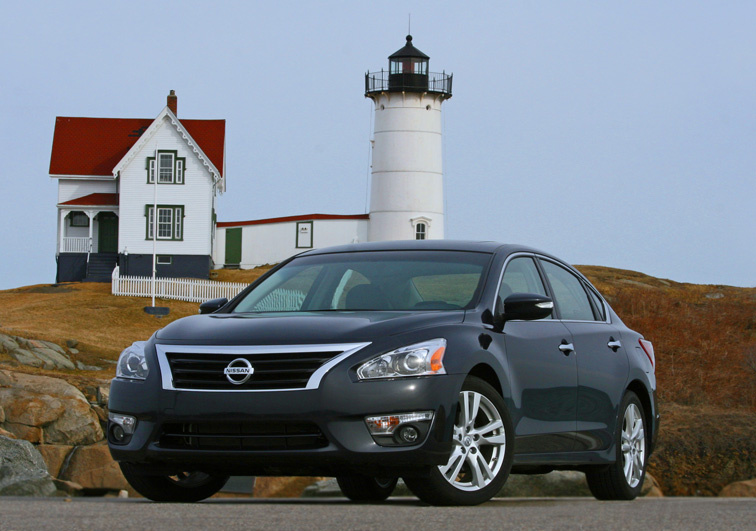
Fourth Generation (2007–2012 plus 2013 Nissan Altima Coupe)
The huge success of the third-generation Altima got Nissan thinking about ways to expand the lineup, and that’s just what happened with the fourth-generation model. In the 2000s, many automakers still offered two- and four-door versions of their midsize cars, so for this generation the lightly redesigned Altima sedan (no need to mess with success) was joined by a two-door coupe on a shorter wheelbase. Both vehicles, as in the third generation, shared Nissan’s D platform with the Murano crossover.
With this redesign, the Altima sedan’s wheelbase shrank by about 2.5 centimetres, but interior volume stayed the same as the third-generation car. One year later, Nissan presented the Coupe. Unfortunately for the automaker, that was in 2008, and many car shoppers stopped buying two-doors during the Great Recession. When they can afford fewer cars, consumers tend to stick with the most practical ones. It looked good, but the Altima Coupe never sold as well as Nissan had hoped, and it was discontinued after 2013.
While the Coupe was the most visible addition to the lineup, Nissan also added an Altima Hybrid in this generation. This version used a 2.5-litre four-cylinder engine mated to an electric motor, with the combination making 198 system horsepower and 199 pound-feet of torque, mated to a CVT. Despite pretty decent performance and 6.9 L/100 km combined fuel economy, the buying public didn’t seem very interested in the Altima Hybrid, and it too was discontinued to due poor sales. The last ones were built in 2011, around the time Nissan was concentrating on the fully electric Leaf.
The other aspects of the fourth-gen Altima lineup were familiar. The standard engine was a 2.5-litre four-cylinder, making 175 horsepower and 180 pound-feet of torque. A 3.5-litre V6 was again optional, with 270 horsepower and 258 pound-feet. Both engines would carry over into the fifth-generation model. Almost all used a CVT, but some lower-end trims were available with a six-speed manual, a far more satisfying experience if you can find one.
The fourth-generation Altima introduced now-common features such as steering wheel-mounted controls in lower trim levels, along with the brand’s “Zero Gravity” front seats, steering wheel, and door and console armrests. 2010 brought a facelift to both the sedan and the coupe and made the continuously variable transmission standard across the board. By 2012, the manual offering was gone from Canada entirely.
This generation of Altima has a better repair record than the one that preceded it and the one that came after, with fewer problems in general, most of which are related to electrical systems. Resale values aren’t great, and finding clean, low-kilometre examples is a real struggle. If you do find one, you can usually get a pretty good deal, as these sell for roughly $4,000 to $9,000. Coupes and Hybrids aren’t any more expensive, but the latter are quite rare and reliability data on them is scant.
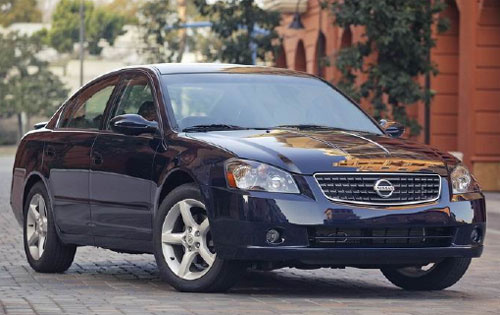
Third Generation (2002-2006)
In a major philosophical shift, the third-generation Altima grew into a proper midsize car, got a new factory, and rode an entirely new platform, the FF-L. Built in Tennessee and designed primarily for North America, the new Altima shared that platform with the Maxima and Murano, and all three got sleek new styling. The Altima also got an optional V6 engine for the first time, and it had a considerably roomier interior than its predecessor.
The third generation Altima’s base engine was a 2.5-litre four-cylinder making 175 horsepower and 180 pound-feet of torque, an engine that would continue to power Altimas for many years afterward. The optional V6 made 245 horsepower and 246 pound-feet of torque, which were muscle car numbers back in 2002. It was quickly identified as the hot rod of the sedan class. Buyers could choose from a five-speed manual or a conventional four-speed automatic transmission.
For a short period, until the Toyota Camry and Honda Accord eventually surpassed it, the Nissan Altima reportedly offered the most power and the best handling of any of the mainstream midsize family sedans. During that two-year period, it was also marginally larger than the Maxima while earning critical praise for performing similar to that car’s past iterations.
This Altima’s interior would seem basic today, with its hard plastics and lack of screens, but in 2002 it looked futuristic, roomy, and ergonomically designed. Tan or gray Altima interiors with titanium accents still look pretty modern, but fake wood-trimmed ones have aged less well. Both entertainment and active safety features were limited or nonexistent, but power windows and locks were standard.
Unfortunately, entirely new designs often have teething troubles, and this Altima did not enjoy a great reputation for long-term durability. Early years tend to have oil leaks and other engine problems, and eventually they were the subject of a class action lawsuit due to early failures. Electrical issues are also common. They also rust, though many 20-year-old designs have that problem.
Due to that last issue, this generation of Altima is now scarce in Canada. It’s also very cheap. If you can find a decent one, expect to pay $5,000 or less, with only modest price premiums for V6s or manual transmissions. The only model potentially worth more is the short-lived SE-R, which came with a six-speed manual and sportier suspension tuning, but many have been used hard. As usual, with such old cars, finding one with maintenance records will help improve a purchase, and a pre-sale inspection is recommended.
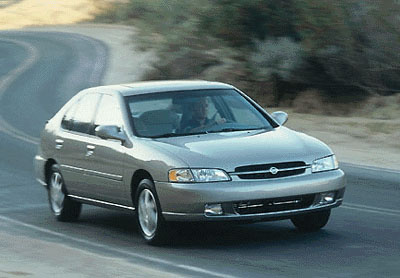
Second Generation (1998-2001)
In response to criticism that the original Altima lacked interior space, Nissan made it larger for its second generation in 1998. Roughly 7.5 centimetres longer overall, the designers (again led by teams at Nissan Design America) also reshaped the cabin and trunk to give it a roomier and airier feel. This did work, but using cheap and plain-looking plastics let down the design’s execution, and lower trim models felt more basic than before. The exterior styling was also considerably more bland.
The first-generation’s 2.4-litre four-cylinder engine carried over largely unchanged until 2000, when it got a five-horsepower bump to 155 in total. As in the first generation, a five-speed manual or four-speed automatic transmission were available, and all Altimas were front-wheel drive. To drive, this Altima was also nothing particularly special. It handled decently and the engine was durable, but zero-to-100 took about nine seconds and it didn’t offer much excitement.
Today, the differences between trims are smaller as they mainly relate to the quality of the materials and appearance. Higher trims got pretty white-faced gauges like the Maxima, and some models got leather interiors and firmer suspensions for better handling. Very late in the run, GXE models offered an available power driver’s seat.
Second-generation Altimas are bland and largely forgotten today, but they were fairly reliable when new. Owner complaints tend to centre around cracked intake manifolds, bad manifold gaskets, and rough idling as a result. This isn’t anything that can’t be fixed, but these cars also aren’t worth very much. This generation of Altima is all but extinct now in Canada, and even the nicest ones still hanging around shouldn’t cost more than $5,000.
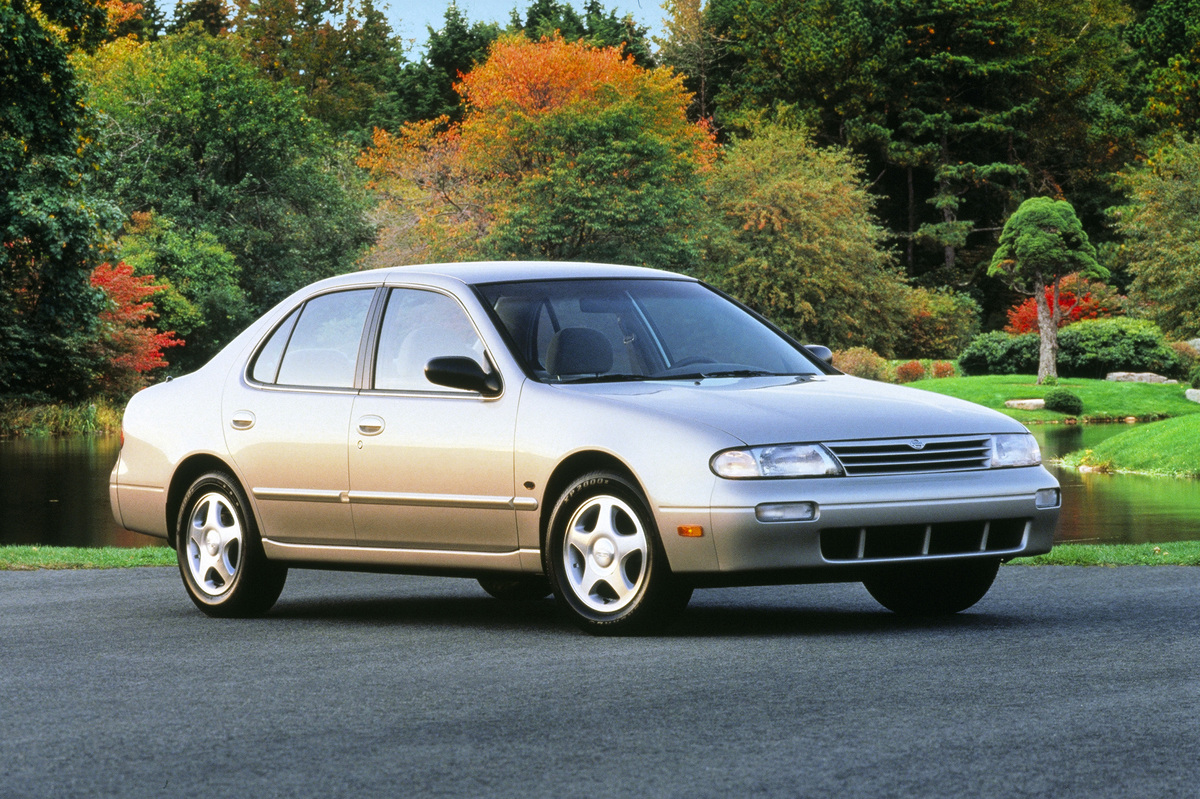
First Generation (1993-1997)
In the early 1980s, when Nissan shelved Datsun's name, its old model names were also replaced. What had been the 510 became the Stanza, and despite some initial success, by 1991, Stanza sales were flat. To get back in the compact-to-midsize game, Nissan completely changed the name and design, creating the first-generation Altima in 1993. The decision to entirely ditch the Stanza name came late in the game, as some early owner’s manuals actually referred to the car as the “Stanza Altima.”
Regardless of the name, the Altima was a much more interesting car than the boxy, plain-jane Stanza, with soft, oval-shaped, almost Jaguar-esque lines. It didn’t hurt that Infiniti, Nissan’s then-still-new luxury brand, had launched a similar-looking luxury car, the J30, only a few months earlier, also drawing positive comparisons to Jaguar. The design came from Nissan Design International (now Nissan Design America), a California studio that the automaker had set up to better cater to North American tastes.
Like the Stanza, the Altima was larger than a Honda Civic but smaller than an Accord, with dimensions slightly smaller than 2024’s Nissan Sentra. In Japan, the same design was sold as the Bluebird U13, just as the Stanza and 510 had been based on earlier Japanese Bluebird designs. Reinventing this formula with new looks and a new name paid off, as the Altima proved a much better seller.
The Altima picked up where the Stanza left off, providing 150 horsepower from the same 2.4-litre inline-four and offering five-speed manual or four-speed automatic transmissions, but it added a ton of equipment to make the car truly feel upscale. Its trim set the Altima apart from other vehicles in its class. All versions of the Altima featured a woodgrain dash, which gave the entire product an even more upscale appearance than the competition.
In the last year of production, the first-generation car offered a GXE Limited Edition that included alloy wheels, keyless entry, an alarm, floor mats, and a Limited Edition decal. Late-production 1997 Altimas were referred to as “1997.5,” because they had additional crash protection that brought the car up to 1997 side-impact standards. This car’s interior seems basic now with its analog systems, but at the time it looked considerably nicer than alternatives like the Ford Contour or Chevy Corsica.
The SE had a sportier suspension with a rear spoiler, sport seats, and a sunroof in 1994 and 1995. Prior to the introduction of standard ABS across the line, the SE was also the least expensive trim to offer four-wheel disc brakes.
First-generation Altimas are all but extinct now in Canada and are rare even in the United States, where collectors don’t have much interest in them. If you come across one, even the nicest examples shouldn’t cost more than $5,000. This generation of Altima is both practical and reliable, if a little small inside. The back seat and trunk, constricted by the curvy styling, were the points buyers liked least, which led to a larger design for the second generation.
Related Topics: