2019 Ford Edge vs 2019 Toyota 4Runner
Overview | |
MSRP$29,995 | MSRP$35,310 |
Listings204 | Listings188 |
Ratings & Reviews | |
User Reviews | User Reviews |
Expert reviews7.3 out of 10 | Expert reviews7.2 out of 10 |
Pros
Cons
| |
2019 Ford Edge Reviews SummaryThe Edge was a key vehicle in the evolution of the family SUV market when Ford first introduced it for the 2007 model year. Back then, automakers were experimenting with just what a “crossover” could constitute—look at the Pontiac Aztec and first-generation Chrysler Pacifica if you disagree. But with the Edge, the midsize, two-row SUV template started to take shape. Ford offers the 2019 Edge with an ST trim, grafting performance onto the utilitarian Edge blueprint. But that begs a question—can a vehicle still be good at family hauling and commuting while also delivering speed and performance? | |
2019 Toyota 4Runner Reviews SummaryIf you’re in the market for a modern SUV capable of getting off the beaten path, you have only a handful of options. These include the 2- and 4-door Jeep Wranglers, the Jeep Cherokee Trailhawk, the Jeep Grand Cherokee Trailhawk, the Land Rover Range Rover, and the Toyota 4Runner. Of those, only the Jeep Wrangler Unlimited and the 4Runner are 4-door SUVs that put off-road grit above all else. While the Jeep Wrangler is only one year removed from a complete redesign that brought in many new technologies, the 2019 Toyota 4Runner is based on a design first introduced in 2009. For those keeping score at home, that means the DNA underpinning the 4Runner is a decade old. Yet picking which vehicle I’d choose as a daily drivable, off-road-capable SUV is a surprisingly difficult decision. So where does an old goat like the 2019 Toyota 4Runner fit in the modern SUV market? Interestingly, the 4Runner's advanced age actually helps it in some respects. | |
Popular Features & Specs | |
Engine2.0L 250 hp I4 | Engine4.0L 270 hp V6 |
Drive TrainFWD | Drive Train4X2 |
Seating Capacity5 | Seating Capacity7 |
Horsepower250 hp @ 5500 rpm | Horsepower270 hp @ 5600 rpm |
MPG City22 | MPG City17 |
MPG Highway29 | MPG Highway21 |
Engine | |
Engine Name2.0L 250 hp I4 | Engine Name4.0L 270 hp V6 |
Torque280 lb-ft @ 3000 rpm | Torque278 lb-ft @ 4400 rpm |
Horsepower250 hp @ 5500 rpm | Horsepower270 hp @ 5600 rpm |
DrivetrainFWD | Drivetrain4X2 |
Fuel Economy | |
MPG City22 | MPG City17 |
MPG Highway29 | MPG Highway21 |
Interior | |
Seating Capacity5 | Seating Capacity7 |
Safety | |
Front Crash Overall5 | Front Crash Overall4 |
Side Crash Overall5 | Side Crash Overall5 |
Dimensions & Capacity | |
Cargo Space39.2 cu ft | Cargo Space47.2 cu ft |
Curb Weight4027 lbs | Curb Weight4400 lbs |
Height68.3 in | Height71.5 in |
Length188.8 in | Length190.2 in |
Width85.8 in | Width75.8 in |
Wheelbase112.2 in | Wheelbase109.8 in |
Maximum Payload1243 lbs | Maximum Payload1700 lbs |
Number of doors4 | Number of doors4 |
Maximum Towing Capacity1500 lbs | Maximum Towing Capacity5000 lbs |
Standard Towing Capacity | Standard Towing Capacity5000 lbs |
Overview | ||
MSRP | $29,995 | $35,310 |
Listings | ||
Ratings & Reviews | ||
User reviews | ||
Expert reviews | 7.3 out of 10Read full review | 7.2 out of 10Read full review |
Pros & cons | Pros
Cons
| |
Summary | The Edge was a key vehicle in the evolution of the family SUV market when Ford first introduced it for the 2007 model year. Back then, automakers were experimenting with just what a “crossover” could constitute—look at the Pontiac Aztec and first-generation Chrysler Pacifica if you disagree. But with the Edge, the midsize, two-row SUV template started to take shape. Ford offers the 2019 Edge with an ST trim, grafting performance onto the utilitarian Edge blueprint. But that begs a question—can a vehicle still be good at family hauling and commuting while also delivering speed and performance? | If you’re in the market for a modern SUV capable of getting off the beaten path, you have only a handful of options. These include the 2- and 4-door Jeep Wranglers, the Jeep Cherokee Trailhawk, the Jeep Grand Cherokee Trailhawk, the Land Rover Range Rover, and the Toyota 4Runner. Of those, only the Jeep Wrangler Unlimited and the 4Runner are 4-door SUVs that put off-road grit above all else. While the Jeep Wrangler is only one year removed from a complete redesign that brought in many new technologies, the 2019 Toyota 4Runner is based on a design first introduced in 2009. For those keeping score at home, that means the DNA underpinning the 4Runner is a decade old. Yet picking which vehicle I’d choose as a daily drivable, off-road-capable SUV is a surprisingly difficult decision. So where does an old goat like the 2019 Toyota 4Runner fit in the modern SUV market? Interestingly, the 4Runner's advanced age actually helps it in some respects. |
Video | ||
Popular Features & Specs | ||
Engine | 2.0L 250 hp I4 | 4.0L 270 hp V6 |
Drive Train | FWD | 4X2 |
Seating Capacity | 5 | 7 |
Horsepower | 250 hp @ 5500 rpm | 270 hp @ 5600 rpm |
MPG City | 22 | 17 |
MPG Highway | 29 | 21 |
Engine | ||
Engine Name | 2.0L 250 hp I4 | 4.0L 270 hp V6 |
Torque | 280 lb-ft @ 3000 rpm | 278 lb-ft @ 4400 rpm |
Horsepower | 250 hp @ 5500 rpm | 270 hp @ 5600 rpm |
Drivetrain | FWD | 4X2 |
Fuel Economy | ||
MPG City | 22 | 17 |
MPG Highway | 29 | 21 |
Interior | ||
Seating Capacity | 5 | 7 |
Safety | ||
Front Crash Overall | 5 | 4 |
Side Crash Overall | 5 | 5 |
Dimensions & Capacity | ||
Cargo Space | 39.2 cu ft | 47.2 cu ft |
Curb Weight | 4027 lbs | 4400 lbs |
Height | 68.3 in | 71.5 in |
Length | 188.8 in | 190.2 in |
Width | 85.8 in | 75.8 in |
Wheelbase | 112.2 in | 109.8 in |
Maximum Payload | 1243 lbs | 1700 lbs |
Number of doors | 4 | 4 |
Maximum Towing Capacity | 1500 lbs | 5000 lbs |
Standard Towing Capacity | 5000 lbs | |
The 2019 Ford Edge received a significant facelift that included a new grille, headlights, and a redesigned lower front fascia. The rear of the vehicle also saw changes, with new taillights and a larger black panel replacing the previous red connector between the taillights. This change gave the Edge a sportier and more contemporary look. However, the interior was a different story. While functional, the cabin felt dated, reminiscent of designs from the early 2010s, if not older. The new rotary shifter was a modern touch, yet the persistent use of plastics and outdated buttons detracted from an otherwise practical interior. Despite its age, the Edge had plenty of standard and available features, such as 18-inch alloy wheels, keyless entry, and rain-sensing wipers from the SE trim. Higher trims like the Titanium and ST added leather upholstery, premium sound systems, and exclusive touches from Ford Performance.
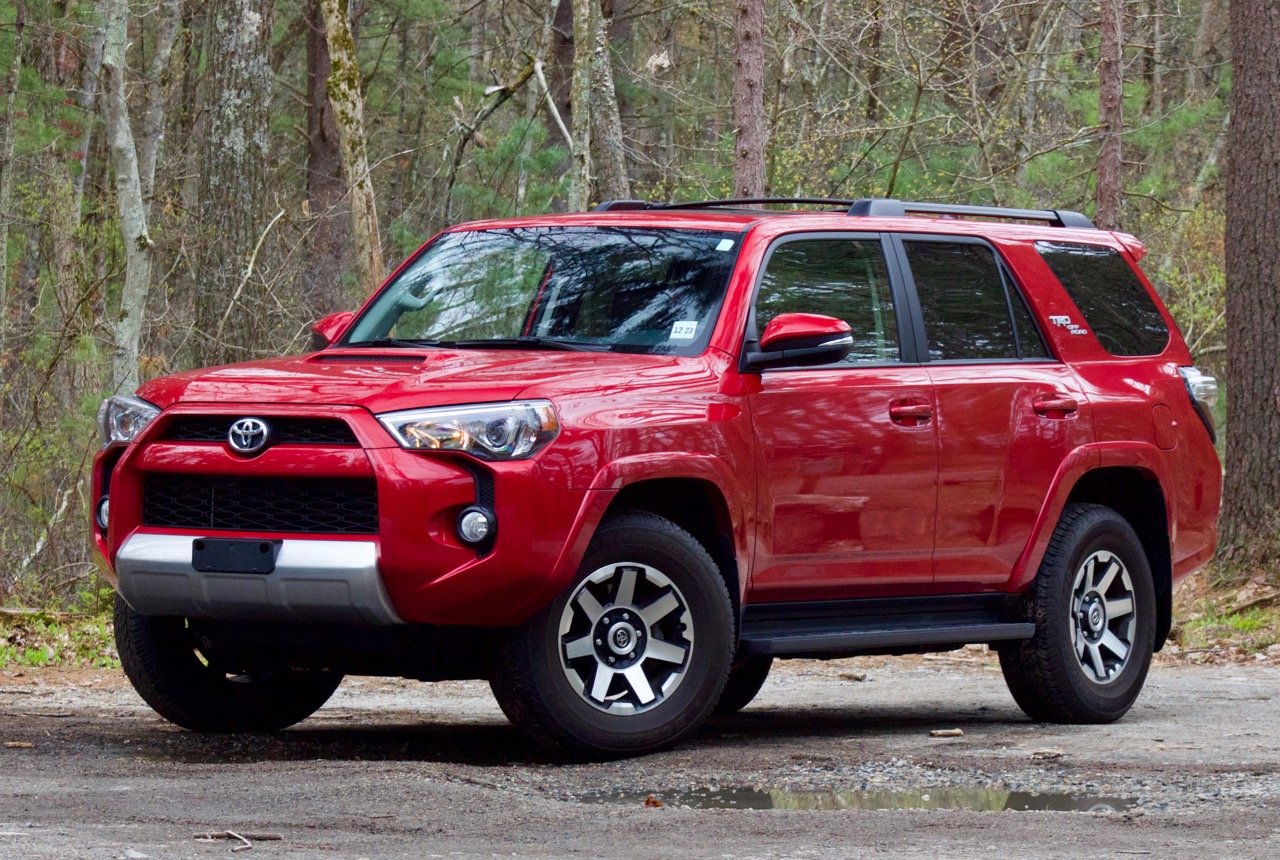
In contrast, the 2019 Toyota 4Runner maintained its rugged, utilitarian design, befitting its off-road capabilities. Although it had received a refresh in 2015 that included an aggressive front end and useful off-road features like large tires and flared fenders, much of its look remained a result of necessity. The 4Runner's stubby front and rear ends, smoked-out taillights, under-body skid plates, and large tires were essential for off-roading. Inside, the 4Runner's design dated back to updates made in 2015, characterized by an older interior layout and a 6.1-inch touchscreen that seemed minuscule by 2019 standards. Yet, it afforded ample head and legroom, even for taller drivers and passengers, and plenty of cargo space. Higher trims like the TRD Off-Road Premium and Limited added comforts such as leather upholstery, heated seats, and advanced audio systems. The top-tier TRD Pro went all out with special off-road enhancements and unique styling elements.


Performance differed significantly between the 2019 Ford Edge and the Toyota 4Runner. The Edge, excluding the sports-focused ST trim, came with a 2.0-liter turbocharged four-cylinder engine, providing 250 horsepower and 280 pound-feet of torque. This powertrain was adequate for most driving scenarios and was available with either front-wheel drive (FWD) or all-wheel drive (AWD). The Edge ST, however, packed a punch with a 2.7-liter EcoBoost V6 producing 335 horsepower and 380 pound-feet of torque, mated to an 8-speed automatic transmission. The ST also featured commendable cornering abilities, providing a balanced and precise driving experience alongside the extra power.
Conversely, the 4Runner boasted a 4.0-liter V6 engine generating 270 horsepower and 278 pound-feet of torque. This engine, paired with a 5-speed automatic transmission, felt somewhat archaic but reliable and capable of towing up to 5,000 pounds. The 4Runner's off-road prowess was further enhanced in the TRD trims, which included features like a locking rear differential, Multi-Terrain Select system, and crawl control. However, these additional capabilities came at the cost of fuel efficiency, with the 4Runner only returning 17 mpg city and 20 highway.
In terms of interior space, the 2019 Ford Edge offered a practical and useful cabin, despite feeling a little dated. The center console featured a deep cargo bin and another storage bin at the bottom of the center stack, with USB ports and an available wireless charger. Although the ST's bucket seats were designed for performance, they weren't ideal for taller drivers. Rear passengers, however, enjoyed ample legroom and headroom. The Edge provided 39 cubic feet of cargo space behind the rear seats, expanding to 73.4 cubic feet with the rear seats folded down, making it competitive with other two-row SUVs in its segment.
The 2019 Toyota 4Runner excelled in cargo capacity and functionality. Offering nearly 90 cubic feet of cargo space with the rear seats folded, it was close to larger SUVs like the Chevy Tahoe. The 4Runner also provided ample head- and legroom for both front and rear passengers. Despite its outdated interior design, the simplicity facilitated ease of use, particularly with large knobs that could be operated while wearing gloves. The lack of modern infotainment and connectivity options was a downside, but the sheer space and practicality made it a favorite for those who needed a rugged and reliable vehicle for both daily driving and off-roading.
The 2019 Ford Edge's base infotainment system featured a diminutive 4.2-inch non-touchscreen, which felt outdated compared to competitors offering larger touchscreens even in base models. However, the higher trims featured Ford's 8-inch Sync 3 infotainment system, which included Apple CarPlay, Android Auto, and Amazon Alexa integration, making it more competitive with modern offerings.
The 2019 Toyota 4Runner lagged behind in terms of technology. Its infotainment system did not support Apple CarPlay or Android Auto, which were becoming standard in many modern vehicles. The upgraded Entune system in higher trims featured navigation and Siri Eyes Free, but the overall tech felt dated. The small 6.1-inch touchscreen and lack of app connectivity were significant drawbacks for tech-savvy drivers.
Safety features distinguished the 2019 Ford Edge from the 2019 Toyota 4Runner. Every Edge came with a reversing camera, traction control, and a full array of front- and side-impact airbags. Additionally, Ford's Co-Pilot360 suite of driver-assistance features was standard, including automatic emergency braking, forward-collision warning, lane-departure warning, automatic high-beams, and blind-spot monitoring with rear cross-traffic alert. Higher trims could be further upgraded with the Co-Pilot360 Assist+ package, adding adaptive cruise control, evasive steering assist, and a lane-centering system.
In contrast, the Toyota 4Runner's safety features were minimal. It came with a reversing camera and traction control as standard, but lacked modern driver-assistance systems. The only notable safety test result was its 4 out of 5 stars overall rating from the NHTSA, with a concerning 3 out of 5 stars in the rollover test. Optional third-row seating in some trims didn’t necessarily make it a more family-friendly vehicle given the dearth of advanced safety features.
CarGurus highlights

According to CarGurus experts, the overall rating for the 2019 Ford Edge is 7.3 out of 10, while the 2019 Toyota 4Runner scores 7.2 out of 10. Despite both vehicles offering specific advantages in their respective domains, the Ford Edge edges out slightly due to its stronger blend of safety features, modern technology, and driver convenience. If you’re looking for a vehicle that offers a more well-rounded package that balances performance, comfort, and tech, the Ford Edge is the better choice.
Choose the 2019 Ford Edge if:
- You prioritize modern driver-assistance features and a comprehensive suite of standard safety technologies.
- You want a vehicle with better fuel efficiency and modern tech integrations like Apple CarPlay, Android Auto, and Amazon Alexa.
- You prefer a sportier, contemporary design with available performance-focused trims.


Choose the 2019 Toyota 4Runner if:
- You need a rugged, off-road capable SUV with tried-and-true components that are reliable.
- You value interior space, especially cargo capacity, and frequently engage in outdoor activities that require gear storage.
- You prefer a more traditional SUV feel that resembles driving a pickup truck.


CarGurus highlights
According to CarGurus experts, the overall rating for the 2019 Ford Edge is 7.3 out of 10, while the 2019 Toyota 4Runner scores 7.2 out of 10. Despite both vehicles offering specific advantages in their respective domains, the Ford Edge edges out slightly due to its stronger blend of safety features, modern technology, and driver convenience. If you’re looking for a vehicle that offers a more well-rounded package that balances performance, comfort, and tech, the Ford Edge is the better choice.
Choose the 2019 Ford Edge if:
Shop Now- You prioritize modern driver-assistance features and a comprehensive suite of standard safety technologies.
- You want a vehicle with better fuel efficiency and modern tech integrations like Apple CarPlay, Android Auto, and Amazon Alexa.
- You prefer a sportier, contemporary design with available performance-focused trims.
Choose the 2019 Toyota 4Runner if:
Shop Now- You need a rugged, off-road capable SUV with tried-and-true components that are reliable.
- You value interior space, especially cargo capacity, and frequently engage in outdoor activities that require gear storage.
- You prefer a more traditional SUV feel that resembles driving a pickup truck.

By: CarGurus + AI
At CarGurus, our team of experienced automotive writers remain at the heart of our content operation, conducting hands-on car tests and writing insightful guides that are backed by years of industry experience. To complement this, we are harnessing AI to make our content offering more diverse and more helpful to shoppers than ever. To achieve this, our AI systems are based exclusively on CarGurus content, ratings and data, so that what we produce is both unique to CarGurus, and uniquely helpful to car shoppers.

