The XC60 is Volvo's best-selling vehicle with more than 2.7 million sold since its global launch in 2008. It's easy to see why so many people have flocked to this five-passenger premium compact crossover. It comes with standard safety tech, luxurious amenities, clean and simple Scandinavian design, and fuel-efficient powertrains.
The ground-breaking City Safety tech introduced on the first-gen XC60 played a role in paving the way for the modern automatic emergency braking systems we know today. Plus, apart from the 2025 model year, the XC60 has made the Insurance Institute for Highway Safety (IIHS) Top Safety Pick or Top Safety Pick+ list since it entered North America for the 2010 model year.
Now in its second generation, the XC60's powertrains are fuel-efficient four-cylinder engines, and the lineup includes a plug-in hybrid (PHEV). Starting in 2022, even the base powertrains incorporated a mild-hybrid system, and Natural Resources Canada fuel economy ratings span 9.0 to 10.0 litres per 100 kilometres in combined driving for most models. The extended-range PHEV introduced at this time gets a combined 8.5 L/100 km, 3.5 litres-equivalent per 100 kilometres, and 58 kilometres of all-electric range.
Though some would argue XC60’s design is dated, others would call it classic and timeless. However, the true selling points are the safety ratings and standard safety features.
Volvo XC60: Cost, Reliability, and the Best Years to Buy
Frequently Asked Questions
Which Volvo XC60 years are the best?
Through two generations, the Volvo XC60 has had fewer consumer complaints and recalls than lots of other vehicles. Consumer Reports gave the first generation lower reliability ratings, but the 2017 model — the last year of the first generation — has the best reliability ratings and just 14 consumer complaints according to the U.S. National Highway Traffic Safety Administration (NHTSA). In the current generation, 2018, 2020, and 2021 have the best reliability verdicts, and the 2018 model has the highest owner satisfaction ratings.
What are the worst Volvo XC60 years?
According to CarComplaints.com the 2019 Volvo XC60 is the worst year to buy due to engine problems. However, the 2010, 2013, and 2022 models have the most consumer complaints on the NHTSA website
How much does a late-model Volvo XC60 cost?
Based on current CarGurus.ca listings, a one-year-old 2025 Volvo XC60 averages around $50,000 in Canada, a three-year-old 2023 model averages around $45,000, and a five-year-old 2021 model averages around $32,000. Older model years offer the best value.
Research Volvo XC60 Price Trends on CarGurus
Is a used Volvo XC60 a good deal?
A used Volvo XC60 can be a good deal, especially considering the original MSRP for most second-generation models was more than $50,000. Go back to about 2016 and you can get a well-equipped model with a reasonable odometer reading for well under $20,000. But with the new generation, you'll likely pay $25,000 or more, which is still a fairly good deal at 50% or more off the original MSRP.
Volvo XC60 Pros and Cons
Pros:
- Stylish design
- Impressive technology
- Great safety ratings
Cons:
- Jerky acceleration and braking
- Tight rear-seat legroom
- Second generation can be pricey
Volvo XC60 Generations
Volvo XC60 Second Generation (2018–Present)
The new Volvo XC60 took all the safety and technology of the first generation and upped the ante with more power, more safety features, and a lot of modern tech. It was built on the same Scalable Product Architecture platform as the S90, V90, and XC90.
Volvo kept the 2.0-litre turbocharged inline-four engine, which delivered 250 horsepower and could be found on T5 models. The T6 got the supercharged and turbocharged inline four, now with 316 hp, and the all-new, top-tier T8 also got a version of the 2.0-litre turbocharged and supercharged engine but as a plug-in hybrid (PHEV), producing a collective 400 hp and 472 lb-ft of torque. All versions of the XC60 were fitted with an eight-speed automatic transmission and standard all-wheel drive (AWD). Three trims were available in Canada: Momentum (T5 or T6), R-Design (T6 or T8), and Inscription (T6 or T8).
Standard features included leather upholstery, heated front seats, "Thor's Hammer" LED headlights, and a nine-inch touchscreen infotainment system with Apple CarPlay and Android Auto integration. Options included a panoramic sunroof, Nappa leather seats, a 15-speaker Bowers & Wilkins premium sound system, air suspension, and the hands-on Pilot Assist semi-autonomous system with adaptive cruise control and steer assist.
As for new safety kit, the 2018 Volvo XC60 added steer assist to the City Safety system. Plus, the new Oncoming Lane Mitigation used steer assist to help mitigate head-on collisions, and the blind spot monitoring system applied it to reduce the risk of lane-changing collisions.
The 2020 model year saw some tech upgrades, including an available 12.3-inch digital instrument cluster and a new Polestar Engineered model. For 2021, the T8 PHEV became the Recharge and blind spot monitoring was standardized.
There was a mid-cycle refresh in 2022. XC60 models got a facelifted interior and exterior and a new Google built-in operating system. The T5 and T6 were replaced by the B5 and B6 mild-hybrid powertrains. The B5 got a 2.0-litre turbocharged 48V mild-hybrid inline-four, and the B6 added an "E-charger" (an electric supercharger). There was also a new extended range PHEV, which could cover up to 58 all-electric kilometres instead of the previous 31 km.
Trim names were changed to Core trim, Plus trim, and Ultimate trim in 2023. In 2024, the mid-level B6 powertrain was eliminated, and the XC60 Black Edition joined the lineup. Exclusive to the top-end Ultimate trim, the Black Edition was a styling pack with Onyx Black paint, 21-inch gloss black alloy wheels, a crystal gear shift knob by Orrefors, and numerous other black details.
There were minor feature updates and a couple of renamed trims in 2025. Ultimate became the XC60 Ultra trim, and the Recharge became simply the Plug-in Hybrid.
The 2026 XC60 received another refresh. This brought a faster infotainment system on a higher-resolution 11.2-inch screen with a redesigned user interface, new cupholders, a better wireless phone charger, and some minor design updates including the latest Volvo grille that debuted on the XC90.
There are plenty of second-generation XC60s advertised at dealerships and by private sellers. While you won't quite get the deal you would with a first-gen XC60, it's possible to find a vehicle with less than 100,000 kilometres, no accidents, and a clean title for $30,000 or less.
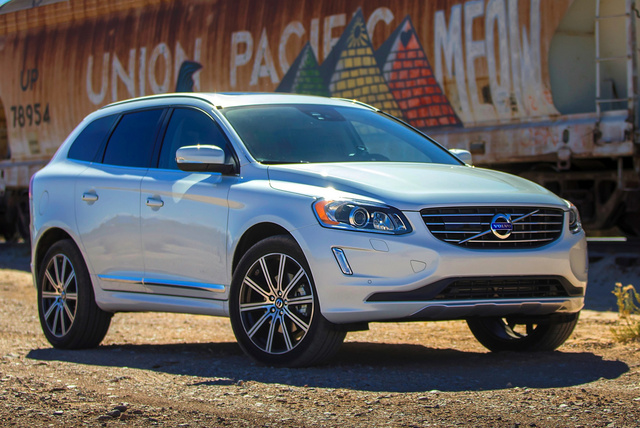
Volvo XC60 First Generation (2010–2017)
The first-generation Volvo XC60 was launched globally for 2009, but it didn't make it to North America until the 2010 model year. This was when Volvo was owned by Ford before it was sold to Geely in 2010, so this compact luxury SUV shared its platform with the Land Rover Freelander as well as the Volvo S80, V70, and XC70.
The 2010 Volvo XC60 was available in three trim levels: 3.2, T6, and T6 R-Design. The base Volvo XC60 3.2 received a 235-hp naturally aspirated inline six-cylinder engine with FWD being the standard drivetrain and available AWD. The Volvo XC60 T6 was equipped with a 281-hp 3.0-litre turbocharged inline six-cylinder engine with standard AWD. The Volvo XC60 T6 R-Design, which became available in the middle of the model year, had the same powertrain as the T6 but a stiffer chassis, stronger damping, and a more direct steering gear in addition to some R-Design styling touches. All powertrains were paired with a six-speed automatic transmission.
Standard features included 17-inch alloy wheels, fog lights, roof rails, a power driver's seat with memory functions, an auto-dimming rearview mirror, cruise control, steering-wheel-mounted audio controls, and an eight-speaker audio system. Available features included Bluetooth phone pairing, blind spot monitoring, a panoramic sunroof, leather upholstery, a six-CD stereo with HD radio and SiriusXM satellite radio, a power front passenger seat, heated outboard rear seats, a power liftgate, rain-sensing wipers, front and rear parking assist, and more.
Volvo has always been known for safety, and the XC60 included features such as whiplash protection, side impact protection, roll stability control, dynamic stability control, inflatable curtain airbags, and hill descent control. The entire first generation received either a Top Safety Pick or Top Safety Pick+ designation from IIHS because of its crash test ratings.
This new compact luxury crossover also introduced a new safety feature called City Safety, which provided automatic emergency braking at speeds up to 30 km/h.
In 2011, both powertrains got a power bump, 18-inch alloy wheels became standard, an R-Design trim was added to the 3.2 range, and some standard equipment was shuffled (e.g., hill descent control was offered only on AWD models, and a panoramic sunroof was standard only on T6 models).
For 2012, Volvo added a series of trim levels: Premier, Premier Plus, and Platinum. The R-Design also got a significant power boost to 325 hp in this model year, and the newly optional Dynamic package added an upgraded suspension and steering to the T6.
Changes for 2013 included an upgrade to City Safety that allowed it to work at speeds up to 50 km/h and new safety systems including road sign information, tunnel detection, and automatic high beams.
There was a mid-cycle refresh in 2014 with a new hood and grille as well as an updated interior. New tech features include Corner Traction Control, an available adaptive digital display, and new sport seats.
Though the 2016 model was largely a carryover, the line-up received new "Drive-E" engines. The base T5 gained a turbocharged 2.0-litre four-cylinder, while the T6 was both turbocharged and supercharged. A T5 AWD Special Edition trim carried over the 2.5-litre turbocharged five-cylinder engine through to the end of this generation.
There are plenty of first-generation Volvo XC60s available in Canada as of this writing. Expect to see pricing of $7,000 on the low end for older vehicles pushing 200,000 kilometres. If you want one with less than 150,000 kilometres, you'll likely spend between $12,000 and $18,000.
Related Topics