The original Toyota 4Runner was a cross between the Toyota Trekker and the Toyota Land Cruiser, and it combined off-road capability with on-road comfort. The first generation was little more than a truck with a fibreglass canopy covering the bed, but as it progressed it took cues from other capable off-roaders such as the Ford Bronco and the Chevrolet K5 Blazer, retaining capability while adding comfort.
Toyota 4Runner Buying Guide: Cost, Reliability, and the Best Years to Buy
Search for Toyota 4Runner
See all


This midsize SUV has been slow to make big changes, but it has undergone continuous improvement and upgrades throughout the years. Slowly but surely, it added more ground clearance, an independent front suspension, side impact protection, airbags, and anti-lock brakes. It went from a barebones off-roader in its first generation to a tech-filled cruiser that can still tackle a tough obstacle in its latest form.
The Toyota 4Runner has evolved into a vehicle that has all the latest standard safety technology, modern amenities such as wireless Apple CarPlay, a smooth hybrid powertrain, and impressive camera displays. Still, it retains that gritty off-road character and go-anywhere attitude that defined the original model more than 40 years ago.
Toyota 4Runner: Cost, Reliability, and the Best Years to Buy
- Frequently Asked Questions
- Toyota 4Runner Pros and Cons
- Toyota 4Runner Generations
- Sixth Generation (2025–present)
- Fifth Generation (2010–2024)
- Fourth Generation (2003–2009)
- Third Generation (1996–2002)
- Second Generation (1990–1995)
- First Generation (1984–1989)
Frequently Asked Questions
Which Toyota 4Runner years are the best?
The first, second, and third generations receive relatively few consumer complaints, but as Consumer Reports points out, those generations are somewhat underpowered. The fourth generation gets CarComplaints.com's "Seal of Awesome" because it has relatively few reliability issues compared to other vehicles of a similar age and one of the lowest driver death rates of any vehicle, so look for 2006 to 2009 models. Otherwise, fifth-gen 4Runners will likely be your best bet because they have more safety features, few consumer complaints, and high predicted reliability ratings.
What are the worst Toyota 4Runner years?
There is a huge spike in complaints regarding the Toyota 4Runner at the beginning of the fourth generation. CarComplaints.com calls 2003 the worst year to own, citing excessive rust and corrosion as the most reported problem. The 2004 model has the most complaints overall, and 2005 is the third-worst year in terms of complaints.
Is a used Toyota 4Runner a good deal?
Due to its solid reliability ratings over the past couple of generations, the Toyota 4Runner holds its value. Even if you go back to near the beginning of the fifth generation, you'll still likely spend at least $12,000, and that’s for exceptionally high-kilometre vehicles. If you look at 2020 when Toyota's safety suite was standardized, the average price is only a few thousand dollars below the original MSRP. While a used 4Runner might not be a good deal in the monetary sense, it is if you want a durable and high-quality vehicle with four-wheel drive (4WD) and good reliability ratings.
Toyota 4Runner Pros and Cons
Pros:
- All-terrain capabilities
- Resale value
- Reliability
Cons:
- Poor on-road handling
- Fuel economy
Toyota 4Runner Generations
Sixth Generation (2025–present)
The new Toyota 4Runner got a complete tech and powertrain overhaul. While the sixth-generation model was completely redesigned, the exterior changes were more of an evolution than a drastic divergence from the previous generation.
The 4Runner remained body-on-frame, sharing a platform with the Tacoma and Tundra pickup trucks, with standard four-wheel drive (4WD) in Canada. Similarly, this generation adopted the turbocharged four-cylinder engine and hybrid powertrain seen in the Tacoma. The non-hybrid i-Force engine was a 2.4-litre turbo that delivered specs of 278 horsepower and 317 lb-ft of torque, while the i-Force Max hybrid offered 326 horsepower and 465 lb-ft, making it the most powerful 4Runner to date. Both engines were mated to a new eight-speed automatic transmission.
Trim levels available at launch included SR5, TRD Sport, TRD Off-Road, Limited, Platinum, TRD Pro, and Trailhunter. The Platinum trim was intended to be more luxurious with swish accents and features, whereas the TRD Pro and Trailhunter had an off-road focus. In fact, the new Trailhunter trim featured 33-inch off-road tires, ARB's Old Man Emu 2.5-inch forged shocks, extra ground clearance, a high-mounted air intake, high-strength steel skid plates, an integrated 20-inch LED light bar, and colour-selectable LED fog lights.
The new 4Runner got Toyota's latest infotainment system with natural voice commands and a larger 8-inch base screen. It also came standard with blind-spot monitoring, fabric seats, a tow hitch receiver, and a power rear window. A third row was still available with this generation, but only with non-hybrid models.
For 2026, Toyota replaced the TRD Pro-exclusive exterior colour Mudbath (a light tan) with Wave Maker (a brilliant teal).
A brand-new 2026 4Runner starts at just under $60,000 in Canada, including destination charges and other fees, for a base SR5. A top-of-the-line Trailhunter starts at nearly $90,000. This generation is still basically brand new, so there aren't many examples on the used market yet.
Fifth Generation (2010–2024)
The fifth-generation Toyota 4Runner maintained its off-road-ready, body-on-frame construction at a time when most other midsize SUVs were switching to a car-based unibody design. In addition to the redesign, this 4Runner was slightly longer, wider, and taller than the previous generation. The short-lived V8 was discontinued in 2010. In Canada, the sole engine offering was a 270 horsepower 4.0-litre DOHC V6. The SR5 was the sole trim, and four packages were offered: Upgrade, Trail Edition, Limited, and Limited with Navigation. Four-wheel drive (4WD) was standard in Canada.
All models got Downhill Assist Control and Toyota's A-TRAC active traction control, while the Trail Edition package added standard features such as an electronic locking rear differential, Crawl Control, and a Multi-Terrain Select system. All 4Runners of this generation also got power windows and door locks, a multi-information display, and 10 cup holders. Available features included satellite radio, Bluetooth, a JBL audio system, leather seats, and heated front seats.
This was the longest generation in 4Runner history, so there were a lot of ongoing improvements rather than big sweeping changes. There was a light refresh for the 2014 model year with a revised front and rear fascia, material upgrades, and a revised dash and centre stack. The 4Runner TRD Pro package made an appearance in 2017, adding exclusive colour options, TRD Bilstein shocks, TRD-tuned front springs, and a TRD front skid plate. In 2017, the Trail Edition became the TRD Off-Road. In 2019, there was a new Nightshade package with blacked-out badging and accents.
Some of the biggest tech changes occurred in 2020 with the addition of an upgraded infotainment system, larger and higher-resolution touchscreen display, Apple CarPlay and Android Auto, additional rear USB ports, and GPS-based navigation. This model year also added Toyota Safety Sense-P (TSS-P) as standard fare, comprising a pre-collision system, lane departure alert, automatic high beams, and adaptive cruise control.
The 2022 model year also saw a series of upgrades, including the addition of standard passive entry and push-button start. The TRD Sport was introduced into the lineup, and the TRD Off-road added a multi-terrain monitor. A 40th Anniversary Special Edition and new paint colours appeared towards the end of this generation's life in 2023.
Due to the longevity of the fifth-gen Toyota 4Runner, these vehicles are prolifically available, but used prices can be steep. The lowest we saw was $12,000 for early models with 300,000 kilometres or more on the odometer. At the top end of the scale were low-kilometre 2024 TRD Pro units for nearly $75,000. If you're willing to go for a pre-2020 model, then you'll find some solid options in the $25,000 to $35,000 range.
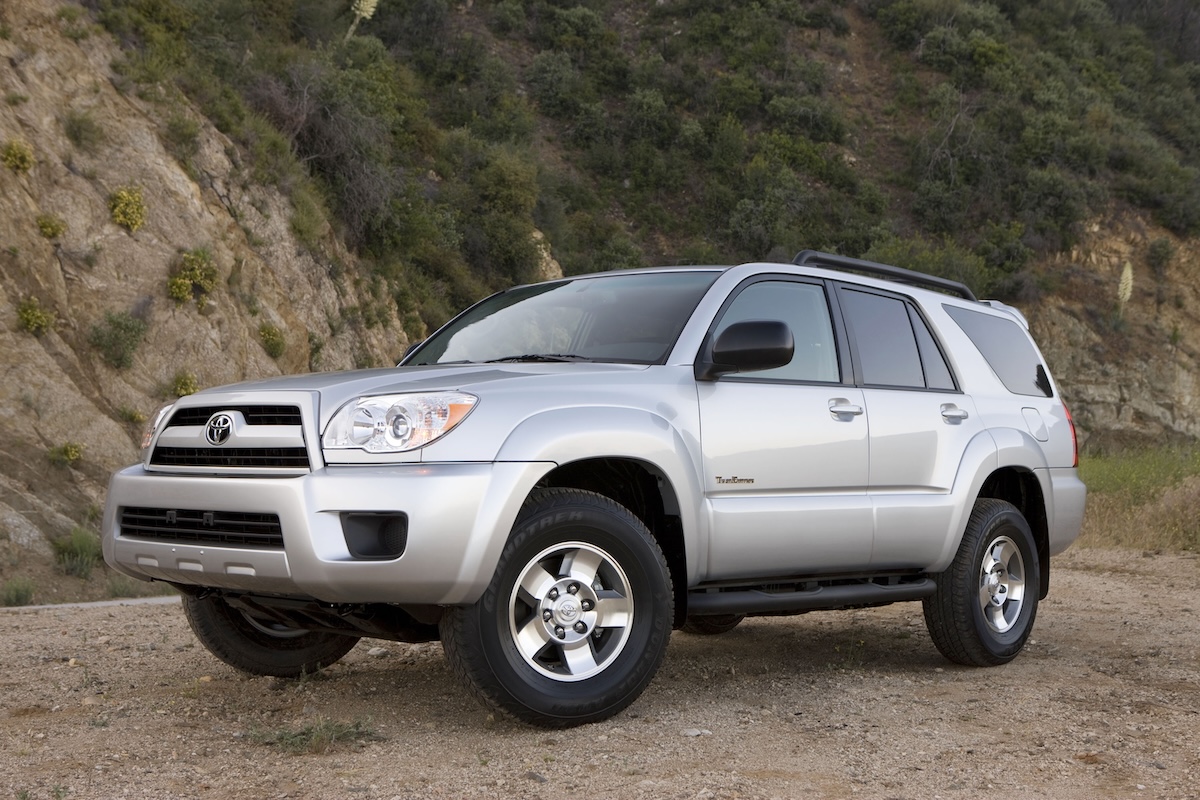
Fourth Generation (2003–2009)
Though the fourth-generation Toyota 4Runner added more technology and safety features, it was still targeting the same off-road buyers. It continued to use a body-on-frame construction and had standard 4WD in Canada, and all models were equipped with skid plates for the engine and transfer case.
At launch, the fourth-gen 4Runner added a new, more powerful V6 engine and a V8 for the first time. Maximum towing capacity with the latter powertrain increased to 3,300 kilograms (7,300 pounds).
The 4WD system was full-time when equipped with the V8 and had multi-mode part-time capability with the V6. A new suspension system, X-Relative Absorber System (X-REAS), was available.
Standard features included remote keyless entry, automatic climate control, power driver's lumbar support, and a power rear tailgate window. There were also available features such as an auto-dimming rearview mirror, a power moonroof, DVD-based navigation, JBL Synthesis audio, and a back-up camera. A third-row seat was made available in 2004.
The fourth-gen 4Runner also upped its safety game, including Toyota's Star Safety System on every model. This brought standard features such as anti-lock brakes, electronic brakeforce distribution, brake assist, traction control, and vehicle stability control. Side airbags became available in 2003. Along with these changes, the Insurance Institute for Highway Safety (IIHS) gave it Good overall ratings in front and side impact crashes. Even though it had Poor ratings for rear impact protection, IIHS released a report in 2007 showing the 4Runner had one of the lowest death rates for all vehicles on the road for the 2003 and 2004 model years.
The fourth-gen 4Runner got a mid-cycle refresh in 2006 with changes to the front and rear bumpers, a new grille, projector-beam headlights, LED taillights, and the addition of an auxiliary input jack. At this time, the Sport package received a six-CD changer and power seats, and the Toyota 4Runner Limited added unique 18-inch wheels and memory seats.
There were no major changes for the rest of this generation.
This generation of Toyota 4Runner was prone to rust, which means there aren’t many available on the Canadian used vehicle market today. We found only four available nationwide during our research with prices ranging from $5,000 to $17,000.
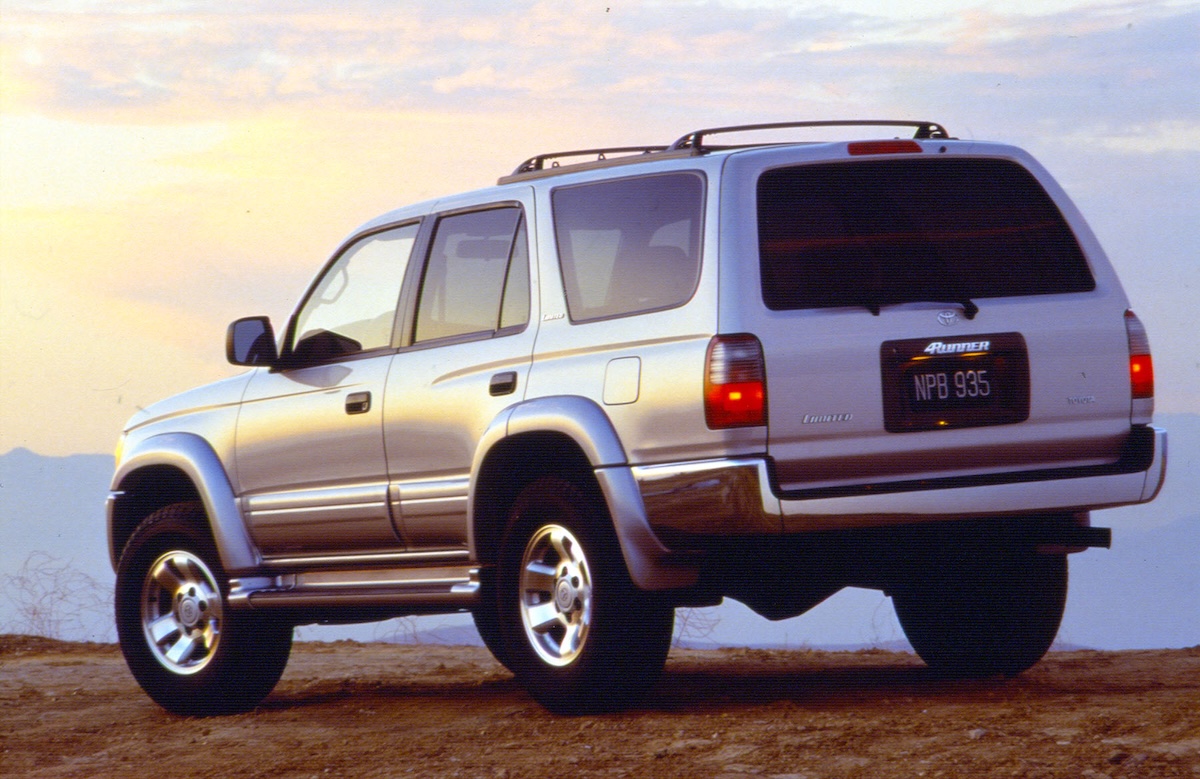
Third Generation (1996–2002)
It was in its third generation that the modern Toyota 4Runner midsize SUV started to take shape. It had an all-new body shell on an all-new chassis. Instead of being based on the Hilux, it shared many of its parts — including the powertrains — with the first-generation Toyota Tacoma midsize pickup truck. It had a larger body on a longer wheelbase, which increased both passenger space and the cargo area.
In Canada, the sole engine offering was a 183-hp 3.4-litre V6, which replaced the previous 3.0-litre unit. A five-speed manual transmission or a five-speed auto were available.
In addition to the new powertrain, the 4Runner added driver and front passenger airbags, a lift-up tailgate, and an optional selectable electric lock in the rear differential. Though ground clearance decreased by just over a centimetre, maximum towing capacity increased to 2,268 kilograms (5,000 pounds).
There was a mid-cycle refresh in 1999 with a new "fat lip" front bumper design and an updated centre console. This model year also added a new 4WD system with a centre differential and a full-time 4WD mode in addition to the existing 2Hi, 4Hi, and 4Lo modes.
Heading into the final years of this generation, the 4Runner got a new grille design, new wheels, standard vehicle stability control, and a multi-mode transfer case on 4WD models.
Used examples of the third-gen Toyota 4Runner are few and far between. When we checked, prices for this generation ranged from $8,000 for a unit with well over 400,000 kilometres on the odometer to a mind-boggling $70,000 for a heavily modified unit. The average price among the five units we found nationwide in our research was roughly $20,000.
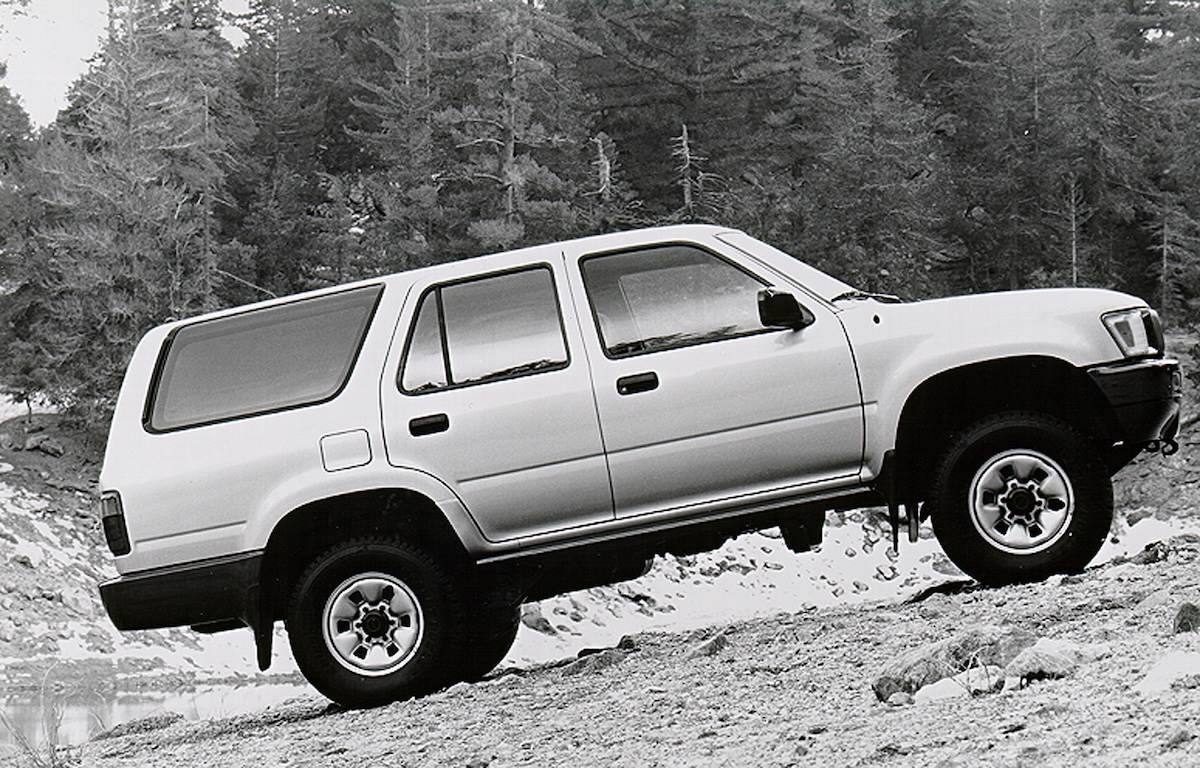
Second Generation (1990–1995)
Though the second-generation Toyota 4Runner was still based on the Hilux pickup, it was redesigned to add a full steel integrated body, taking on a classic SUV-like shape.
Most models had four doors, but two-door versions remained available until 1993. The rear suspension switched to a multilink coil spring design, replacing the previous model's leaf springs. The powertrain was a carry-over from the first generation. Anti-lock brakes were standard on the SR5 V6 models from 1990, and four-wheel anti-lock brakes were optional.
Neither the first- nor the second-generation 4Runners were considered particularly safe. Toyota added side-impact door beams in 1994, but crash test ratings for the second-generation models were low. It received one or two stars (out of five) for the driver's side in a frontal collision, while the passenger side received three to four stars.
4Runners in this generation are around in Canada, but they're very scarce. We found just two in a nationwide search, both with well over 300,000 kilometres on the odometer and priced at $3,000 and $5,000. Classic.com lists the average price of a 4Runner in this generation at around USD$13,000, and it notes a top sale of USD$31,000 for a 1994 SR5 V6 4X4 with a manual transmission.
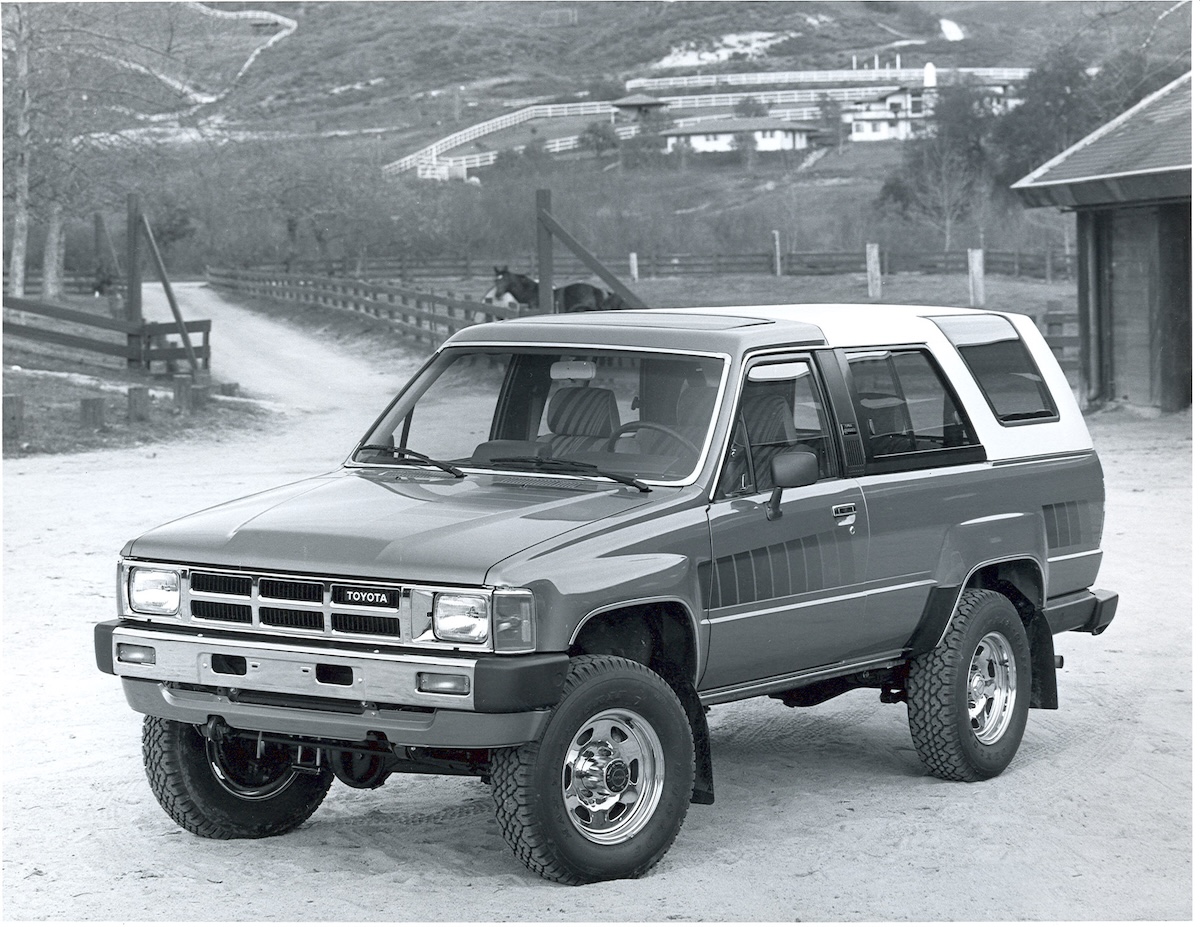
First Generation (1984–1989)
The first-generation Toyota 4Runner followed the Toyota Trekker, which was a third-party conversion of the Toyota Hilux short-bed pickup truck. Similarly, the 4Runner was also based on the Hilux, but it added a roll bar and a removable fibreglass canopy as well as a retractable window in the tailgate. Originally, it only had two doors and two seats in the front. It took inspiration from the Ford Bronco and Chevrolet K5 Blazer, which were also based on short-bed pickups and built for off-road prowess.
The original 4Runner was mechanically identical to the Hilux, and initially it was equipped only with a four-cylinder engine and five-speed manual transmission. A turbocharged four-cylinder engine was added in 1986 along with an automatic transmission and a heavier rear differential, but it was replaced by a 3.0-litre V6 in 1988. Both RWD and 4WD drivetrains were available.
It's rare to find a first-generation 4Runner for sale these days, at least on mainstream websites, and you're more likely to see it in classic-car circles. Classic.com notes the average transaction price for a vehicle in this generation is about USD$19,000 and lists a top sale price of USD$42,000 for a 1988 SR5 model with a V6 engine, which sold at auction.
Related Topics



by Jill Ciminillo
Jill Ciminillo is a Chicago-based automotive writer, influencer, TikTok Creator, YouTube personality, and podcast host, with her articles appearing on websites such as U.S. News & World Report, Capital One Auto Navigator, Consumer Guide Automotive, A Girl's Guide to Cars, and Drive Chicago. Additionally, she co-hosts a weekly Car Stuff radio show via Talk Zone. Previously, Jill has been the automotive editor for the Chicago Sun-Times News Group as well as Sinclair Broadcast Group. She is also a past president for the Midwest Automotive Media Association and has the distinction of being the first female president for that organization. Jill is also currently a juror for the North American Car, Utility and Truck of the Year (NACTOY) and Women's Worldwide Car of the Year (WWCOTY).
The content above is for informational purposes only and should be independently verified. Please see our Terms of Use for more details.


