Tesla has made only modest design changes to the Model S over its 15-year lifespan, so older examples look very similar to the ones being produced today. Constant tech and spec updates have kept it competitive, though, and over-the-air updates mean that any Model S will have the latest software that its hardware will support. All of this is good news for the used car buyer.
Tesla eschews much of traditional automotive culture, skipping dealerships in favour of direct-to-consumer sales and purposefully ignoring model-year cycles. The Model S is more of a software-driven vehicle. Like a smartphone, the automaker rolls out changes when they're ready rather than waiting for one big annual update. Thus, as you look at the various years the Tesla Model S has been available, you’ll notice there could be multiple battery packs, different model names, and new standard features at various times of the year.
Slated to be discontinued in 2026, the Tesla Model S and Tesla Model X are the oldest vehicles in the brand’s current lineup. The smaller Tesla Model 3 started production in 2017, and the corresponding Tesla Model Y SUV was introduced in 2020. The most recent addition is the Cybertruck, which was introduced in late 2023.
Our buying guide looks at how the Model S has changed over time, the best and worst versions to buy, and how much you can expect to pay for one.
Tesla Model S Buying Guide: Cost, Reliability, and the Best Years to Buy
Frequently Asked Questions
Which Tesla Model S years are the best?
We generally recommend that you look at newer versions of the Model S, with some exceptions. A lot of the earlier glitches have been worked out, and you’ll see better real-world range. If you’re looking for something a little older, 2018 and 2019 have fewer consumer complaints and recalls with the U.S. National Highway Traffic Safety Administration (NHTSA) than anything that came before them. Otherwise, 2024 and 2025 have the fewest recalls to date and, according to Consumer Reports, better-than-average owner satisfaction ratings. As a new car, the Model S comes with a four-year, 80,000-kilometre bumper-to-bumper warranty and an eight-year/240,000-kilometre battery and drive unit warranty.
What are the worst Tesla Model S years?
The single worst year for the Tesla Model S appears to be 2021, which has 23 recalls and 170 consumer complaints according to NHTSA. Consumer Reports also gives this year the lowest predictive reliability score we’ve ever seen. Outside of that, we generally recommend steering clear of the earliest Model S years due to niggles such as electrical problems, suspension issues, and door handle failures.
Is a used Tesla Model S a good deal?
A used Tesla Model S can be a good deal, especially if you’re willing to go back a few years. Prices for a 2018 example are a quarter of the original MSRP. At this age, you should be able to find a used Model S for less than $30,000. Even if you’re looking at cars from 2022, prices are about 50% of what the Model S cost when it was new. Prices start to climb for post-2022 cars, but it can still be considered a good deal when you’re paying $20,000 to $30,000 less than the original sticker price.
Note that used examples of the Tesla Model S are almost exclusively found in Quebec, British Columbia, and the Greater Toronto Area as these areas are historically where the best purchase incentives have been available.
Tesla Model S Pros and Cons
Pros:
- Impressive range
- Advanced technology
- Sports car-style acceleration
Cons:
- No Apple CarPlay or Android Auto
- Poor build quality
- Weird steering yoke in some models
Tesla Model S Generations
Tesla Model S First Generation (2012–Present)
The prototype for the Tesla Model S debuted in 2009, a year after Tesla started selling its first vehicle, the low-volume Roadster. It took three more years for Tesla to begin producing and selling the Model S. When this luxury electric sedan finally entered the market, it was revolutionary in offering more than 400 kilometres of electric range, a minimalist interior, and an exterior design more influenced by aerodynamics than by fashion. At the time, the Nissan Leaf hatchback with 117 kilometres of range and the Mitsubishi i-MiEV with 100 kilometres were the only other mass-market electric vehicles sold in Canada.
At launch, the Tesla Model S was equipped with an 85-kWh battery pack and promised 426 kilometres of range. It also sported a huge (for the time) 17-inch infotainment screen, while the long wheelbase and clever packaging provided generous interior space. All original models were rear-wheel-drive only. In 2013, a 60-kWh battery pack model with less range became available. The 60-kWh models delivered 302 hp, and the 85-kWh models 362 hp or 416 hp depending on whether you opted for the Performance model.
The original Tesla Model S, billed as a luxury vehicle, was equipped with heated front seats, leatherette seating surfaces, a seven-speaker 200-watt audio system, power-adjustable front seats, and two USB ports. This first-gen Model S also offered unlimited free supercharging at the Tesla Supercharger network, although this was discontinued in 2017 (but reintroduced in 2023). Since the feature is not meant to be passed on beyond the original owner, not all cars have it that are still on the road today. The standard 17-inch infotainment touchscreen controlled climate, entertainment, and various vehicle functions. Additionally, the Model S lacked a stop/start button and instead turned on as soon as a driver sat in the seat and put a foot on the brake. These two features were novel at the time, and now we see them regularly in EVs.
Factory options for this era of Model S included a panoramic glass roof, Nappa leather seats, a 12-speaker premium audio system, HID headlights, navigation, a backup camera, a power liftgate, active air suspension, and rear-facing jump seats (big enough for children only).
Tesla doesn’t really follow a model year strategy. It offers updates when they are available rather than as a part of a big model-year release, which makes tracking changes and generations difficult. A dual-motor AWD drivetrain with “Insane” acceleration became available toward the end of 2014. Then in 2015, the 60 kWh models were phased out in favour of a new 70 kWh battery pack that delivered 329 horsepower and 386 kilometres of range.
At this time, Tesla also started phasing out the 85 kWh option for the 90 kWh battery pack, which offers “Ludicrous” high-performance mode with 762 hp and up to 435 kilometres of range, and between 417 and 691 non-Ludicrous horsepower for the regular and Performance models, respectively. Vehicles started to be equipped with Autopilot hardware in late 2014 with a software update in late 2015 activating Autopilot features.
Many consider the Tesla Model S to exist in one continuous generation with ongoing software updates, but the first major refresh occurred in 2016. At this time the black “grille” was replaced by a body-coloured nose. The headlights are also redesigned and now include full-LED adaptive beams.
Other changes that came online in late 2016 include the addition of the 100-kWh battery and Autopilot Hardware 2.0. This year is a mess of battery packs with 60-, 70-, 75-, 85-, 90-, and 100-kWh versions being sold all at once, so be sure to look at any used car listings carefully to understand what you’re buying.
Standard features include 12-way power adjustable seats, heated front seats, navigation, a high-definition rear-view camera, leatherette seating surfaces, and two USB ports. Available features include a panoramic glass roof, Nappa leather seats, premium audio, Autopilot, lighted door handles, a power rear liftgate, active air suspension, heated steering wheel, heated rear seats, and heated washer nozzles.
In 2017, Tesla began phasing out the 60-kWh battery pack models it had reintroduced in 2016. In 2018, the range was simplified to standard all-wheel drive and two battery pack options: 75- and 100-kWh. Tesla also started to limit its free supercharging to 400 kWh per year. That
year also saw some quiet tech upgrades with faster screen processing and better navigation.
In 2019, the 100-kWh battery pack became standard, though you do still see some 2019 75-kWh battery models for sale. Model names were simplified to Long Range and Performance, with Long Range models jumping up to about 595 kilometres of range. All Model S vehicles were equipped with the “Full Self-Driving Computer,” laying the groundwork for the FSD Beta that was released in 2020. The last year of this second iteration received few changes, but it is generally considered a great year thanks to better fit and finish and fewer software glitches. Autopilot is now standard, and the Model S sees new 200-kWh V3 Supercharger compatibility for faster charging.
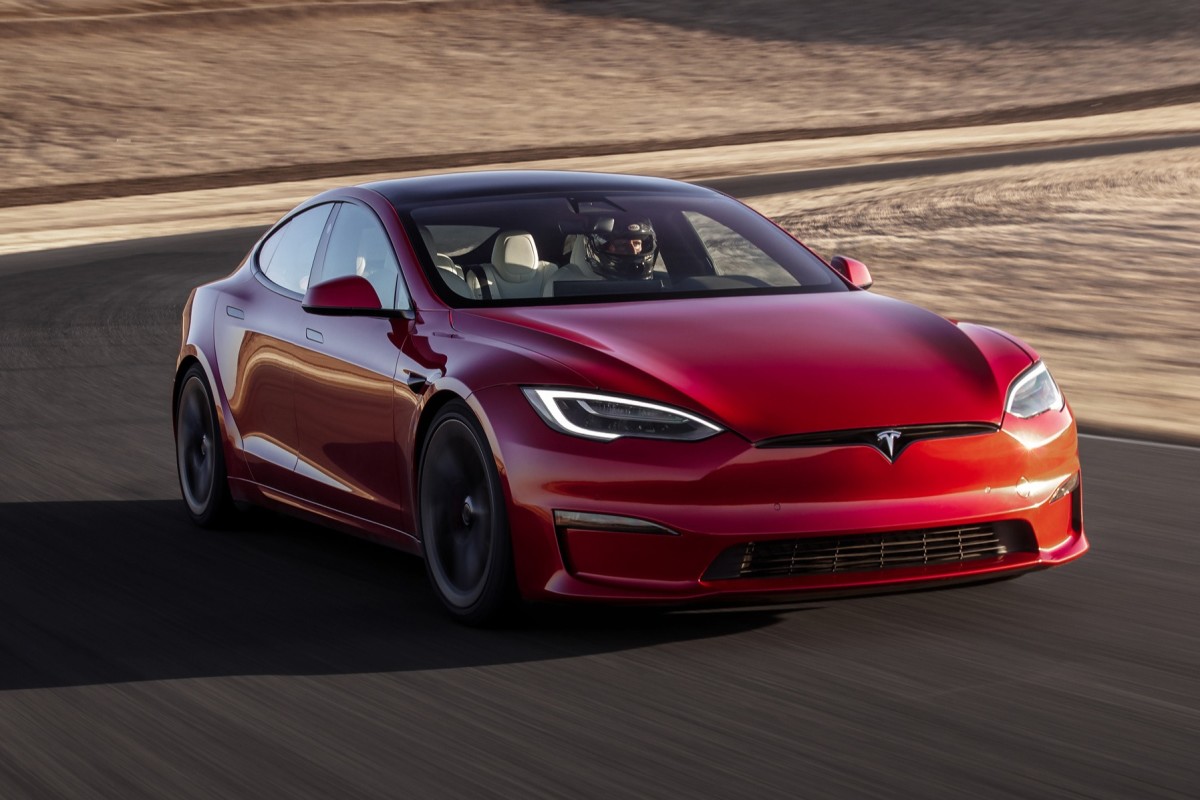
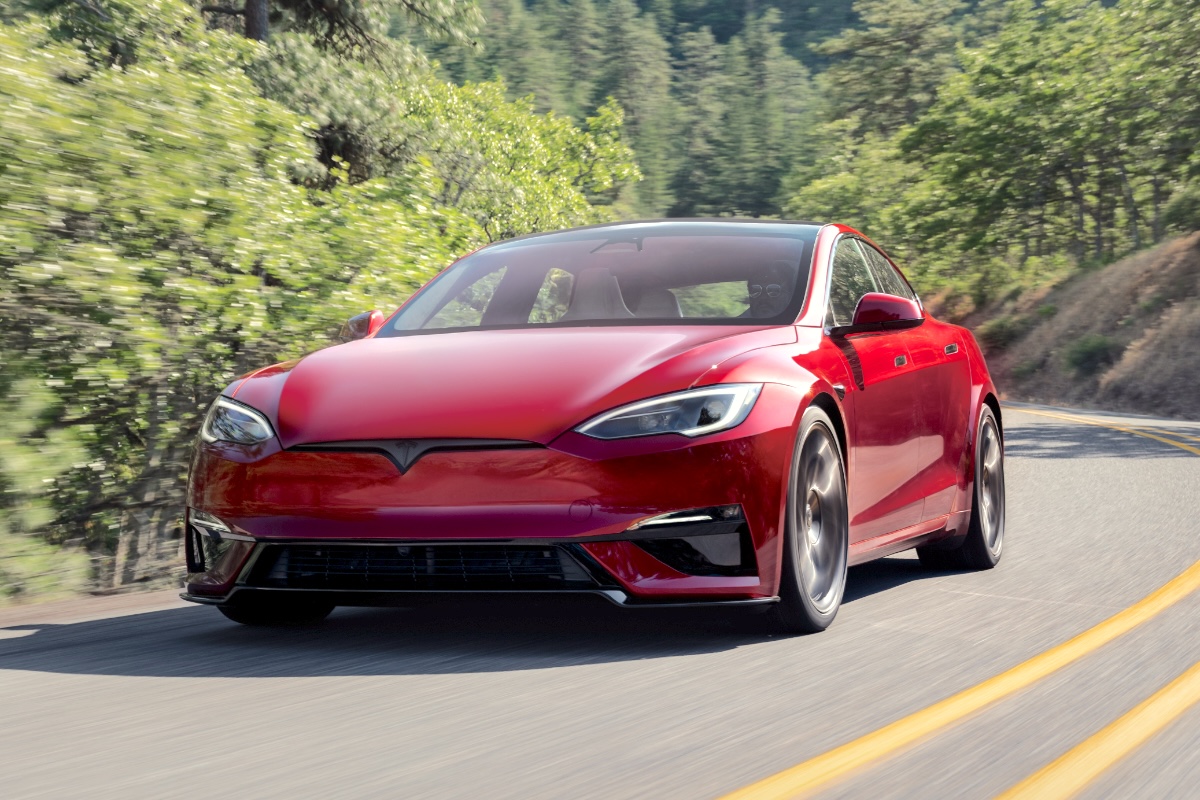
In 2021, the Model S received its biggest update yet in the shape of the ‘Palladium’ refresh. (Tesla gives its model updates names rather than model year designations.) In addition to minor exterior design changes, there was an all-new interior featuring a yoke steering wheel. The powertrain was also overhauled with a new battery pack and motors bringing increased efficiency, range, and power.
The base Long Range version features dual electric motors and all-wheel drive. The new Tesla Model S Plaid model featured three electric motors (one up front and two in back) and standard AWD, delivering an eye-popping 1,020 horsepower. Maximum range for these two models is 652 and 637 kilometres respectively.
Standard features include vegan leatherette seats, heated front and rear seats, ventilated front seats, adaptive air suspension, glass roof, wiper blade defrosters, heated windshield washer nozzles, a heated steering wheel, Wi-Fi connectivity, wireless phone charging, a premium 22-speaker, 560-watt audio system, adaptive cruise control, and a blind spot monitor. Available features include the Full Self-Driving Capability (FSD) Package, which includes self parking, the Smart Summon valet, and hands-free highway driving. Apple CarPlay or Android Auto phone mirroring are not available at all.
From 2022 through 2025, the Model S received mostly software upgrades, rolling out Autopilot HW4 in 2022 and making constant improvements via over-the-air (OTA) releases with a focus on autonomy and FSD. Other OTA software updates in this period include navigation enhancements, user interface changes, battery optimizations, and feature unlocks. In 2023, the Long Range model became the Standard model, and a regular steering wheel became an option.
In 2025, the Model S got another refresh that brought some minor cosmetic changes, a new forward-facing camera in the front bumper, improved suspension, and a quieter cabin. Maximum range for the base Model S increased to 660 kilometres, making it the longest-range Model S, with the Plaid rated at up to 560 kilometres. Top speed for the Plaid model dropped from 320 km/h to 240 km/h. Tesla announced plans to discontinue the Model S in 2026.
If you’re looking for a used 2012-2016 Tesla Model S, you can expect to pay anywhere from about $10,000 for a very high-kilometre car to about $30,000 for a low-kilometre model. Budget for at least $20,000 for one that’s covered less than 100,000 kilometres.
Prices for used 2017-2021 Model S sedans range from about $28,000 to $65,000. The updated post-2021 models start at about $50,000 and go all the way up to more than $100,000.
Related Topics