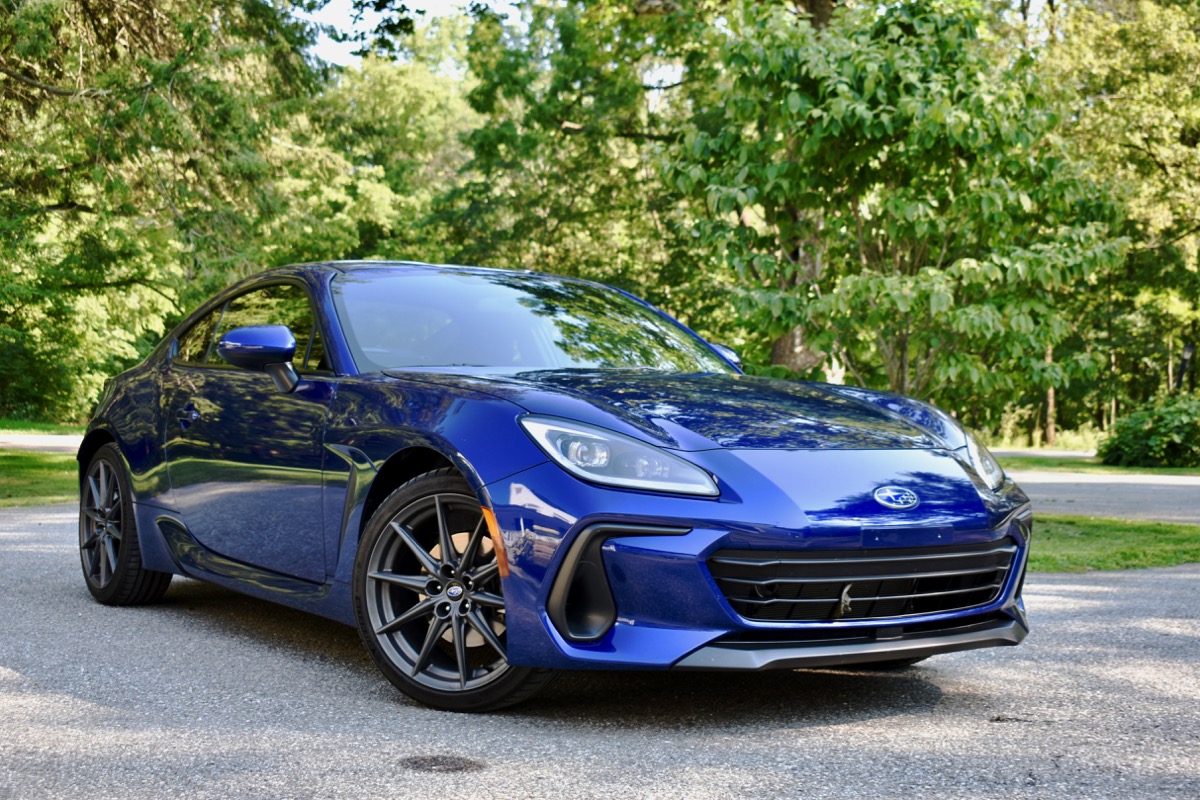
The Subaru BRZ coupe and its sibling from Toyota, first known as the Scion FR-S and then the Toyota 86/GR86, represent a return to the days when drivers could walk into a car dealership and buy a real rear-wheel-drive sports car for a reasonable sum. In this case, that car comes with just enough power to have fun, crisp handling, and plenty of modern conveniences.
The Subaru BRZ debuted in its initial form for the 2013 model year here in North America. It was equipped with a 2.0-litre four-cylinder engine producing 200 horsepower and 151 pound-feet of torque. That powerplant was hooked to either a six-speed manual transmission or an available automatic transmission and, in proper sports car style, power was sent solely to the rear wheels. The BRZ has never been marketed based on its straight-line acceleration, although 0-100 km/h times in the six-second range and quarter-mile times of less than 15 seconds are decent. Instead, its appeal lies in the fact that it’s a well-balanced machine and lots of fun at a price that won’t break the bank.
The second-generation BRZ arrived for the 2022 model year with almost identical dimensions to the first and a very similar exterior design. It gained a more powerful engine, a stiffer chassis, and a smarter interior, but it retained the original’s back-to-basics ethos.
Subaru BRZ Buying Guide: Cost, Reliability, and the Best Years to Buy
Frequently Asked Questions
Which Subaru BRZ years are the best?
The Subaru BRZ has been reliable across both generations. Those looking for the sportiest driving experience should target a BRZ tS model with its handling upgrades.
What are the worst Subaru BRZ years?
The initial 2013 model year has seen more complaints from owners than any other year according to CarComplaints.com. The overall number of complaints is low, though, and it’s not unusual for the first model year of a new vehicle to have some teething pains as engineers work out the kinks.
Is a used Subaru BRZ a good deal?
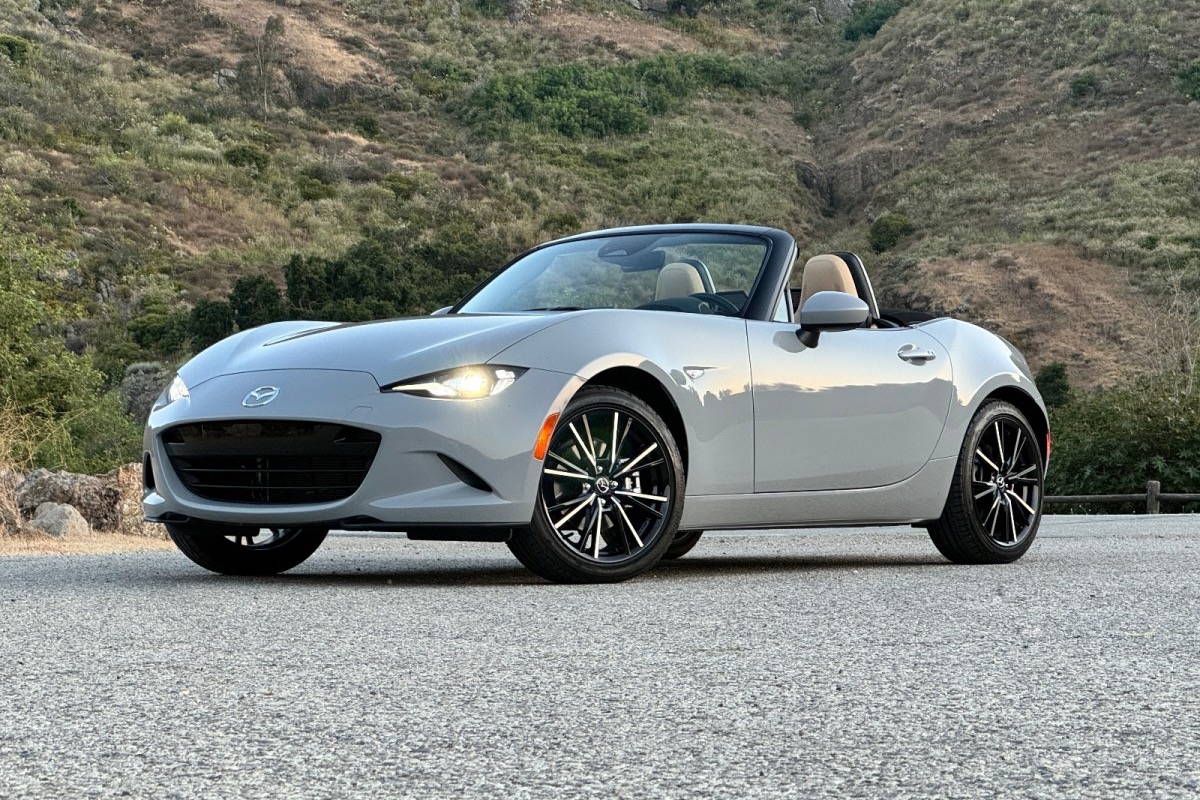
A used Subaru BRZ represents a very good deal for buyers who want something that’s relatively economical but extremely rewarding and fun to drive, as long as they won’t often use the small back seat or need a big trunk. A used Mazda MX-5 is also a lot of fun to drive but has only two seats, so it’s even less practical than the BRZ. Some buyers may prefer a larger and more powerful coupe such as a Ford Mustang, but the American pony car doesn’t offer the same kind of nimble feel as the BRZ.
Buyers should also look at the closely related Toyota GR86, which was initially known as the Scion FR-S in North America.
Subaru BRZ Pros and Cons
Pros
- Fun to drive
- Manual transmission available
- Excellent value for money
Cons
- Cramped back seat
- Outdated technology
- Limited power
Subaru BRZ Generations
## Subaru BRZ Second Generation (2022-Present)
An all-new Subaru BRZ was launched in 2022 alongside its Toyota sister car, this time called the GR86. Despite looking very similar to the first, the second BRZ didn’t have many carryover parts. There were improvements in key areas with a stiffer body, a higher-grade interior, and a more powerful 2.4-litre boxer engine with a 7,000-rpm redline. Outputs of 228 horsepower and 184 pound-feet of torque represented increases of 23 hp and 28 lb-ft over the previous model’s 2.0-litre engine.
As before, the BRZ was offered with six-speed manual or six-speed automatic transmissions, both of which sent power solely to the rear wheels. With the manual transmission, Natural Resources Canada estimated the 2022 BRZ would get 12.0 litres per 100 kilometres in the city, 8.8 on the highway, and 10.5 combined. With the optional automatic, the 2022 BRZ got estimates of 11.0 L/100 km city, 7.7 highway, and 9.5 combined.
Subaru claimed a 50% increase in torsional stiffness from the redesigned chassis, and the new BRZ remained the lightest four-passenger sports car on sale. Measuring just about 2.5 centimetres longer and just over a centimetre lower than the car it replaced, the new Subaru BRZ closely resembled the original but gained a more modern look at the front and rear.
As before, Subaru offered the BRZ in base and Sport-tech trim levels. Standard features included a customizable 7-inch digital dashboard that replaced the analog gauge cluster of older BRZ models. An 8-inch infotainment touchscreen running Subaru’s Starlink multimedia system included standard smartphone integration with Apple CarPlay and Android Auto, Bluetooth hands-free phone connectivity and audio streaming, a rear-view camera, and SiriusXM satellite radio.
BRZs equipped with the six-speed automatic transmission also got Subaru’s EyeSight Driver Assist Technology, which included adaptive cruise control, automatic emergency braking, lane departure and sway warning, and Lead Vehicle Start Alert, which flashes a warning and sounds an alert if the vehicle in previously stationary traffic ahead has moved but the BRZ's driver hasn't.
Inside, the 2022 BRZ featured black upholstery with contrasting red stitching on the front seat bolsters and a leather-wrapped steering wheel. The Sport-tech trim gained Ultrasuede seating surfaces with red leather accents along with dual-mode seat-heater controls. Additional driver assistance aids included blind spot monitors with lane keep assist and rear cross-traffic alert, steering-responsive headlights with high-beam assist, and Subaru’s STARLINK safety and security package.
In addition to the base and Sport-tech trim levels, Subaru reintroduced the BRZ tS model for the 2024 model year. It added STI-tuned front and rear Hitachi dampers and a high-performance Brembo braking system featuring gold four-piston front calipers and gold two-piston rear calipers. Unique 18-inch alloy wheels in a dark grey metallic finish wearing Michelin Pilot Sport 4 tires improved grip.
The interior of the 2024 Subaru BRZ tS wore black upholstery with blue contrast stitching on the front seat bolsters and a leather-wrapped steering wheel. Performance-design front seats with height-adjustable head restraints featured a blue leather accent down the middle.
The 2025 Subaru BRZ kept the base, Sport-tech, and tS trim levels and gained a new BRZ Murasaki Edition limited to 100 units in Canada. In addition to its unique Galaxy Purple Pearl exterior, the limited-edition model was fitted with 18-inch alloy wheels in a new satin silver finish. Interestingly, the purple hue didn’t carry forward inside. The front seats were shod with Ultrasuede seating surfaces and had grey bolsters and height-adjustable head restraints. The 2025 Subaru BRZ Murasaki Edition got a standard STI short-throw shifter and a flexible V-Bar under the hood for improved performance.
For the 2026 model year, a new limited-production Kaminari Edition, limited to 50 units for Canada, replaces the previous year’s Murasaki Edition and features a Sunrise Yellow exterior, matte-black finishes for the alloy wheels, and black interior accents complemented by yellow contrast stitching. The BRZ Kaminari Edition is available exclusively with a six-speed manual transmission.
In 2026, the base price for a new Subaru BRZ is $36,027. Prices for used models start at about $20,000, and buyers don’t have to pay much more for one that’s covered less than 80,000 kilometres.
Subaru BRZ First Generation (2013-2021)
The Subaru BRZ debuted for the 2013 model year alongside the nearly identical Scion FR-S (badged Toyota 86 from 2016 onwards). Most car enthusiasts were thrilled by its back-to-basics approach. While some wished for more horsepower from the Subaru Boxer engine, others countered by highlighting the BRZ’s favourable power-to-weight ratio, excellent chassis, and crisp six-speed manual transmission. While rumours of a high-performance BRZ STI with a turbocharged engine never materialized, Subaru eventually added a bit more horsepower to the BRZ’s only engine and would go on to introduce sportier derivatives.
The 2013 Subaru BRZ was offered in two trim levels. The base BRZ trim came standard with 17-inch alloy wheels, a Torsen limited-slip differential, bi-xenon headlights, keyless entry, and cruise control. Inside, there was a leather-wrapped steering wheel with contrasting stitching, a touchscreen infotainment system with navigation, and an eight-speaker audio system with Bluetooth. Also standard were vehicle stability control and a traction control system with five settings that included both a Sport mode and a TCS Off switch for driving at the racetrack.
The 2013 Subaru BRZ Sport-tech benefited from fog lights and a body-colour trunk spoiler, Alcantara upholstery inserts, and leather bolsters. Dual-zone automatic climate control replaced the base model’s manual HVAC system, and heated front seats were added. Keyless access and start with illuminated push-button start also came standard with the Sport-tech trim.
Natural Resources Canada rated the 2013 Subaru BRZ at 11.0 L/100 km in the city, 7.9 on the highway, and 9.6 combined with the manual transmission. With the optional six-speed automatic, those figures dropped to 9.6 L/100 km city, 7.1 highway, and 8.5 combined.
The Insurance Institute for Highway Safety awarded the 2013 Subaru BRZ its top rating, and it gained a Top Safety Pick award in 2014. The BRZ also gained voice-activated navigation and SiriusXM satellite radio in 2014. A revised suspension setup for 2015 heralded improvements in both handling and ride quality and a BRZ Aozora Edition limited-run model launched in the same year with an STI-branded aerodynamics kit, black STI 17-inch wheels, and unique interior trim with blue contrasting stitching. All were equipped with a six-speed manual transmission and red brake calipers.
For the 2016 model year, a BRZ Hikari Edition debuted, again with blue contrasting stitching inside, 17-inch black alloy wheels, and other black exterior badging.
The first-generation BRZ was refreshed for the 2017 model year, gaining five more horsepower and five additional lb-ft of torque (now peaking at 205 hp and 156 lb-ft) when equipped with the six-speed manual transmission (BRZs with the automatic transmission remained at 200 hp and 151 lb-ft). Combined with a revised rear stabilizer bar and shock absorbers, the new Subaru BRZ handled slightly better than before. The BRZ’s exterior was revised with a new front fascia and LED headlights.
A new Inazuma Edition for the 2017 BRZ Limited with the six-speed manual transmission came with SACHS Performance shock absorbers, wider alloy wheels, and a high-performance braking system featuring Brembo rotors. This limited-edition car wore brilliant yellow paint, unique black alloy wheels, black BRZ and SUBARU badging, and black foldable exterior mirrors. The 2017 Subaru BRZ Inazuma Edition debuted with black leather and Alcantara upholstery with yellow contrast stitching for the seats, door and dash panels, steering wheel, knee pads, and shifter boot.
The 2018 Subaru BRZ finally got Apple CarPlay and Android Auto integration. A limited-production BRZ tS (tuned by STI) model also appeared for 2018, fitted with STI-tuned front and rear SACHS dampers and coil springs and flexible V-braces in the engine compartment. Chassis and sub-frame stiffeners promised to improve steering responses, and the BRZ tS was the first model to feature 18-inch alloy wheels. Michelin Pilot Sport 4 tires and high-performance Brembo brakes rounded out the high-performance additions. A manually adjustable carbon fibre spoiler increased rear downforce for track driving, while front, rear, and side underspoilers from STI were said to help control airflow for better traction and stability. Exclusive Cherry Blossom Red accents and unique exterior badging were also part of the BRZ tS package, along with red seatbelts and interior contrasting red stitching.
In addition to an upgraded Starlink infotainment system for 2019 that ran on a larger 7-inch touchscreen, Subaru launched a special-edition Raiu Edition in Cool Grey Khaki with unique exterior and interior trim.
For 2020, there were no changes as Subaru prepared to introduce the second-generation BRZ. Model year 2021 was skipped as the new BRZ launched for 2022.
Buyers can now pick up an early, high-kilometre BRZ for about $10,000, but those who want one that’s covered less than 100,000 kilometres should budget closer to $15,000. Later, high-spec models cost upwards of $25,000 or more. It’s always worth checking the car’s history and maintenance since many are likely to have been driven hard and seen track use.
Related Topics