The Kia Niro is a subcompact hybrid crossover and the brand’s most fuel-efficient gas-powered vehicle. It’s also available as the Niro plug-in hybrid (PHEV) and the Kia Niro EV electric vehicle, both of which we detail separately.
The Niro is longer than Kia’s other subcompact SUVs, the now-discontinued Soul and the Seltos, although its total interior volume is slightly less than that of the Soul. Canadian MSRPs started at $33,535 including fees at the time of writing, which makes it the third-most affordable Kia behind the Seltos and the K4. The Sportage, which is also available as a hybrid, is larger and starts at more than $35,000.
While acceleration is very slow and the cabin is noisier than the PHEV or the EV models, the hybrid Niro delivers fuel economy as low as 4.4 litres per 100 kilometres combined, offers a lot of space in a small package, and has impressive yet accessible technology.
Kia Niro Buying Guide: Cost, Reliability, and the Best Years to Buy
Frequently Asked Questions
Which Kia Niro years are the best?
The second-generation Niro is the best in terms of exterior and interior design. It also has the most up-to-date technology.
Which Kia Niro years are the worst?
The base first-generation Niro models with keyed ignitions are the worst, as these (along with all Kia models with keys) are easily stolen unless you can confirm they received a manufacturer-approved repair.
Is a used Kia Niro a good deal?
Yes, for its fuel economy and general quality, the Niro is a good deal.
Kia Niro Pros and Cons
Pros:
- Excellent fuel economy
- Stylish second-generation models
- Great infotainment
Cons:
- Slow
- Noisy inside compared to the PHEV and EV
- First generation feels very dated
Kia Niro Generations
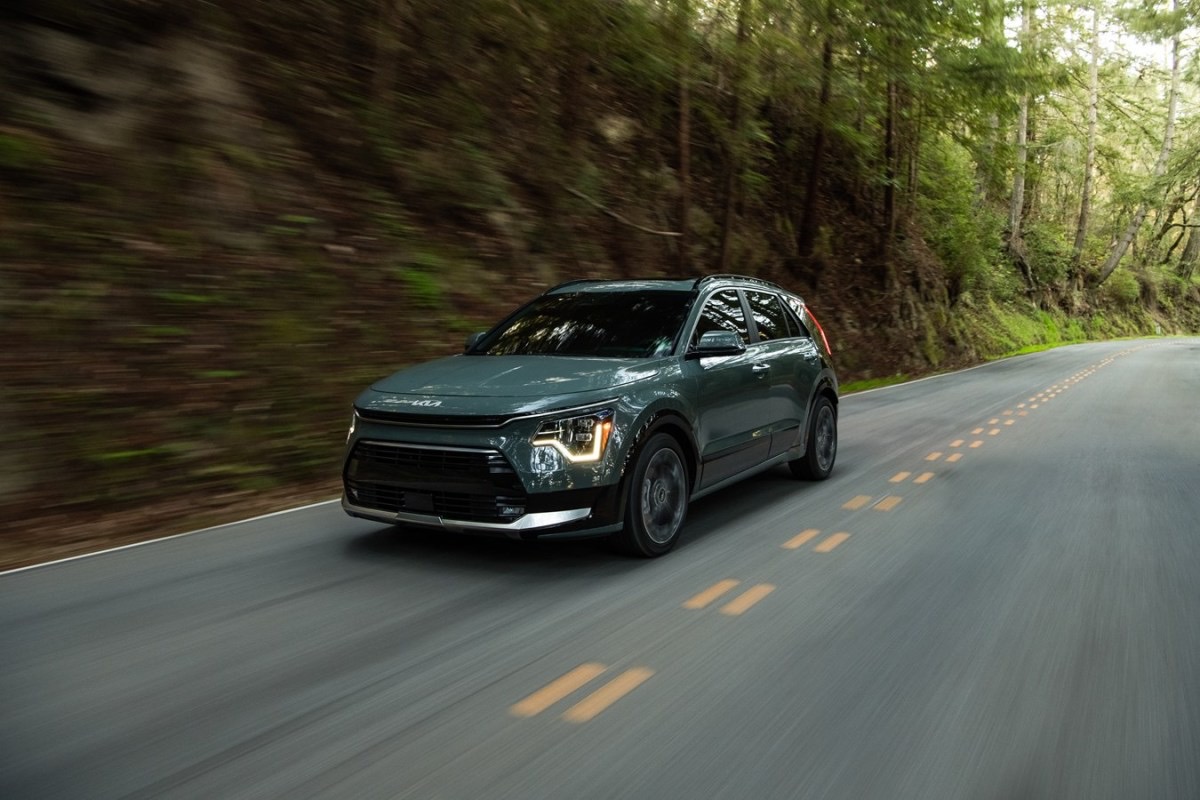
Kia Niro Second Generation (2023-Present)
Like the first generation, the gas-powered hybrid Niro models use a 1.6-litre four-cylinder engine with a 32-kW motor producing a combined 139 hp and 195 lb-ft of torque. The lithium-ion polymer battery is rated at a lower 1.3 kWh as compared with its predecessor’s 1.6 kWh. Unlike most hybrids that use a continuously variable transmission (CVT), the Niro uses a dual-clutch transmission with six gears.
Despite having only a 42-litre fuel tank, the Niro can cover well over 800 kilometres when averaging below 5 L/100 km, which we found easy to attain during our test. All Kia Niro trims have impressive fuel efficiency. The most fuel-efficient versions can attain 4.5 L/100 km city, 4.4 highway, and 4.4 combined, while the higher trims average 4.5 L/100 km city, 5.2 highway, and 4.8 combined.
While the wheelbase and the overall length are longer (2 cm and just over 6 cm respectively) compared with the first generation, the Niro is a short subcompact crossover. Width increased by a little more than a centimetre, while height and ground clearance (16 cm) are unchanged. The Niro's body is rectilinear with thin and level lines accenting the grille, the lower door stampings, and the body's shoulder line. Polished black trim accent the wheel wells, while a large, arrow-shaped black panel is behind the rear door — reminiscent of the Audi R8. Boomerang-style taillights create a thick and bright border against the tailgate glass and snap to the edges of the roof, the rear fascia, and the spoiler.
Straight and diagonal lines pervade the cabin, which uses design cues from the electric EV6. The two-spoke steering wheel, Nike swoosh-style door handles, and steeply angled door pulls blend into the rhomboidal and trapezoidal shapes on the dash. Dual 10.25-inch displays are standard on Niro EX, EX Premium, and SX trims, while the base LX has the same instrument panel paired with a smaller eight-inch touchscreen. Oddly, like the first generation, only the LX has wireless Apple CarPlay and Android Auto; higher trims are incompatible. As a recourse, those higher trims come with over-the-air updates, digital keys (which allow for keyless entry and the ability to virtually share keys with others via Kia’s Access App) for smartphones and smartwatches, and ambient lighting, while the EX Premium and SX trim levels add a power sunroof.
Standard safety features include rear cross-traffic collision avoidance assist, blind spot monitoring, a rear-seat occupant alert, and forward emergency braking. Since smart cruise control is standard on most Niro models, Kia uses the radar sensors to automatically adjust the car's regenerative braking to pace the traffic ahead. (It can also be adjusted using the paddles on the steering wheel.) The Niro also moderates the brake regeneration level depending on the road gradient and can automatically switch the car into EV mode when driving through school zones or other congested areas calculated by the navigation. Kia's Highway Driving Assist, a semi-automated system for marked highways, is equipped with all trims except the LX.
Average list prices for used second-generation Kia Niros on CarGurus.ca ranged from $23,000 to $40,000 at the time of writing.
Kia Niro First Generation (2017-2022)
Kia's first dedicated hybrid, the Niro, was launched for the 2017 model year. It competed with the Nissan Kicks, Chevrolet Trax, Honda HR-V, and Mazda CX-3 — none of which were hybrids. It was designed to compete directly, in terms of performance and size, against the Toyota Prius V and the Ford C-Max, both of which were discontinued shortly after the Niro debuted. The design was conservative and dated, but the car was notable for its build quality.
The Niro had a front-wheel-drive drivetrain, while the powertrain was a 1.6-litre gasoline engine with a 32-kW electric motor and 1.6-kWh lithium-ion polymer battery. Together, they sent 139 horsepower and 195 lb-ft of torque through a six-speed dual-clutch automatic transmission. In our test of a 2017 Niro SX Touring, the steering was vague, and our real-world fuel economy was an unimpressive 6.7 litres per 100 kilometres. Fuel economy was Natural Resources Canada-rated at 4.5 L/100 km city, 4.8 highway, and 4.7 combined on the base FE, 4.6/5.1/4.8 L/100 km on the middle trims, and 5.1/5.8/5.4 L/100 km on the SX Touring trim.
Specs for the base L included Apple CarPlay and Android Auto functionality, a seven-inch touchscreen, and Kia's Uvo telematics. Available upgrades included push-button start with a smart key, heated front seats and exterior mirrors, an eight-inch touchscreen with navigation, an upgraded audio system, automatic emergency braking, forward collision warning, lane departure warning, and adaptive cruise control.
Kia redesigned the grille, the headlights, the taillights, and the bumpers for 2020, and added new 16- and 18-inch alloy wheels and standard roof rails. A 10.25-inch touchscreen with navigation was available while the 8-inch screen became standard along with paddle shifters.
For 2021, Kia made wireless Apple CarPlay and Android Auto available with trims with the smaller touchscreen, and the EX Premium trim was deleted. For 2022, Kia's new logo appeared on the Niro. There were no other major changes.
Average list prices on CarGurus.ca for used first-generation Kia Niros range from $8,000 to $25,000 at the time of writing.
Related Topics