That means buyers either need to look to used models, which aren’t that good of a deal, or consider the Bronco Sport (often known as the Baby Bronco). It shares a unibody platform with the Ford Escape, which lacks the conventional Bronco’s versatility on- and off-road, but its lower price makes it more attainable.
The new Ford Bronco has a lot to offer in terms of tech and amenities, but the classic models deliver some serious style.
Ford Bronco: Cost, Reliability, and the Best Years to Buy
Frequently Asked Questions
Which Ford Bronco years are the best?
The modern Ford Bronco has been subject to a lot of recalls. However, assuming they’ve been fixed, we’d say 2023 is the best model year of the bunch. It has zero investigations and fewer complaints than the previous two, so it should offer more peace of mind. If you’re looking at classic Broncos, sources around the web say 1977, the final year of the first generation, is the most reliable. Plus, the first generation is just cool.
What are the worst Ford Bronco years?
The new Ford Bronco was plagued with recalls, complaints, and quality issues when it returned, so we’d steer clear of 2021 and 2022 model years. CarComplaints.com even calls 2022 the worst model year due to engine problems. If you’re looking at classic Broncos, sources across the web point to two years to avoid: 1993 and 1988. The former had recalls and issues including fire risk, parking brake issues, and the transfer case slipping out of gear, and the latter had issues with the electrical system.
Is a used Ford Bronco a good deal?
In Canada, you’re unlikely to find a good deal in a used Ford Bronco. Few fifth-gen or earlier models have survived here, and even the roughest ones have five-figure price tags at minimum while quality restorations can run deep into six figures. In other words, you’ll likely need to look to the U.S. if you’re determined to find a true bargain, which means going through the classic car import process. As for newer Broncos, they’re still commanding close to new prices on the used car market. The cheapest ones we could find start at roughly $32,000 at the time of writing.
Ford Bronco Pros and Cons
Pros:
- Excellent off-road capability
- Stylish design
- Removable roof
Cons:
- Poor fuel economy
- Noisy
- Big blind spots
Ford Bronco Generations
Ford Bronco Sixth Generation (2021–present)
The sixth-generation Ford Bronco is a reboot after a 25-year hiatus. It takes a lot of styling cues from the original first-generation model, including round headlights. This time around, it’s based on the Ford Ranger and has the proportions of a mid-size SUV. It’s offered in both two- and four-door configurations, and both have a convertible option. As is the case with the Jeep Wrangler, its direct competitor, the doors can be removed.
While this new Ford Bronco is retro, it has modern functionality, including a touchscreen infotainment system with Apple CarPlay and Android Auto, a six-speaker audio system, SiriusXM Satellite Radio, a 4G LTE wireless modem, and keyless entry. Available features include a premium B&O sound system, navigation, a wireless charger, auto high-beam headlights, and heated seats.
In addition to the Base trim, additional trim levels available at launch included the Bronco Big Bend, Black Diamond, Outer Banks, Badlands, and the Wildtrak. The First Edition model, based on the Badlands trim, was also available in 2021 and produced in limited numbers. Trims added in 2022 included Everglades and Raptor. The Heritage Edition and Heritage Limited Edition were added in 2024.
A trio of engine options is available. A 2.3-litre inline-four and a 2.7-litre twin-turbo V6 were offered at launch, and a 3.0-litre twin-turbo V6 was added with the Raptor trim. The base four-cylinder powertrain can be paired with a seven-speed manual transmission, while a 10-speed automatic transmission is standard fare with other versions.
The sixth-generation Bronco has a body-on-frame construction with twin A-arm front suspension and rear five-link coilover suspension and solid axle. It has an optional HOSS (High-Performance Off-Road Stability suspension), with position-sensitive Bilstein shocks and multiple compression and rebound zones at all four corners. Dana axles with front and rear electronic differentials are fitted as standard, and the drivetrain can toggle between 4WD Low, 4WD High, 4WD Automatic, and 2WD High (rear-wheel drive).
There are several items of optional equipment and packages available to cement the Bronco’s status as a true off-roader and boost durability. One is a G.O.A.T. Modes (Goes Over Any Terrain) terrain-management system, with up to seven drive modes: Normal, Eco, Sport, Slippery, Sand, Baja, Mud and Ruts, and Rock Crawl. There’s also a system known as Trail One-Pedal Drive, which prevents unexpected rollbacks, and Trail Turn Assist for tight corners. Then there’s the Sasquatch package, which can be added to the Badlands model. This adds 17-inch beadlock wheels, 35-inch all-terrain tires, electronic-locking front and rear axles, a suspension lift, and HOSS.
The Bronco Raptor, introduced in 2022, is only available as a four-door model and sits at the top of the lineup. It has several off-road upgrades, including 37-inch tires—and wide fender flares to accommodate them—plus Fox suspension, the most powerful twin-turbo V6 engine, a heavy-duty modular front bumper, Rigid Industries front foglamps, a 360-degree off-road camera, and heavy-duty steel bash plates. The interior is unique, with Code Orange accents, the larger 12-inch infotainment screen, and marine-grade vinyl-trimmed seats.
Because this is the current generation of Ford Bronco, there are going to be very few deals to be had. The least expensive models we see for sale in Canada at the time of writing are 2021 and 2022 Big Bend models that start at just over $32,000. Newer Wildtrak models are listed for roughly $75,000. Top-end models like the Bronco Raptor aren’t showing up often on the Canadian used car market.
Ford Bronco Fifth Generation (1992–1996)
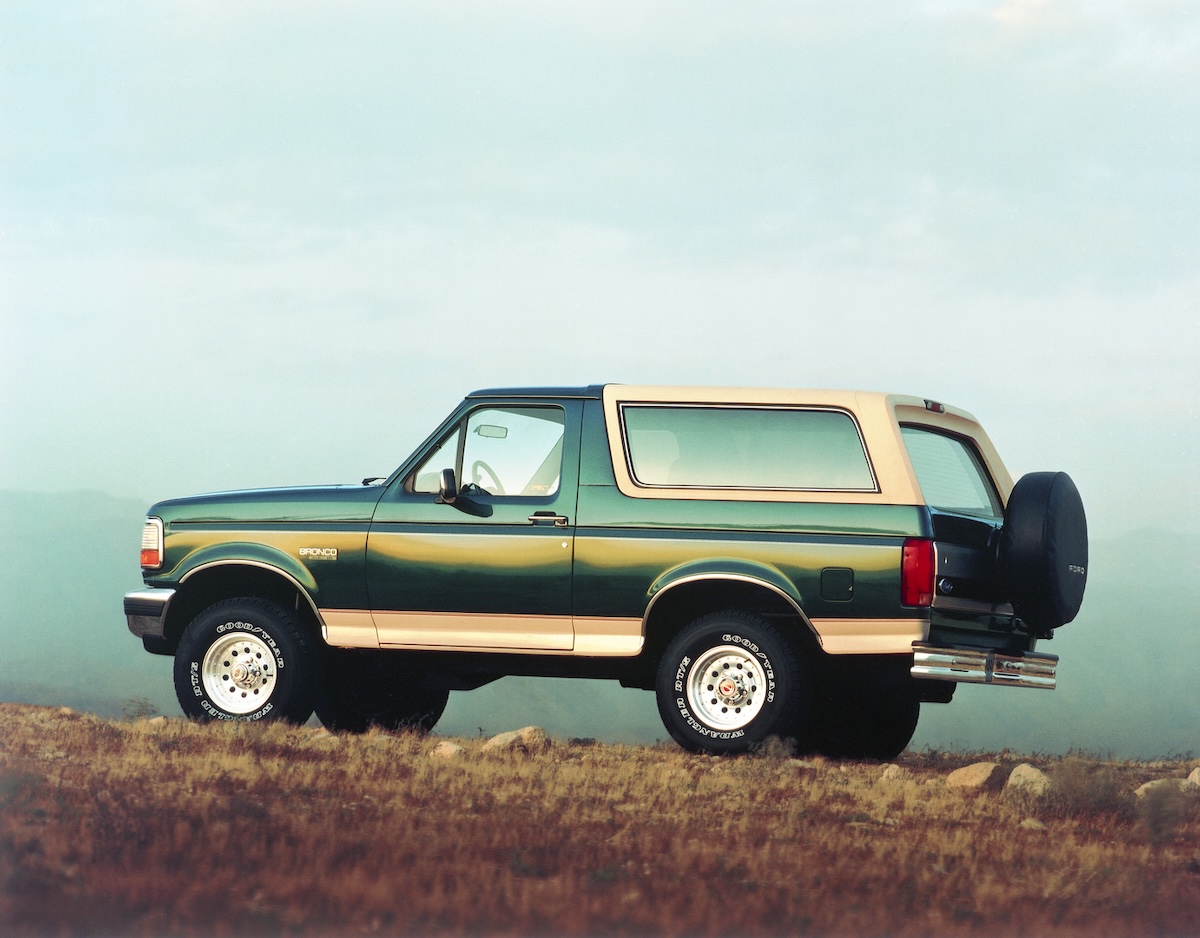
The fifth-generation Ford Bronco was based on the ninth-generation Ford F-150, but it retained the third-generation Bronco’s chassis, its full-size status, and the three-door body style. It had a rounder exterior and a redesigned grille, front bumper, and headlights. The inside got updates to the dashboard and instrument panel, and new options included leather front seats, remote keyless entry, and an anti-theft alarm.
The redesign included a front crumple zone built into the frame, a rear centre-mounted brake light on the hardtop, and three-point seatbelts for rear passengers. Other safety updates for this generation included four-wheel anti-lock brakes for the 1993 model and a driver’s-side airbag in 1994. Because of the brake light and rear seatbelts, which were mounted to the hardtop, the Bronco was no longer marketed as a lift-off hardtop—even though you could still remove the top.
The powertrains carried over from the fourth generation and included an inline-six (which was dropped in 1994) and two V8s. For 1996, the last model year of this generation, the Bronco became the first Ford to incorporate turn signals into the side mirrors.
There were a total of six fifth-gen and earlier Ford Broncos for sale in all of Canada at the time of writing, and they were largely professional restorations priced near or above six-figures. All older Broncos now qualify for import into Canada under classic car exemptions, so we’ll focus on the U.S. market through the rest of this buying guide, where there’s a much wider selection.
Classic.com says the average U.S. transaction price for Broncos in this generation is USD$22,000. At the time of writing, it logs the lowest sale price at about USD$2,000 and the highest at USD$85,000. When we searched classified adverts online, we saw prices ranging from USD$4,000 for high-mileage Broncos in poor condition to USD$65,000 for a custom modified example in excellent condition.
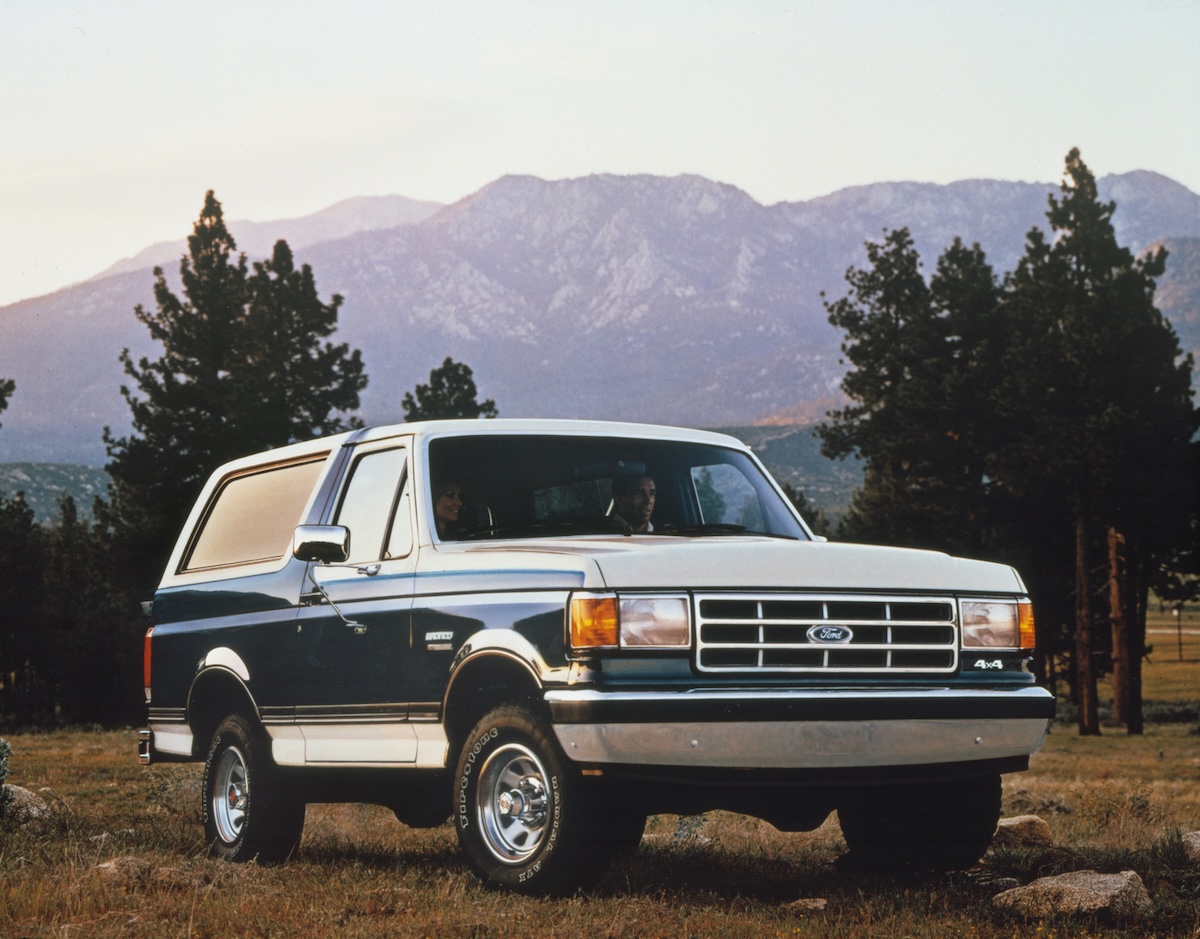
Ford Bronco Fourth Generation (1987–1991)
The fourth-generation Ford Bronco was once again based on the F-Series pickup truck and maintained the previous generation’s chassis. It received a number of styling updates, some shared with the eighth-generation F-150, including a reshaped front bumper, a flatter grille, a reshaped hood, and headlights flush with the grille. The interior also got an overhaul that included redesigned front seats, dashboard, steering wheel, and instrument cluster.
The powertrains remained similar to the previous generation, including an inline-six and two V8s. A manual and an automatic transmission were available in the base two powertrains, but a four-speed automatic was the only transmission for the top-tier V8.
Rear anti-lock brakes were standardized as safety started to become more important in the 1980s. In 1988, a skid plate for the transfer case also became standard equipment.
According to Classic.com, the average U.S. transaction price for vehicles in the fourth generation is about USD$20,000, and it logs sales in this generation from USD$3,000 to USD$90,000. We saw prices ranging from USD$6,000 to USD$75,000 on classified sites.
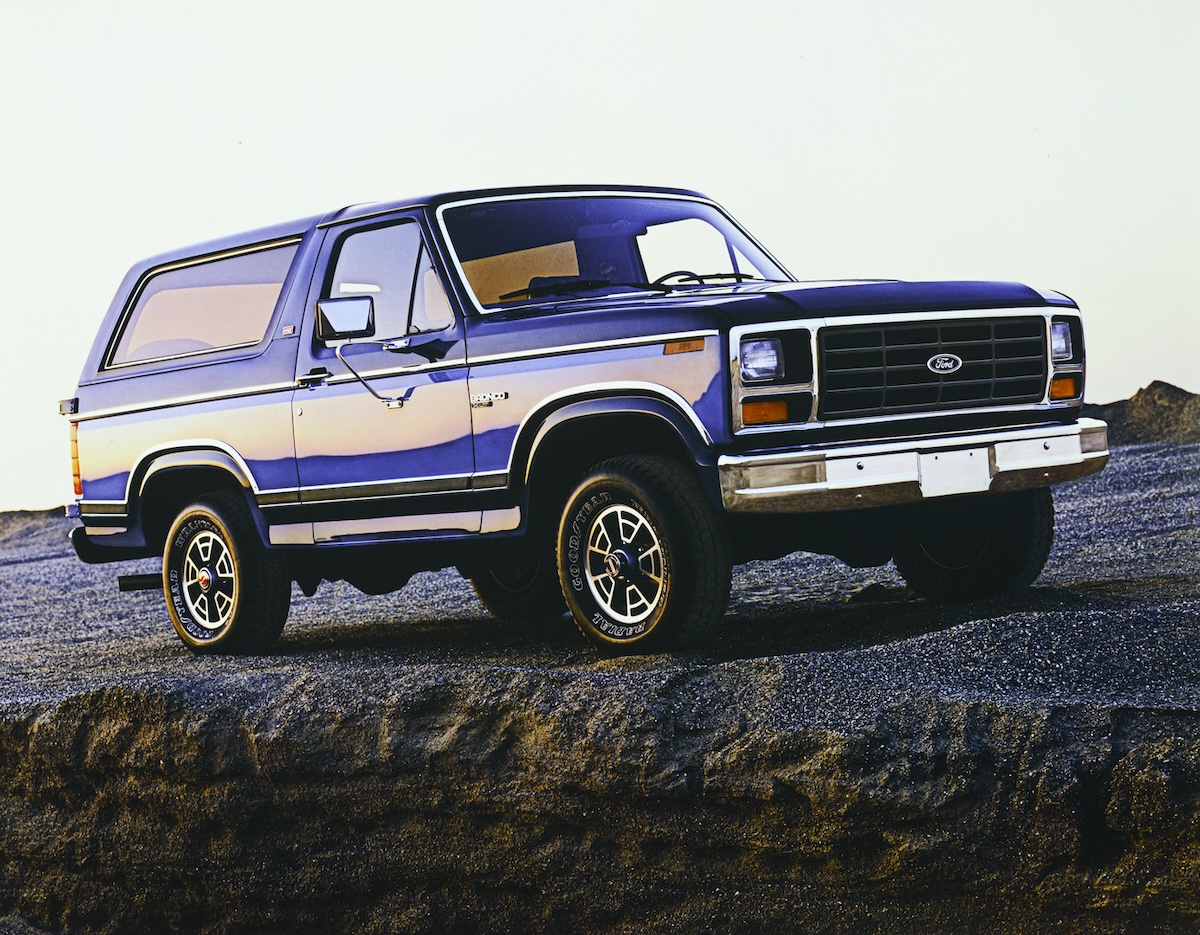
Ford Bronco Third Generation (1980–1986)
When the third-generation Ford Bronco came on the scene, it was more compact and fuel efficient to address rising gas prices. It was still full-size and based on the F-Series pickup, but it had a shorter chassis and essentially shared the same components with the F-150 from the doors forward. It also had the same three trims: Bronco, Bronco XL, and Bronco XLT.
This generation dropped 170 kilograms (375 pounds), and 1980-81 models had a weaker frame with holes stamped out at the factory.
An inline-six was reintroduced as the base engine and available only with a manual transmission. There were also V8 options available with both manual and automatic transmissions.
The third-gen Bronco got a facelift in 1982. It adopted Ford’s Blue Oval logo on the grille instead of the FORD lettering on the hood, and the Bronco horse was removed from the fender emblems. The extra-light frame was ditched this year, and more strength and rigidity were added, the trade-off being a 14-kilogram (31-pound) weight gain.
The Ford Bronco II was introduced, also in 1982, but it had nothing to do with the full-size Bronco because it was based on the then-new mid-size Ranger pickup truck.
According to Classic.com, the average U.S. transaction price for a third-generation Bronco is about USD$25,000, and it logs sales from USD$3,000 to USD$72,000.
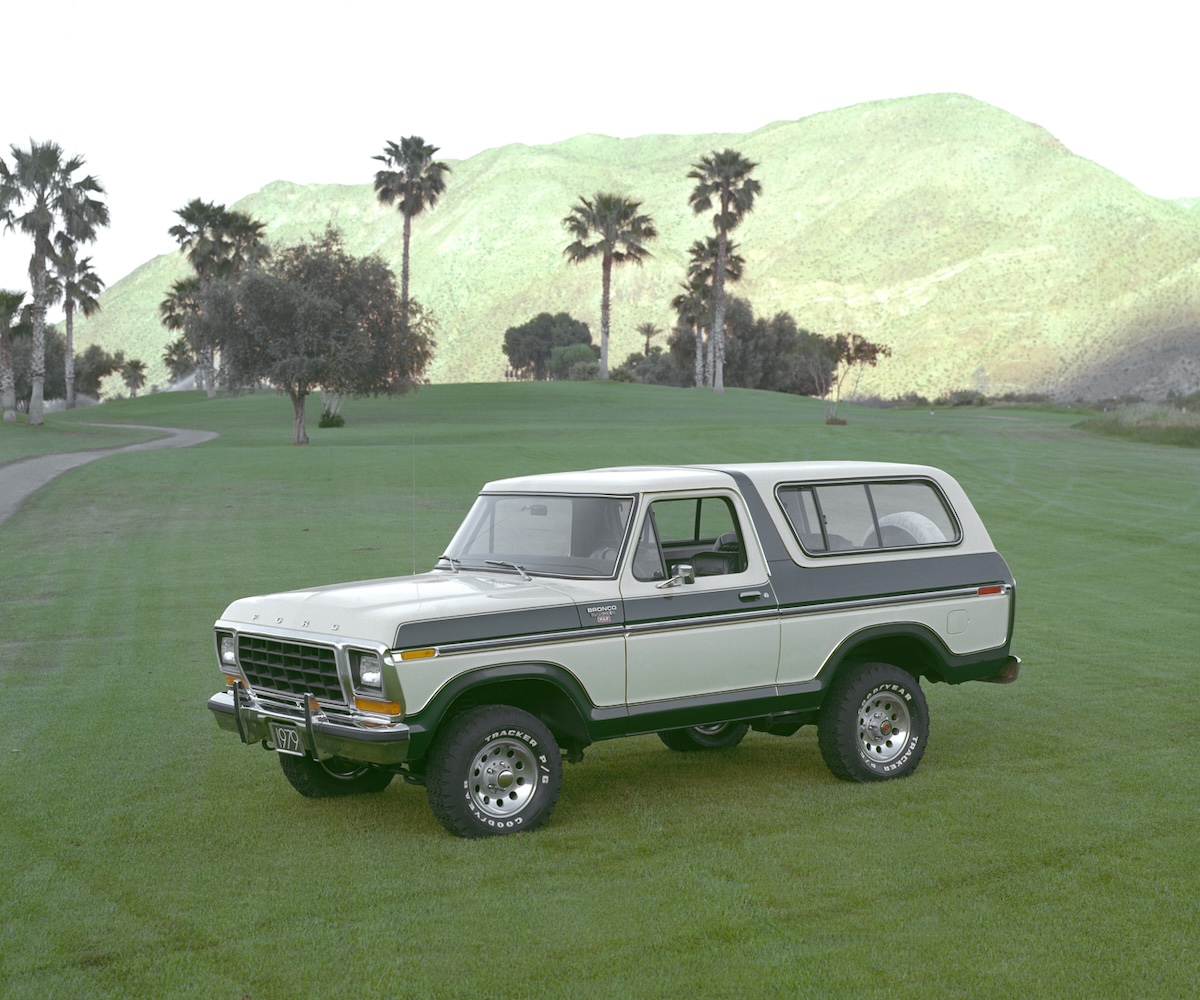
Ford Bronco Second Generation (1978–1979)
The second generation of the Ford Bronco was short but sweet. It was based on the Ford F-100 pickup and entered the full-size SUV segment to compete with the Chevrolet K5 Blazer, the Dodge Ramcharger, and the Jeep Cherokee. It was a full 71 centimetres longer and 28 cm wider than its predecessor. The second-gen Bronco was supposed to hit the market in 1974 but was delayed due to the 1973 fuel crisis, hence its 1978 launch and short production run.
It was available only as a three-door wagon with a lift-off hardtop body, but it was noticeably more comfortable and more capable off-road than its predecessor. Because of its commonality with the F-100, it included new features such as air conditioning, a radio, and tilt steering. The Bronco’s trims mirrored the F-100’s, so there was a Bronco Custom, which was the base trim, and a Bronco Ranger XLT. Initially, the Customs had round headlamps and the Ranger XLT had rectangular units, but the rectangular headlamps became standard across the board in 1979.
There were two powertrains, both V8s—a 5.8 and a 6.6—and manual and automatic transmissions were available.
According to Classic.com, the average U.S. transaction price for a vehicle in this generation is about USD$47,000. It logs sale prices ranging from about USD$7,000 to USD$217,000.
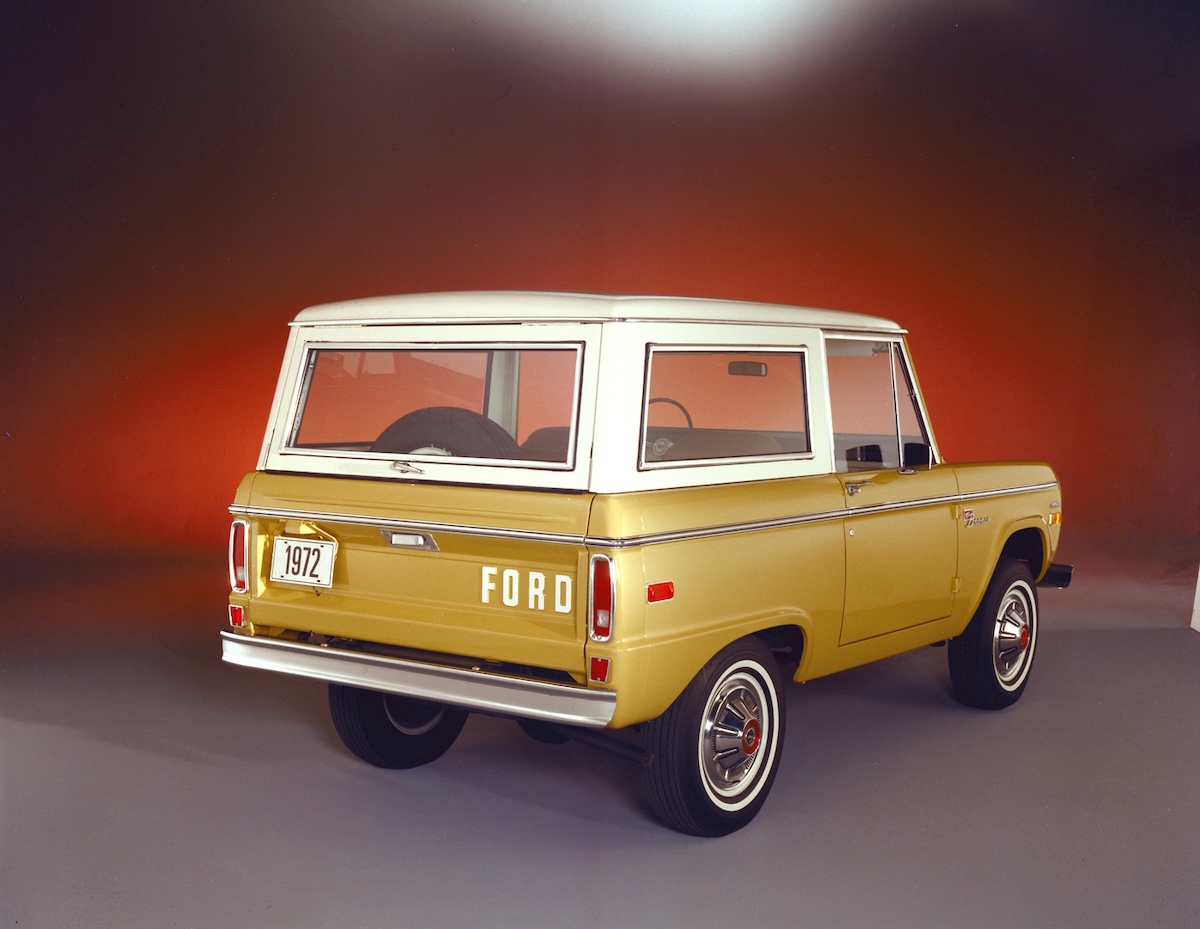
Ford Bronco First Generation (1966–1977)
The first-generation Ford Bronco was introduced as a compact SUV to compete with the Jeep CJ-5, the International Scout, and the Toyota Land Cruiser. At launch, it was offered as a two-door wagon, a half-cab pickup, and as an open-body roadster. Unlike the badge-engineered vehicles from General Motors, the first Bronco had a chassis developed specifically for this model range and didn’t share it with any other Ford, Lincoln, or Mercury vehicle.
It had a boxy design and a 2,336-millimetre wheelbase. All original models were sold with four-wheel drive and a shift-on-the-fly transfer case. It had solid front and rear axles with coil springs in the front, while a heavier duty suspension system was an option, along with air front springs.
At launch, the sole powertrain was an inline-six, but an optional V8 was quickly introduced. Initially, the only transmission was a three-speed, column-shift manual, but an automatic transmission was added in 1973.
The first-gen Ford Bronco was pretty bare-bones and had few standard features. Options, however, were plentiful and included front bucket seats, a rear bench seat, a tachometer, and a CB radio.
The Ford Bronco Sport option was introduced in 1967, which was an appearance package that added chrome exterior trim and wheel covers. Plus, the FORD on the grille was painted red. Ford dropped the Roadster after 1968, and the pickup disappeared after 1972.
According the Classic.com, the average U.S. transaction price of a first-gen Bronco is about USD$81,000. It logs sale prices from about USD$8,100 to a staggering USD$1.9 million.
Related Topics