2025 Audi A6 e-tron Reviews, Pricing & Specs
Write a review--
Original MSRP
7.7
of 10
expert review
avg user rating
(0 reviews)
Pros
Comfortable
Impressive electric range
Plenty of cargo space
Cons
Unimpressive interior materials
Little differentiation between A6 e-tron Quattro and S6 e-tron models
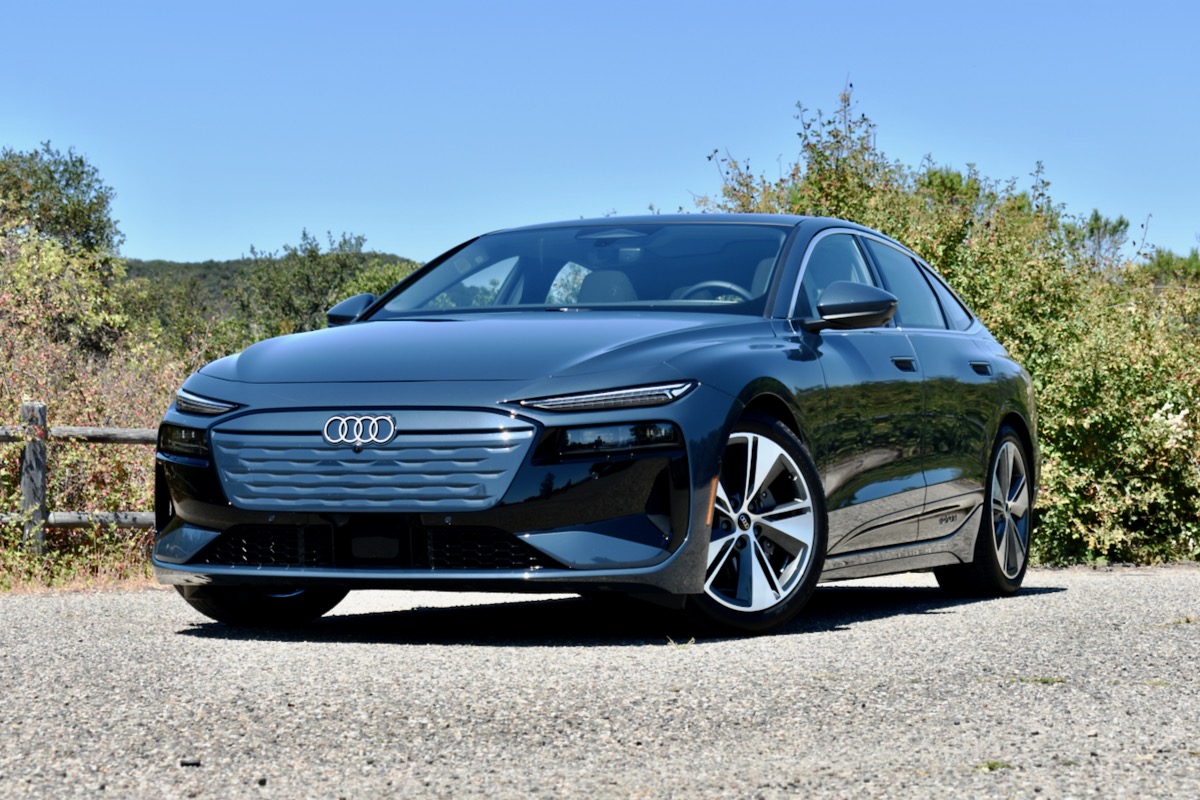
One of Audi’s longest-running nameplates is reinvented as an electric vehicle.
While it wears a familiar name, the 2025 Audi A6 e-tron is an entirely new, all-electric model. It’s based on the same Premium Platform Electric (PPE) architecture as the Audi Q6 e-tron and Porsche Macan Electric crossover SUVs, which includes 800-volt electrical architecture for faster charging and battery and powertrain tech designed to maximize efficiency. Competitors include electric luxury sedans such as the BMW i5, Lucid Air, and Mercedes-Benz EQE sedan.
Verdict: The first electric Audi A6 is competently executed, but the A6 e-tron Ultra with its smaller wheels is definitely the one to have.

The full name of this EV is technically the Audi A6 Sportback e-tron because it’s not a traditional sedan. Instead of a trunk, it’s got a rear hatch, part of a shape that Audi tried to make as sleek as possible to lower aerodynamic drag. That’s always a major consideration with electric cars because the less drag there is, the farther you can go on a charge. The Audi’s 0.23 coefficient of drag is indeed impressive. While it’s a tick higher than the 0.22 of the Mercedes-Benz EQE, Audi ended up with a less polarizing look than Mercedes. While the Sportback is the only body style available in North America, an A6 e-tron Avant wagon is available in Europe.
The other design highlight is a front end defined by stacked lights—thick rectangles serve as the headlights with thinner LED daytime running lights above—and, typically for Audi, an oversized grille. This is an EV, though, so the grille is body coloured and the surrounds are blacked out, the reverse of Audi’s combustion cars. That emphasizes that the grille is just a styling feature and not actually functional. Because of its lower cooling needs, the e-tron features a compact ducted cooling system that contributes to the car’s low drag coefficient.
The lineup is similar to that of other Audi models. There’s a standard A6 e-tron and a sportier Audi S6 e-tron, with base, Progressiv, and Technik trim levels for both, while the A6 has an additional Ultra trim that slots in just above the base model. Audi claims the standard 20-inch wheels are its most aerodynamic yet, but the 19-inch wheels with the Ultra trim are even better for range. The S6-etron comes standard with model-specific 20-inch wheels, but can be equipped with 21-inch wheels as a standalone option. The Black Optics package adds black exterior trim and darkened Audi badges.
Aside from the wheels, a subtle rear spoiler, and the trademark silver mirror housings of an Audi performance model, there isn’t much to distinguish the S6 from the A6 on the outside. Step inside, though, and the S6 features standard sport seats with Nappa leather upholstery and diamond stitching, plus a more traditional steering wheel (the A6 e-tron has a squircle that looks straight out of the 1980s). The upgraded interior might be worth the price, though, as the standard A6 e-tron cabin was a disappointing jumble of plastics that looked and felt cheaper than the materials in the gasoline A5 fastback sedan, which sits below this model in Audi’s hierarchy.

In Canada, all A6 e-tron models feature a dual-motor quattro all-wheel drive (AWD) system generating 422 hp (456 hp with launch control), while the sportier dual-motor S6 e-tron ups output to 496 hp (543 hp with launch control). Both have a 100-kilowatt-hour battery pack with 94.4-kWh of usable capacity.
A6 e-tron models can sprint from 0-100 km/h in 4.5 seconds, according to Audi. The automaker claims the S6 e-tron cuts the 0-100 time down to 3.9 seconds (again, with launch control), which is quicker than the equally sporty BMW i5 M60 and the Mercedes-AMG EQE sedan. The S6 e-tron also has a top speed of 240 km/h, compared to 210 km/h for other models.
A6 e-tron models have a steel-spring suspension, but a sport-tuned air suspension is standard with the S6 e-tron. The air-spring S6 e-tron provides a comfortable ride on pavement with the smoothness of peanut brittle. Body control is also reasonably good for big sedans with heavy battery packs. However, the S6 e-tron’s sportier suspension tuning didn’t really make an impression, nor did its extra power. It was hard to feel the difference between this model and the A6 e-tron, which at least means the Audi RS e-tron GT won’t have to worry about competition for its position in the lineup.
Audi hard-mounts the front subframe and steering rack in all A6 e-tron models for better steering feel. The lack of bushings didn’t negatively impact comfort, nor did it fulfill its intended purpose. Steering feel is still decidedly lacking on twisty roads, and the front wheels responded in a laid back way appropriate for a luxury cruiser but not a sports sedan. However, that’s because Audi also prioritizes stability at highway speeds, and the A6 e-tron certainly exhibits that. Its steadiness is Autobahn-appropriate.
When it comes to regenerative braking, the A6 e-tron offers plenty of options. One-pedal driving is available by sliding the shifter toggle from “D” into “B”. You can choose from multiple, more relaxed levels with steering-wheel paddles, or minimize regen and allow the car to coast. There’s also an automatic mode that varies regen based on driving conditions, but we’ve found these can be a bit unpredictable. Leaving the Audi in one of its higher regen settings is the way to go, as it’s easy to modulate speed just by lifting off the right pedal.

The A6 e-tron offers reasonable interior space in both the front and the back seats, although if you’re regularly carrying rear-seat passengers, the Mercedes EQE and the Lucid Air offer more legroom. Most competitors have more front headroom as well, which might be related to the Audi’s steeply raked windshield—part of the A6 e-tron’s wind-cheating styling. That also requires a very deep dashboard, which somewhat limits forward visibility, but the A6 e-tron is far from being the only modern car with that issue.
Helping to make the most of the available headroom is a standard panoramic glass roof with electrochromic dimming. This allows the glass roof panel to switch from opaque to transparent at the push of a button, which is much more convenient than a conventional sunroof. Audi deserves credit for going above and beyond with this feature, as some manufacturers don’t even offer the option of a shade with their glass roofs.
The Audi Sportback design creates an easily accessible cargo area with 735 litres of space behind the rear seats. That’s more than you get in any of the A6 e-tron’s rivals. Folding the second row opens up available cargo space to 1,129 litres. Audi also included a small under-hood storage compartment that’s good for storing charging cables, but it can’t compete with the Lucid Air’s 283-litre frunk, which is the size of the trunks in some sedans. Utility comes at the expense of visibility, though. The tiny rear window is something we’d expect to see on a convertible, not a hatchback.
Small-item storage space is reasonable for a sedan, thanks to a centre console bin that’s actually usable, cupholders that hold normal-sized beverages, and an angled wireless device charging pad. Designers and engineers accommodated all of this without raising the centre console or puffing out the door panels, which means the front seats don’t feel claustrophobic.

The A6 e-tron features a curved dashboard display, including an 11.9-inch digital instrument cluster, 14.5-inch central touchscreen, and an available 10.9-inch front-passenger touchscreen, which the automaker calls its Digital Stage. That setup—shared with the Q6 e-tron crossover SUV, as well as the gasoline A5 fastback sedan and the Q5 crossover—is underpinned by Audi’s latest Android-based infotainment system. But unlike certain other automakers, Audi hasn’t had any issues with incorporating Apple CarPlay or standalone Android Auto connectivity from the get-go. Audi’s commitment to this interface pays off for the most part. The curvature of the combination instrument cluster/touchscreen housing makes everything easy to see and reach from the driver’s seat, and it isn’t so tall as to obstruct the view ahead. That required tilting the main touchscreen away from the passenger’s seat, but that’s presumably what the available third screen is for. Front-seat passengers can play DJ or watch videos (YouTube and a couple of other streaming apps are supported) with a privacy filter to avoid driver distraction.
However, it’s not possible to show navigation maps in the instrument cluster, something Audi itself pioneered with its original Virtual Cockpit units. The passenger screen menus in our test cars also had a superfluous icon for regenerative braking, something only the driver can actually adjust, thankfully. And while Audi’s voice recognition system is pretty good—we particularly appreciate its emphasis on helping to find on-screen menus—it’s still not as intuitive as the Mercedes system.
The available 20-speaker Bang & Olufsen audio system includes headrest speakers for taking phone calls, so everyone else in the car doesn’t have to listen to your conversation. Those speakers also pipe in directions when using the navigation system, while an available head-up display shows arrows to ensure you don’t miss your turn. The HUD can also display warnings from certain driver aids, and we found it clear and visible throughout a sunny day of driving.

Standard driver-assist features include: adaptive cruise control, forward collision warning, lane-departure warning, rear cross-traffic alert, traffic sign recognition, and park assist. On cars equipped with a head-up display, the lane-departure warning system highlights the lane marker, which we found very helpful. However, audio warnings from the various driver aids were issued with a startling beep that proved more distracting than helpful. The car also issued that sudden, loud noise when its forward-facing sensors appeared to be confused by roadworks, making certain functions temporarily unavailable.
Safety ratings from the Insurance Institute for Highway Safety (IIHS) and the U.S. National Highway Traffic Safety Administration (NHTSA) weren’t available at the time of writing. Note that ratings for the gasoline 2025 Audi A6 do not apply to the e-tron, as it’s a wholly separate model based on a different architecture.

Official Natural Resources Canada range ratings measure up at 536 kilometres for the A6 e-tron (or 607 km in the Ultra trim), and 521 kilometres for the S6 e-tron with 20-inch wheels or 486 km with 21-inch wheels. That’s much more than the legacy-automaker competition, although the Lucid Air Pure tops it at up to 676 km.
The A6 e-tron can DC fast charge at up to 270 kilowatts, which doesn’t push the envelope, but does deliver a claimed 10-80% charge in 21 minutes. The e-tron can also Level 2 AC charge at up to 9.6 kW, which Audi estimates should be enough for a full charge in 11.5 hours.
Like other Audi EVs, the A6 e-tron’s battery is covered by an eight-year/160,000-kilometre warranty that guarantees 70% retention of battery capacity during that period. That’s in addition to the four-year/80,000-kilometre new vehicle and powertrain warranties matching other Audi models.
Pricing starts at $87,095 for a base A6 e-tron, including the $2,850 destination charge and other fees, and tops out at $93,095 for the Technik trim. For the S6 e-tron, pricing starts at $98,695 and climbs to $106,954. Options can add a considerable amount to those base prices, but Audi does at least include a decent amount of standard equipment.
For just a tick under $100,000 Canadian, you could have a Lucid Air Pure with more range and sharper handling, while the BMW i5 offers a more traditional sedan look and feel for a similar price to the Audi. The Mercedes EQE sedan is also in the same pricing ballpark, but its range is lower. In general, with more than 600 kilometres of range, the A6 e-tron Ultra with its smaller wheels is definitely the one to have. It’s a decent value for this segment, while the extra power and performance pretensions in the other models don’t really add much to the equation.

