2023 Nissan Z Reviews, Pricing & Specs




Pros & cons
What we like
Stylish design
Powerful engine
Good value for money
What to consider
Noisy
Not much cargo space
Stereo is lacking
Expert review
Nissan wisely prices and positions the new 2023 Z as a performance value, laying claim to an unpopulated segment of the two-seat sports car market.
With the introduction of the 2023 Nissan Z, the automaker refers to its two sports cars as “beauty and the beast.” Indeed, the legendary GT-R is a beast. And now that Nissan has reskinned and thoroughly updated the sixth-generation Z34 370Z to create the mostly new seventh-gen 2023 Z, it sure is a beauty. Moreover, now that we’ve put nearly 200 kilometres on the Nissan Z, we can say it drives like it’s all-new, despite hints of the old 370Z that remain evident.
out of 10 expert review
Look & feel
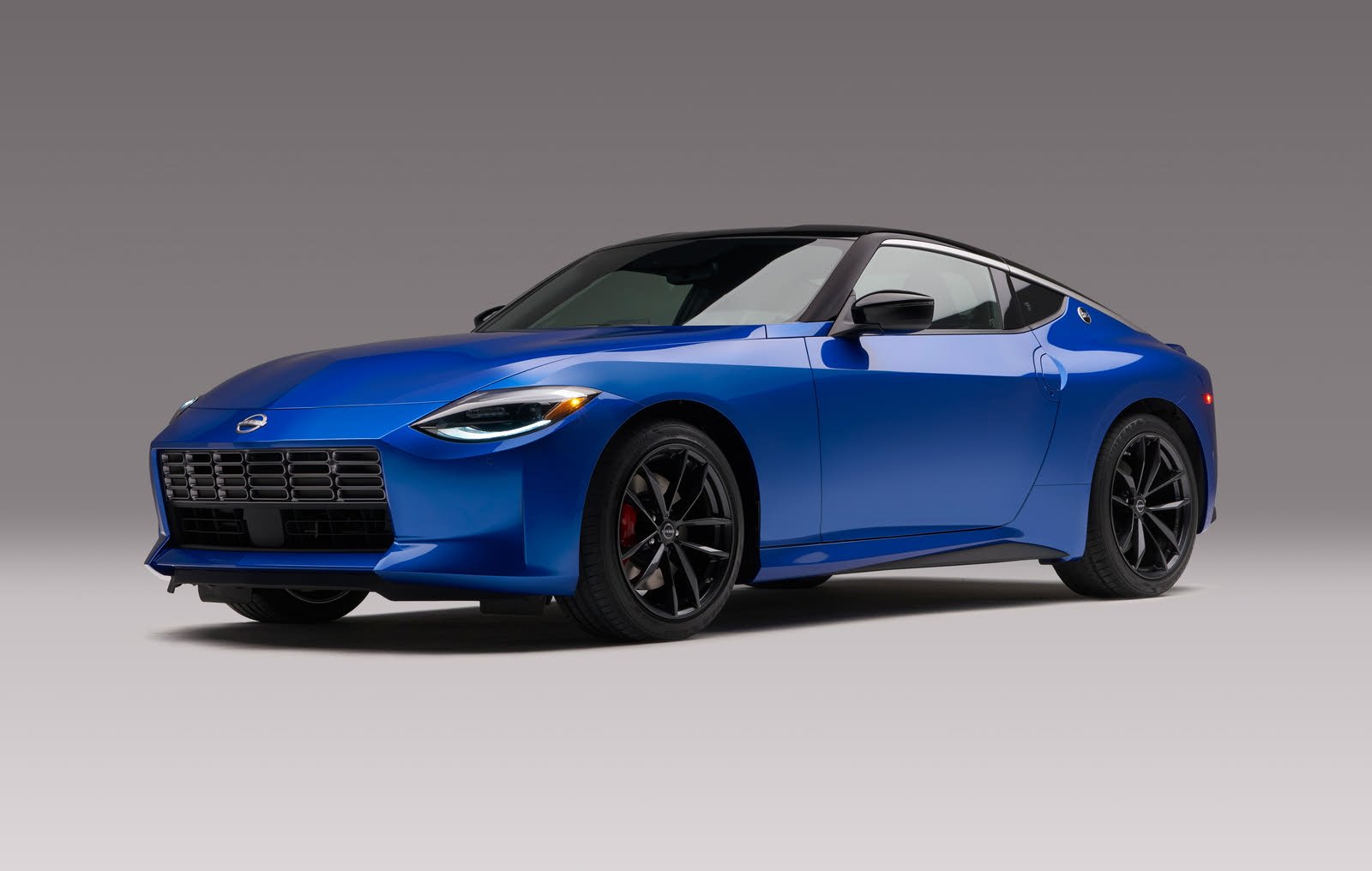
Nissan product planner Paul Hawson told us his favourite change to the 2023 Z is the cleaned-up aesthetics of the car. We agree that the new Z looks great, better in person and on the road than in photos.
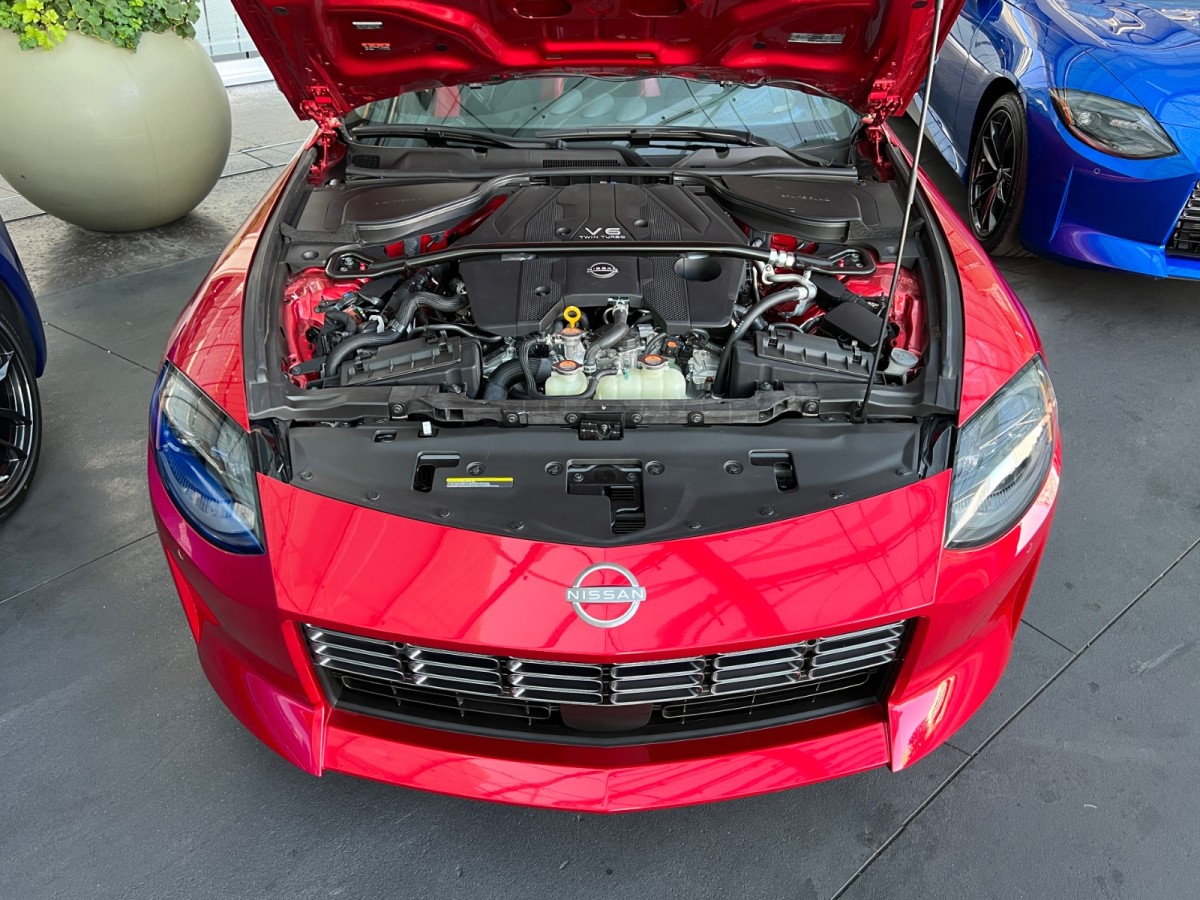
Nissan spokesperson Dan Passe told us the Z is approximately 80-percent new. The styling takes inspiration from the original 1970 240Z in the front, the 350Z and 370Z in the middle, and the fourth-generation 1990 300ZX at the rear—particularly with regards to its taillights. The large, rectangular grille appears uninspired, but as Hawson explains, if you removed the chrome bumper from a first-gen 240Z, you’d see the same shape and location on the original Z car. Plus, given the cooling requirements of the new twin-turbocharged V6 engine revving under the new car’s retro, long hood, the grille needed to be big.
Two trim levels of the 2023 Nissan Z are available. The base Z Sport trim starts at $49,344 in Canada including delivery and dealer fees, while the performance-tuned Performance trim starts at $61,344.
This range undercuts the Toyota Supra lineup by a few grand while providing significantly more power in standard spec. But the Supra’s BMW-based mechanicals and BMW-sourced interior bits and pieces make the Toyota look, feel, and drive like it rightly commands more money.
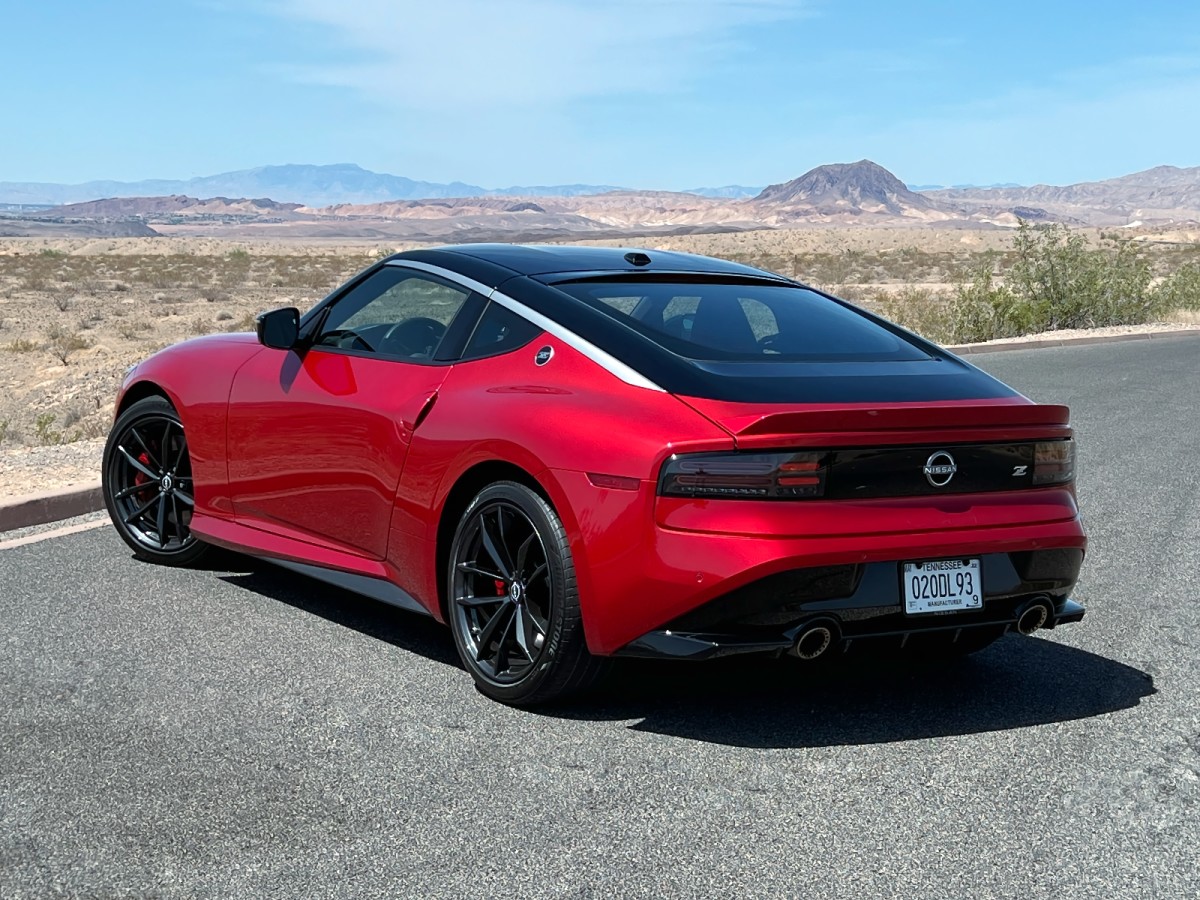
Not that the new Nissan Z comes across as cheap. Especially in Performance trim with its 19-inch, matte-black, staggered-width alloy wheels and tires and its two-tone paint with a black roof, the Z looks terrific—and much better than the Supra.
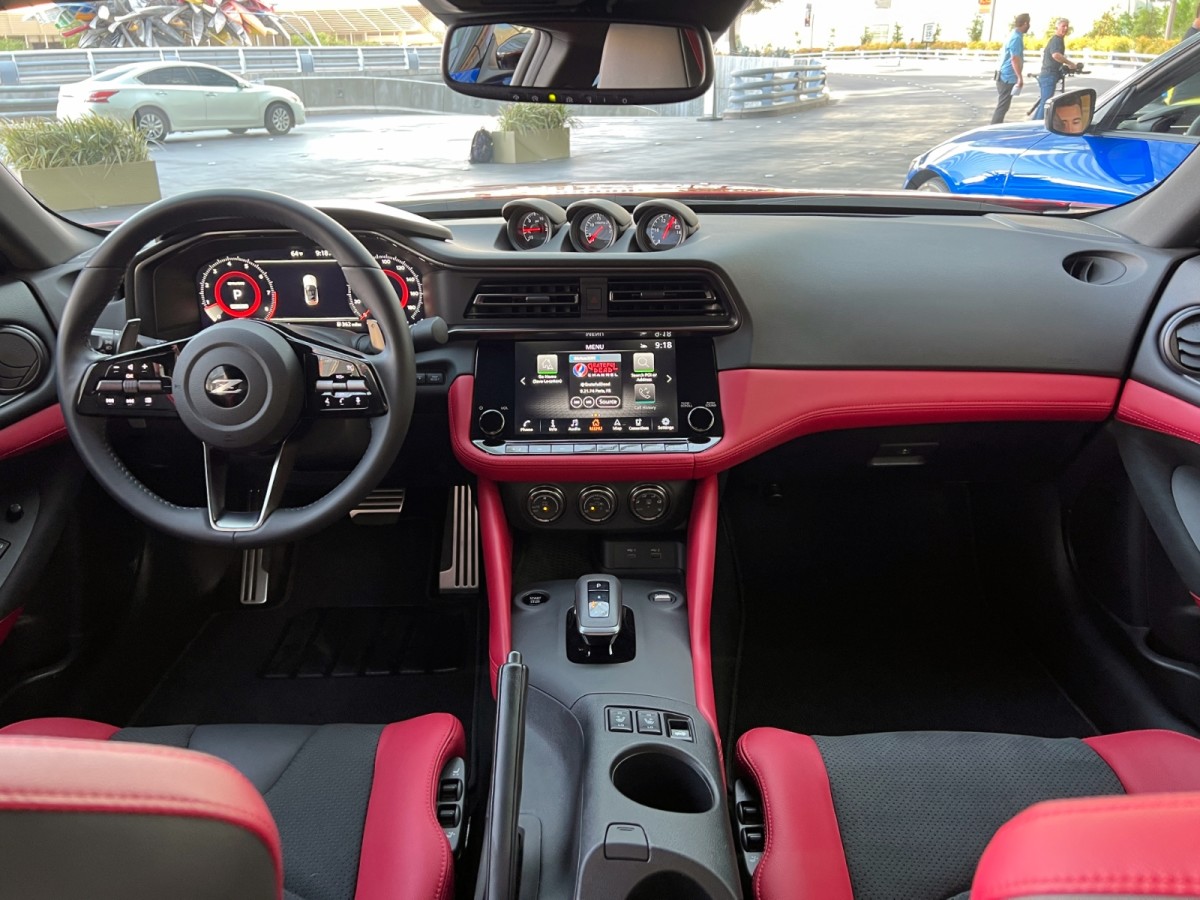
Inside, except for some carryover pieces from the 370Z and some truly unfortunate lower door panel plastic that glistens in the sunlight, the new Z comes across as far more refined and sophisticated than the vehicle it replaces. Our Z Performance test car, equipped with an automatic transmission and extra-cost paint, wears a window sticker price of $63,794 in Canada, including the destination charge. It is a reasonable price for what you get, most notably the new engine.
Performance
Nissan sources the Z’s twin-turbo 3.0-litre V6 engine from the Infiniti Q50 and Infiniti Q60 Red Sport 400 models and tunes it for improved throttle response. When you’re accelerating hard, the car's rear end feels greasy thanks to the twin-turbo V6 engine’s 400 horsepower at 6,400 rpm and 350 pound-feet of torque between 1,600 rpm and 5,200 rpm, all sent to the rear wheels.
A six-speed manual transmission is standard. Carried over from the 370Z but reworked for use in the new Z, it offers smoother, more positive throws and pairs with an upgraded clutch that is reasonably easy to modulate. With Performance trim, it features SynchroRev Match, a delightful add-on that makes you feel like a pro driver while improving the car’s aural soundtrack.
You can get a nine-speed automatic transmission for $1,500 extra. It has a Sport mode and paddle shifters and is relatively fun to shift manually. Passe told us that in addition to offering the best fuel economy, the automatic also puts up the best performance numbers.
With Performance trim, both transmissions work with launch control to harness the engine’s power for the quickest acceleration. Performance trim also installs a mechanical limited-slip differential which, in our opinion, you’re going to want. It doesn’t take much to start breaking this car’s rear end loose, which can be thrilling, terrifying, or both at the same time.
Performance trim also adds a throatier exhaust note, larger brakes with red calipers, a sport suspension, Rays 19-inch forged aluminum wheels, and sticky Bridgestone Potenza S007 high-performance tires sized 255/40 in front and 275/35 in back.
So, how did all of these components come together in Nissan’s new sports car? We can’t truthfully say. The drive route east of Las Vegas near a startlingly empty Lake Las Vegas could’ve been driven fast in a Nissan Kicks, let alone a Nissan Z. Furthermore, the maximum posted speed limit on those flat, wide, gently curving roads was a meager 50 mph, or 80 km/h.
Here is what we did learn:
First, the Z is fast in a straight line, and you’ll need to carefully modulate the throttle to keep the rear tires glued to the road. Additionally, a short stint in a Z with the SynchroRev rev-matching manual gearbox demonstrated significant improvement over the old 370Z and convinced us this is the way to go for true driving enthusiasts, even if it’s not the fastest model. It adds joy to driving the car that is absent with the automatic, despite the auto’s fast downshifts. And the Performance trim’s forged aluminum wheels contribute to good ride quality in the city and on the highway, thanks to reduced unsprung weight at each corner of the car.
Road noise, we’re sorry to report, is excessive and likely contributed to some of our dissatisfaction with the Z’s voice recognition technology and Bose premium sound system.
In the city or traffic on the highway, the Performance trim’s stouter braking components provide a near-instantaneous response, so there is an acclimation period. Under hard braking, followed by fast turn-in, the Z’s brakes proved responsive and balanced. Still, nothing about the drive route tested the fortitude of those brakes under duress or fostered the highly focused, intense driver concentration that could determine whether the Z achieves that holy grail of man and machine as one.
The new rack-mounted electric steering is also more agreeable than the heavy hydraulic steering of the old 370Z. No, it’s not the drive-by-wire tech you’ll find in the Infiniti Q50 and Q60. And, finally, the exhaust note doesn’t have the same distinctive character as the old 370Z, but the new Z has a refined and engaging sound of its own.
For now, we’re going to give the Nissan Z the benefit of the doubt and err on the side of a favourable rating. But until we can get the car onto a challenging road with narrow lanes, undulating pavement, decreasing radius corners, and off-camber curves, we cannot put our stamp of approval on anything but the powertrain, which is delightful. However, even that comment is qualified until we examine how the car behaves under hard acceleration out of a corner.
Not only that, but during our (relaxed) driving experience, the Z returned better fuel consumption than expected. Natural Resources Canada provides fuel efficiency ratings of 10.6 litres per 100 kilometres in combined driving for the manual transmission and 11.9 for the 9-speed automatic. We got 10.5 L/100 km with the manual and 8.6 with the automatic.
However, you should take our results with a grain of salt because of the type of driving we experienced. Had we been able to drive the car in the manner for which it is designed, engineered, and tuned, it undoubtedly would have consumed more fuel.
Form & function
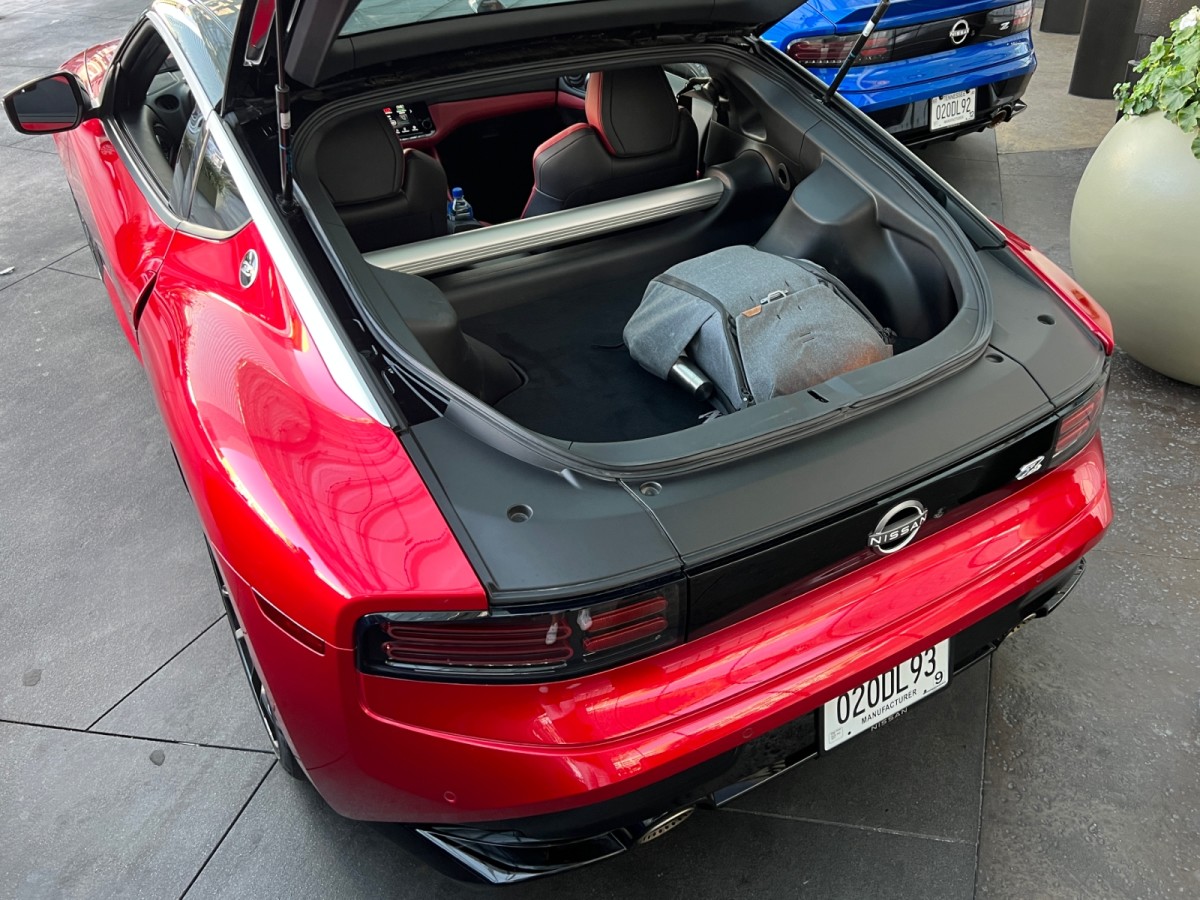
It goes without saying that the Nissan Z is all about form and not at all about function. This two-seat coupe sits low to the ground, has very little interior storage space, and offers no more than 241 litres of cargo space under its rear hatch. The Z’s purpose is to look good and go fast, full stop.
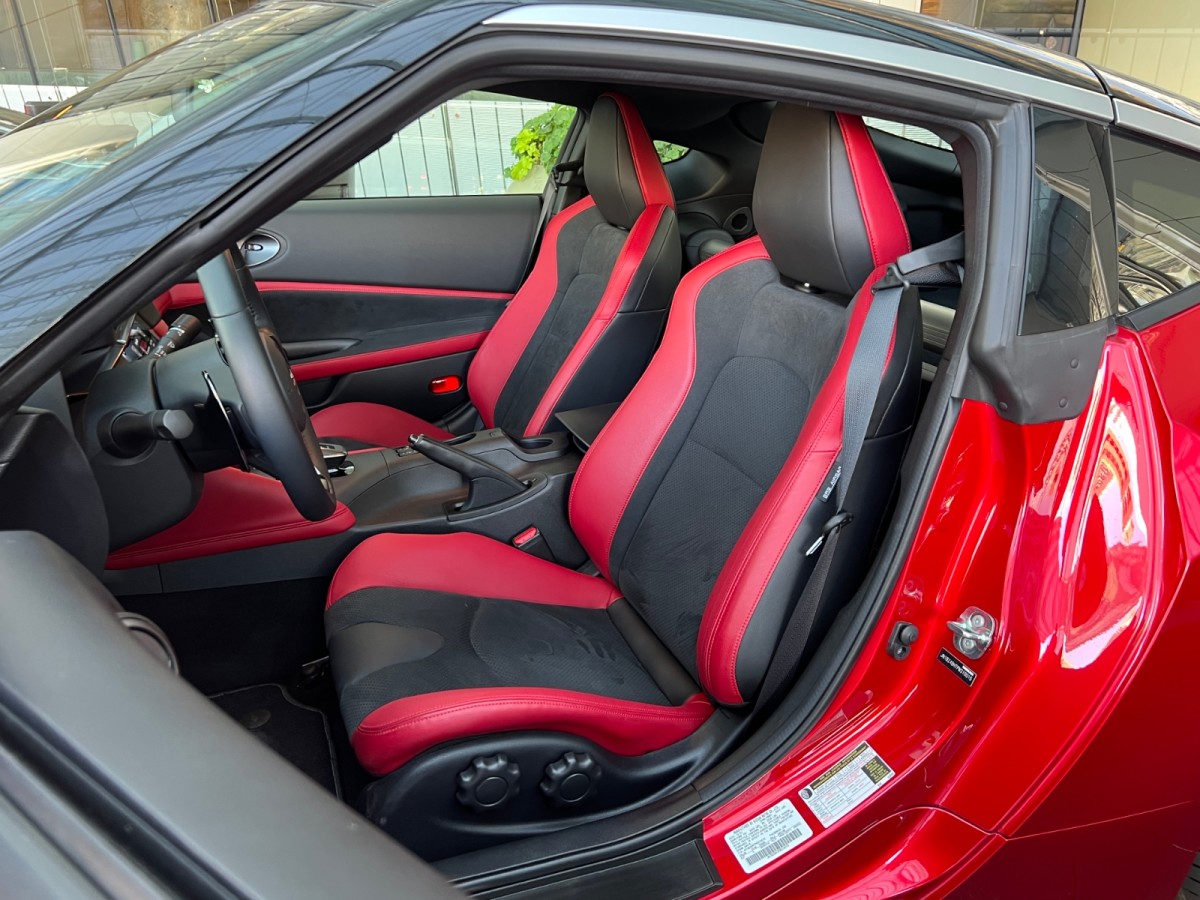
With that understanding, the new 2023 Z appears to be easier to live with on a daily basis than previous iterations of the sports car. The sport-bolstered front seats are a new design, and with the Nissan Z Performance trim, the leather seats offer eight-way power adjustment for the driver, four-way power adjustment for the front passenger, and heated cushions.
We spent hours in the car, and aside from the lack of seat ventilation on a warm, sunny Nevada-desert day, the driver’s seat proved quite comfortable. We can also report that thanks to its power height adjuster, we raised it enough to make it easier to get into and out of the car. But, if you raise the seat, the sharply angled roofline requires more head-ducking as you get in and get out.
To further improve comfort, Nissan adds padding to the sides of the centre console where the driver and passenger will rest their legs. Additionally, the telescoping steering wheel’s design takes inspiration from the R32 GT-R. Nissan’s Paul Hawson explained it is one component of that model that tuners rarely replace because of its superior feel.
Storage space is scant but is better than before. A tray exists forward of the shifter where you can stash your smartphone and house keys. Nissan also added a second cupholder under the sliding centre console armrest. Otherwise, you can use the glove compartment, the shallow centre console storage bin, or the small bins at the bottom of each door panel.
The Nissan Z’s 241-litre trunk isn’t big, but it offers more space than a Mazda MX-5. A Toyota Supra supplies nearly 100 litres more cargo space compared to the new Z.
Technology
Nissan offers a choice between two infotainment systems in the new 2023 Z. The car has an 8-inch touchscreen display, Bluetooth connectivity, satellite radio, Apple CarPlay, Android Auto, and six stereo speakers. (The 9-inch touchscreen with wireless Apple CarPlay that’s available in the U.S. is not offered in Canada.)
Unfortunately, we did not have much luck with the voice recognition system. When using our standard voice command test prompts, the technology accurately responded only to a request for directions to the closest Starbucks and a local hospital. Failed responses to our commands could have been due to road noise interfering with the system’s ability to interpret what we said.
Road noise also negatively impacted our enjoyment of the Bose audio system upgrades on the Performance model. Nissan had to use the same speaker locations as in the old 370Z, but Hawson confirmed that Bose worked with the automaker to improve audio quality in the new Z. However, it still emits muddy lows and brassy highs to our ears, so you’ll want to fiddle with the adjustments rather than settle for the defaults.
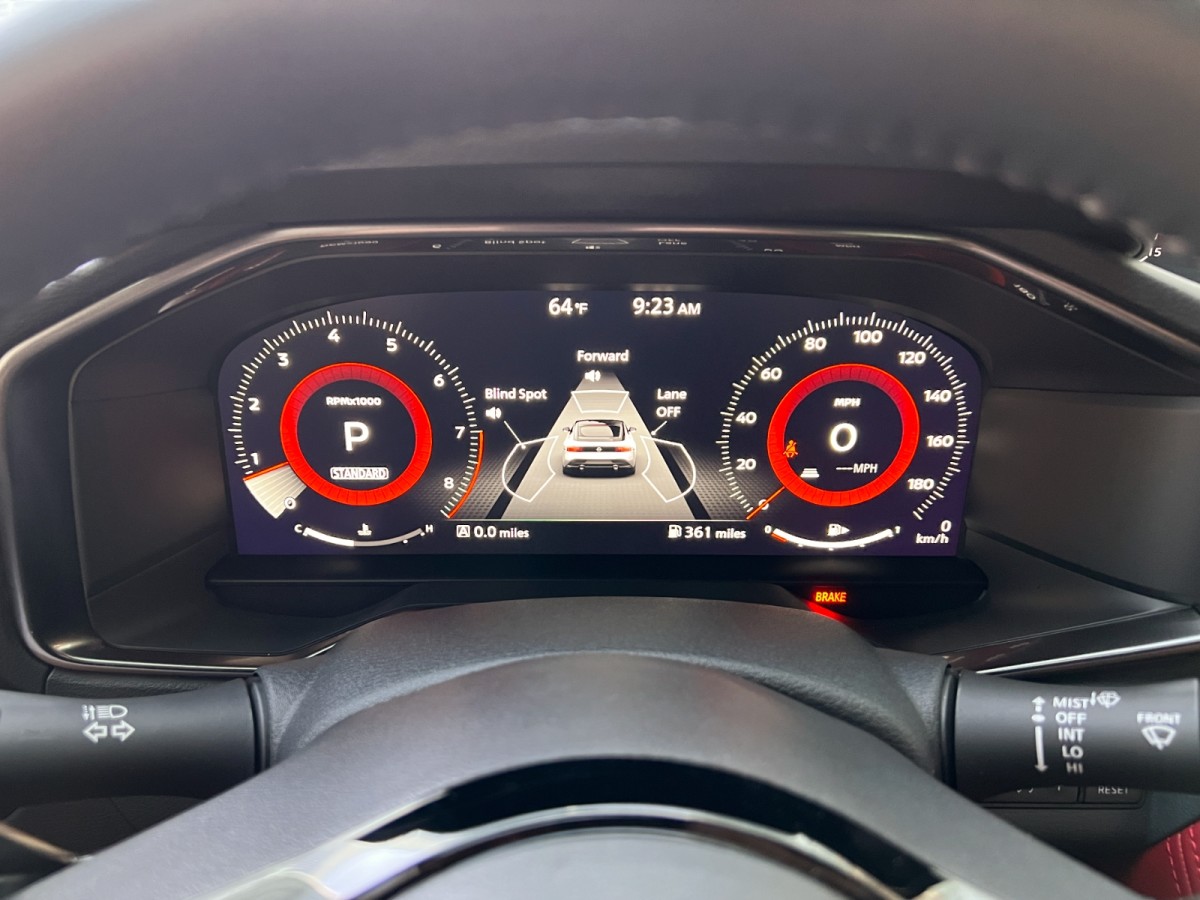
Digital instrumentation is standard in all new Nissan Z models. The 12.3-inch display offers three different arrangements. One of them puts an analog-style tachometer in the middle of the panel with a redline indicator at the top of the gauge where a driver can easily see it in their peripheral vision as a cue to upshift to the next gear.
Safety
Nissan equips every new Z with several driver-assistance and collision-avoidance systems. They include adaptive cruise control (with full-stop capability with the automatic transmission), forward-collision warning with pedestrian detection, automatic emergency braking, and lane-departure warning. You may find that the latter feature’s beeping is a source of irritation.
Importantly, every Z now has blind-spot monitoring with rear cross-traffic alert and parking sensors at each end of the car. In combination with an improved reversing camera and what we believe are clearer outward sightlines, the new Z is much easier to see out of and maneuver in parking lots and adds confidence when changing lanes on the highway.
Through NissanConnect Services equipped on the Performance grade, Z buyers receive six months of complimentary access to automatic collision notification and programmable settings related to vehicle speed, curfew time, and geographic boundaries. If you want to extend these services, a paid subscription is necessary.
Cost-effectiveness
Three excellent rear-wheel-drive (RWD) sports cars are available for less money than the new 2023 Nissan Z, but the Mazda MX-5 RF, Subaru BRZ, and Toyota GR86 all make substantially less hp and fewer lb-ft of torque than the Z.
New Nissan Z prices undercut the Toyota Supra. Also, to obtain comparable power in the Toyota, you must spend roughly $10,000 extra to get into the Supra 3.0. So comparatively, the Nissan Z comes across as a relative bargain.
Then you’ve got more expensive alternatives to the Nissan Z, such as the BMW Z4, Jaguar F-Type, and Porsche 718 Cayman, which command between $20,000 and $50,000 more than the Z’s base price.
Based on this market assessment, Nissan wisely prices and positions the new Z as a performance value and lays claim to an unpopulated segment of the two-seat sports car market. Sure, you could get into a V8-powered Chevrolet Camaro or Ford Mustang for the same money as the Nissan Z, but those cars are larger and more cheaply outfitted inside, and they appeal to a different buyer.
Just because the Nissan Z plugs a hole in a segment doesn’t mean it deserves consideration. However, even though we didn’t get a chance to properly evaluate the new Z’s driving dynamics, we can state that it’s a better sports car than the one it replaces, and it shows real promise as a desirable alternative to similar vehicles regardless of price.
Note: Images show a US model.

What owners say
This car is great. Very fast, very capable, and overall fun to drive. You must keep in mind it’s a drivers car, it has one cup holder, and the passenger space isn’t ideal. But it’s worth it
December 20, 2022Great car for performance and daily diver ! Good valve
October 22, 2022Trims & specs
Base MSRP $54,480 | Seating 2 |
Engine 3.0L 400 hp V6 | Cargo Capacity 7.0 cu ft |
Combined MPG 21 | Drivetrain RWD |
Base MSRP $44,480 | Seating 2 |
Engine 3.0L 400 hp V6 | Cargo Capacity 7.0 cu ft |
Combined MPG 23 | Drivetrain RWD |
Base MSRP $53,990 | Seating 2 |
Engine 3.0L 400 hp V6 | Cargo Capacity 7.0 cu ft |
Combined MPG 23 | Drivetrain RWD |


Pricing trends
MSRP range
$40,990 - $53,990
Current avg. market price
$47,067
Trending down by 1.6% this month
April 2026 - October 2026

