2023 BMW 3 Series Reviews, Pricing & Specs
Write a reviewPros
Stylish design
Great ride quality
Quiet cabin
Cons
Manual transmission not available
Interior materials feel cheap
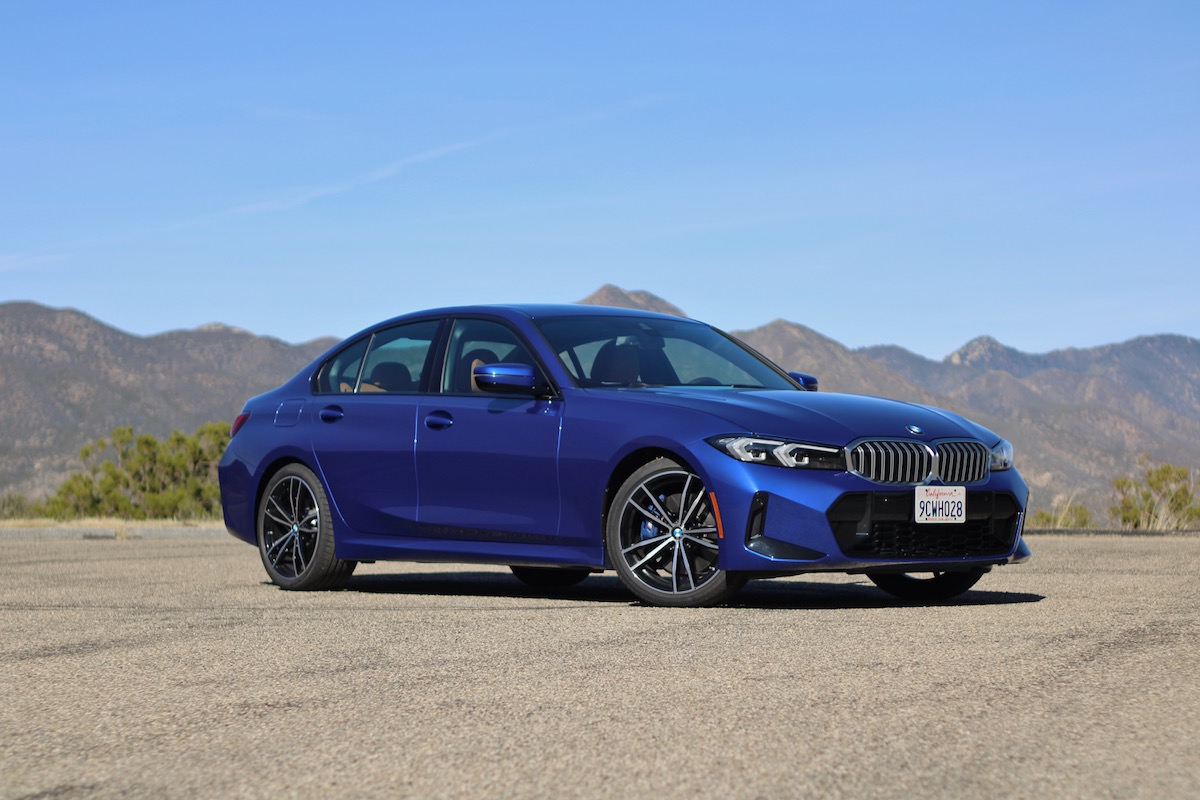
The refreshed 2023 BMW 3 Series benefits from sportier styling, interior design updates, and technology upgrades.
The BMW 3 Series sedan has been the heart of the Bavarian brand since its inception in 1975. More than 16 million buyers can’t be wrong, can they? The current seventh-generation model debuted in 2019 but enjoys a mid-cycle refresh for the 2023 model year. The 3 Series carries over its lineup offerings of the petrol-powered 330i and M340i as well as the plug-in hybrid (PHEV) 330e.
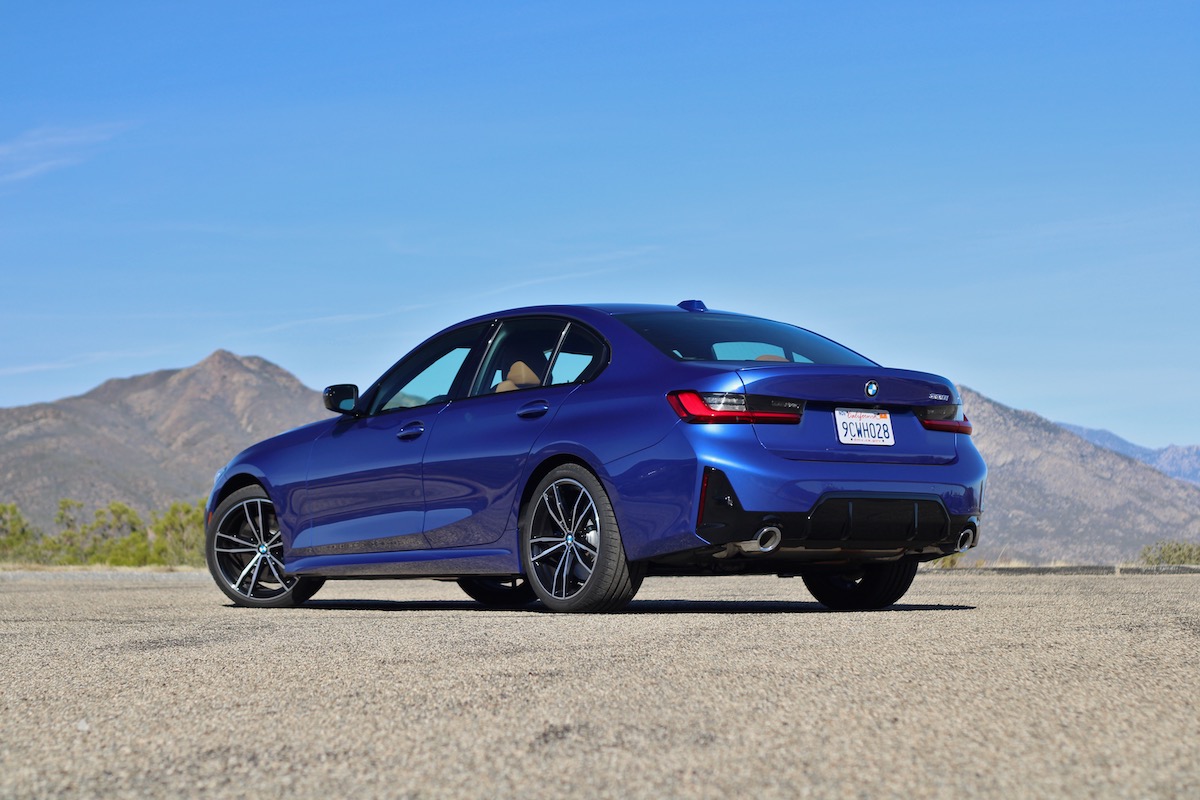
Exterior design modifications for the new model are subtle but noticeably sporty. Not yet braced with the orthodontic upgrades seen on the BMW 4 Series coupe and 7 Series, the 3 Series maintains a narrow kidney grille shape that leads into redesigned full-LED headlights. These standard twin-accent projectors enjoy a slimmed-down silhouette with daytime running lights redone as inverted L shapes.
The lower air intakes of the front fascia have been reshaped as well, with the carried-over character lines leading the eyes to flared rear-wheel arches. These slight changes make for an impactful first impression. The finishing touch? Standard 18-inch double-spoke light alloys with an optional 19-inch wheel upgrade for all trims.
Skyscraper Grey and Brooklyn Grey metallic are new paint options. The M Sport package adds exterior bits like chrome grille accents, different style air curtains, and a larger rear diffuser. Separately, the M340i receives a trim-exclusive mesh-design kidney grille, trapezoidal tailpipes, and a body-colour M rear spoiler.
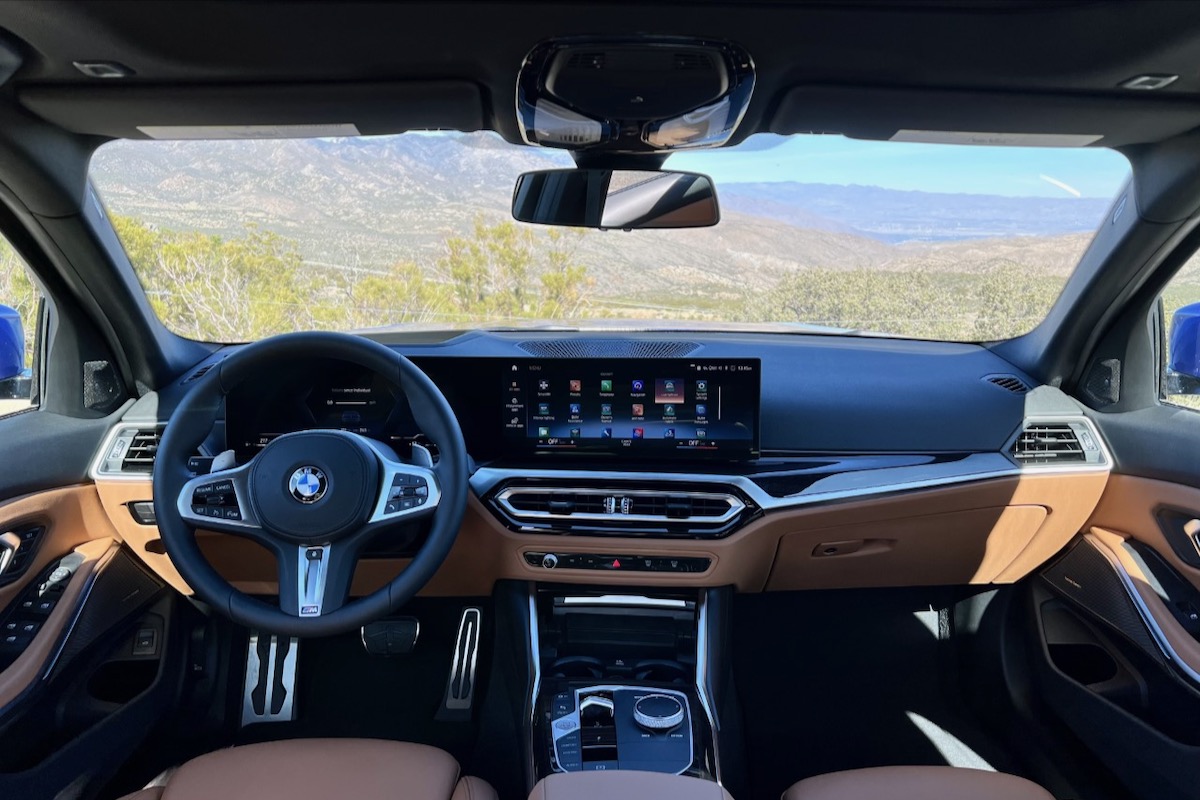
In the cabin, however, is where the real design drama occurs. The new 3 Series comes standard with BMW iDrive 8, which is powered by the automaker’s most advanced operating system to date. And with it comes the new BMW Curved Display, which totals 27.2 inches of continuous high-definition screens. It’s a bit imposing for the cabin of a compact sports sedan.
However, a minimalist approach is taken with everything else on the dashboard, leading to results like fewer buttons. And with the long display curved toward the driver, the 3 Series interior sports a genuinely driver-centric cockpit.
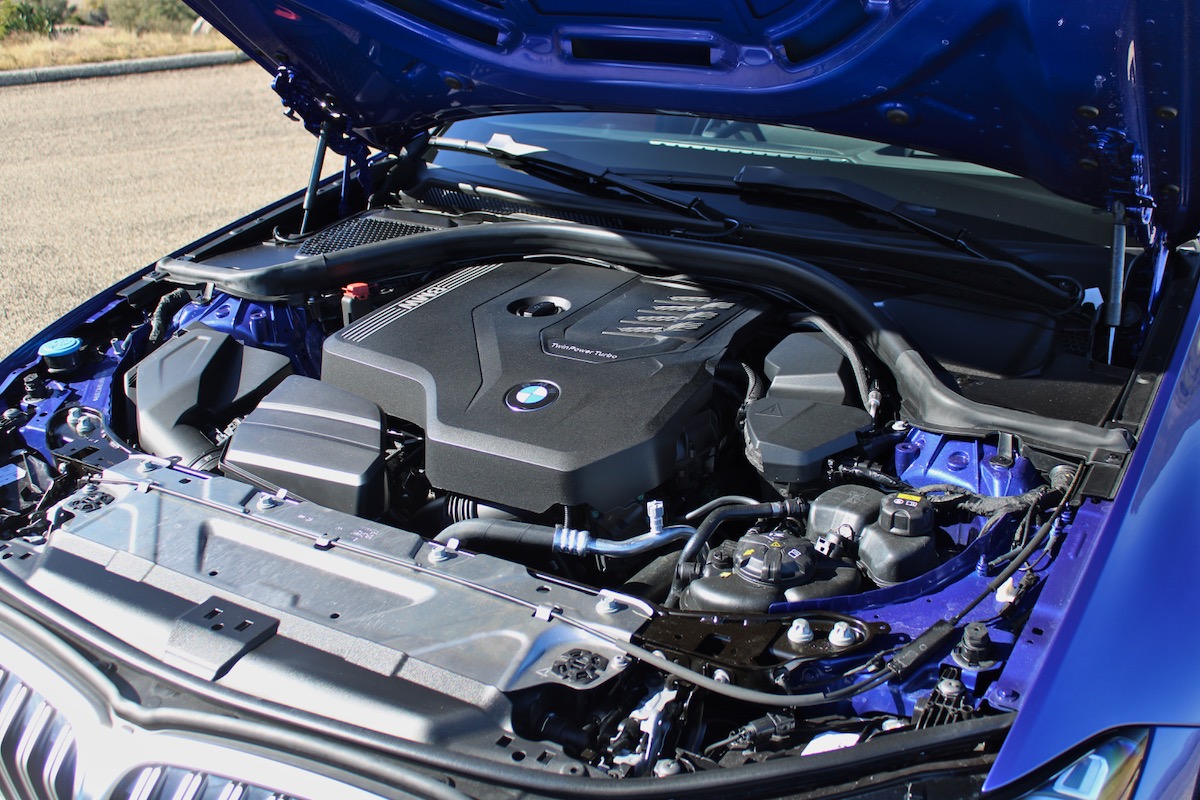
The 2023 3 Series powertrains are carried over from the previous model years. That means a twin-turbo 2.0-litre four-cylinder engine for the 330i and 330e (with electric assist for the latter) and a twin-turbo 3.0-litre inline-six for the M340i. All feature an eight-speed automatic transmission. If you want a stick-shift 3 Series, you’ll have to opt for the M3, which can be equipped with a six-speed manual. In Canada, xDrive all-wheel drive (AWD) is standard on all models except the PHEV, which is also offered with a rear-wheel drive (RWD) drivetrain to put the price below the threshold for federal and provincial (where applicable) EV rebates.
The base 330i produces power specs of 255 horsepower and 295 pound-feet of torque. Zero-to-100 kilometres per hour is clocked at 5.6 seconds. With its eDrive electric motor pairing, the 330e produces a combined output of 288 hp and 258 lb-ft of torque. Acceleration to 100 km/h is a little slower but you do get up to 35 kilometres of electric-only range. The M340i is, of course, stronger and quicker. Featuring a 48-volt mild-hybrid system (added for the 2022 model year), the M340i offers 382 hp and 369 lb-ft of torque and reaches 100 km/h in 4.3 seconds.
The three trims are closer on fuel economy than performance. The 330i xDrive has a Natural Resources Canada estimated rating of 9.8 litres per 100 kilometres in city driving, 7.0 on the highway, and 8.6 combined. The 330e receives a gas-only rating of 8.8 L/100 km, and an efficiency rating of 3.2 Le/100 km combined when operating in electric mode, where you get those aforementioned 35 kilometres of zero-emission driving. Electric range decreases slightly with xDrive to 34 kilometres, and fuel economy and electric efficiency go up to 9.2 L/100 km combined and 3.4 Le/100 km combined, respectively. The M340i achieves 10.3 L/100 km city, 7.4 highway, and 9.0 combined.
Even though essentially an entry Bimmer with some performance flourishes, the 330i sedan didn’t feel like a budget model. It was a quiet companion in spite of traffic noise. In Comfort mode, the suspension was just that, with steering feel on the neutral side albeit still precise. Switching to Eco Pro when driving through town did mean longer engine spooling but when going from red light to red light, what did that matter?
When taking the vehicle to task on curvy elevation-changing mountain roads, the 330i was proficient but not superb. The turbocharged inline-four offered plenty of power during the climb but the engine note was a bit drowned out. Even when switching to Sport mode, the turbo-four sounded distant. Manual shifts using the steering column-mounted paddle shifters (and dropping a gear) made the engine roar more clearly and tightened up the steering feel—but only a tad.
Not being an M-powered vehicle, there was no Sport Plus mode option and the steering was only slightly stiffer than neutral. Nevertheless, sharp cornering and hard braking were never a point of concern, especially with the optional M Sport brake system. The 330i was a fun canyon carver, but its comfortable suspension and neutral steering reminded us that it was more of an all-season performer than a sport-tuned driver. Luckily, for those looking for something other than standard transportation, the 3 Series lineup has elevated-performance options with the M340i and M3.
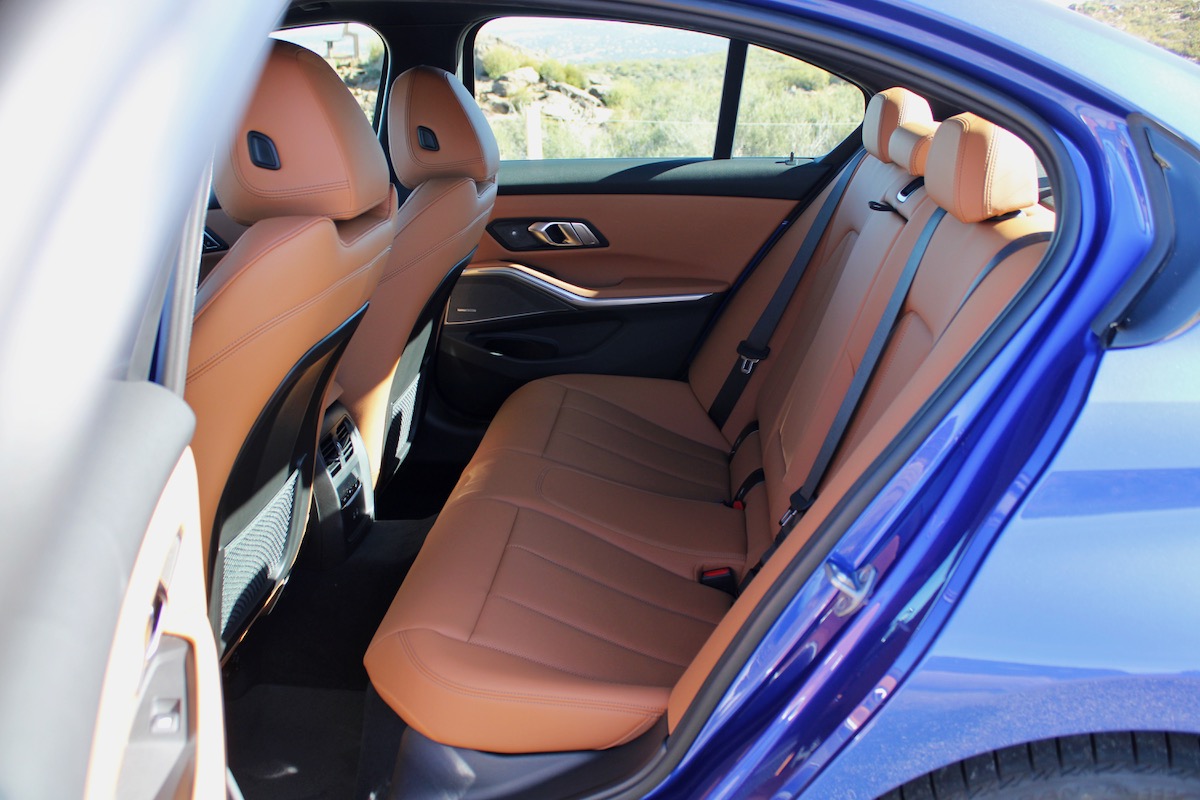
Comfort and convenience are not issues for the 3 Series. The interior is compact but not claustrophobic. Up front, headroom is 982 millimetres and legroom is 1,066 millimetres. For rear occupants, the measurements are 955 mm and 894 mm, respectively. This is ample room for average-size adults. Taller occupants may experience a snugger fit but that would be true of any vehicle that isn’t a large car or crossover SUV.
Standard upholstery is SensaTec faux leather. The power-adjustable front sport seats were supportive with good bolstering and adjustable thigh support, but we found the seat bottom cushion to be on the stiff side. The leather steering wheel is meaty and provides plenty of grip for those winding roads days (and even for the city straights). In general, ergonomics are quite good. There is little need to reach for buttons and functions. The iDrive controller knob is a BMW icon at this point and more intuitive than ever to use.
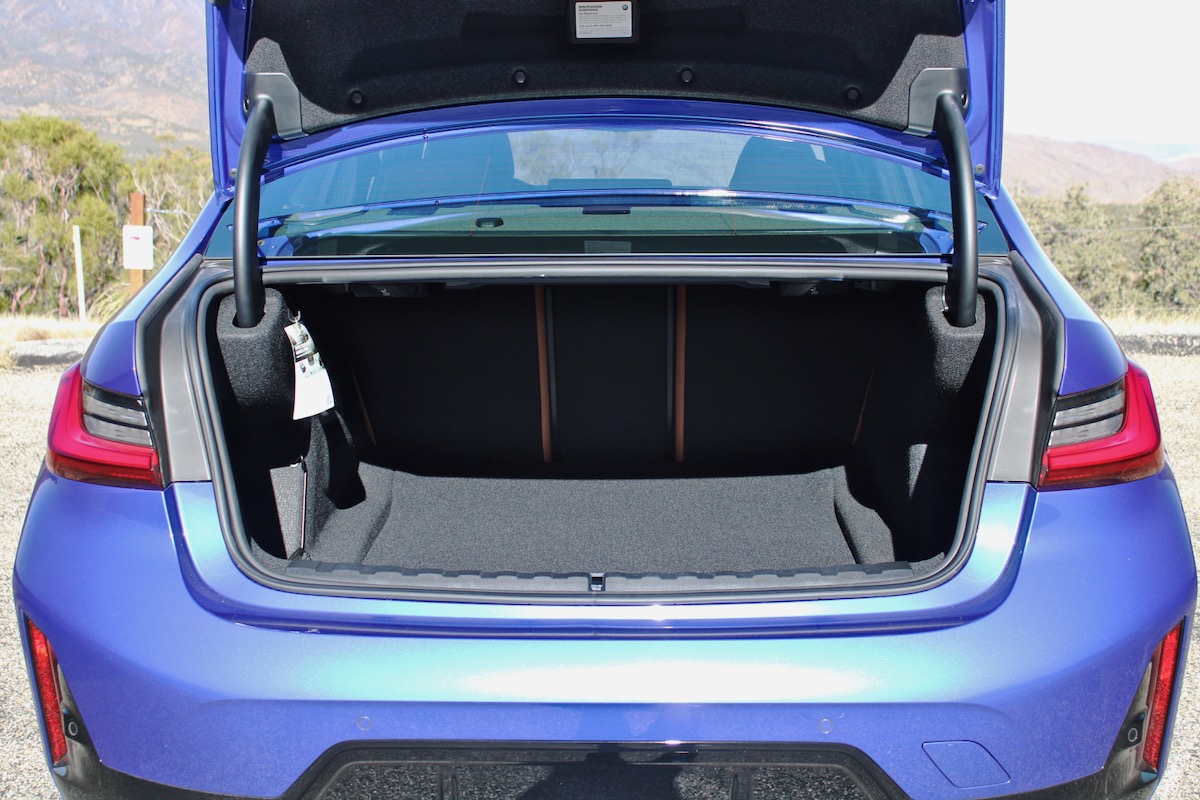
For nooks and crannies, the 3 Series has the standard offerings—cup holders, rubberized trays, a useable glovebox. Cargo space is 481 litres. The rear seats fold down in a 40/20/40-split to accommodate larger, bulkier items in the trunk space. With the seats up, a mix-and-match of carry-on- and check-in-sized suitcases will fit just fine.
A power moonroof, heated front seats, and remote start (via the BMW Connected app) are standard, while a heated steering wheel, power lumbar support, and keyless entry are optional.
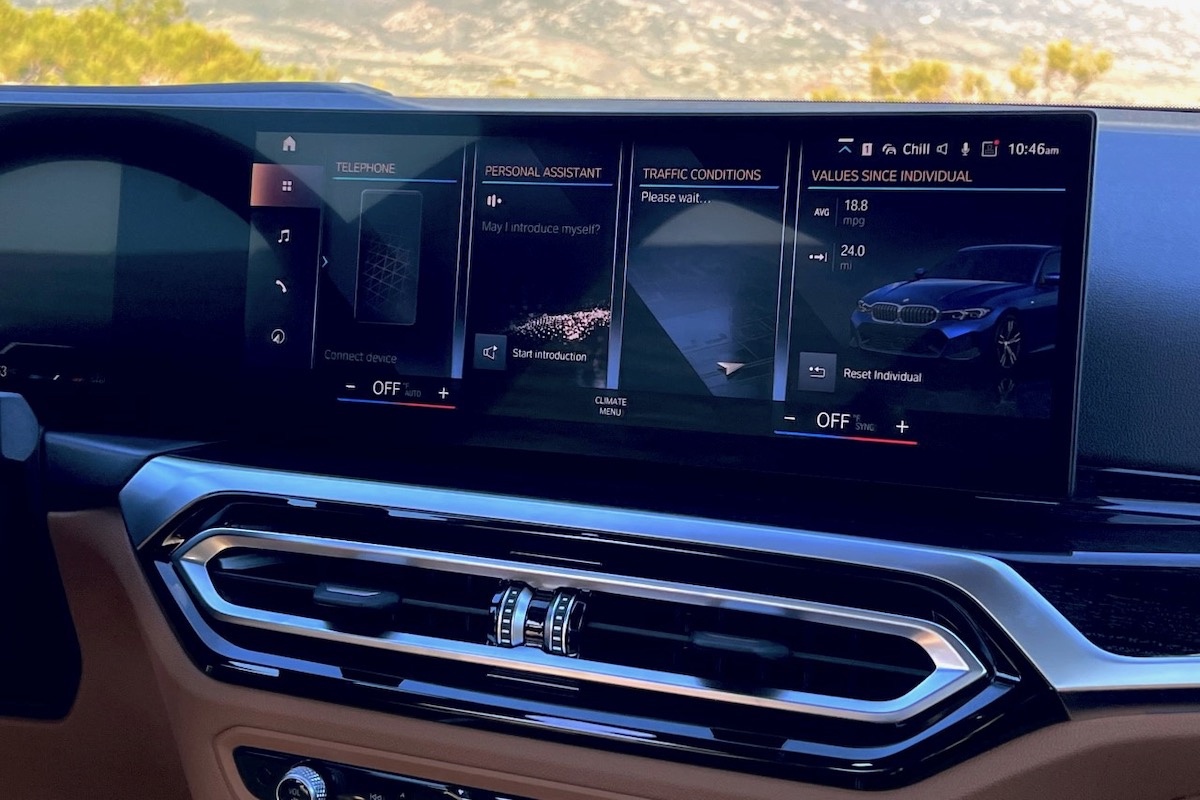
BMW iDrive 8 has finally trickled down from Bavaria’s six-figure models to the brand’s more affordable fare like the 3 Series. And just like in its higher-priced uber-luxo siblings, the curved-display iDrive 8 is fast and pretty. Calling it the supercar of vehicle infotainment systems wouldn’t be far-fetched.
The BMW Curved Display is one part 12.3-inch driver information display and one part 14.9-inch touchscreen. Functionality via touch is as easy and familiar as browsing and making selections on a smartphone or tablet. Widgets on the main menu can be reorganized at will with the touch of a finger. Vehicle and travel information within the driver information cluster can be customized almost as quickly using the steering wheel-mounted controls.
Don’t feel like futzing around through menus for certain controls? Just ask BMW Intelligent Personal Assistant to take you there. For example, we couldn’t figure out where the head-up display settings were. We decided to utter “Hey, BMW, head-up display settings” and, voila, the HUD menu appeared. We don’t remember what menu it was filed under because we didn’t need to.
The system’s ability to understand a person’s natural speech patterns deftly minimizes the usual frustrations with commuting with a computer. Many automaker’s systems require very specific voice prompts in a very specific way. This takes away the convenience of voice activation. BMW’s system is simple to use from the get-go; no need to read an owner’s manual. If issues do arise, it’s generally with navigation maps as the system is cloud-based. If you’re in an area where cellular service is weak, the system will either find directions to different locations or no locations at all.
Other standard entertainment and tech features include USB-C ports (front and rear), enhanced Bluetooth, Android Auto and Apple CarPlay connectivity, a 10-speaker HiFi audio system, a one-year SiriusXM satellite radio subscription, and over-the-air updates. Available on the new 3 Series are wireless device charging, a premium Harman Kardon surround sound system, and a wireless 5G hotspot.
The 2023 BMW 3 Series has been awarded a five-star crash safety rating, the highest grade offered by the National Highway Safety Administration (NHTSA). However, no rating is listed for the PHEV model.
The Insurance Institute for Highway Safety (IIHS) has yet to rate the new 3 Series but the 2022 model did earn a Top Safety Pick nod. The vehicle missed the mark on the additional top-tier “Plus” distinction by falling short in the headlights category where the 330i earned an overall rating of Poor.
Standard safety for the 2023 3 Series include a rear view camera, LED headlights, LED daytime running lights, BMW Assist eCall, Active Guard (frontal collision warning, automatic city collision mitigation and braking), and the Active Protection System (automatic seat belt pretensioners, automatic window/moonroof closing, post-crash braking, and fatigue/focus alert). Additional safety features, including most driving assistance systems, are available in packaged bundles.
The Advanced Driver Assistance Package includes active blind spot detection, lane-departure warning, park-distance control, pedestrian and frontal collision warnings, and semi-autonomous and hands-on driving systems Traffic Jam Assistant and Driving Assistant Professional. The latter combines several features such as adaptive cruise control, lane-keep assist, lane-change assist, emergency stop assistant and evasion aid. The optional head-up display is part of a convenience package. Parking assistance and a Drive Recorder are also available.
Pricing for the 2023 3 Series starts at $55,000 for the 330i xDrive, $54,990 for the 330e (which means the PHEV qualifies for federal and provincial rebates; the 330e xDrive variant starts from $58,900), and $68,000 for the BMW M340i xDrive sedan. Destination is another $2,480 extra. The 330i sedan we tested was moderately optioned to include performance and safety packages.
Luxury car rivals to the BMW 3 Series models include the Acura TLX, Alfa Romeo Giulia, Audi A4, Genesis G70, Lexus IS 500, and Mercedes-Benz C-Class. Although some cross-shopping does happen, buyers within the segment tend to stick with what they know and what they want. Genesis leads the way with features-laden value while Alfa and Lexus might offer that extra styling flair. Audi and Merc? They’ve got an established brand cache.
If you’re looking for cheap luxury, it’s not going to be the BMW. If you’re looking for affordable performance plus handsome looks plus high-end tech, pay extra for the good stuff. And the 3 Series fits the bill. We’ll ask again: more than 16 million buyers can’t be wrong, can they?
Note: Images show a US model.

User reviews for 2023 BMW 3 Series
Write a review2023 BMW 3 Series Pricing
Trims & specs
Air Conditioning
Active charcoal air filtration · Automatic climate control front air conditioning · Dual front air conditioning zones · Automatic climate control rear air conditioning · Single rear air conditioning zones
Airbags
Dual front airbags · Dual front knee airbags · Passenger airbag deactivation: occupant sensing deactivation · Front side airbags · Front side curtain airbags
Audio System
Antenna Type: mast · Voice recognition audio system · Bluetooth auxiliary audio input · Internet radio app: Spotify · AM/FM radio · Satellite Radio: SiriusXM · Total Number of Speakers: 10 · 205 watts
Brakes
ABS: 4-wheel · Braking assist: hill start assist · Electronic parking brake: auto off · Front brakes: ventilated disc · Rear brakes: ventilated disc
Comfort Features
Armrests: rear center with cupholders · Center console trim: leatherette · Dash trim: wood · Door trim: leatherette · Floor Mat Material: carpet · Floor Material: cargo area carpet · Floor Mats: front · Interior accents: wood · Shift knob trim: alloy · Steering wheel trim: leather
Convenience Features
Ambient lighting: color-adjustable · Assist handle: rear · Center console: front console with armrest and storage · Cupholders: front · Dimming rearview mirror: auto-dimming · Footwell lights: color-adjustable · Memorized settings: climate control · Multi-function remote: trunk release · One-touch windows: 4 · Power outlet(s): 12V front · Power steering: speed-proportional · Power windows: lockout button · Reading lights: rear · Steering wheel: tilt and telescopic · Steering wheel mounted controls: audio · Storage: door pockets · Universal garage door opener: Homelink · Vanity mirrors: dual illuminating
Driver Seat
Power adjustments: 10
Drivetrain
Axle ratio: 2.81
Engine
Battery: maintenance-free
Exterior Features
Door handle color: body-color · Exhaust: dual exhaust tips · Exhaust tip color: chrome · Front bumper color: body-color · Grille color: chrome surround · Mirror color: body-color · Rear bumper color: body-color · Rocker panel color: body-color · Window trim: black
Headrests
Adjustable rear headrests: foldable · Front headrests: adjustable · Number of front headrests: 2 · Number of rear headrests: 3
In Car Entertainment
Connected in-car apps: Google POIs · Infotainment screen size: 14.9 in. · Smartphone integration: wireless Apple CarPlay
Instrumentation
Fuel economy display: MPG · Instrument cluster screen size: 12.3 in. · Warnings and reminders: maintenance reminder
Lights
Daytime running lights: LED · Exterior entry lights: security approach lamps · Headlights: automatic high beam dimmer · Tail and brake lights: LED · Taillights: adaptive
Mirrors
Exterior mirrors: power
Passenger Seat
Power adjustments: 10
Rear Seats
Type: 40-20-40 split bench
Roof
Moonroof: one-touch open/close · Moonroof / Sunroof: power sunshade
Safety
Automatic emergency braking: front pedestrian · Camera system: rearview · Child seat anchors: LATCH system · Crumple zones: front · Impact sensor: door unlock · Pre-Collision Warning System: audible warning · Pre-collision warning system: pedestrian detection · Rearview monitor: in dash
Seatbelts
Emergency locking retractors: front and rear · Front seatbelts: 3-point · Seatbelt force limiters: front · Seatbelt pretensioners: front · Seatbelt warning sensor: driver and passenger · Second row seatbelts: 3-point
Seats
Driver seat power adjustments: height · Front seat type: sport bucket · Passenger seat power adjustments: height · Rear headrests: adjustable · Rear seat folding: split · Upholstery: leatherette
Steering
Steering ratio: 13.2
Suspension
Front Arm Type: lateral links · Front Shock Type: gas shock absorbers · Front Spring Type: coil springs · Front Suspension Classification: independent · Front Suspension Type: strut · Rear Shock Type: gas shock absorbers · Rear Spring Type: coil springs · Rear Suspension Classification: independent · Rear Suspension Type: multi-link · Stabilizer bar(s): rear
Telematics
Driver assistance app: roadside assistance · Electronic messaging assistance: with voice recognition · Navigation system: hard drive navigation system · Phone: voice activated · Phone wireless data link: Bluetooth · Satellite communications: BMW Assist · Smart device app compatibility: Amazon Alexa · Smart device app function: send destination to vehicle
Tires
Type: all season
Tires and Rims
Wheel type: aluminum alloy
Windows
Front wipers: speed sensitive · Power windows: remote operation
Air Conditioning
Active charcoal air filtration · Automatic climate control front air conditioning · Dual front air conditioning zones · Rear air conditioning: with independent controls · Single rear air conditioning zones
Airbags
Dual front airbags · Dual front knee airbags · Passenger airbag deactivation: occupant sensing deactivation · Front side airbags · Rear side curtain airbags
Audio System
Antenna Type: mast · Voice recognition audio system · Bluetooth auxiliary audio input · Internet radio app: Spotify · HD radio · Satellite Radio: SiriusXM · Total Number of Speakers: 10 · 205 watts
Brakes
ABS: 4-wheel · Braking assist: hill start assist · Electronic parking brake: auto off · Front brakes: ventilated disc · Rear brakes: ventilated disc
Comfort Features
Armrests: rear center folding with pass-thru · Center console trim: leatherette · Dash trim: wood · Door trim: leatherette · Floor Mat Material: carpet · Floor Material: cargo area carpet · Floor Mats: front · Interior accents: wood · Shift knob trim: alloy · Steering wheel trim: leather
Convenience Features
Ambient lighting: color-adjustable · Assist handle: front · Center console: front console with armrest and storage · Cupholders: front · Dimming rearview mirror: auto-dimming · Footwell lights: color-adjustable · Memorized settings: side mirrors · Multi-function remote: trunk release · One-touch windows: 4 · Power outlet(s): 12V front · Power steering: electric · Power windows: lockout button · Reading lights: rear · Steering wheel: tilt and telescopic · Steering wheel mounted controls: audio · Storage: accessory hook · Universal garage door opener: Homelink · Vanity mirrors: dual illuminating
Driver Seat
Power adjustments: 10
Drivetrain
Axle ratio: 3.23
Engine
Battery: maintenance-free · EV battery capacity: 9.1 kWh · Electric Charge Cord: 120 volt · Electric Motor Battery Type: lithium ion · Electric Motor HP: 107 · Electric Motor Power Output (Kilowatts): 80 · Electric Motor Torque: 77 · Electric motor charger connector: SAE J1772 · Electric motor charging time: 3 hours · Electric motor miles per charge: 22 · Hybrid Gas Engine HP: 181 · Hybrid Gas Engine HP@RPM: 3800 · Hybrid Gas Engine Torque: 258 · Hybrid gas Engine Torque@RPM: 1450
Exterior Features
Door handle color: body-color · Exhaust: dual exhaust tips · Exhaust tip color: chrome · Front bumper color: body-color · Grille color: black · Mirror color: body-color · Rear bumper color: body-color · Rocker panel color: body-color · Window trim: black
Headrests
Adjustable rear headrests: foldable · Front headrests: adjustable · Number of front headrests: 2 · Number of rear headrests: 3
Hybrid
Starter Type: motor/generator
In Car Entertainment
Connected in-car apps: Google POIs · Infotainment screen size: 14.9 in. · Smartphone integration: wireless Apple CarPlay
Instrumentation
Fuel economy display: MPG · Instrument cluster screen size: 12.3 in. · Warnings and reminders: maintenance reminder
Lights
Daytime running lights: LED · Exterior entry lights: security approach lamps · Headlights: auto delay off · Tail and brake lights: LED · Taillights: adaptive
Mirrors
Exterior mirrors: power
Passenger Seat
Power adjustments: 10
Rear Seats
Type: 40-20-40 split bench
Roof
Moonroof: tilt/slide · Moonroof / Sunroof: power sunshade
Safety
Automatic emergency braking: front · Camera system: rearview · Child seat anchors: LATCH system · Crumple zones: front · Impact sensor: fuel cut-off · Pre-Collision Warning System: visual warning · Pre-collision warning system: pedestrian detection · Rearview monitor: in dash
Seatbelts
Emergency locking retractors: front · Front seatbelts: 3-point · Seatbelt force limiters: front · Seatbelt pretensioners: front · Seatbelt warning sensor: driver and passenger · Second row seatbelts: 3-point
Seats
Driver seat power adjustments: reclining · Front seat type: sport bucket · Passenger seat power adjustments: reclining · Rear headrests: adjustable · Rear seat folding: split · Upholstery: leatherette
Steering
Steering ratio: 13.2
Suspension
Front Arm Type: lateral links · Front Shock Type: twin-tube gas shock absorbers · Front Spring Type: coil springs · Front Suspension Classification: independent · Front Suspension Type: strut · Rear Shock Type: twin-tube gas shock absorbers · Rear Spring Type: coil springs · Rear Suspension Classification: independent · Rear Suspension Type: multi-link · Stabilizer bar(s): rear
Telematics
Driver assistance app: roadside assistance · Electronic messaging assistance: with voice recognition · Navigation system: touch screen display · Phone: voice activated · Phone wireless data link: Bluetooth · Satellite communications: BMW Assist · Smart device app compatibility: Amazon Alexa · Smart device app function: maintenance scheduling
Tires
Type: all season
Tires and Rims
Wheel type: aluminum alloy
Windows
Front wipers: speed sensitive · Power windows: remote operation
Air Conditioning
Active charcoal air filtration · Automatic climate control front air conditioning · Dual front air conditioning zones · Rear air conditioning: with independent controls · Single rear air conditioning zones
Airbags
Dual front airbags · Dual front knee airbags · Passenger airbag deactivation: occupant sensing deactivation · Front side airbags · Rear side curtain airbags
Audio System
Antenna Type: mast · Voice recognition audio system · USB auxiliary audio input · Internet radio app: Spotify · HD radio · Satellite Radio: SiriusXM · Total Number of Speakers: 10 · 205 watts
Brakes
ABS: 4-wheel · Braking assist: hill start assist · Electronic parking brake: auto off · Front brakes: ventilated disc · Rear brakes: ventilated disc
Comfort Features
Armrests: rear center with cupholders · Center console trim: leatherette · Dash trim: wood · Door trim: wood · Floor Mat Material: carpet · Floor Material: cargo area carpet · Floor Mats: front · Interior accents: wood · Shift knob trim: alloy · Steering wheel trim: leather
Convenience Features
Ambient lighting: color-adjustable · Assist handle: front · Center console: front console with armrest and storage · Cupholders: rear · Dimming rearview mirror: auto-dimming · Footwell lights: color-adjustable · Memorized settings: driver seat · Multi-function remote: keyless entry · One-touch windows: 4 · Power outlet(s): 12V front · Power steering: speed-proportional · Power windows: lockout button · Reading lights: rear · Steering wheel: tilt and telescopic · Steering wheel mounted controls: audio · Storage: front seatback · Universal garage door opener: Homelink · Vanity mirrors: dual illuminating
Driver Seat
Power adjustments: 10
Drivetrain
4WD Type: full time · Axle ratio: 2.81
Engine
Battery: maintenance-free
Exterior Features
Door handle color: body-color · Exhaust: dual exhaust tips · Exhaust tip color: chrome · Front bumper color: body-color · Grille color: black · Mirror color: body-color · Rear bumper color: body-color · Rocker panel color: body-color · Window trim: black
Headrests
Adjustable rear headrests: foldable · Front headrests: adjustable · Number of front headrests: 2 · Number of rear headrests: 3
In Car Entertainment
Connected in-car apps: Google search · Infotainment screen size: 14.9 in. · Smartphone integration: wireless Android Auto
Instrumentation
Fuel economy display: range · Instrument cluster screen size: 12.3 in. · Warnings and reminders: low fuel level
Lights
Daytime running lights: LED · Exterior entry lights: puddle lamps · Headlights: automatic high beam dimmer · Tail and brake lights: LED · Taillights: adaptive
Mirrors
Exterior mirrors: power
Passenger Seat
Power adjustments: 10
Rear Seats
Type: 40-20-40 split bench
Roof
Moonroof: power glass · Moonroof / Sunroof: power sunshade
Safety
Automatic emergency braking: front pedestrian · Camera system: rearview · Child seat anchors: LATCH system · Crumple zones: front · Impact sensor: battery disconnect · Pre-Collision Warning System: audible warning · Pre-collision warning system: pedestrian detection · Rearview monitor: in dash
Seatbelts
Emergency locking retractors: front and rear · Front seatbelts: 3-point · Seatbelt force limiters: front · Seatbelt pretensioners: front · Seatbelt warning sensor: driver and passenger · Second row seatbelts: 3-point
Seats
Driver seat power adjustments: height · Front seat type: sport bucket · Passenger seat power adjustments: height · Rear headrests: adjustable · Rear seat folding: split · Upholstery: perforated
Steering
Steering ratio: 13.2
Suspension
Front Arm Type: lateral links · Front Shock Type: gas shock absorbers · Front Spring Type: coil springs · Front Suspension Classification: independent · Front Suspension Type: strut · Rear Shock Type: gas shock absorbers · Rear Spring Type: coil springs · Rear Suspension Classification: independent · Rear Suspension Type: multi-link · Stabilizer bar(s): rear
Telematics
Driver assistance app: roadside assistance · Electronic messaging assistance: with voice recognition · Navigation system: hard drive navigation system · Phone: voice activated · Phone wireless data link: Bluetooth · Satellite communications: BMW Assist · Smart device app compatibility: Amazon Alexa · Smart device app function: maintenance scheduling
Tires
Type: all season
Tires and Rims
Wheel type: aluminum alloy
Windows
Front wipers: variable intermittent · Power windows: remote operation
Air Conditioning
Active charcoal air filtration · Automatic climate control front air conditioning · Dual front air conditioning zones · Rear air conditioning: with independent controls · Single rear air conditioning zones
Airbags
Dual front airbags · Dual front knee airbags · Passenger airbag deactivation: occupant sensing deactivation · Front side airbags · Front side curtain airbags
Audio System
Antenna Type: diversity · Voice recognition audio system · Bluetooth auxiliary audio input · Internet radio app: Spotify · HD radio · Satellite Radio: SiriusXM · Total Number of Speakers: 10 · 205 watts
Brakes
ABS: 4-wheel · Braking assist: hill start assist · Electronic parking brake: auto off · Front brakes: ventilated disc · Rear brakes: ventilated disc
Comfort Features
Armrests: rear center folding with pass-thru · Center console trim: wood · Dash trim: wood · Door trim: wood · Floor Mat Material: carpet · Floor Material: carpet · Floor Mats: front · Interior accents: wood · Shift knob trim: alloy · Steering wheel trim: leather
Convenience Features
Ambient lighting: color-adjustable · Assist handle: front · Center console: front console with armrest and storage · Cupholders: rear · Dimming rearview mirror: auto-dimming · Footwell lights: color-adjustable · Memorized settings: driver seat · Multi-function remote: vehicle and key memory · One-touch windows: 4 · Power outlet(s): 12V front · Power steering: speed-proportional · Power windows: lockout button · Reading lights: front · Steering wheel: tilt and telescopic · Steering wheel mounted controls: voice recognition controls · Storage: in-floor · Universal garage door opener: Homelink · Vanity mirrors: dual illuminating
Driver Seat
Power adjustments: 10
Drivetrain
4WD Type: full time · Axle ratio: 3.23
Engine
Battery: maintenance-free · EV battery capacity: 9.1 kWh · Electric Charge Cord: 120 volt · Electric Motor Battery Type: lithium ion · Electric Motor HP: 107 · Electric Motor Power Output (Kilowatts): 80 · Electric Motor Torque: 77 · Electric motor charger connector: SAE J1772 · Electric motor charging time: 3 hours · Electric motor miles per charge: 20 · Hybrid Gas Engine HP: 181 · Hybrid Gas Engine HP@RPM: 3800 · Hybrid Gas Engine Torque: 258 · Hybrid gas Engine Torque@RPM: 1450
Exterior Features
Door handle color: body-color · Exhaust: dual exhaust tips · Exhaust tip color: chrome · Front bumper color: body-color · Grille color: black · Mirror color: body-color · Rear bumper color: body-color · Rocker panel color: body-color · Window trim: black
Headrests
Adjustable rear headrests: foldable · Front headrests: adjustable · Number of front headrests: 2 · Number of rear headrests: 3
Hybrid
Starter Type: motor/generator
In Car Entertainment
Connected in-car apps: Google search · Infotainment screen size: 14.9 in. · Smartphone integration: wireless Apple CarPlay
Instrumentation
Fuel economy display: range · Instrument cluster screen size: 12.3 in. · Warnings and reminders: maintenance reminder
Lights
Daytime running lights: LED · Exterior entry lights: puddle lamps · Headlights: auto delay off · Tail and brake lights: LED · Taillights: adaptive
Mirrors
Exterior mirrors: heated
Passenger Seat
Power adjustments: 10
Rear Seats
Type: 40-20-40 split bench
Roof
Moonroof: power glass · Moonroof / Sunroof: power sunshade
Safety
Automatic emergency braking: front · Camera system: rearview · Child seat anchors: LATCH system · Crumple zones: front · Impact sensor: alert system · Pre-Collision Warning System: vibrating steering wheel · Pre-collision warning system: pedestrian detection · Rearview monitor: in dash
Seatbelts
Emergency locking retractors: front and rear · Front seatbelts: 3-point · Seatbelt force limiters: front · Seatbelt pretensioners: front · Seatbelt warning sensor: driver and passenger · Second row seatbelts: 3-point
Seats
Driver seat power adjustments: height · Front seat type: sport bucket · Passenger seat power adjustments: height · Rear headrests: adjustable · Rear seat folding: split · Upholstery: perforated
Steering
Steering ratio: 13.2
Suspension
Front Arm Type: lateral links · Front Shock Type: twin-tube gas shock absorbers · Front Spring Type: coil springs · Front Suspension Classification: independent · Front Suspension Type: strut · Rear Shock Type: twin-tube gas shock absorbers · Rear Spring Type: coil springs · Rear Suspension Classification: independent · Rear Suspension Type: multi-link · Stabilizer bar(s): rear
Telematics
Driver assistance app: roadside assistance · Electronic messaging assistance: with voice recognition · Navigation system: with voice recognition · Phone: voice activated · Phone wireless data link: Bluetooth · Satellite communications: BMW Assist · Smart device app compatibility: BMW ConnectedDrive · Smart device app function: maintenance status
Tires
Type: all season
Tires and Rims
Wheel type: aluminum alloy
Windows
Front wipers: rain sensing · Power windows: with safety reverse
Air Conditioning
Active charcoal air filtration · Automatic climate control front air conditioning · Dual front air conditioning zones · Rear air conditioning: with independent controls · Single rear air conditioning zones
Airbags
Dual front airbags · Dual front knee airbags · Passenger airbag deactivation: occupant sensing deactivation · Front side airbags · Rear side curtain airbags
Audio System
Antenna Type: mast · Voice recognition audio system · USB auxiliary audio input · Internet radio app: Spotify · Touch screen display radio · Satellite Radio: SiriusXM · Total Number of Speakers: 10 · 205 watts
Brakes
ABS: 4-wheel · Braking assist: hill start assist · Electronic parking brake: auto off · Front brake diameter: 13.7 · Front brakes: ventilated disc · Rear brake diameter: 13.6 · Rear brakes: ventilated disc
Comfort Features
Armrests: rear center folding with pass-thru · Center console trim: aluminium · Dash trim: aluminum · Door sill trim: scuff plate · Door trim: leatherette · Floor Mat Material: carpet · Floor Material: carpet · Floor Mats: front · Foot pedal trim: aluminum · Shift knob trim: alloy · Steering wheel trim: leather
Convenience Features
Ambient lighting: color-adjustable · Assist handle: front · Center console: front console with armrest and storage · Cupholders: rear · Dimming rearview mirror: auto-dimming · Footwell lights: color-adjustable · Memorized settings: audio system · Multi-function remote: proximity entry system · One-touch windows: 4 · Power outlet(s): 12V front · Power steering: electric · Power windows: lockout button · Reading lights: front · Steering wheel: tilt and telescopic · Steering wheel mounted controls: cruise controls · Storage: accessory hook · Universal garage door opener: Homelink · Vanity mirrors: dual illuminating
Driver Seat
Adjustable lumbar support: 4-way power · Power adjustments: 14
Drivetrain
Axle ratio: 2.81 · Locking differential: rear
Engine
Battery: maintenance-free · Electric Motor HP: 11 · Electric Motor Power Output (Kilowatts): 8 · Electric Motor Torque: 37 · Hybrid Gas Engine HP: 382 · Hybrid Gas Engine HP@RPM: 5800 · Hybrid Gas Engine Torque: 369 · Hybrid gas Engine Torque@RPM: 1800
Exterior Features
Door handle color: body-color · Exhaust: dual exhaust tips · Exhaust tip color: chrome · Front bumper color: body-color · Grille color: black with chrome accents · Mirror color: black · Rear bumper color: body-color · Rear spoiler: lip · Rear spoiler color: body-color · Rear trunk/liftgate: power operated · Rocker panel color: body-color · Window trim: black
Headrests
Adjustable rear headrests: foldable · Front headrests: adjustable · Number of front headrests: 2 · Number of rear headrests: 3
Hybrid
Starter Type: starter/belt alternator
In Car Entertainment
Connected in-car apps: Google POIs · Infotainment screen size: 14.9 in. · Smartphone integration: wireless Android Auto
Instrumentation
Fuel economy display: MPG · Instrument cluster screen size: 12.3 in. · Warnings and reminders: lamp failure
Lights
Daytime running lights: LED · Exterior entry lights: puddle lamps · Headlights: Auto on/off · Tail and brake lights: LED · Taillights: adaptive
Mirrors
Exterior mirrors: heated
Passenger Seat
Power adjustments: 10
Rear Seats
Type: 40-20-40 split bench
Roof
Moonroof: power glass · Moonroof / Sunroof: power sunshade
Safety
Automatic emergency braking: front · Camera system: rearview · Child seat anchors: LATCH system · Crumple zones: front · Impact sensor: alert system · Pre-Collision Warning System: visual warning · Pre-collision warning system: pedestrian detection · Rearview monitor: in dash
Seatbelts
Emergency locking retractors: front and rear · Front seatbelts: 3-point · Seatbelt force limiters: front · Seatbelt pretensioners: front · Seatbelt warning sensor: driver and passenger · Second row seatbelts: 3-point
Seats
Driver seat power adjustments: height · Front seat type: sport bucket · Passenger seat power adjustments: height · Rear headrests: adjustable · Rear seat folding: split · Upholstery: perforated
Steering
Steering ratio: 13.2
Suspension
Front Arm Type: lateral links · Front Shock Type: gas shock absorbers · Front Spring Type: coil springs · Front Suspension Classification: independent · Front Suspension Type: strut · Rear Shock Type: gas shock absorbers · Rear Spring Type: coil springs · Rear Suspension Classification: independent · Rear Suspension Type: multi-link · Stabilizer bar(s): front
Telematics
Driver assistance app: roadside assistance · Electronic messaging assistance: with voice recognition · Navigation system: with voice recognition · Phone: voice activated · Phone wireless data link: Bluetooth · Satellite communications: BMW Assist · Smart device app compatibility: Amazon Alexa · Smart device app function: horn/light operation
Tires
Type: all season
Tires and Rims
Wheels: aluminum with painted accents
Windows
Front wipers: rain sensing · Power windows: with safety reverse
Air Conditioning
Active charcoal air filtration · Automatic climate control front air conditioning · Dual front air conditioning zones · Automatic climate control rear air conditioning · Single rear air conditioning zones
Airbags
Dual front airbags · Dual front knee airbags · Passenger airbag deactivation: occupant sensing deactivation · Front side airbags · Rear side curtain airbags
Audio System
Antenna Type: mast · Voice recognition audio system · USB auxiliary audio input · Internet radio app: Spotify · HD radio · Satellite Radio: SiriusXM · Total Number of Speakers: 10 · 205 watts
Brakes
ABS: 4-wheel · Braking assist: hill start assist · Electronic parking brake: auto off · Front brake diameter: 13.7 · Front brakes: ventilated disc · Rear brake diameter: 13.6 · Rear brakes: ventilated disc
Comfort Features
Armrests: rear center with cupholders · Center console trim: leatherette · Dash trim: aluminum · Door sill trim: aluminum · Door trim: aluminum · Floor Mat Material: carpet · Floor Material: cargo area carpet · Floor Mats: front · Foot pedal trim: aluminum · Shift knob trim: alloy · Steering wheel trim: leather
Convenience Features
Ambient lighting: color-adjustable · Assist handle: front · Center console: front console with armrest and storage · Cupholders: front · Dimming rearview mirror: auto-dimming · Footwell lights: color-adjustable · Memorized settings: side mirrors · Multi-function remote: keyless entry with panic alarm · One-touch windows: 4 · Power outlet(s): 12V front · Power steering: speed-proportional · Power windows: lockout button · Reading lights: rear · Steering wheel: tilt and telescopic · Steering wheel mounted controls: paddle shifter · Storage: cargo tie-down anchors and hooks · Universal garage door opener: Homelink · Vanity mirrors: dual illuminating
Driver Seat
Adjustable lumbar support: 4-way power · Power adjustments: 14
Drivetrain
4WD Type: full time · Axle ratio: 2.81 · Locking differential: rear
Engine
Battery: lithium ion · Electric Motor HP: 11 · Electric Motor Power Output (Kilowatts): 8 · Electric Motor Torque: 37 · Hybrid Gas Engine HP: 382 · Hybrid Gas Engine HP@RPM: 5800 · Hybrid Gas Engine Torque: 369 · Hybrid gas Engine Torque@RPM: 1800
Exterior Features
Door handle color: body-color · Exhaust: integrated exhaust · Exhaust tip color: chrome · Front bumper color: body-color · Grille color: black with chrome accents · Mirror color: black · Rear bumper color: body-color · Rear spoiler: lip · Rear spoiler color: body-color · Rear trunk/liftgate: sensor-activated · Rocker panel color: body-color · Window trim: black
Headrests
Adjustable rear headrests: foldable · Front headrests: adjustable · Number of front headrests: 2 · Number of rear headrests: 3
Hybrid
Starter Type: starter/belt alternator
In Car Entertainment
Connected in-car apps: Google POIs · Infotainment screen size: 14.9 in. · Smartphone integration: wireless Android Auto
Instrumentation
Fuel economy display: range · Instrument cluster screen size: 12.3 in. · Warnings and reminders: coolant temperature warning
Lights
Daytime running lights: LED · Exterior entry lights: security approach lamps · Headlights: auto delay off · Tail and brake lights: LED · Taillights: adaptive
Mirrors
Exterior mirrors: power folding
Passenger Seat
Power adjustments: 10
Rear Seats
Type: 40-20-40 split bench
Roof
Moonroof: remote operation · Moonroof / Sunroof: power sunshade
Safety
Automatic emergency braking: front pedestrian · Camera system: rearview · Child seat anchors: LATCH system · Crumple zones: front · Impact sensor: fuel cut-off · Pre-Collision Warning System: visual warning · Pre-collision warning system: pedestrian detection · Rearview monitor: in dash
Seatbelts
Emergency locking retractors: front and rear · Front seatbelts: 3-point · Seatbelt force limiters: front · Seatbelt pretensioners: front · Seatbelt warning sensor: driver and passenger · Second row seatbelts: 3-point
Seats
Driver seat power adjustments: reclining · Front seat type: sport bucket · Passenger seat power adjustments: reclining · Rear headrests: adjustable · Rear seat folding: split · Upholstery: leatherette
Steering
Steering ratio: 13.2
Suspension
Front Arm Type: lateral links · Front Shock Type: gas shock absorbers · Front Spring Type: coil springs · Front Suspension Classification: independent · Front Suspension Type: strut · Rear Shock Type: gas shock absorbers · Rear Spring Type: coil springs · Rear Suspension Classification: independent · Rear Suspension Type: multi-link · Stabilizer bar(s): front
Telematics
Driver assistance app: roadside assistance · Electronic messaging assistance: with voice recognition · Navigation system: hard drive navigation system · Phone: voice activated · Phone wireless data link: Bluetooth · Satellite communications: BMW Assist · Smart device app compatibility: BMW ConnectedDrive · Smart device app function: horn/light operation
Tires
Type: all season
Tires and Rims
Wheels: aluminum with painted accents
Windows
Front wipers: variable intermittent · Power windows: with safety reverse

